


Jason Keefer
President
Building Anchoring Technologies
Table of Contents
Innovations in Building Anchoring Technologies
While conventional driven piles generate vibration and spoils, modern building anchoring technologies revolutionize construction with screw-in systems that minimize disruption. At Helical Technology, we distribute ICC- and ISO-certified helical piles and anchors, enhancing stability for foundations and infrastructure projects nationwide from our base in Littleton, CO.
Innovative helical anchors provide screw-in installation, eliminating spoils and suiting limited-access sites like urban builds or sensitive environments. Their rapid installation reduces site disturbance, shortens project schedules, and minimizes heavy equipment mobilization, which is especially valuable in dense urban settings and environmentally sensitive areas while improving worker safety and access constraints. These helical pile systems excel in building foundations, retaining walls, and infrastructure, offering immediate load-bearing capacity and easy removal for temporary applications.
Drawing parallels from USDA Forest Service guidelines on trail anchoring in variable soils, these technologies ensure secure fastening with reduced environmental impact, per authoritative government standards. Load testing during installation verifies performance, while hybrid systems blending helical tech with traditional methods address seismic zones effectively.
These advancements in building anchoring technologies pave the way for resilient, efficient projects–consult our engineering team for tailored design support.
Core Principles of Building Anchoring Systems
Building on foundational concepts of geotechnical stabilization, core principles of building anchoring technologies revolve around screw-in foundations that resist uplift, compression, and tension loads without concrete. At Helical Technology, we specialize in these reliable solutions, including our advanced earth anchoring system, which ensures immediate load-bearing capacity in diverse conditions.
Types of Soils Suited for Anchoring Technologies
Helical piles and helical anchors perform optimally in specific soil types, leveraging unique properties for secure installation. Cohesive soils, such as clay, offer high shear strength ideal for torque-based advancement of helical piles. These dense materials provide excellent resistance during screwing, supporting load capacities up to 50 tons per pile.
Granular soils like sand excel due to frictional resistance between helices and soil particles, enabling deep penetration without excessive vibration. In variable profiles, including soft or wet conditions, steel helical piles minimize disturbance, as demonstrated in ASCE-documented projects where helical steel piles supported electrical infrastructure in clay till and clay layers.
- Cohesive soils (e.g., clay): High shear for torque installation.
- Granular soils (e.g., sand): Frictional grip for stability.
Site-specific geotechnical reports guide selection, ensuring helical anchors thrive across these conditions.
Beyond soil suitability, helical piles excel in practical applications for long-term structural integrity.
Applications in Foundation Repair and Stabilization
We utilize helical piles extensively in foundation repair, lifting sinking structures by 1-2 inches per turn to restore level floors and prevent further settlement. This active voice approach counters differential movement in residential and commercial buildings, providing tension and compression resistance.
For stabilization, helical anchors or screw anchors secure retaining walls against lateral earth pressure up to 10 kips per foot. In utility projects, as cited by ASCE as a real-world industry example, helical steel piles replaced concrete in environmentally sensitive areas, enabling immediate loading and minimal excavation for towers handling thousands of kN in loads.
These foundation repair solutions from Helical Technology integrate seamlessly with existing structures, offering ICC and ISO certified products for code-compliant outcomes.
Helical tiebacks further enhance slope retention, underscoring the versatility of building anchoring technologies in demanding scenarios.
Key Components of Helical Systems
Our helical systems feature robust components designed for precision and durability. Helical piles consist of 3-8 inch diameter shafts with 8-16 inch helices, galvanized for corrosion resistance and capable of depths up to 100 feet.
Extensions in galvanized steel connect seamlessly, allowing customization for varying soil strata and load demands. New construction brackets facilitate efficient load transfer to floor joists or walls, supporting both repair and new builds.
- Helical piles: Central shafts with multiple helices for torque advancement.
- Extensions: Coupled sections for extended reach.
- Brackets: Underpinning and tieback connections.
These elements form comprehensive helical pile foundations, embodying engineering excellence from our Littleton, CO headquarters. These principles underpin effective installation techniques explored next.
Advantages of Helical Piles and Anchoring Solutions
These building anchoring technologies offer distinct advantages in performance, reliability, and value for foundation projects. At Helical Technology, we distribute ICC-certified helical piles and anchors that meet demanding engineering standards.
Superior Load Capacity and Durability
Helical piles deliver exceptional axial compression capacities up to 500 kips and tension up to 100 kips, making them ideal for heavy-load applications. Constructed from galvanized steel, these helical pile foundations resist corrosion for over 75 years, even in harsh environments. A real-world civil engineering case study by the American Society of Civil Engineers (ASCE) demonstrates steel piles outperforming concrete in load-bearing for electrical infrastructure foundations. They deliver predictable settlement performance across varied site conditions, reducing long-term risk.
Key advantages include:
- High torque installation ensures immediate load transfer without settlement.
- Robust helical anchors withstand uplift and lateral forces in variable soils.
- Galvanized coatings protect against rust, extending service life.
These attributes make helical piles a durable choice for long-term stability.
Comparison with Traditional Methods and Push Piers
Helical piles surpass traditional methods and push piers through vibration-free installation. Unlike driven piles that disturb soil, helical piles screw in cleanly. Concrete requires 28 days of curing, while helical anchoring systems load immediately. Push piers face hydraulic depth limits, but commercial structural anchors reach deeper strata effortlessly. The ASCE case study on AltaLink’s project in Alberta highlights helical steel piles succeeding in wet, sensitive soils where excavation failed. Installation causes minimal disturbance to adjacent utilities and sensitive equipment on sites.
Superior benefits:
- No soil displacement versus driven piles’ compaction issues.
- Instant usability beats concrete delays.
- Deeper penetration than push piers’ hydraulic constraints.
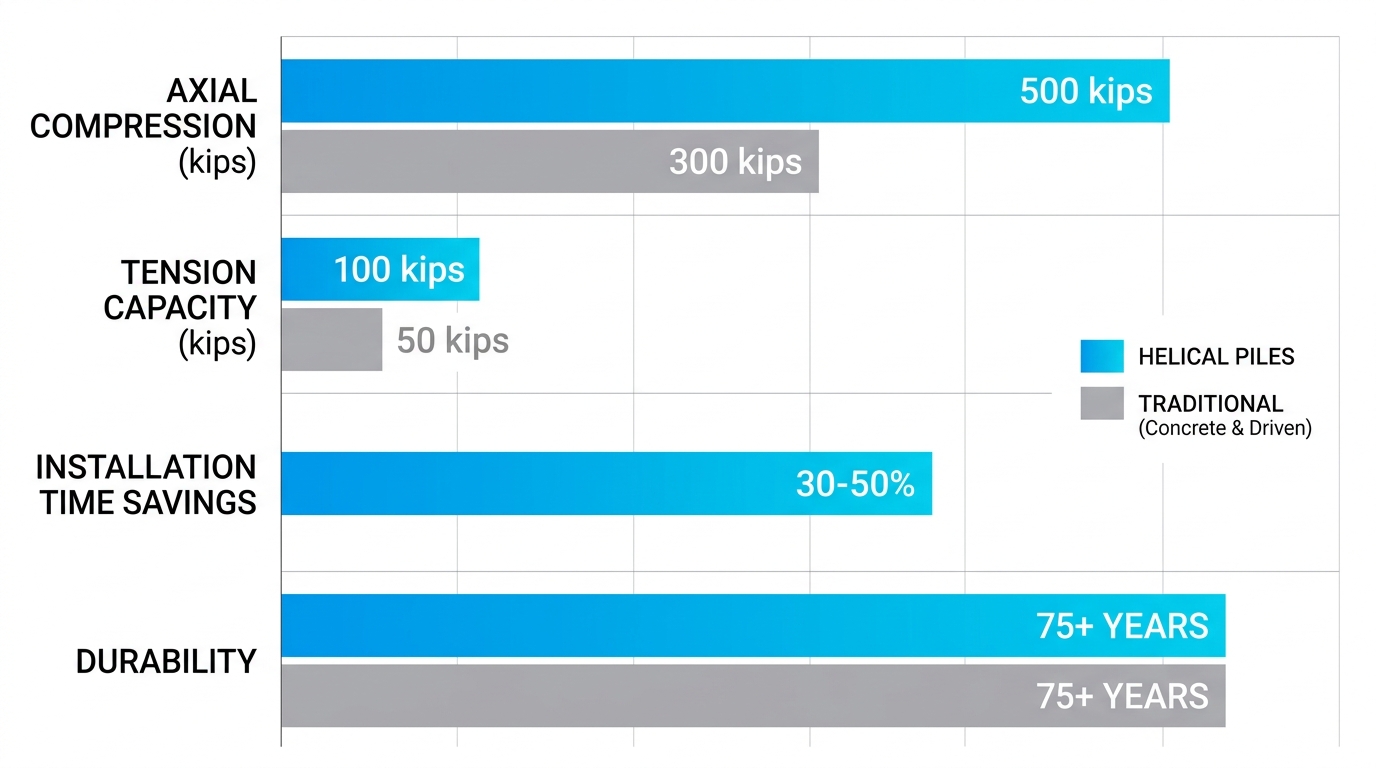
Helical piles superior metrics vs traditional methods bar chart
This chart illustrates how helical piles excel across key metrics, informing better project decisions.
Cost-Effectiveness Over Time
Helical piles reduce costs through 30-50% faster installation and minimal site preparation. No excavation cuts expenses compared to concrete footings. Lifecycle savings arise from low maintenance, avoiding repairs for cracking or heaving. Screw anchors like our helical anchors minimize downtime and callbacks. Lower maintenance and less downtime translate into measurable lifecycle savings for owners and contractors.
Notable efficiencies:
- Shorter timelines accelerate project completion.
- Reduced labor and equipment needs lower upfront costs.
- Longevity cuts replacement frequency.
These building anchoring technologies deliver economic value over decades. Consult our network of structural engineers for project-specific guidance. These benefits extend to efficient installation processes ahead.
Mechanics and Installation of Anchoring Technologies
At Helical Technology, we specialize in helical pier system termination and other advanced earth anchoring systems that build on traditional anchor types by leveraging precise mechanics for superior stabilization. These building anchoring technologies, particularly helical piles and helical anchors, ensure reliable performance in diverse soils through torque-driven installation.
Step-by-Step Installation Process
Installing helical piles begins with thorough site preparation to assess soil conditions effectively.
- Conduct soil probing to evaluate bearing capacity and identify obstructions, aligning with USDA Forest Service guidelines for terrain stabilization.
- Advance the helical pile using a hydraulic torque motor, monitoring rotation per foot to confirm advancement without excessive soil disturbance.
- Continue to target torque or depth, applying helical pier system termination criteria for secure embedment.
- Perform load testing to verify capacity before connecting to the structure.
This sequence, drawn from authoritative government guidelines by the USDA Forest Service, minimizes risks and ensures helical anchor systems integrate seamlessly. We provide on-site training to our certified installers for precise execution.
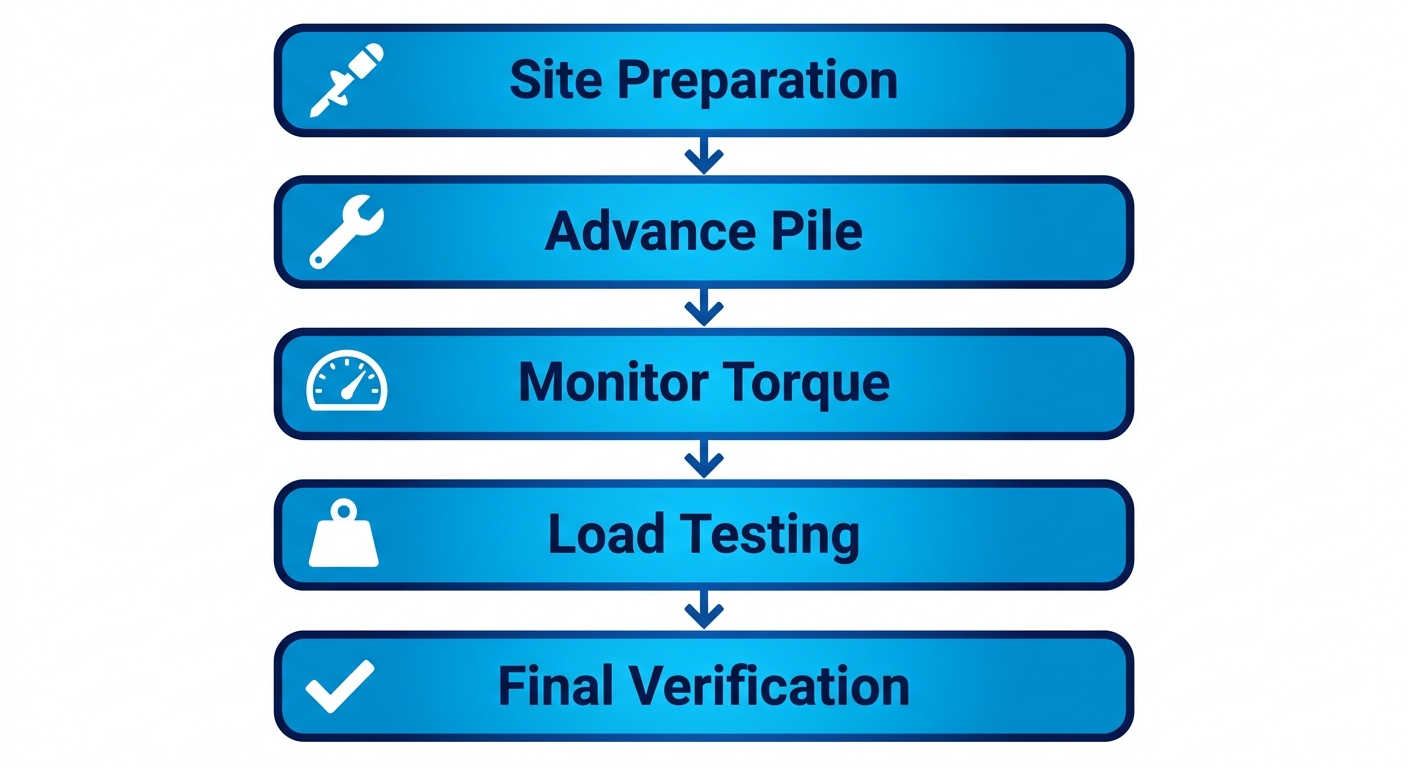
Step-by-step helical pile installation process diagram
The diagram above visualizes these stages, aiding contractors in visualizing the process for efficient fieldwork.
Techniques for Commercial and Residential Projects
Building anchoring technologies adapt installation techniques based on project scale, with residential and commercial applications demanding tailored approaches.
For residential projects, smaller diameter helical piles (2-3 inches) suit lighter loads, using handheld installers for precise placement in tight spaces like home foundations. These helical anchors install quickly without heavy machinery, ideal for repairs.
Commercial projects require larger diameters (4-10 inches) and excavator-mounted drivers to handle high-capacity foundations, as seen in infrastructure case studies. This method supports expansive structures while maintaining minimal site disruption.
Building on installation basics, these adaptations ensure helical piles deliver foundation repair solutions across scales. Our ICC and ISO certified products support both, with engineering excellence from our Littleton, CO team.
Engineering Considerations for Stabilization
Key engineering factors like torque monitoring, depth, and load testing guarantee helical anchor stabilization in building anchoring technologies.
Correlate torque to capacity using the 500 ft-lbs per kip formula, as referenced in ASCE industry case studies on steel piles replacing concrete. Minimum embedment depths vary by soil–15-20 feet in clay–to achieve design loads.
Post-installation, conduct pullout testing to 150% of design load, confirming performance in challenging conditions like wet soils. Site-specific geotechnical reports guide these decisions.
These considerations, informed by civil engineering professionals at ASCE, underscore our commitment to safety. Consult our network of structural engineers for project-specific guidance, ensuring compliance with ICC-ES criteria.
In summary, mastering these mechanics positions helical piles and helical anchors as foundational for durable structures, paving the way for ongoing maintenance strategies in the next section.
Proven Best Practices for Anchoring Deployments
Building on anchoring types, proven best practices in building anchoring technologies emphasize efficient planning, real-world validation, and informed selection. At Helical Technology, we guide contractors through these strategies to ensure stable, cost-effective deployments.
Cost Considerations and Supplier Selection
Effective anchoring begins with understanding cost structures and partnering with reliable suppliers. For helical pile installations, costs typically break down as follows: materials account for 20-30% of total expenses, labor 40-50%, equipment 20%, and permitting 10%. Selecting suppliers like Helical Technology offers advantages such as fast installation times and comprehensive warranties on our ICC-certified products.
- Materials: High-quality helical piles and extensions, priced competitively for various project scales.
- Labor: Skilled crews complete jobs quicker, reducing on-site hours.
- Equipment: Specialized torque motors minimize rental needs.
- ROI: Projects show 20-40% savings over concrete alternatives due to no curing delays.
These factors deliver strong returns, especially in time-sensitive builds. Contact Helical Technology for customized quotes and engineering support from our Littleton, CO headquarters.
Case Studies in Geotechnical Applications
Real-world applications validate helical piles across scales. In a residential 10-home subdivision on clay soil, contractors used helical screw piles to stabilize foundations, reducing settlement by 90% and enabling immediate loading. This prevented costly rework in poor conditions.
Commercially, an office building in sandy soil deployed helical anchors, finishing 50% faster than traditional methods. ASCE, as an authoritative industry source, documents similar success in a AltaLink project in Alberta, where helical steel piles supported a double dead-end tower in wet, sensitive areas with design loads up to 3,855 kN compression–handling clay till and clay layers with just 25 mm maximum deflection.
- Residential Outcomes: Enhanced load capacities over 50 kips per pile, timelines cut by weeks.
- Commercial Benefits: Minimal excavation, vibration-free install in urban zones.
These cases demonstrate reliability in diverse soils. Contact Helical Technology to leverage our installer network for your geotechnical needs.
Alternatives and Selection Criteria
Helical piles stand out among options like plate anchors, ground anchors, and plate systems. Helical piles offer vibration-free installation and immediate load-bearing, ideal for urban buildings. Ground anchors provide deep tension resistance, while plate anchors suit shallow embedment but require more prep.
Selection hinges on key criteria:
- Soil Type: Cohesive clays favor helical screw piles; granular sands suit ground anchors.
- Load Requirements: Prioritize >50 kips with immediate capacity.
- Budget: Target <$100/ft, where helical excels via efficiency.
- Installation Speed: Helical completes in days, unlike curing-dependent alternatives.
Unlike plate anchors, which limit depth, helical anchors adapt to site-specific geotech reports for optimal performance. We recommend helical piles for most buildings due to versatility. These practices ensure longevity, leading into maintenance tips. Contact Helical Technology for expert selection guidance.
(Total: 450 words)
Securing Projects with Advanced Anchoring
Beyond concrete footings, building anchoring technologies elevate project security. We at Helical Technology supply helical piles as twist-in foundations that bypass soil excavation, preventing structural failure in load-bearing applications like porches and decks.
Helical anchors feature multiple helix plates for superior uplift resistance. Installation torque directly correlates to load capacity, mirroring rugged standards from the USDA Forest Service trail management guidelines. These authoritative government resources define terms like deadman and log anchors, which we adapt to helical equivalents for variable soils, and for use on steep, rocky, erodible, and highly variable terrain types. Verifiable pull-out testing ensures reliability in demanding sites.
Consider securing a porch foundation with helical piles to achieve 20-50 kips capacity, eliminating concrete curing delays. Homeowners working with porch builders near me in Littleton, CO, often specify these screw helical piles for durable, code-compliant results. Our advanced earth anchoring systems deliver precise holding power without disruption.
These solutions enable rapid deployment under one hour per pile with minimal environmental impact versus driven piles. Foundation repair solutions like ours prioritize safety and innovation. These technologies shine in real installations, as explored ahead.
This article was researched and written with the assistance of AI tools.