


Jason Keefer
President
Building Structural Supports
Table of Contents
Understanding Building Structural Supports
While foundation issues threaten stability, understanding building structural supports provides the groundwork for reliable foundation repair solutions. These essential load-bearing components–including foundations, piers, and footings–transfer building loads safely to the soil, ensuring structural integrity as we support contractors nationwide from Littleton, Colorado.
According to the International Code Council (ICC)’s IBC Chapter 18 on soils and foundations, designs must account for allowable soil bearing pressures, classified soil types, minimum depths, reinforcement, and mandatory inspections to prevent settlement. Proper design also requires thorough site-specific soil testing and geotechnical reports, attention to lateral loads and frost depth, appropriate reinforcement detailing, and coordinated inspections to verify bearing capacities before construction proceeds on each project phase and timelines. Helical piers, such as the helical pier system, offer screw-like supports rotated into stable strata for strong uplift and compression resistance in various soils. In contrast, push piers use steel shafts driven hydraulically to refusal, excelling under heavier loads in compressible ground.
Inadequate building structural supports risk differential settlement, cracking, and failure, emphasizing code-compliant soil analysis and ICC and ISO Certified products. We recommend consulting our network of structural engineers for project-specific guidance to meet IBC standards. With these supports in mind, solutions like helical piers address common deficiencies per code.
Fundamentals of Building Structural Supports
Effective load transfer starts with robust foundations in any construction project. At Helical Technology, we recognize building structural supports as essential systems that transfer building loads to stable soil or rock layers below. These supports prevent settlement, ensure stability, and safeguard structures against environmental forces like wind, seismic activity, and soil movement. Without reliable foundations, even the strongest superstructures risk failure.
Shallow foundations suit stable soils near the surface. Common types include:
- Footings: Concrete pads under columns or walls distributing loads over wider areas.
- Slab-on-grade: Continuous concrete slabs acting as both floor and foundation for lighter buildings.
These options work well for low-rise structures where soil conditions permit direct bearing without deep excavation.
Deep foundations extend into stronger strata for challenging sites. They include piles and piers, with helical piles providing superior performance in challenging soils. Helical piers, screw-in steel shafts with helix plates, resist uplift and compression effectively in weak or variable soils. In contrast, push piers involve hydraulically driven steel sections for dense soils, offering robust load-bearing capacity through friction and end-bearing.
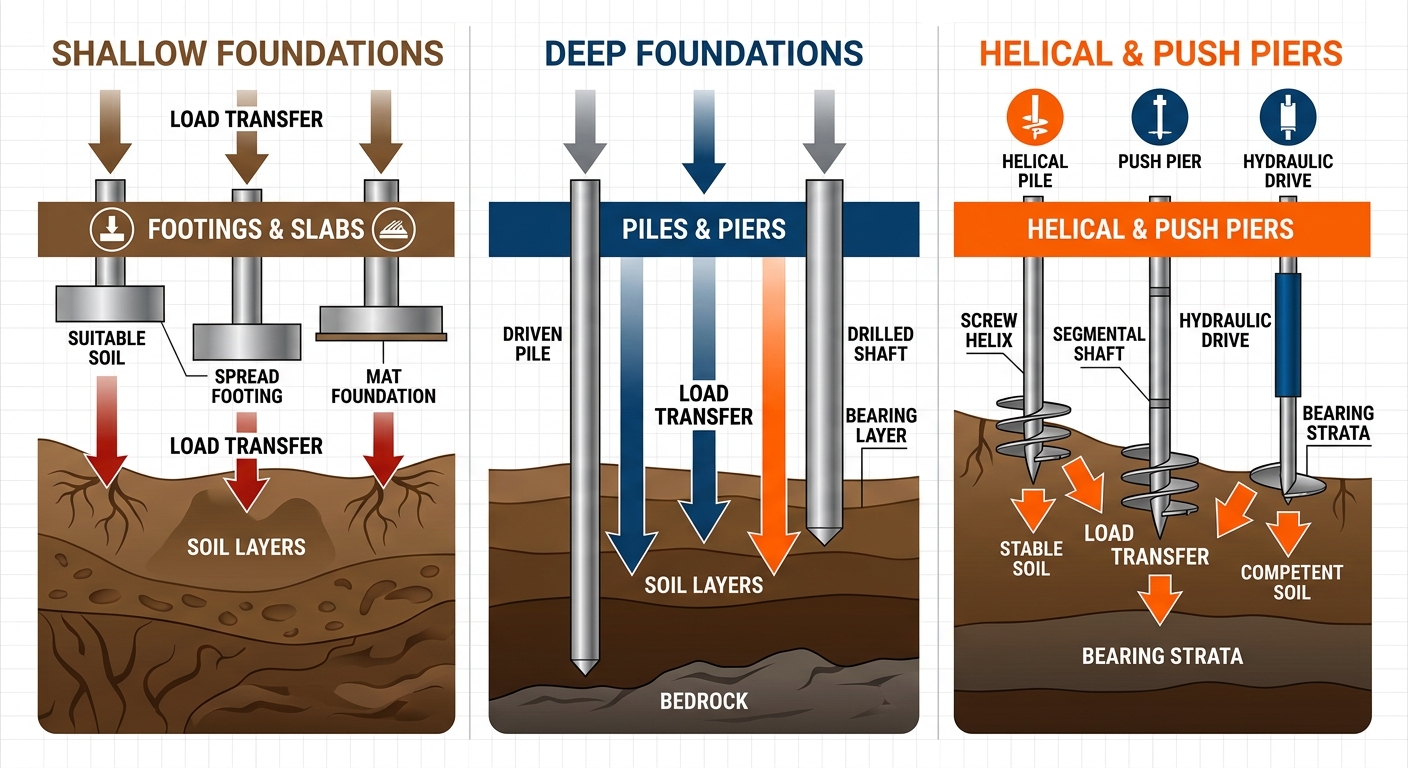
Illustration of shallow, deep, and helical building structural supports categories
This infographic highlights how these categories address diverse soil profiles, aiding selection for specific projects. Factors influencing bearing capacity include soil type, installation depth, and method. For instance, helix plates on helical piers enhance grip in soft clays, while push piers excel in frictional sands.
The International Code Council (ICC) sets authoritative standards in IBC Chapter 18 for soils and foundations. Section 1806 mandates soil bearing capacity tests to determine allowable pressures. Section 1808 addresses expansive soils with design protections against heave, and Section 1804 requires inspections during excavation and placement. Test soil per IBC to ensure compliance.
Adhering to these codes delivers safety, durability, and legal assurance. Helical piers shine in variable soils with our ICC-certified products, offering foundation repair solutions and versatility. Building on these fundamentals, specialized supports like helical piles offer advanced applications for complex builds. Consult our network of structural engineers for project-specific guidance and engineering design support services.
Mechanics of Helical Piles in Structural Support
When foundations fail due to soil instability or settlement, helical piles emerge as essential building structural supports for restoration and reinforcement. At Helical Technology, we distribute ICC-approved helical pier systems that leverage proven engineering principles to transfer loads effectively to stable strata. These advanced earth anchoring systems provide immediate stability, aligning with foundation repair solutions demanded by contractors nationwide.
How Helical Piles Function as Supports
Understanding their core mechanics reveals why helical piles excel in structural applications. Installation relies on torque-based advancement, where the pile is rotated into the ground using hydraulic torque motors. This process achieves precise embedment depth, with measured installation torque directly correlated to ultimate load capacity per International Code Council standards in ICC Building Code Chapter 18.
The process unfolds in these key steps:
- Shaft preparation: Assemble the lead section with welded helical plates sized for site soil conditions.
- Torque application: Rotate the shaft clockwise while applying downward pressure, allowing helices to pull the pile into competent bearing layers.
- Capacity verification: Monitor torque readings, where higher values indicate greater soil resistance and load-bearing potential.
Once installed, load transfer occurs primarily through the helical plates, which bear axial compression or tension forces against the soil. The central shaft resists lateral shear and bending moments, ensuring comprehensive support. This mechanism delivers predictable performance without extensive excavation, making helical pier foundations versatile for diverse geotechnical challenges. Torque correlation provides instant feedback, often eliminating the need for static load tests in preliminary assessments.
Helical Piles Versus Push Piers
Compared to alternatives like push piers, helical piles offer distinct advantages in installation and performance. Push piers rely on hydraulic rams to drive steel sections into the soil via skin friction and end bearing, typically requiring preload to advance. This method suits cohesive clays but struggles in variable or granular soils where displacement causes refusal.
In contrast, helical piles advance through rotation, excavating minimal soil and penetrating obstructions like cobbles or roots. No preload is needed, reducing equipment demands and site disruption. Performance-wise, helical piles achieve immediate capacity via torque correlation, ideal for tension applications such as uplift resistance. Push piers, however, verify capacity through incremental load testing during installation, providing direct confirmation but extending timelines.
Helical piers demonstrate superior versatility across soil profiles, from soft silts to dense sands, while push piers excel in uniform, high-friction strata. According to International Code Council authoritative standards, both systems comply with design provisions, yet helical pile systems often simplify seismic retrofitting due to bidirectional load handling. Selecting between them depends on site-specific geotechnics, with our engineering excellence and design support guiding optimal choices.
Applications in Foundation Repair
Helical piles shine in real-world foundation repair solutions, stabilizing sinking slabs, underpinning bowing walls, and retrofitting for seismic resilience. In residential settings, we see them lifting settled concrete slabs by bracketing to structure and incrementally raising via hydraulic jacks until helical pier system termination criteria confirm load transfer completion.
Commercial projects, like stabilizing a multi-story tower in expansive clays, employ helical pier foundations to depths of 30 feet or more, preventing differential settlement. New construction benefits from their use in tieback anchors for retaining walls or tower crane bases, ensuring ICC and ISO Certified products meet code.
Key scenarios include:
- Sinking foundations: Underpin perimeter beams to arrest movement.
- Seismic upgrades: Install in tension for lateral bracing.
- Lightweight structures: Support additions without soil excavation.
Consult our network of structural engineers for project-specific guidance, as installations must comply with ICC-ES AC358 criteria. These pier-based supports restore site stability, paving the way for durable, code-compliant outcomes.
Practical Applications of Structural Supports
Building on support categories, practical applications of building structural supports focus on foundation repair and reinforcement using helical piers and push piers. At Helical Technology, we provide ICC-certified products and engineering support to ensure reliable implementation nationwide from our base in Littleton, CO.
Installation Methods for Helical and Push Piers
Helical piers and push piers offer distinct installation approaches for building structural supports, each suited to specific soil conditions while adhering to International Code Council requirements in Chapter 18 for pier design loads, spacing, and corrosion protection.
Helical pier installation follows a precise, torque-monitored process:
- Excavate an access pit to expose the foundation footing.
- Align the lead helical section vertically using a template.
- Advance the pier with a hydraulic torque motor, monitoring installation torque for capacity correlation.
- Add extensions as needed until reaching competent load-bearing soil.
- Attach the underpinning bracket and perform a load test to verify performance.
In contrast, push pier installation relies on hydraulic driving:
- Position the solid steel shaft against the footing.
- Drive the shaft using hydraulic rams until refusal.
- Add extensions to reach stable strata.
- Hydraulically load test the assembly to confirm load transfer.
These methods minimize vibration and disruption, complying with ICC standards for embedment depths. We recommend pre-construction surveys to optimize pier placement, ensuring long-term stability per code guidelines.

Helical piers vs. push piers installation process comparison
The diagram illustrates these sequences visually, highlighting helical piers’ rotational advancement versus push piers’ linear driving. This clarity aids contractors in selecting the right system.
Cost Factors and Timing for Repairs
Cost factors for helical piers and push piers vary based on site specifics, influencing decisions for timely repairs. Helical piers typically range from $1,000 to $3,000 per pier, including materials and labor, while push piers cost $800 to $2,500 per pier.
Key influencers include:
- Soil type and required depth
- Site access and number of piers
- Local labor rates and mobilization
Use helical piers in unstable or variable soils where torque-correlated capacity provides verifiable performance. Opt for push piers in cohesive clays, leveraging hydraulic resistance for rapid refusal. Decision criteria: Select helical if precise capacity verification is needed; choose push for budget-sensitive projects with predictable soils.
International Code Council standards in Chapter 18 guide these choices, mandating corrosion protection and load testing. Timing minimizes downtime–helical installations suit phased repairs, while push piers excel in urgent scenarios. Consult our network of structural engineers for project-specific guidance.
These economic and timing considerations directly inform successful outcomes, as demonstrated in real-world projects.
Real-World Project Examples
Real-world applications showcase helical piers and push piers in diverse scenarios, emphasizing best practices like code-compliant monitoring.
In a residential sinking foundation in Colorado, we supplied 12 helical piers driven to 25 feet, costing $28,000 and completed in three days. Pre-construction surveys identified variable soils, with post-install torque verification ensuring ICC Chapter 18 compliance.
A commercial building with 8 feet of settlement used 20 push piers, stabilizing the structure swiftly via hydraulic load tests. For crawlspace applications, the floor stabilizer post kit provided immediate hydraulic adjustment and long-term support, integrating seamlessly with underpinning brackets.
Best practices include geotechnical borings upfront and annual monitoring. These cases highlight our foundation repair solutions, delivering engineering excellence. Always consult a structural engineer for site-specific designs, as our team supports with ICC-ES compliant products.
Advanced Considerations for Structural Integrity
Building on foundational principles, advanced considerations for building structural supports address complex soil-foundation interactions to ensure long-term durability. At Helical Technology, we emphasize code-compliant practices that enhance load-bearing capacity and resist tension in variable conditions. These strategies, including plate anchors and pier systems, align with International Building Code (IBC) standards for site-specific designs in Littleton, CO, and beyond.
IBC Chapter 18 mandates rigorous soil investigations per Section 1803, requiring borings, sampling, and detailed reporting to determine allowable pressures and foundation suitability. Conduct at least one boring per 2,500 square feet, extending 10 feet below anticipated footings, as per IBC 1803.5.12. We recommend geotechnical engineers analyze expansive soils to inform helical piers placement, preventing differential settlement. Additionally, grade sites per IBC 1804.4 with minimum 5% slope away from structures, compact backfill to 95% Proctor density, and install drainage to mitigate hydrostatic pressures, according to International Code Council standards.
Helical piers, or screw piles, excel in transferring compressive and tensile loads through interlocking helices that advance into stable strata, ideal for variable soils. In contrast, push piers–also known as hydraulic resistance piers–rely on skin friction for uplift resistance and settlement control in expansive clays. Select helical piers for high tension needs in seismic zones; use push piers where end-bearing dominates. Our ICC-certified products support these installations, with helical piers distributing loads progressively to minimize heave.
Incorporate plate anchors for lateral stability in deep excavations per IBC 1807 anchorage provisions. Ongoing monitoring via inclinometer readings and settlement gauges verifies performance, with quarterly surveys detecting shifts exceeding 1 inch. These protocols, mandated under IBC deep foundation elements (1810-1814), ensure sustained integrity. Consult our network of structural engineers for project-specific guidance and code compliance.
These advanced building structural supports strategies pave the way for practical applications in challenging sites, delivering engineering excellence.
Frequently Asked Questions on Structural Supports
To address common concerns about building structural supports, we provide clear answers below.
What are building structural supports?
Building structural supports stabilize foundations and load-bearing elements against settling or shifting soils. Our helical piers and similar systems transfer loads to stable strata, ensuring long-term structural integrity for homes and commercial buildings.
What is the difference between helical piers and push piers?
Helical piers screw into the ground with torque, creating minimal vibration and ideal for sensitive sites; we call them helical pile foundations for precision. Push piers, or pushed steel piers, advance hydraulically by load-bearing resistance, suiting denser soils.
Do structural supports comply with building codes?
Yes, they fully comply. According to the International Code Council (ICC), authoritative International Building Code (IBC) standards in Chapter 18 cover soils and foundations, including piers and piles for reliable support systems. Installations must meet local codes.
How are supports connected to walls?
Supports connect securely to walls using wall plate anchors, which distribute loads evenly and prevent movement. These accessories ensure robust attachment during foundation stabilization projects.
Contact us for helical pier consultations. Learn more about our solutions below.
Securing Long-Term Building Stability
With signs confirmed, securing long-term building stability requires proven building structural supports. Foundation settlement risks cracks and uneven floors, demanding reliable foundation underpinning solutions like helical piers and push piers.
Helical piers, also known as helical piles or screw piles, are twisted into stable soil strata to transfer building loads with superior load-bearing capacity. They resist uplift and compression effectively for over 50 years, ensuring enduring performance with minimal disruption.
In contrast, push piers or hydraulic piers drive hydraulically into soil for immediate load transfer, ideal for heavier commercial structures despite potential site disturbance.
Key benefits include:
- Minimal site disturbance
- Immediate stability gains
- Compliance with seismic building codes
At Helical Technology, we recommend professional assessment for helical pier installations. Consult our network of structural engineers for project-specific guidance. Proper deployment follows rigorous engineering protocols.
This article was researched and written with the assistance of AI tools.