


Jason Keefer
President
Deep Foundation Stabilization
Table of Contents
Deep Foundation Stabilization Overview
Shallow foundations often fail in weak surface soils or expansive clays, leading to differential settlement. We at Helical Technology provide deep foundation stabilization solutions that install piers to bypass unstable layers and transfer loads to competent strata, ensuring reliable long-term structural integrity for residential and commercial buildings.
Helical pier systems feature screw-like steel shafts installed by torque, achieving immediate load capacity ideal for new construction and retrofits. Helical pier system installation causes minimal vibration and site disturbance. Push piers consist of steel sections driven hydraulically until refusal, then extended and bonded to evenly distribute loads.
The International Code Council, as the primary authoritative source in IBC 2024 Chapter 18, mandates geotechnical investigations, allowable pressures, installation tolerances, and corrosion protection for deep foundations like piers.
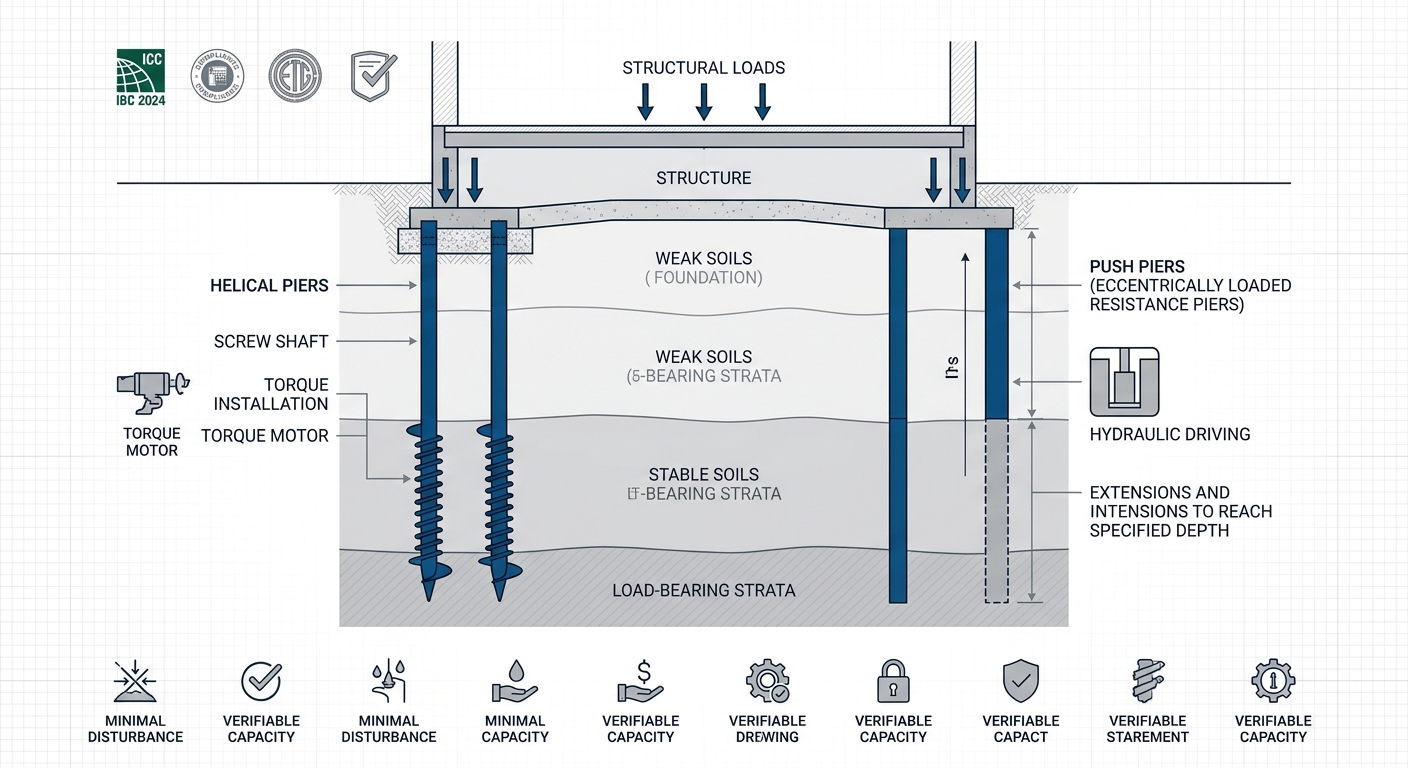
Deep foundation stabilization techniques overview with helical and push piers
These methods offer verifiable capacitythrough torque or load tests, vibration-free installation, and compliance with code standards. Explore helical piers next for detailed torque-based solutions and installation guidance for contractors.
Recognizing Deep Foundation Issues
Signs Indicating Deep Foundation Stabilization Needs
Early detection of deep foundation stabilization needs prevents escalation. We recommend monitoring structures for these visible signs, where temporary measures like a floor stabilizer post kit can support uneven floors while awaiting permanent helical piers installation.
- Wall cracks wider than 1/4 inch diagonally: These jagged fissures signal differential settlement, requiring helical piers to lift and stabilize.
- Uneven floors sloping more than 1/2 inch over 10 feet: Indicate deep soil consolidation, addressed by piering techniques.
- Sticking doors and windows needing force to open: Result from frame distortion due to foundation shift.
- Gaps around door frames exceeding 1/8 inch: Show separation from settling supports.
- Bowing basement walls over 2 inches: Point to lateral pressure and vertical instability.
- Jammed cabinets or counters separating from walls: Evidence of progressive settlement.
These indicators often reflect underlying settlement beyond superficial fixes. According to the International Code Council (ICC), foundations must resist differential movement per IBC Chapter 18 standards. Contact our experts at Helical Technology for a helical piers assessment to avoid further damage.
These signs often stem from underlying issues such as…
Common Causes of Foundation Instability
Deep foundation stabilization becomes essential when instability arises from soil and site factors. The International Code Council (ICC)’s IBC 2024 Chapter 18 provides the latest guidelines on soil classification and drainage to mitigate these risks.
- Soil settlement due to consolidation under load: Exceeds IBC allowable bearing capacities, like 1,500 psf for clays.
- Poor site drainage causing erosion around footings: Violates grading slopes away from structures per code.
- Expansive clay soils shrinking and swelling: As noted in IBC 2021 for soils requiring stabilization design.
- Construction defects like inadequate compaction: Fails geotechnical investigation standards in Chapter 18.
Per ICC authoritative standards, geotechnical reports must evaluate these, including moisture effects on bearing capacity. Helical piers offer reliable solutions for such conditions. At Helical Technology, our ICC-certified products support contractors addressing these causes effectively. Early intervention with proper investigation preserves structural integrity.
Addressing these promptly involves deep foundation stabilization, with costs varying by…
Initial Cost Considerations
Deep foundation stabilization projects demand budget planning for helical piers or push piers. Industry estimates for 2024 range from $10,000-$30,000 for residential setups (10-20 piers at $1,000-$1,500 each) and $50,000-$150,000 for commercial push piers, influenced by site specifics.
- Project scale (linear feet stabilized): Larger areas increase pier counts.
- Soil type (cohesive vs. sandy): Affects depth per IBC presumptive values like 3,000 psf for gravels.
- Accessibility (basement vs. crawlspace): Impacts equipment needs.
- Pier depth (20-50 feet): Driven by settlement analysis.
- Urgency of repairs: Expedited work raises labor costs.
The ICC’s IBC Chapter 18 emphasizes investigations determining these factors for deep foundations. Consult a structural engineer or our network for project-specific guidance–Helical Technology provides engineering support. Our foundation repair solutions ensure cost-effective, code-compliant outcomes.
Benefits of Deep Foundation Methods
Addressing these challenges, deep foundation methods like helical piers and push piers provide superior benefits. These advanced systems deliver enhanced load-bearing capacity, minimal site disruption, long-term durability, and strong ROI, achieving reliable deep foundation stabilization for commercial structures. At Helical Technology, we supply ICC-certified products that meet these demands.
Advantages of Helical Piers Over Traditional Techniques
Helical piers excel in deep foundation stabilization compared to driven piles or concrete piers. Their helical plates are screwed into the soil, achieving 100% torque correlation for predictable load-bearing capacity, as aligned with International Code Council (ICC) standards in IBC Chapter 18 for foundation design and installation.
Key advantages include:
- Minimal site disruption: Vibration-free installation eliminates excavation, spoil removal, and heavy equipment, ideal for urban commercial sites.
- Superior predictability: Unlike driven piles prone to settlement, helical pile systems offer immediate load transfer without long-term adjustments.
- Rapid deployment: Helical piers, including helical anchors, install quickly, reducing project timelines.
These features ensure stable foundations with no post-installation settlement, outperforming traditional methods in efficiency and reliability.
Steel Pier Durability and Rust Resistance
Steel piers in helical and push piers systems prioritize longevity through rigorous corrosion protection. We provide hot-dip galvanization per ASTM A123 standards, delivering over 50 years of resistance in most soils, supplemented by epoxy coatings for aggressive environments. This aligns with ICC authoritative international building code standards for deep foundations in Chapter 18.
Proven benefits encompass:
- No-rust performance: Thousands of installations show zero corrosion failures, unlike untreated steel.
- Enhanced resilience: Galvanized coatings withstand pH extremes and moisture, ensuring structural integrity.
- Code compliance: Meets IBC requirements for materials in seismic zones and high-load applications.
Push piering extends this durability to retrofit projects, providing deep foundation stabilization without compromising steel integrity over decades.
Cost-Effectiveness for Commercial Applications
For commercial buildings, helical piers offer unmatched economics at $200-400 per foot versus $300-500 for drilled piers, with 20-30% faster installation times minimizing downtime. Our ICC and ISO Certified products deliver 75-year warranties, boosting ROI through reduced maintenance and superior performance over concrete alternatives.
Notable advantages are:
- Lower total costs: No curing delays or site prep cuts expenses in high-volume projects.
- High ROI: Predictable capacity eliminates callbacks, enhancing profitability for contractors.
- Versatile application: Helical piling suits varied soils, optimizing budgets in deep foundation stabilization.
These savings make helical piers the smart choice for commercial ROI. These benefits translate to real-world success in commercial projects. They consistently reduce schedule risk, enhance structural performance, and simplify maintenance planning for owners and investors.
Mechanisms of Deep Foundation Stabilization
Deep foundation stabilization employs specialized piers to bypass weak surface soils and transfer structural loads to competent strata below. At Helical Technology, we distribute ICC-approved helical piers and push piers that achieve this load transfer, complying with International Code Council (ICC) standards in IBC Chapter 18 for design capacities and installation tolerances.
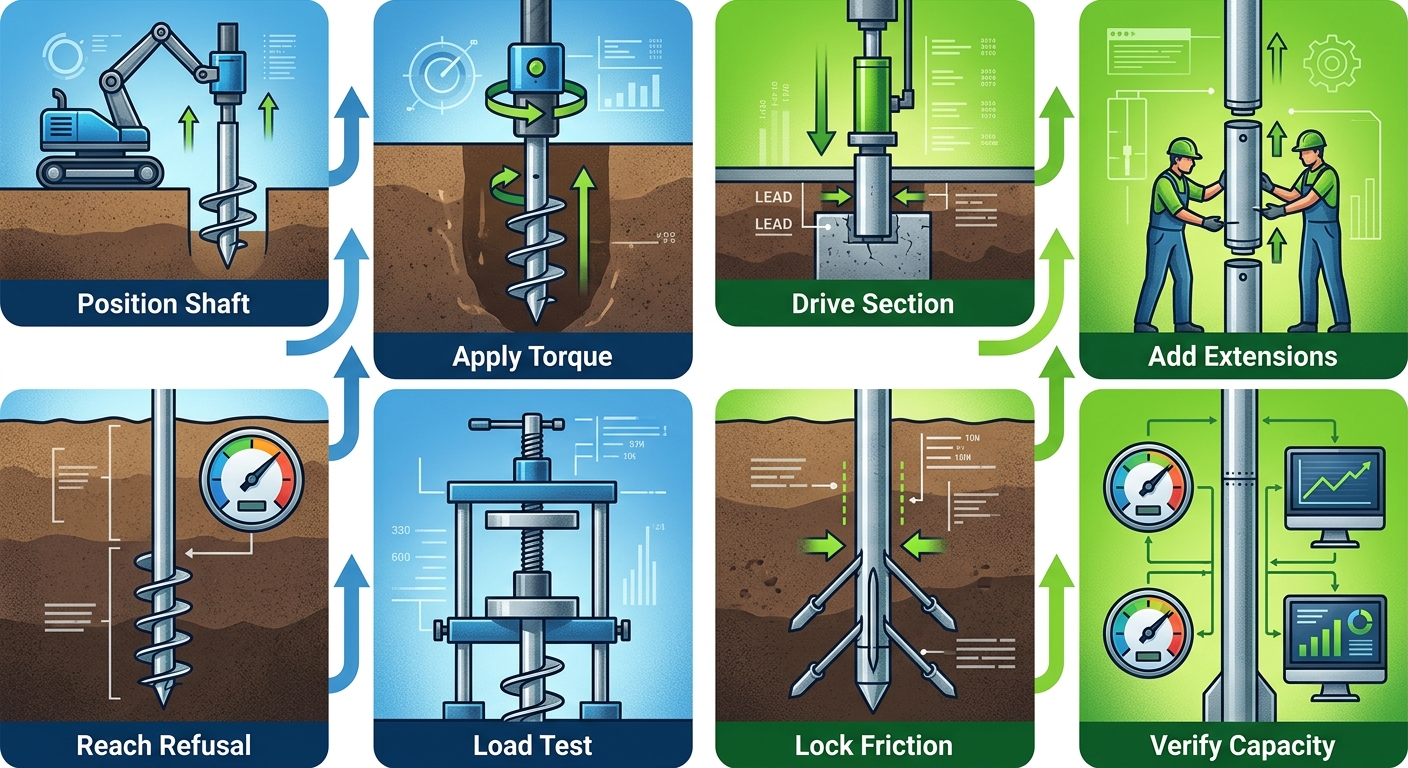
Side-by-side helical piers and push piers deep foundation stabilization process
These diagrams illustrate the distinct processes, highlighting how each method supports foundation underpinning in unstable soils.
How Helical Piers Provide Stabilization
Helical piers provide deep foundation stabilization through a screw-in installation process. These helical screw piles advance into the ground via applied torque, with helical plates displacing soil laterally to grip stable strata.
Helical piers function as an advanced earth anchoring system by rotating the shaft and plates, achieving approximately 90% of ultimate capacity during installation, per ICC authoritative international building code standards.
Installation follows these steps:
- Position the lead section at the required location.
- Apply torque using hydraulic equipment until refusal on competent soil.
- Add extensions as needed to reach bearing depth.
- Perform load testing to verify capacity.
This vibration-free method transfers loads in compression or tension, ideal for variable soils. IBC Chapter 18 mandates geotechnical investigations and helical pile equations for sizing and tolerances, ensuring stability.
Push Piers Installation and Operation
Push piers, or driven push piers, correct soil settlement using hydraulic rams that drive steel sections into the ground until refusal on bedrock or dense strata.
The process locks external sleeves to mobilize skin friction, halting further movement and enabling pier-based stabilization.
Key steps include:
- Attach the pier section to the structure via bracket.
- Hydraulically drive the pier until resistance peaks.
- Couple extensions to advance deeper.
- Verify load capacity through hydraulic resistance and post-install tests.
Per ICC IBC Chapter 18, installations require driving criteria and special inspections for deep foundations. This method suits cohesive clays, with load transfer via end-bearing and friction, though it may generate vibrations.
Comparing Helical and Push Piers
Helical piers and push piers differ in installation, soil suitability, and performance for deep foundation stabilization.
Helical piers use torque-driven, vibration-free advancement, suiting variable or loose soils, with immediate 90% capacity confirmation. Push piers employ hydraulic driving, best for cohesive clays, relying on post-install verification per ICC standards.
Helical methods avoid soil disturbance, while push piers risk heave but excel in high-load transfer via friction lock-up. IBC Chapter 18 governs both with tolerances, load tests, and geotechnical data.
We recommend consulting our network of structural engineers for project-specific guidance, ensuring compliance with ICC-ES criteria. These mechanisms underpin real-world repairs as detailed next.
Implementing Best Practices in Stabilization
Building on foundation assessment, effective implementation of deep foundation stabilization starts with pier selection tailored to soil challenges. At Helical Technology, we supply ICC-certified helical piers and push piers for US projects, ensuring code-compliant results that address settlement and instability.
Selecting Piers for Challenging Soils
Choosing between helical piers and push piers depends on soil conditions, settlement patterns, and load demands in US projects. Helical piers excel in cohesive or unstable soils with low torque resistance, while push piers suit dense sands. Differential settlement exceeding 1/4 inch triggers pier use, with residential loads differing from commercial over 50 kips. The International Code Council (ICC)’s IBC 2024 Chapter 18 provides current standards for Site Class F soils and pier capacities.
- Conduct geotechnical investigation per ICC guidelines to classify soils and predict bearing values, such as 1,500 psf for clays.
- Select helical piers for expansive clays or soft strata where rotation advances without refusal.
- Opt for push piers in frictional sands achieving hydraulic resistance quickly.
- Consider plate anchors for shallow stabilization when piers alone suffice for minor settlements under 1 inch, per ICC 2021 benchmarks.
- Evaluate project scale: Residential favors lighter helical piles; commercial demands resistance piers verified for group effects.
Installation Processes and Techniques
Proper installation verifies pier performance through monitored advancement and testing, aligning with IBC deep foundation rules. We train contractors on helical and push pier techniques for precise execution in challenging US sites. ICC 2024 Chapter 18 mandates load tests and verification for stability.
- For helical piers: Pre-drill obstructions, advance sections with torque monitoring to minimum 5,000 ft-lbs, then perform load test to 200% design load.
- For push piers: Use hydraulic ram for incremental loading to refusal in dense layers, confirming with dial test at 2x safety factor.
- Monitor alignment continuously to prevent deviation, using plumb bob or laser tools.
- Bracket connection: Secure to structure with engineered steel plates after pier proofing.
- Document process with torque logs and test data for building official review, per ICC standards.
Optimizing for Unstable Soils and Longevity
Helical piers optimize deep foundation stabilization in unstable soils through extensions and protections, promoting decades of performance in US projects. ICC 2021 Chapter 18 complements with benchmarks for expansive soils and verification. Our engineering support ensures compliance.
- Extend helical piers 10-20 ft into stable stratum below expansive clays for bypass.
- Apply galvanized coatings per ASTM A153 against corrosion in high-moisture regions.
- Incorporate helical piles with multiple blades for enhanced uplift resistance in Site Class F soils.
- Schedule monitoring: Annual tiltmeter checks for 5+ years post-install to detect movement under 1 inch.
- Consult our network of structural engineers for site-specific designs, as products comply with ICC-ES AC358.
Post-install monitoring upholds these gains, linking to long-term maintenance strategies.
Securing Long-Term Foundation Stability
Beyond immediate repairs, securing long-term foundation stability requires proactive deep foundation stabilization. This approach transfers structural loads to deeper, load-bearing soil strata, mitigating differential settlement over time and preventing structural failure.
Helical piers provide screw-like piles installed via torque, achieving immediate load capacity without soil excavation. These ICC-certified systems excel in softer soils, offering long-term stability. In addition, push piers use hydraulically driven steel shafts, suiting denser soils for reinforcement. They minimize site disturbance and can include corrosion-resistant coatings for longevity.
Per International Code Council (ICC) authoritative standards in IBC 2021 Chapter 18 Section 1807, foundation walls demand specific embedment depths and lateral support to resist uplift and shear. Use wall plate anchors to connect elements to the structure above, ensuring monotonic load paths. For expansive soils in Littleton, CO, we applied helical piers with code-compliant design factors, stabilizing an existing foundation effectively. Design must be informed by geotechnical investigations and verified by a registered design professional.
Implementing these code-compliant helical pier-based and push pier solutions via expert installation maximizes durability. Consult our engineering team for project-specific guidance. Ask about our on-site installation training programs.
This article was researched and written with the assistance of AI tools.