


Jason Keefer
President
Geotechnical Anchoring Systems
Table of Contents
Geotechnical Anchoring Systems Overview
Unstable soil poses significant risks to civil engineering projects, from sloping excavations to retaining walls. At Helical Technology, we specialize in geotechnical anchoring systems, ground improvement techniques that transfer tensile loads into stable soil strata to enhance overall stability.
These systems include three primary types. Soil nails consist of grouted steel bars installed at shallow angles to reinforce soil masses. Tieback anchors are prestressed tendons drilled deep into competent strata for active support. The helical pier system uses screw piles with helical plates that provide immediate load-bearing capacity in poor soils, as outlined in academic fundamentals from Columbia University.
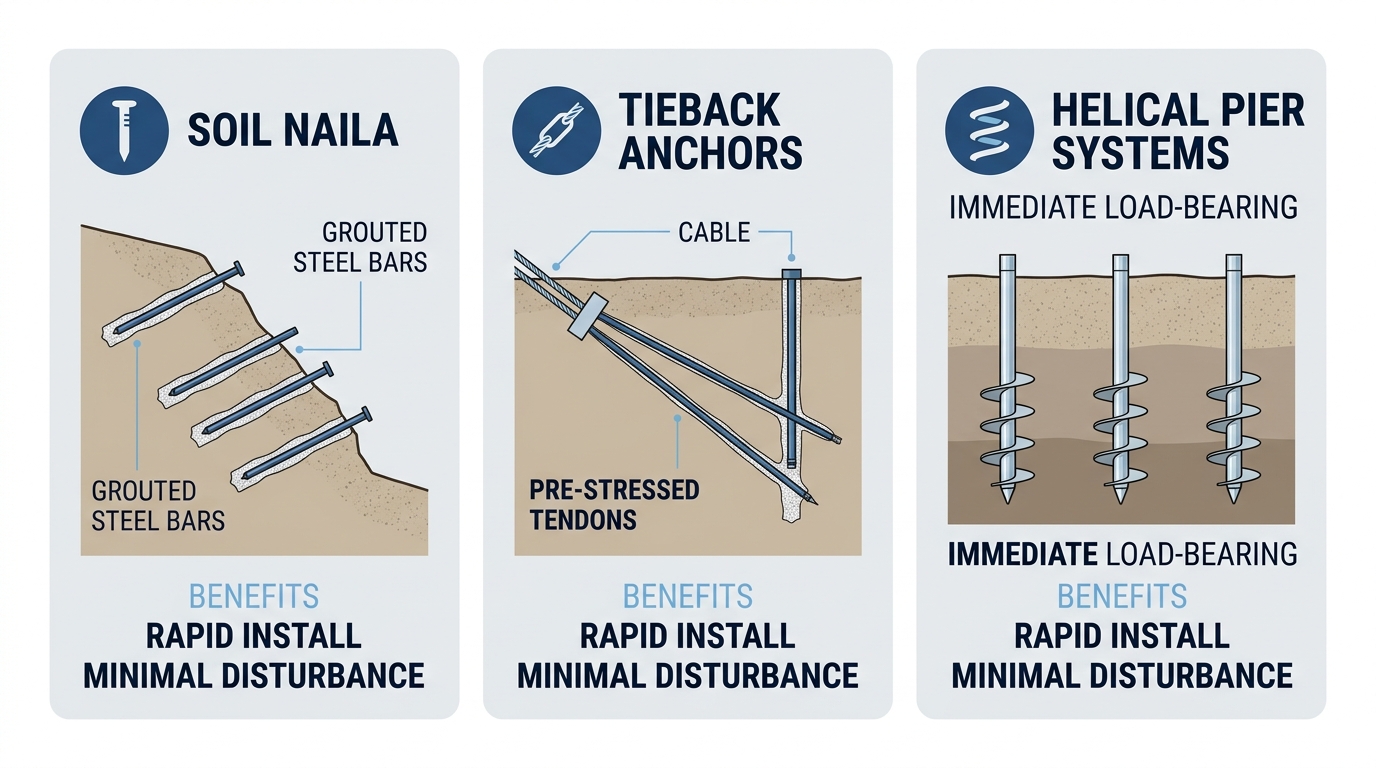
Key geotechnical anchoring systems: soil nails, tiebacks, helical piers overview
Key benefits include rapid installation, minimal site disturbance, and proven performance in challenging conditions. A real-world case from the American Society of Civil Engineers (ASCE) demonstrates steel piles replacing concrete foundations for electrical infrastructure, offering faster deployment and higher load capacity. These advanced earth anchoring systems outperform traditional methods.
Explore our detailed sections on soil nailing techniques, tieback anchoring methods, and helical pier advantages next.
Helical Anchors
Among geotechnical anchoring systems, helical anchors stand out as steel shafts with helical plates. They advance into soil via torque, providing immediate load capacity without concrete.
We offer corrosion-resistant galvanized versions for rapid, vibration-free installation across soil conditions. Unlike soil nails requiring grouting or tieback anchors needing prestressing, they correlate torque directly to capacity.
An American Society of Civil Engineers (ASCE) case study demonstrates their success replacing concrete in electrical infrastructure, making helical anchors ideal for utility foundations.
Soil Nails
Building on basic stabilization, soil nails provide targeted reinforcement in geotechnical anchoring systems. Small-diameter grouted steel tendons reinforce in-situ soil through closely spaced patterns, per Columbia University’s geotechnical curriculum.
Installation includes:
- Drilling holes at 10-20° downward angle
- Inserting threaded steel bar
- Injecting cement grout from bottom up
Applications cover temporary retaining structures, slope stabilization, and excavations up to 40 feet. In geotechnical anchoring systems, soil nails outperform tieback anchors in cohesive soils, suiting shallow excavations.
Tieback Anchors
Unlike passive soil nails, tieback anchors provide active reinforcement in geotechnical anchoring systems. Prestressed, grouted steel tendons installed at an angle actively support retaining structures and slopes.
Drill borehole at 15-45°, insert tendon with centralizer, inject high-pressure grout, allow curing, then prestress to 70-80% capacity. Tiebacks, tension-only, extend beyond failure planes, actively stressed post-installation.
Applications include excavations, bridge abutments, dams per Columbia University Department of Civil Engineering and Engineering Mechanics principles. Traditional tiebacks precede helical alternatives.
Helical Piers
Building on traditional methods, helical piers offer advanced geotechnical anchoring systems. These screw-like steel shafts with helical plates advance via torque without excavation, distributing loads through bearing and skin friction in diverse soils.
A real-world engineering case study by the American Society of Civil Engineers (ASCE) shows steel piles replacing concrete for electrical infrastructure foundations, cutting installation time and costs dramatically.
Unlike soil nails or tieback anchors, helical piers enable immediate full-capacity loading. These integrate seamlessly into projects; contact porch builders near me for expert installations.
Push Piers
A specialized type within geotechnical anchoring systems, push piers are hydraulically driven steel shafts inserted incrementally to support settling structures.
Contractors attach external steel brackets to the foundation. Hydraulic rams push sections through unstable soil to the bearing stratum, then load test for capacity.
Benefits over concrete: minimal site disturbance, immediate load transfer, no curing time, proven durability.
American Society of Civil Engineers case study shows steel piles replacing concrete for electrical infrastructure, with faster installation and reduced impact.
Unlike soil nails or tieback anchors, push piers provide direct support. While effective in cohesive soils, helical piers suit variable conditions.
Plate Anchors
Building on helical piles, plate anchors form a vital part of geotechnical anchoring systems. These bearing plates anchor in soil or rock, resisting loads via direct bearing and friction, as outlined in Columbia University Department of Civil Engineering’s geotechnical fundamentals curriculum.
We supply them for retaining walls, slope stabilization, and foundation support. Unlike soil nails or tieback anchors, plate anchors offer superior load capacity and simpler installation in geotechnical anchoring systems.
Installation follows standard grouting protocols, detailed next.
Underpinning Brackets
Building on helical pile technology, underpinning brackets in geotechnical anchoring systems are steel attachments that secure helical piles to building footings or walls, transferring loads to deeper stable soils via bolted or welded customizable plates.
Faster than soil nails or tieback anchors with minimal disruption, they excel in foundation repair solutions. An ASCE industry case study illustrates steel piles replacing concrete for electrical infrastructure, proving load efficiency. Suitable for residential settling, commercial retrofits, and utilities, these enable efficient installations ahead.
Duckbill Anchors
Unlike traditional helical piles, Duckbill Anchors provide efficient geotechnical anchoring systems. These foldable steel Duckbill plates, shaped like a duckbill, deploy perpendicular to the installation rod under tension for high-capacity soil grip, per Columbia University Civil Engineering Department fundamentals.
Installation steps:
- Insert anchor head with extension rod using hand hammer or driver.
- Apply pull load to rotate bill 90 degrees into locking position.
Faster no-drill, no-grout setup than soil nails or tieback anchors in granular soils, with holding capacities up to 10,000 lbs. We supply these for temporary shoring, retaining walls, pole guying, and erosion control. While effective in many soils, consider micropiles for cohesive conditions.
Manta Ray Anchors
Manta Ray Anchors serve as specialized helical screw anchors in geotechnical anchoring systems, featuring 1-4 helical plates welded to a galvanized steel shaft. These tension-focused variants of general helical anchors suit light structures like boardwalks, towers, and retaining walls.
Install by rotating the shaft with hydraulic equipment until target torque confirms capacity, per Columbia University Department of Civil Engineering foundational principles on torque correlations and soil interaction. Key applications include guyed structures, pipeline supports, and erosion control.
Unlike soil nails (grouted bars) or tieback anchors (prestressed), they provide immediate load capacity and removability in granular soils.
Advanced Earth Anchoring Systems
While basic systems suffice for simple loads, advanced geotechnical anchoring systems like high-capacity helical piles and grouted anchors–including the advanced earth anchoring system–exceed standard driven piles in load-bearing capacity. They provide rapid installation, minimal site disturbance, and superior adaptability to poor soils over concrete foundations.
According to the American Society of Civil Engineers (ASCE), an authoritative industry case study, steel piles installed 70% faster than concrete for electrical transmission towers, cutting costs by 40%. Used in power lines with soil nails and tieback anchors for retaining walls, these anchoring systems in geotechnical engineering offer vibration-free advantages. These innovations enable reliable foundations, as seen in electrical projects.
Geotechnical Anchoring Systems Comparison
Building on anchoring principles, this comparison of geotechnical anchoring systems highlights trade-offs in load capacity, cost, installation time, soil suitability, and applications. Helical anchors offer 50-500 kips load in soft/clay soils for foundations at $500-2000 per unit with 0.5-1 hour installs, ideal for quick setups. Soil nails provide 20-100 kips versatility across all soils for slopes at $100-300/m and 1-2 hours. Tieback anchors deliver 100-1000 kips in firm soils for excavations at $1000-5000 and 2-4 hours. Push piers handle 30-200 kips in firm soils for underpinning at $800-1500 and 1 hour. Plate anchors suit dense soils for walls with 10-50 kips at $200-600 and 0.25 hours, prioritizing speed over capacity.
The following table summarizes these key metrics:
Key Comparison of Geotechnical Anchoring Tools
| Tool | Load Capacity (kips) | Cost per Unit ($) | Install Time (hours/unit) | Best Soils | Applications |
|---|---|---|---|---|---|
| Helical Anchors | 50-500 | 500-2000 | 0.5-1 | Soft/clay | Foundations |
| Soil Nails | 20-100 | 100-300/m | 1-2 | All | Slopes |
| Tieback Anchors | 100-1000 | 1000-5000 | 2-4 | Firm | Excavations |
| Push Piers | 30-200 | 800-1500 | 1 | Firm | Underpinning |
| Plate Anchors | 10-50 | 200-600 | 0.25 | Dense | Walls |
At Helical Technology, we recommend helical anchors for rapid installs in soft soils, drawing from industry case studies by the American Society of Civil Engineers (ASCE) on steel pile foundations. Soil nails suit versatile slope stabilization across soil types, while tieback anchors excel in high-load excavations, per Columbia University geotechnical fundamentals. These estimates align with industry standards; select based on project soils and demands for optimal results. Our ICC-certified products support precise applications.
This comparison underscores efficiency trade-offs, aiding engineers in matching systems to site conditions. Visual metrics further clarify selections for foundation repair solutions.
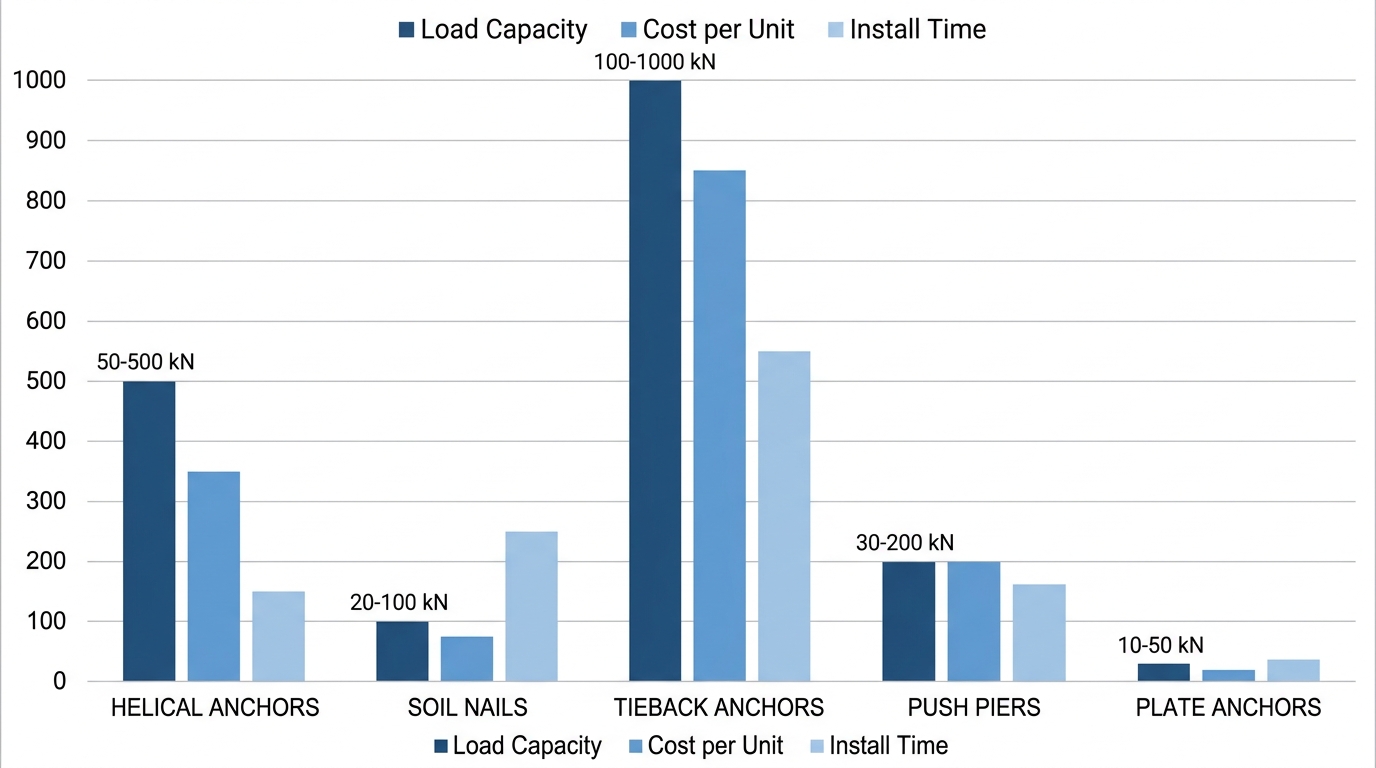
Geotechnical anchoring systems key metrics comparison chart
Select geotechnical anchoring systems based on project needs, detailed in applications below.
Selecting the Right Geotechnical Anchoring Solution
With diverse options available, selecting the right geotechnical anchoring systems starts with evaluating site-specific soil classification, groundwater presence, and seismic risks. Key criteria include cohesive versus granular soils, drawing from soil mechanics principles like shear strength and earth pressures outlined in Columbia University Department of Civil Engineering and Engineering Mechanics’ foundational academic curriculum.
Consider these prescriptive steps for optimal selection:
- Use soil nails for temporary excavations in soft clays, offering cost-effective stabilization, versus tieback anchors for permanent retaining walls in dense sands, which provide higher load capacities with corrosion protection.
- Opt for helical anchors in variable soils due to minimal disturbance and reliable torque-to-capacity correlations, ideal for commercial structural anchors in urban developments.
- Conduct site borings to calculate pullout resistance via effective stress methods, ensuring a factor of safety ≥2.0 for permanent loads.
At Helical Technology, we emphasize consulting certified geotechnical engineers for custom solutions integrating multiple anchor types. Once selected, proper installation ensures performance–detailed next.
This article was researched and written with the assistance of AI tools.