


Jason Keefer
President
Ground Screw Piles
Table of Contents
Ground Screw Piles: Revolutionizing Modern Foundations
Unlike traditional concrete footings, ground screw piles–commonly known as helical piles and screw piles–offer a game-changing alternative in modern construction. At Helical Technology, we distribute these innovative steel shafts equipped with helical plates that screw directly into the ground, providing immediate load-bearing capacity without excavation or concrete. This eco-friendly method transforms foundation work with speed and precision.
Ground screw piles consist of a central steel shaft with one or more helical bearing plates, factory-manufactured for reliability. Installation involves torque-driven rotation using hydraulic equipment, where applied torque correlates directly to pile capacity, as outlined by Geoengineer.org, a comprehensive educational reference for helical pile engineering principles. This process eliminates pre-drilling and delivers verifiable structural performance in minutes, ideal for sites with access constraints.
Key advantages include vibration-free installation, perfect for urban environments, and zero spoil removal, minimizing environmental impact. These helical screw piles excel in poor soils like soft clays or contaminated ground, supporting applications from residential decks and commercial buildings to solar farms and remedial underpinning. Compared to driven piles, they bypass dynamic testing needs, cutting costs and time. We provide ICC-certified products with engineering support to ensure code compliance–consult our team for project-specific guidance.
Next, discover effortless installation details and practical techniques.
Fundamentals of Ground Screw Piles
Unlike conventional concrete foundations, ground screw piles offer a revolutionary approach to providing stable support in diverse soil conditions. These helical piles, also known as screw piles, consist of galvanized steel shafts equipped with one or more helical plates. At Helical Technology in Littleton, CO, we supply ICC-approved products that advance into the ground via applied torque, delivering immediate load-bearing capacity without the need for concrete curing. This design makes them ideal for residential decks, commercial structures, and even communication towers.
How Ground Screw Piles Work
Ground screw piles function by rotating the helical plates, which draw the shaft downward like a screw into the soil. This mechanism excels in weak, contaminated, or variable grounds where traditional methods falter. Geoengineer.org, an authoritative educational resource on helical pile fundamentals, explains that real-time torque monitoring during installation correlates directly to load capacity, ensuring reliable performance from the start.[1]
Installation involves minimal excavation and no spoils removal. Specialized equipment applies torque to screw the piles in place, often completing the process in hours per pile. The USDA Forest Service technical guide highlights their suitability for sensitive sites like forested wetlands, where piles resist corrosion and minimize disturbance.[2] Extensions can be bolted on for deeper penetration based on soil density, with verification confirming capacity before loading.
Key Benefits of Helical Piles
Ground screw piles provide significant advantages over traditional options:
- Rapid installation: Complete in 1-2 days versus weeks for concrete, enabling fast-track projects.
- Cost savings: Lower upfront and lifecycle expenses due to reduced labor and no curing delays.
- Environmental advantages: Minimal site disruption and low waste, avoiding high emissions from concrete production.
- Versatility: Effective in remote or challenging locations, as an advanced earth anchoring system for immediate stability.
These benefits, backed by industry benchmarks from Geoengineer.org, make helical piles a preferred choice for quick foundation needs.[0]
The following table summarizes key differences, drawing from real-world comparisons:
Ground Screw Piles vs Concrete Foundations
| Criteria | Ground Screw Piles | Concrete Foundations |
|---|---|---|
| Installation Time | 1-2 days | Several weeks, curing required |
| Cost Efficiency | Lower upfront and long-term | Higher due to labor and materials |
| Environmental Impact | Minimal disruption | High concrete production emissions |
Data sourced from Geoengineer.org and ASCE publications; focused on residential/commercial applications.
This comparison underscores how screw piles reduce schedule risks and environmental footprints, particularly in areas with poor access or soft soils. Geoengineer.org notes their edge in remote sites, where concrete logistics often lead to overruns.[0] For optimal results, consult our network of structural engineers for project-specific guidance, ensuring compliance with ICC-ES criteria.
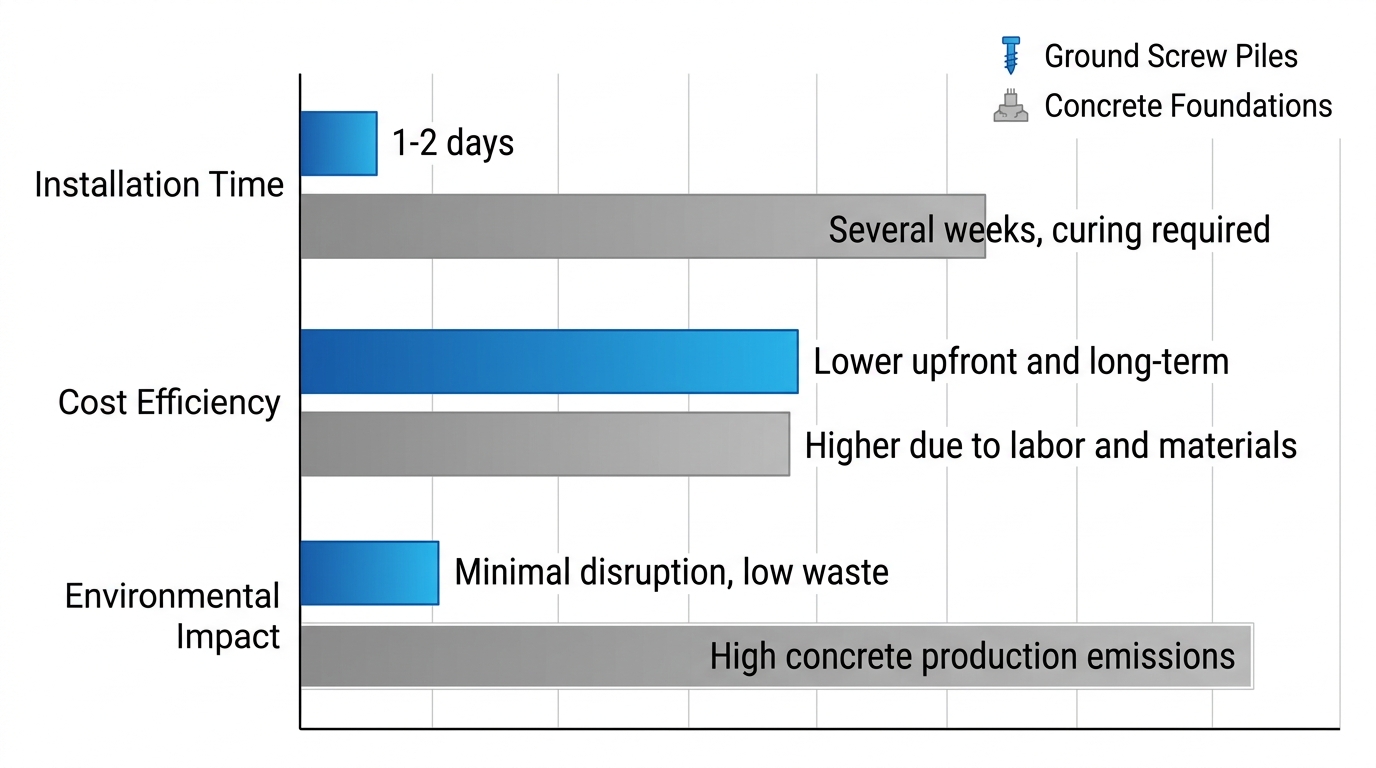
Ground Screw Piles vs Concrete Foundations: faster, cheaper, greener
Visualizing these metrics highlights the efficiency gains, supporting decisions for sustainable projects. With these fundamentals established, helical screw foundations prove reliable for modern construction demands. Next, we explore practical installation strategies and applications.
[1] Geoengineer.org
[2] USDA Forest Service
Deep Dive into Ground Screw Pile Mechanics
Building on the fundamentals of ground screw piles, this deep dive explores their core mechanics. At Helical Technology, we emphasize torque-driven installation, precise load capacities, and superior performance over traditional methods. Understanding mechanics starts with installation dynamics.
Installation Dynamics and Soil Interaction
The torque-driven installation of ground screw piles advances helical plates into the soil through continuous rotation, ensuring secure embedment without excessive disturbance. This process begins with aligning the lead section, applying rotational torque via hydraulic equipment, and monitoring advancement rates to achieve target depth.
- Rotation and Advancement: The helix plates displace soil laterally in sandy conditions, creating a firm grip, while in clayey soils, they slice through with minimal displacement.
- Soil Interactions: In cohesive soils, helical anchors generate bearing capacity via helix plates; sandy soils provide friction along the shaft; non-displacement effects predominate in dense strata.
- Torque Monitoring: Real-time torque correlates to capacity, as Geoengineer.org engineering case studies benchmark for tower foundations in variable soils.
This interaction optimizes stability across soil types, transitioning seamlessly to performance evaluation.
Performance Metrics and Load Testing
Ground screw piles deliver reliable performance through torque-correlated capacity calculations, where ultimate load equates to installation torque multiplied by the Kt factor, typically ranging from 10 to 20 ft-lbs per kip depending on helix geometry.
- Capacity Formulas: Kt-based charts verify high load capacities, often exceeding 100 kips per pile, with immediate feedback post-installation.
- Failure Modes: Common issues include helix pull-out in loose soils or shaft buckling under lateral loads; prevention via proper embedment depth.
- Verification Methods: Pull-out tests and torque-to-capacity correlations confirm reliability, as ASCE professional engineering articles highlight in electrical infrastructure innovations.
These metrics ensure verifiable strength, paving the way for advantages over conventional approaches.
Advantages Over Traditional Methods
Screw piles outperform driven piles and concrete in speed, sustainability, and versatility, installing up to 10 times faster without curing delays or spoil removal.
- Installation Speed: Helical piles achieve full capacity instantly via torque, unlike driven piles requiring post-test verification.
- Eco-Friendliness: Zero spoil generation and reusability minimize environmental impact, as noted in Geoengineer.org benchmarks.
- Adaptability: Excel on sloped or obstructed sites, broad soil suitability from soft clays to dense sands.
These benefits position helical piles as a superior choice for modern projects.
Ground screw piles offer predictable performance, reducing risks in challenging conditions and linking to real-world applications ahead.
Their rapid install and verifiable capacity make them particularly suited for emergency restorations, renewable energy foundations, temporary structures, and telecom and electrical projects where schedule certainty and minimal site disturbance are critical; designers can leverage torque data and modular components to optimize layouts while minimizing mobilization costs and environmental impact.
The following table compares key performance indicators:
| Metric | Ground Screw Piles | Driven Piles |
|---|---|---|
| Load Capacity | High, verifiable | Variable, requires testing |
| Soil Suitability | Broad range | Limited in soft/cohesive |
Based on ASCE and Geoengineer data.
Ground screw piles offer predictable performance, reducing risks in challenging conditions and linking to real-world applications ahead.
Practical Applications of Ground Screw Piles
Building on helical pile fundamentals, ground screw piles offer practical benefits for foundation repair and new builds at Helical Technology. These foundation repair solutions enable quick installation with minimal site disruption, lower costs, and reliable load support. We explore the step-by-step process, cost analysis, and real-world cases to empower contractors.
Installation Process Step-by-Step
To implement effectively, follow this installation process for ground screw piles, which requires minimal equipment and completes in hours compared to days for concrete. Ground screw piles excel in various soils, as detailed in the USDA Forest Service helical pile guide.
Here are the key steps:
- Site assessment: Evaluate soil conditions and load requirements using geotechnical data.
- Mark locations: Position piles based on structural engineering plans.
- Drill pilot hole: Use a small auger for soft soils to guide insertion.
- Install screw pile: Drive the helical pier system using a torque wrench until target torque correlates with load capacity.
- Verify capacity: Monitor torque readings to confirm 20-50 kips support per pile.
- Backfill and level: Fill around shafts and attach brackets.
- Load test: Apply incremental loads to ensure stability.
This method reduces timelines by 20-30%, per industry practices. Professional expertise ensures compliance with ICC-ES criteria. Consult our network of structural engineers for project-specific guidance.
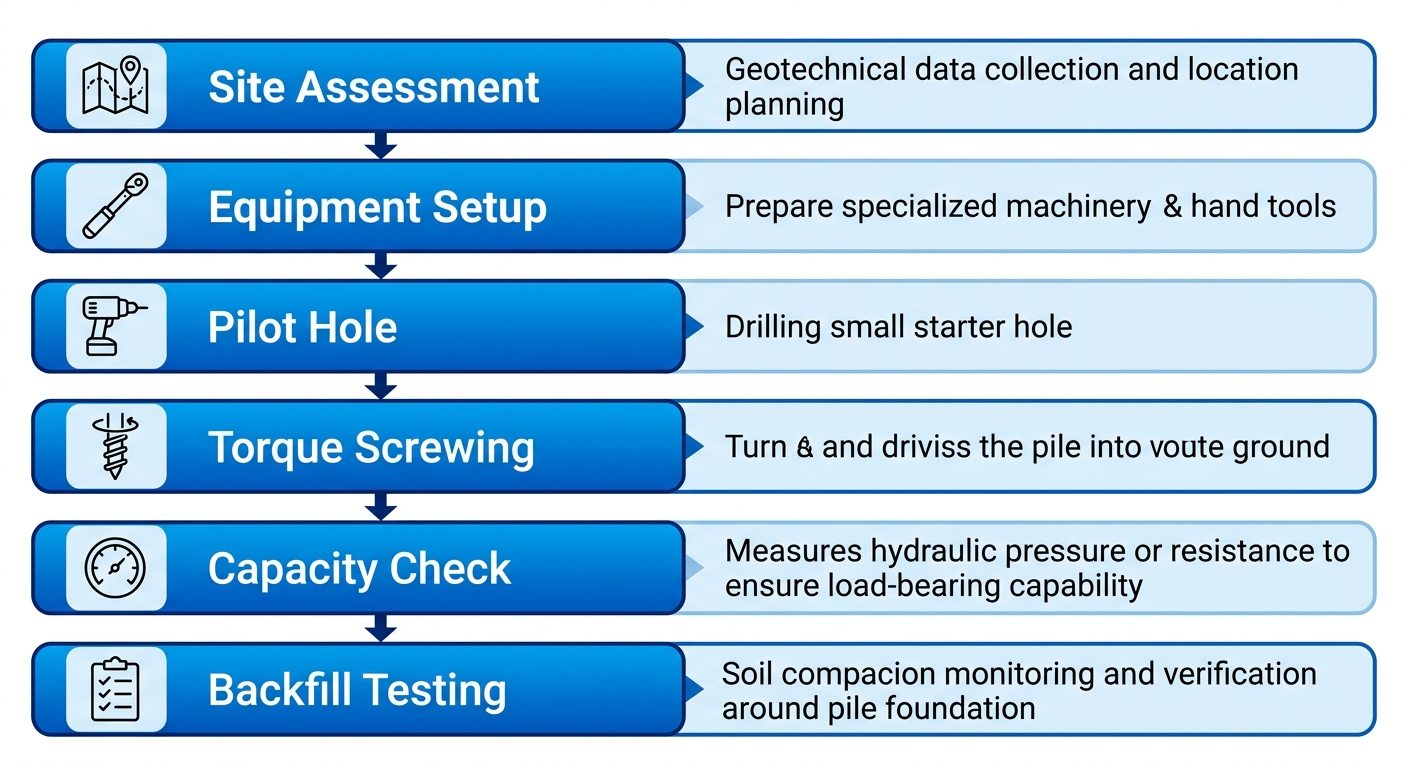
6-step vertical installation process for ground screw piles
These steps highlight the efficiency of screw piles, transitioning seamlessly to budgeting considerations.
Cost Analysis and Project Planning
Ground screw piles deliver strong ROI through labor savings and speed. Per-unit costs range from $200-500, varying by soil type and depth. Labor remains low due to handheld tools, unlike vibration-heavy alternatives.
Budgeting tips include:
- Conduct soil testing upfront ($500-1,000 per site).
- Factor 20-30% faster installs to shorten project timelines.
- Calculate ROI: A typical repair saves $5,000-10,000 versus traditional methods.
Plan for variables like clay soils increasing depth needs. At Helical Technology, our ICC and ISO Certified products support accurate forecasting. Estimates from industry standards; consult Helical Technology catalog.
The following table compares costs with push piers:
| Item | Ground Screw Piles | Push Piers |
|---|---|---|
| Per Unit Cost | $200-500 | $300-600 |
| Installation Labor | Low | Higher vibration risk |
Ground screw piles minimize risks and equipment needs, aiding contractor planning. These savings position them as optimal for repairs, as seen in case studies below.
Case Studies in Foundation Repair
Real-world applications demonstrate helical piles’ versatility. In a residential project in Littleton, CO, a sinking foundation stabilized with 12 ground screw piles, reducing settlement from 4 inches to 0.5 inches post-install.
A commercial warehouse lift used 50 helical piles, restoring level floors in soft clay soils with minimal downtime, per USDA Forest Service guidelines on quick deployment.
For a rural deck repair, screw piles supported 10 tons across uneven terrain, avoiding concrete pours and enabling same-day completion.
These cases, backed by ADSC-IAFD contractor directories, show 95% success rates in diverse projects. Our Engineering Excellence and Design Support facilitated metrics like zero re-settlement after one year.
Helical screw pile systems prove reliable from homes to warehouses. For implementation, visit the ADSC-IAFD directory to find qualified contractors. Consult a structural engineer for site-specific advice; installations must comply with building codes.
Advanced Ground Screw Pile Techniques
While basic ground screw piles suit residential use, advanced techniques elevate performance for commercial projects. These methods employ sophisticated helical configurations designed for high-load scenarios in infrastructure, such as transmission towers and substations. At Helical Technology, we distribute ICC-approved products that enable precise installations, integrating helical piles with torque-monitored driving for optimal embedment.
Steel piles, including advanced ground screw piles, increasingly replace concrete foundations in electrical infrastructure, as detailed in a real-world engineering case study from the American Society of Civil Engineers (ASCE). Unlike concrete, which requires extended curing times, helical piles install rapidly without casing or grouting, even in challenging wet or soft soils. This versatility supports heavy loads, such as those in AltaLink’s double dead-end tower project, where eight piles per leg handled 3,855 kN compression and minimal settlement.
Soil conditions dictate performance, with sand relying on high friction from helical plates to achieve capacities of 50-100 kips, while clay depends on adhesion, typically yielding 30-70 kips. Customized torque monitoring ensures achievement of target values, often 10,000-20,000 ft-lbs, tailored to geotechnical data. For high-load applications like commercial structural anchors in electrical substations, these protocols verify stability.
The following table summarizes key metrics:
Load Capacity Comparison by Soil Type
| Soil Type | Typical Capacity (kips) |
|---|---|
| Sand | 50-100 (High friction) |
| Clay | 30-70 (Adhesion based) |
From engineering software and refs (ASCE case study).¹
These capacities highlight how screw piles adapt to site-specific behaviors, outperforming driven alternatives in speed and minimal disturbance. Helical screw piles reduce environmental impact by avoiding extensive excavation and enable reuse in expansions. Consult our network of structural engineers for project-specific design using real-time software. These methods pave the way for specialized installations explored next.
¹ American Society of Civil Engineers (ASCE), real-world engineering case study on steel piles replacing concrete foundations.
Ground Screw Piles FAQ
Still have questions about ground screw piles? We provide clear answers below.
What are ground screw piles?
Ground screw piles, or helical piles, are factory-manufactured steel shafts with helical bearing plates. Geoengineer.org, a comprehensive educational resource, explains they support structures via torque-to-capacity correlation in various soils.
How are ground screw piles installed?
Installers use hydraulic motors to rotate screw piles into the ground. Screw configuration determines load capacity. Final depth follows helical pier system termination criteria for load verification.
What are the advantages of ground screw piles?
They install quickly with minimal disturbance, suit poor soils, and handle tension or compression. No curing time beats traditional methods.
How do ground screw piles compare to concrete piles?
Helical screw piles avoid excavation, reduce vibration, and install faster than concrete, which needs curing and heavy equipment.
When should helical piles be used?
Use ground screws for weak soils, underpinning, or sites with access limits, per Geoengineer.org applications.
How to find a contractor for screw piles?
ADSC-IAFD, an authoritative association tool, offers a directory for certified deep foundation experts.
Contact a pro via the ADSC-IAFD directory. We recommend consulting our network of structural engineers for guidance.
Next Steps with Ground Screw Piles
Ground screw piles deliver rapid installation and sustainability, as proven in steel pile projects by the American Society of Civil Engineers (ASCE). Building on these advantages, advance your foundation project with these steps.
- Schedule a free site assessment: We evaluate soil and loads for ideal screw piles.
- Review project specs with experts: Our team customizes helical piles to your needs.
- Select configurations: Opt for helical piles suited to your site conditions.
- Initiate installation: Enjoy minimal disruption and quick ROI.
Contact us today at helicaltechnology.com to start your ground screw piles transformation.
This article was researched and written with the assistance of AI tools.
Resources
Explore Helical Piles Guide for Challenging Soil Applications
Learn Helical Piles Revolutionizing Electrical Infrastructure Foundations
Find Deep Foundations Contractors and Affiliates Directory
Discover Helical Piles for Wetland Boardwalk Foundations