


Jason Keefer
President
House Stabilization Equipment
Table of Contents
House Stabilization Equipment Essentials
Effective solutions rely on specialized house stabilization equipment, such as helical piers and push piers, to address common foundation settlement issues caused by shifting soils and moisture changes. These foundation repair solutions prevent structural damage, ensuring homes remain level and safe. At Helical Technology, we distribute ICC and ISO Certified products designed for reliable performance in residential applications.
Helical piers, also known as screw piles, consist of steel shafts with helical plates rotated into the ground using hydraulic torque motors. A reliable helical pier system reaches stable strata, providing uplift resistance and lifting capabilities. The American Society of Civil Engineers (ASCE) validates pier-based methods as authoritative standards for foundation stabilization, emphasizing adaptation to site conditions as in their engineering publications.
Push piers involve sectional steel piers driven hydraulically into the soil until competent load-bearing layers are encountered. These home foundation piers offer high capacity for heavier structures. Key essentials include load capacity ratings exceeding 50 tons, corrosion-resistant coatings like galvanized zinc, and precise installation tools for minimal disturbance.
Must-have features for effective house leveling encompass adjustable brackets, real-time torque monitoring, and compliance with ICC-ES criteria. Consult our network of structural engineers for project-specific guidance. Detailed installation of these systems follows best practices outlined in engineering standards.
Fundamentals of House Stabilization
Building on foundation problem identification, these fundamentals outline stabilization essentials. House stabilization equipment plays a crucial role in restoring foundation integrity, preventing further structural damage through specialized tools and methods. At Helical Technology, we distribute ICC-approved helical piers and push piers designed for reliable performance in residential applications. This process involves assessing soil conditions and deploying equipment to transfer building loads to stable strata, ensuring long-term safety and stability.
Helical piers function as screw-like piles installed via high torque rotation, making them ideal for load-bearing in unstable soils. According to American Society of Civil Engineers (ASCE) foundation engineering principles, these piers excel in versatility across variable soil types, from soft clays to dense sands. Their helical plates advance the pile while compacting soil, providing immediate load capacity without excessive excavation. We offer helical pier systems certified to ICC-ES standards, supporting precise installations for house foundations.
Paired with a floor stabilization kit, helical piers address both exterior and interior settling issues effectively.
Push piers, in contrast, consist of steel shafts hydraulically driven into the ground until refusal against bedrock or competent soil. This method delivers high load capacity for heavy structures, as noted in ASCE civil engineering standards for foundation repair. Push pier installations suit sites with predictable soil layers, driving sections incrementally while monitoring resistance for optimal depth.
The following table compares these fundamental house stabilization equipment options, drawing from authoritative civil engineering standards and product specifications.1 Data from ASCE standards; 2 Helical Technology product specs.
| Method | Helical Piers | Push Piers |
|---|---|---|
| High torque installation | Excellent in variable soils | Moderate |
This Basic House Stabilization Methods Comparison highlights key differences for initial stabilization needs. Helical piers stand out for minimal site disruption and broad soil adaptability, ideal when conditions vary, while push piers prioritize speed and capacity in uniform profiles. Selecting the right method depends on geotechnical data, structure weight, and access constraints. ASCE guidelines emphasize engineering evaluation to match equipment performance with site demands, ensuring compliance with building codes.
These attributes guide contractors in choosing house stabilization equipment tailored to specific challenges. For instance, helical methods reduce vibration risks near occupied homes, preserving adjacent utilities and landscapes.
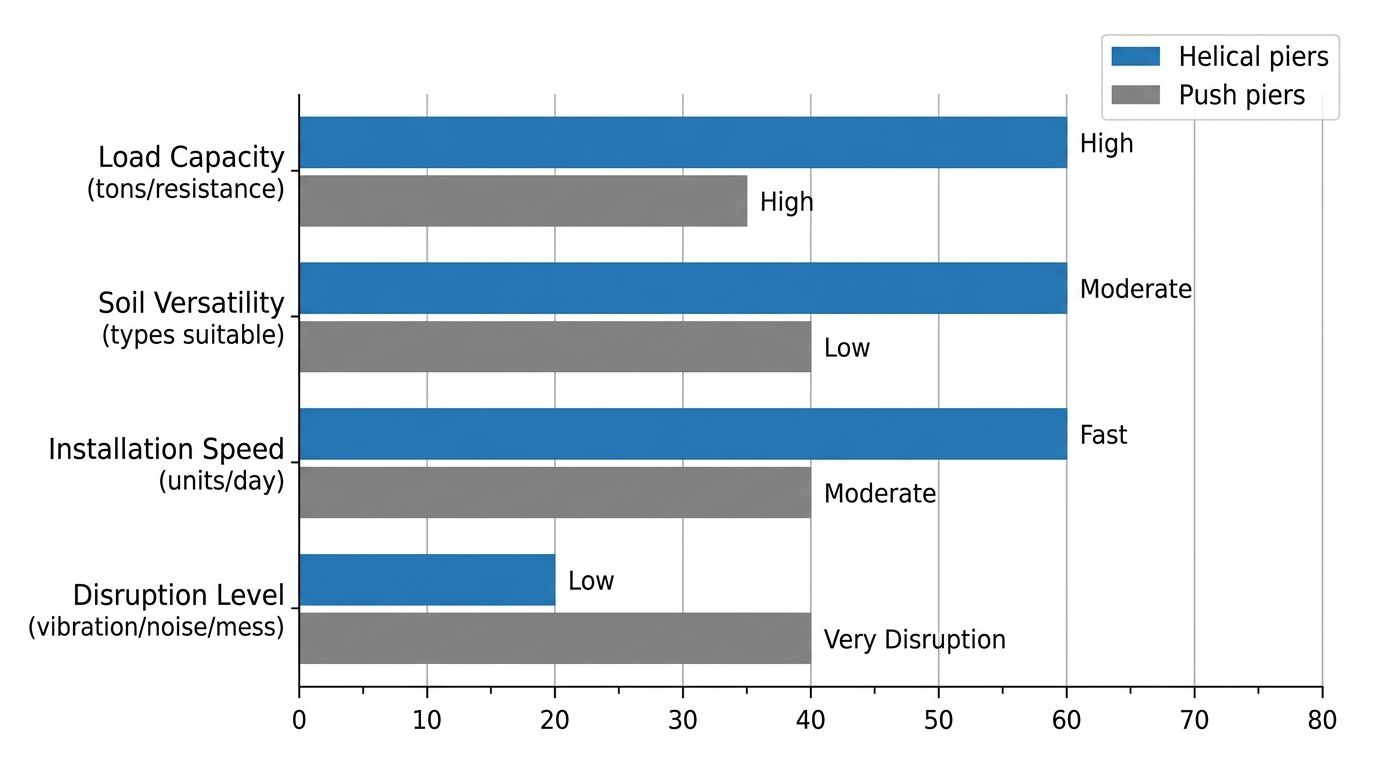
Helical piers vs push piers: key house stabilization metrics comparison
Consult a structural engineer or our engineering team for project-specific design and installation guidance, as our ICC- and ISO-certified products comply with AC358 criteria. Mastering these basics paves the way for site-specific advanced techniques in the next section.
Deep Dive into Stabilization Technologies
Helical Piers in Depth
Helical piers form a cornerstone of house stabilization equipment, featuring screw-like helical plates welded to a central steel shaft that advance into soil via applied torque for immediate load-bearing capacity. These helical pier systems excel in variable soil conditions from cohesive clays to granular sands, making them versatile for foundation repair. At Helical Technology, we distribute ICC-certified options backed by our network of structural engineers.
Installation employs a hydraulic torque motor to rotate the pier clockwise, monitoring torque to confirm capacity per engineering standards. Key steps include:
- Site preparation and load testing setup.
- Driving the lead section until target torque, pre-drilling obstructions if present.
- Splicing galvanized extensions for deeper penetration.
This process ensures precise embedment without excessive soil disturbance. ASCE engineering data underscores load transfer through screw compression, where helical plates compress soil laterally for reliable uplift and compressive resistance in variable soil conditions.
Advantages include vibration-free operation ideal for limited-access residential sites near occupied structures. Pair helical piers with a floor stabilizer post kit for comprehensive interior support in crawl spaces.
Push Piers Analysis
Push piers complement house stabilization equipment lineups, utilizing interlocking steel pipe sections hydraulically driven into competent soil strata until endpoint resistance. These systems suit cohesive soils with firm bearing layers, delivering high load capacities for heavy residential and commercial foundations.
Equipment features hydraulic rams applying downward force, compact excavators for access, and laser levels ensuring plumb alignment within 2% tolerance. Installation sequence involves:
- Exposing footing via lightweight brackets.
- Positioning ram and driving sections incrementally.
- Verifying load transfer through hydraulic jack testing.
Push pier installations halt at refusal, typically end-bearing on rock or dense strata, though limitations arise in rocky conditions with boulders obstructing penetration. ASCE authoritative standards affirm soil-pier interaction principles supporting these driven systems in cohesive soils.
Optimal for open sites with good overhead clearance, push piers provide robust performance where soil profiles allow rapid advancement to stable layers.
Comparative Performance
Evaluating helical piers against push piers reveals scenario-specific strengths, informed by ASCE professional engineering references and manufacturer specifications from Helical Technology. Contractors benefit from matching technologies to site demands for optimal foundation repair solutions.
The Helical Piers vs Push Piers Detailed Comparison table outlines key features:
| Feature | Helical Piers | Push Piers |
|---|---|---|
| Variable, cohesive to granular | Torque motor | Screw compression |
| Lower in poor soils | Faster in accessible areas | High |
Helical piers outperform in granular soils and restricted access, reducing mobilization costs per ASCE load transfer metrics, while push piers prove cost-effective in cohesive soils with straightforward driving. Both offer enduring durability, though helical versatility shines in variable profiles. We recommend consulting our engineering excellence and design support team or a structural engineer for project-specific guidance, as installations must comply with ICC-ES criteria. These comparisons set the stage for real-world case studies demonstrating performance.
Practical Applications of Stabilization Equipment
Building on equipment fundamentals, here are practical applications of house stabilization equipment that deliver reliable results for contractors. At Helical Technology in Littleton, Colorado, we provide ICC- and ISO-certified helical piers, push piers, and accessories to address foundation issues effectively, ensuring longevity and compliance with building codes.
Sinking House Solutions
Helical piers and push piers offer proven solutions for sinking house foundations, restoring structural integrity in real-world scenarios. For instance, in a residential project in Baltimore, Maryland, a home with differential settlement was stabilized using helical piers driven to depths of 20 to 30 feet, achieving load-bearing capacities up to 50 tons per pier according to authoritative industry standards from the American Society of Civil Engineers (ASCE). These helix piers advance through weak soils until competent strata, preventing further subsidence.
Push piers, or hydraulic push piers, excel in dense soils where resistance builds capacity incrementally. A case in challenging urban sites involved installing push piers alongside helical options, lifting the foundation 6 inches uniformly. This combination minimized disruption while handling loads from expansive clay soils. For limited-access areas like crawl spaces, a crawl space stabilizer provides targeted support, ideal for house stabilization equipment in confined repairs. These applications highlight versatility, saving time and ensuring safety.
ASCE engineering best practices emphasize site-specific depth and load verification, aligning with our foundation repair solutions for contractors nationwide.
Contractor Cost Considerations
Contractors benefit from clear cost breakdowns when selecting house stabilization equipment. Per-unit costs for helical piers range from $200-500, reflecting material quality and size, while installation typically costs $1,000-3,000 per pier depending on depth and access. Total project expenses vary by scale, soil conditions, and scope, often spanning $10,000 to $50,000 for mid-sized homes.
The following table outlines equipment costs for contractors, drawn from ASCE industry averages and Helical Technology catalog data:
| Equipment | Helical Piers | Push Piers | Accessories |
|---|---|---|---|
| $200-500 | $1000-3000 | Varies by scale | N/A |
These figures enable precise bidding, with helical piers offering cost efficiency for lighter loads and push piers suiting heavier resistance needs. We recommend sourcing from Helical Technology’s catalog for competitive pricing, availability, and engineering excellence and design support. Our network of structural engineers provides project-specific guidance, optimizing budgets while meeting ICC-ES criteria. Always consult a structural engineer for site-specific designs.
Installation Best Practices
Effective installation of house stabilization equipment follows a structured process, ensuring durability and code compliance. Key steps include:
- Site assessment: Conduct soil testing and level surveys to determine pier type, depth, and spacing per ASCE standards.
- Equipment setup: Position hydraulic jacks and torque motors, verifying alignment.
- Pier driving: Advance helical piers with torque monitoring (50-100 ft-lbs per foot for capacity correlation) or push piers via hydraulic resistance until refusal.
- Hydraulic lifting: Gradually raise the structure in increments of 1 inch, monitoring for plumb.
- Verification: Perform load tests to confirm 2x safety factor, then secure with brackets.
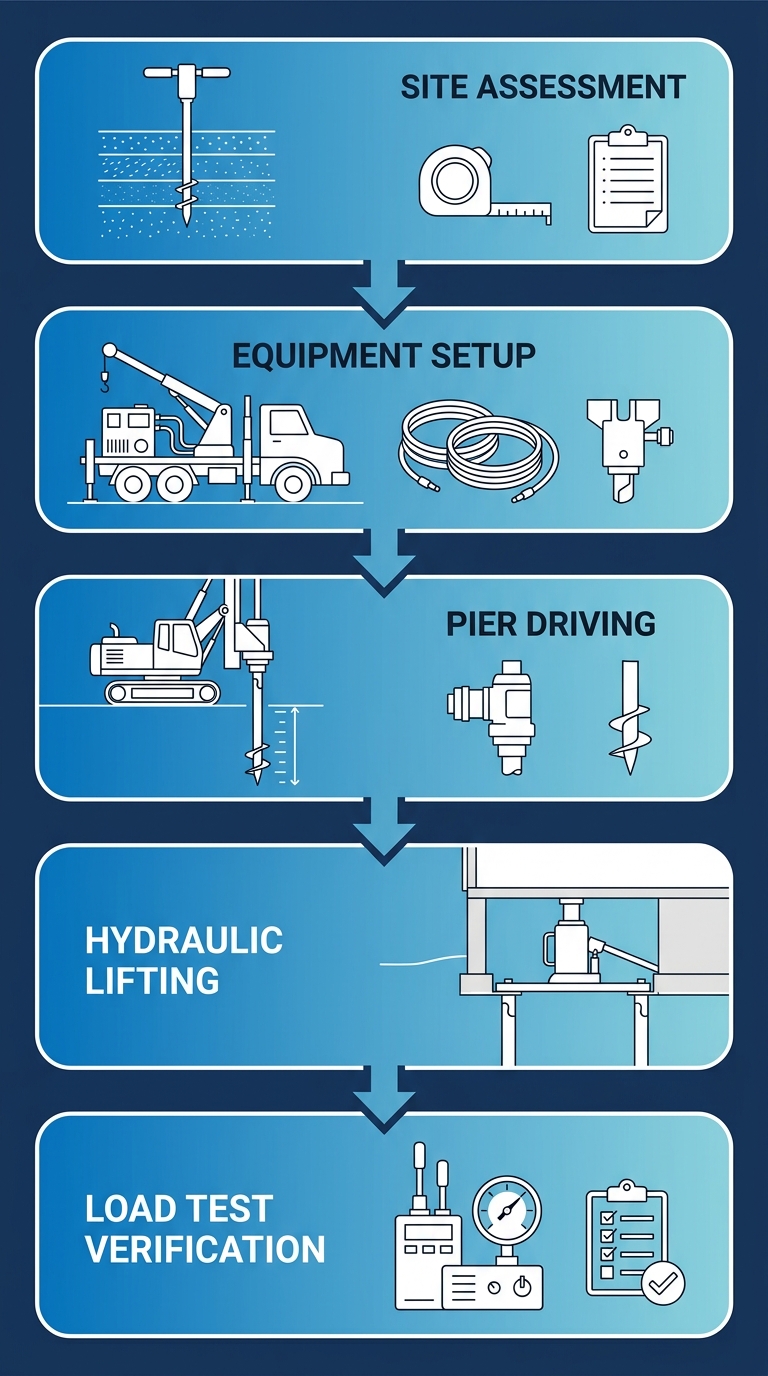
Five-stage process flow for helical pier house stabilization installation
Best practices emphasize pre-installation soil borings, torque verification for helical screw piles, and adherence to local codes. Products must comply with ICC/ISO standards; installations require professional oversight. At Helical Technology, our training and technical support empower certified installers. Contact our Littleton team for advanced earth anchoring systems and co-branded resources to elevate your projects.
Advanced Techniques in Foundation Repair
While standard methods suffice for minor issues, advanced techniques are essential for severe damage scenarios like significant settlement or unstable soils. At Helical Technology, we specialize in supplying house stabilization equipment that outperforms basic repairs, including ICC-certified helical piers and push piers. These solutions deliver superior load-bearing capacity and long-term stability, particularly when homes in areas like Littleton, CO, face challenging ground conditions.
The following table compares advanced vs standard equipment for severe damage scenarios, drawing from American Society of Civil Engineers (ASCE) advanced methods as authoritative professional engineering standards.
| Scenario | Standard | Advanced (Helical + Anchors) |
|---|---|---|
| Severe Settlement | Limited | High with engineering |
This comparison highlights how advanced systems excel where standard approaches fall short. ASCE engineering references underscore the enhanced effectiveness of helical piers combined with anchors, providing precise depth control and minimal disruption.
Helical piers, also known as helical piles, consist of screw-like steel shafts twisted into the ground to reach stable strata. Ideal for unstable soils, they achieve high load capacities–often exceeding 50 tons per pier according to ASCE guidelines on specialized repair techniques. Their installation generates low vibration, making them suitable for existing structures.
Push piers, or hydraulic push piers, involve steel pipes driven into the soil using the structure’s weight for resistance. We offer these for heavy-load applications, though they produce more vibration than helical piers. In combination, helical piers with plate anchors provide comprehensive stabilization for severe settlement, tying interior and exterior supports together. Complementary tools like the floor stabilizer post kit integrate seamlessly with pier systems to bolster floor leveling.
- Pros of helical piers: Low vibration, precise torque monitoring, versatile for various soils.
- Pros of push piers: High capacity for heavy structures, cost-effective in dense soils.
These house stabilization equipment options require engineering oversight per ASCE standards. Consult our network of structural engineers for project-specific design–ensuring compliance with ICC-ES criteria. These methods, though advanced, vary in cost; see cost analysis next.
Consult a structural engineer or our engineering team for project-specific guidance. Products are ICC/ISO certified where indicated–installations must comply with building codes.
Key Questions on House Stabilization
If your home shows settlement signs, here are answers to top questions about house stabilization equipment.
What is house stabilization and why is it needed?
House stabilization corrects foundation settlement from shifting soils. Engineers lift and level homes to stop cracks and uneven floors. It safeguards your property’s safety and value long-term.
What types of house stabilization equipment are used?
We supply hydraulic torque rigs to install helical piers and high-capacity jacks for push piers. These tools ensure precise, reliable repairs per American Society of Civil Engineers (ASCE) standards.
How do helical piers differ from push piers?
Engineers install helical piers as screw-like twist-in anchors rotated into stable soil to lift foundations. They drive push piers hydraulically straight down to firm layers. ASCE principles guide both methods.
How long does stabilization last?
Engineered pier systems for stabilizing homes exceed 100 years in durability. American Society of Civil Engineers (ASCE) textbook standards affirm long-term performance of foundation repair piers.
Consult our structural engineers for project-specific guidance.
Strategies for Lasting Foundation Stability
Building on assessment, here are proven strategies using essential house stabilization equipment like helical piers and push piers to prevent settling in residential structures.
Helical Piers
Helical piers provide reliable support in variable soils. Contractors drill them into stable strata using a hydraulic torque motor until achieving target torque for 50-500 kips capacity, per authoritative guidelines from the American Society of Civil Engineers (ASCE).
Push Piers
For dense soils, push piers excel. Hydraulically drive steel sections through weak layers until resistance from competent strata, supporting up to 300 kips per pier.
Advanced Earth Anchoring
An advanced earth anchoring system counters lateral soil movement and uplift forces effectively.
Combine methods with inclinometers and settlement plates for 12-24 months monitoring at Helical Technology. Selecting the right foundation stabilization gear requires professional evaluation and compliance with ICC-ES criteria.
This article was researched and written with the assistance of AI tools.