


Jason Keefer
President
Structural Reinforcement Supplier
Table of Contents
Understanding Structural Reinforcement Suppliers
Building on structural requirements, understanding structural reinforcement supplier roles is key to reliable foundation repairs. A structural reinforcement supplier provides specialized materials like steel rebar, FRP rebar, and accessories to enhance structural integrity in buildings and foundations. These providers ensure projects meet demanding engineering standards.
Rebar suppliers focus on steel reinforcements ideal for high-strength applications, while others specialize in FRP rebar for corrosion-resistant environments, such as coastal or chemical-exposed sites. We at Helical Technology, based in Littleton, CO, recognize how these categories support diverse needs in helical pile installations and underpinning. Suppliers also offer accessories like helical piles and rivets, ensuring comprehensive solutions for contractors. They also coordinate logistics, verify material traceability, and provide technical data and installation guidance to support complex foundation projects efficiently and reliably.
The National Foundation Repair Association (NFRA) offers authoritative industry certifications ensuring quality in structural reinforcement and foundation repair. Key programs include:
- Certified Installer: Hands-on training for practical expertise in repairs.
- Contractor Certification: Business standards for reliable operations.
Certified suppliers comply with building codes and provide warranties on materials like helical piles and nylon rivets.
Select suppliers by certifications, product range, and experience in similar projects. These suppliers offer specialized items like nylon rivets for installations.
Fundamentals of Structural Reinforcement
Building on foundation repair needs, fundamentals of structural reinforcement stabilize structures using piers and brackets in civil engineering projects. At Helical Technology, we emphasize choosing a reliable structural reinforcement supplier for quality assurance.
Key Certifications for Suppliers
The International Code Council Evaluation Service (ICC-ES) approval verifies that products meet stringent building code standards. This certification, as outlined by the National Foundation Repair Association (NFRA), ensures contractors can secure necessary permits efficiently. ICC-ES documentation streamlines compliance in foundation repair projects, reducing risks associated with non-standard materials.
ISO certification from the International Organization for Standardization establishes robust quality management systems. According to NFRA authoritative industry association guidelines, it guarantees consistent manufacturing processes, minimizing defects in critical components like piers and brackets. These certifications build trust in suppliers’ adherence to high standards.
The following table compares key certifications and their benefits for foundation repair projects:
| Certification | Description | Benefits |
|---|---|---|
| International Code Council Evaluation Service approval | Ensures products meet building code standards | Provides compliance documentation for permits |
| International Organization for Standardization | Quality management system certification | Guarantees consistent manufacturing processes |
Data sourced from NFRA certifications and industry standards. These benchmarks help contractors select ICC and ISO Certified products confidently.
Helical Technology supplies these certified solutions nationwide from our Littleton, CO headquarters, supporting projects with engineering excellence and design support.
Criteria for Choosing Reliable Suppliers
Evaluating structural reinforcement suppliers requires a systematic approach. Follow these five steps to identify dependable partners:
- Verify ICC-ES and ISO certifications to confirm code compliance and quality systems.
- Assess product range, including helical piers, push piers, and options from rebar suppliers.
- Evaluate customer support responsiveness, such as technical assistance and delivery timelines.
- Review years in business, testimonials, and track record in civil engineering applications.
- Check warranty policies for long-term durability guarantees.
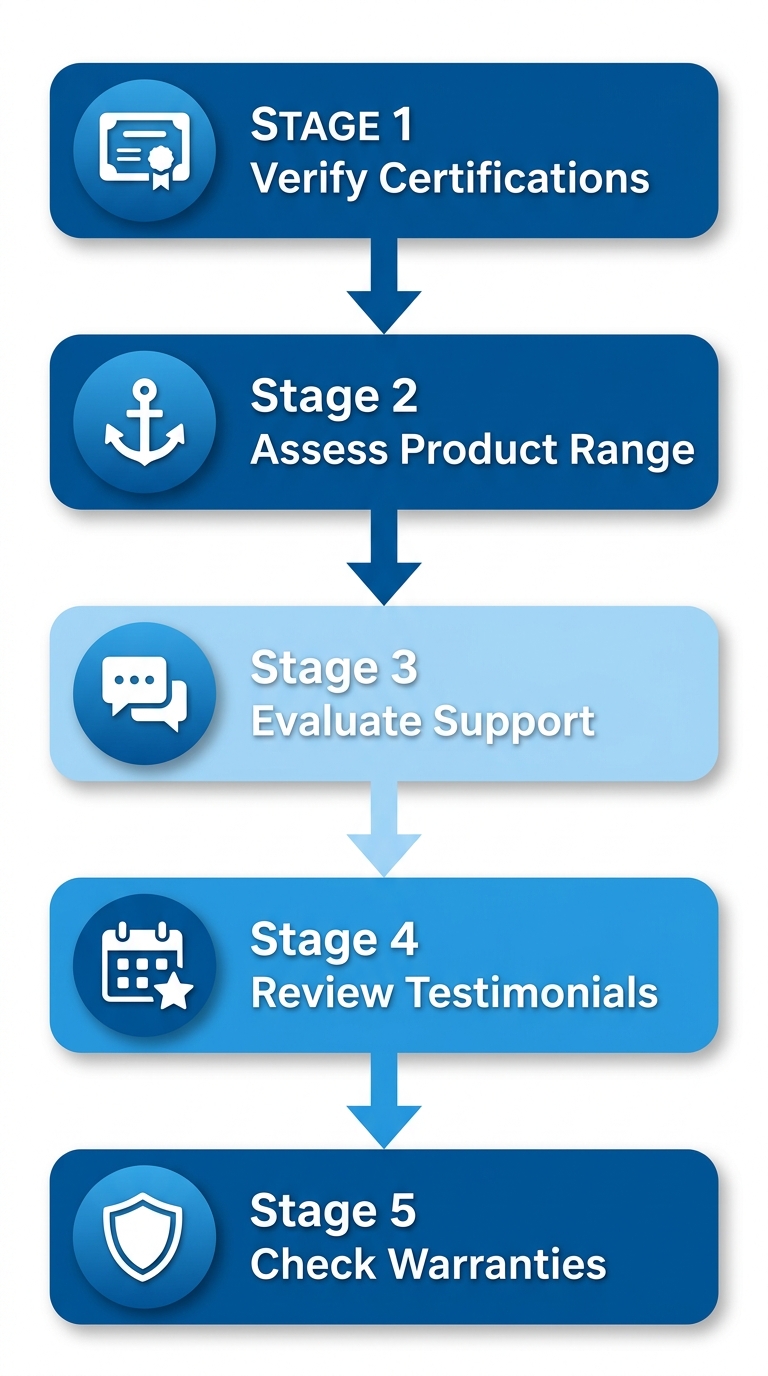
Five-step process for choosing certified helical pile suppliers
This process aligns with NFRA guidelines, enabling contractors to partner with vetted structural reinforcement suppliers. We at Helical Technology exemplify these criteria through our extensive catalog and installer support.
Basic Product Offerings
Helical piers serve as screw anchors that provide superior load-bearing capacity in varied soils. These advanced earth anchoring systems install with minimal vibration, ideal for foundation reinforcement in residential and commercial settings.
Push piers consist of hydraulic-driven steel shafts that reach stable strata for precise load transfer. They excel in heavy-duty applications, offering reliable underpinning without extensive excavation.
Underpinning repair brackets connect piers to foundations, distributing loads effectively across underpinning repair brackets. Alternatives like FRP rebar provide corrosion-resistant options for enhanced longevity. These foundation repair solutions form the core of our offerings at Helical Technology.
Consult our network of structural engineers for project-specific guidance, ensuring installations comply with ICC-ES criteria (AC358). This groundwork prepares for advanced applications in subsequent sections.
Deep Dive into Reinforcement Products
To address foundation challenges in civil engineering, structural reinforcement supplier Helical Technology provides essential products like helical piers and push piers. As a trusted provider of structural reinforcements headquartered in Littleton, Colorado, we deliver ICC- and ISO-certified solutions for contractors nationwide.
Types of Products for Civil Engineering
Helical piers function as screw-like foundations ideal for light structures in poor soil conditions, twisting into the ground to reach stable strata without excessive excavation. Push piers support heavy loads through hydraulic pushing, driven incrementally until load-bearing capacity is achieved, perfect for underpinning existing foundations. Plate anchors resist tension forces, securing walls against lateral movement via grouted plates embedded in stable soil.
These products excel in residential foundation stabilization and new construction, minimizing disruption while ensuring longevity. The National Foundation Repair Association (NFRA) certifications confirm professional qualifications and system reliability for helical piers, push piers, and anchors, as authoritative industry standards.
Applications span settling slabs, bowed walls, and uplift prevention, with our advanced earth anchoring systems enabling precise load transfer. NFRA-vetted installers uphold these standards, giving contractors confidence in project outcomes.
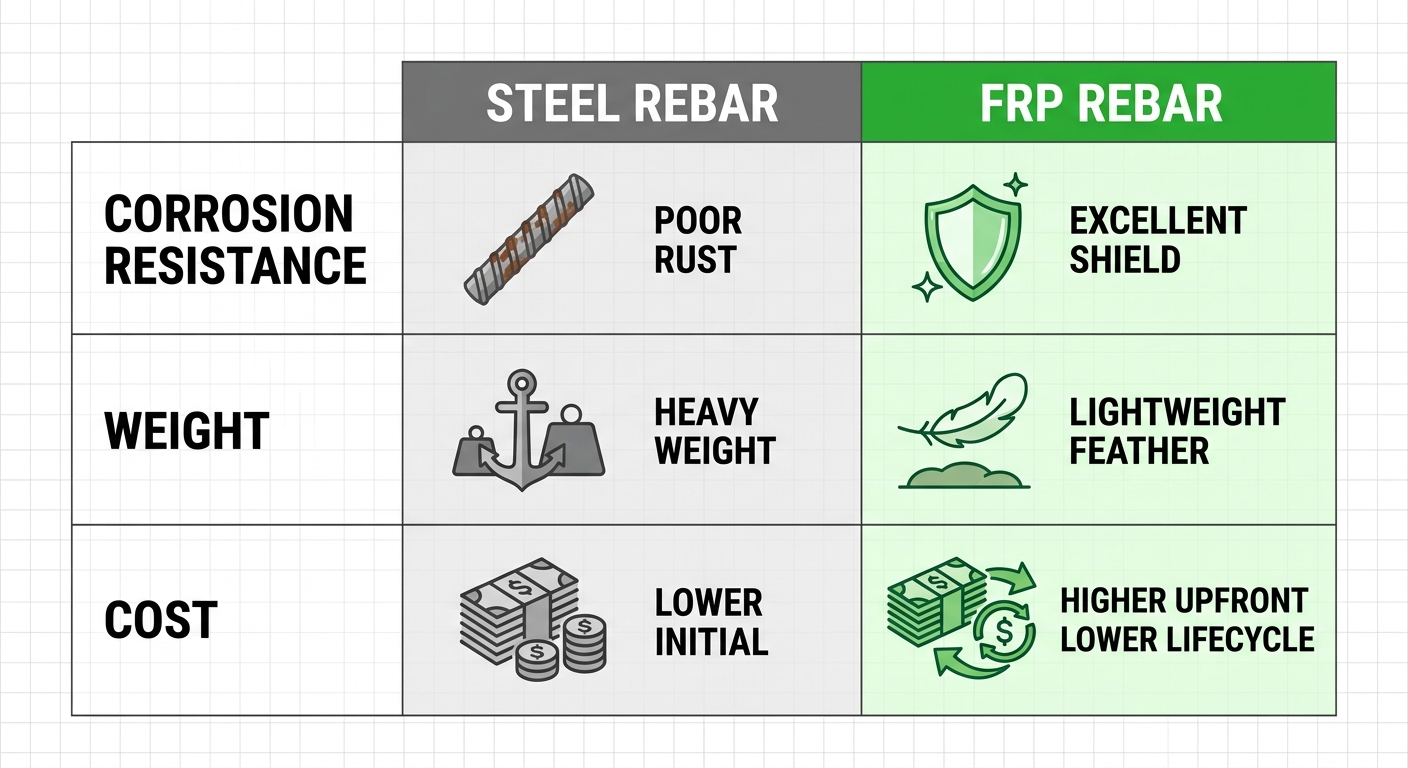
Steel Rebar vs FRP Rebar: corrosion, weight, cost comparison
This visual underscores material tradeoffs, guiding selection for corrosive environments common in foundation work. At Helical Technology, we integrate such reinforcements with our foundation repair solutions to optimize performance.
Rebar Suppliers and Options
Traditional rebar suppliers like Nucor and CMC Steel offer high-strength steel bars for concrete reinforcement, available through wholesale platforms such as Metal Supermarkets. These structural reinforcement suppliers ensure Grade 60 rebar in various diameters for structural integrity.
Regional availability in the US includes distributors in Texas for Gulf Coast projects, California hubs serving seismic zones, and Midwest centers for infrastructure builds. Wholesale rebar suppliers in the US provide bulk pricing, custom cutting, and rapid delivery to meet civil engineering demands.
NFRA certifications validate complementary installer expertise, ensuring rebar integration aligns with foundation repair standards. We at Helical Technology connect contractors to these reliable sources, streamlining procurement.
FRP Rebar Advantages
FRP rebar outperforms steel in harsh environments, boasting excellent corrosion resistance, reduced weight at one-quarter of steel, and extended lifespan exceeding 75 years in aggressive soils. Fiberglass FRP bars eliminate rust-related failures, ideal for marine or de-icing salt exposures.
Costs range $2-4 per foot versus $1-2 for steel, but lower lifecycle expenses from minimal maintenance yield superior value. Suppliers like FiRig and Creative Pultrusions deliver custom pultruded profiles. The following table summarizes key differences, based on industry comparisons from manufacturer data:
| Feature | Steel Rebar | FRP Rebar |
|---|---|---|
| Corrosion Resistance | Poor – rusts in moist environments | Excellent – non-corrosive composite |
| Weight | Heavy | Lightweight |
| Cost | Lower initial cost | Higher upfront but lower lifecycle |
Steel suits dry, low-stress apps, while FRP excels in durability-critical projects, aligning with our engineering excellence and design support. NFRA standards reinforce certified installations. Consult our structural engineers for project-specific guidance. Transitioning to extensions, these enhance pile depth.
Helical Pipe Extensions
Helical pipe extensions adjust pile depth in variable soils, with common sizes like the helical pipe 3-1/2 diameter 84 extension for robust load transfer via bolted couplings. These 84-inch sections extend helical piles to refusal, maintaining alignment and capacity in deep installations.
Smaller helical pipes 2-7/8 diameter extension helix integrate helix plates for combined extension and bearing, optimizing uplift resistance. Coupling mechanisms ensure torque transmission, critical for foundation repair solutions.
NFRA certifications affirm product and installer reliability, as per industry benchmarks. At Helical Technology, our ICC and ISO Certified products like these support precise reinforcement, with on-site training available. Products comply with ICC-ES AC358; always verify local codes.
Practical Strategies for Supplier Selection
Beyond basic criteria, we recommend focusing on practical strategies when choosing a structural reinforcement supplier. Evaluate installation training, technical support, lead times, and local availability to ensure seamless project execution and long-term reliability. These steps empower contractors to select partners like premium providers for superior outcomes.
Supplier Support Services Comparison
| Service | Standard Supplier | Premium Supplier (e.g., Helical Technology) |
|---|---|---|
| Installation Training | Basic manuals | On-site certification programs |
| Engineering Support | Limited | Project-specific structural engineers |
Based on industry best practices and certifications
This comparison highlights how premium options deliver enhanced value, particularly for complex foundation repair projects requiring specialized expertise.
Evaluating Installation Training
Hands-on training programs from reputable suppliers reduce installation errors and boost installer confidence. Look for providers offering NFRA-recognized certifications, as validated by the National Foundation Repair Association (NFRA), which set authoritative industry standards for foundation repair competency. These certifications ensure professionals meet rigorous quality benchmarks.
- On-site support visits for initial projects: Premium suppliers conduct field training to address site-specific challenges, minimizing risks.
- Certification programs: Structured courses cover product handling, safety protocols, and best practices, leading to credentialed installers.
- Ongoing refreshers: Access to updated modules keeps teams aligned with evolving codes.
At Helical Technology, our on-site certification programs exemplify this approach, fostering installer proficiency for durable results.
Technical Support and Engineering Aid
Access to structural engineers for custom designs is crucial for FRP rebar and helical systems. Premium structural reinforcement suppliers provide real-time design software, such as pile calculators, enabling precise modeling. Our network of structural engineers offers project-specific guidance, ensuring compliance with ICC and ISO standards.
- 24/7 troubleshooting hotlines: Immediate assistance resolves issues without delays.
- Engineering design support: Tailored plans for unique soil conditions or loads.
For advanced products like the helical pipe 3-1/2 diameter 64 extension, these tools optimize installations, enhancing load capacity and longevity. This level of aid differentiates reliable partners.
Lead Times and Delivery Logistics
Standard lead times for stock items from structural reinforcement suppliers typically range from 2-4 weeks, while custom orders may take 6-8 weeks. Factors like material shortages, seasonal demand, or high-volume projects can extend timelines, so inquire about production schedules upfront.
- Expedited shipping options: Available for urgent needs, often at a premium.
- Bulk discounts: Incentives for larger orders to offset logistics costs.
- Tracking and communication: Real-time updates prevent surprises.
We at Helical Technology streamline logistics nationwide, offering flexible delivery to meet tight schedules and maintain project momentum. Prioritizing suppliers with robust supply chains ensures reliability.
Local Suppliers in Key Regions
Searching for ‘rebar suppliers near me’ via Google Maps or industry directories simplifies sourcing. In Texas, local rebar suppliers in Texas provide faster delivery for regional projects, reducing transport costs. Nationwide networks cover FRP rebar distribution effectively.
- Texas distributors: Proximity cuts lead times to days for stock items.
- US-wide options: Premium suppliers like Helical Technology ship from strategic hubs.
- Verification tips: Check certifications and reviews for vetted partners.
Leveraging local and national rebar suppliers balances speed and expertise, supporting efficient procurement.
Advanced Considerations for Supplier Partnerships
Building on foundational supplier choices, advanced partnerships involve evaluating certifications and logistics for reliable structural reinforcement supplier relationships. At Helical Technology, we prioritize partners who meet rigorous industry standards to ensure quality helical piles, rebar, and other foundation repair products reach contractors efficiently. Selecting the right structural reinforcement supplier minimizes project delays and enhances structural integrity for demanding applications.
The National Foundation Repair Association (NFRA) sets industry-standard certifications ensuring supplier reliability and quality for reinforcement products like helical piles. These certifications, including vendor approvals, verify that providers adhere to high standards in foundation repair materials. Key benefits include:
- Guaranteed product quality: Certified suppliers deliver ICC- and ISO-approved components tested for performance.
- Risk reduction: Vetted vendors lower the chance of substandard materials causing failures.
- Professional assurance: NFRA-backed partners provide confidence in procurement for helical extensions and rebar.
This vetting process is essential when sourcing from rebar suppliers for structural reinforcement supplier strategies.
Lead Time Comparison by Supplier Type
| Supplier Scale | Lead Time | Delivery Options |
|---|---|---|
| Local | 1-3 days | Standard shipping |
| National | 3-7 days | Nationwide distribution |
Overview of delivery options and timelines for reinforcement products.
General industry averages.
Local suppliers offer quick turnarounds ideal for urgent jobs, but national partners provide broader access to specialized inventory despite slightly longer lead times. Partnering with certified national suppliers unlocks advanced products and consistent supply chains, balancing speed with comprehensive options for helical pipe extensions. We recommend national scale for complex projects requiring precision engineering support.
For instance, national suppliers stock specialized items such as the helical pipe 2-7/8 diameter 64 extension, vital for deep foundation stabilization. Certified providers also mitigate risks in FRP rebar procurement, ensuring compliance and durability. With reliable partners secured, focus next on project execution strategies.
Frequently Asked Questions on Structural Reinforcement
Still have questions about finding a reliable structural reinforcement supplier? We address key concerns below.
What certifications should I seek from a structural reinforcement supplier?
Seek National Foundation Repair Association (NFRA) certifications, like NCFRS and vendor approvals. According to the NFRA, these validate expertise in foundation repair and ensure high-quality structural reinforcement.
What is FRP rebar and its advantages?
FRP rebar is fiber-reinforced polymer rebar, corrosion-resistant for harsh environments. It offers superior durability, lighter weight, and longevity over steel, ideal for helical pile projects. Suppliers of FRP rebar enhance project resilience.
How do I choose reputable rebar suppliers?
Verify NFRA certifications, experience with helical systems, and ICC/ISO approvals. Reputable rebar suppliers provide engineering support. Check references and proven track records in the US for reliable structural reinforcement providers.
Why choose certified structural reinforcement suppliers?
Certified suppliers guarantee safety, quality, and project longevity. NFRA standards minmize risks and ensure compliance, building trust for foundation repairs. We at Helical Technology embody this excellence.
Contact us at Helical Technology for certified solutions and expert guidance.
(Total: 132 words)
Building Strong Reinforcement Partnerships
Beyond selecting materials, success hinges on trusted partners. We partner with certified structural reinforcement suppliers to ensure project durability and compliance in foundation repair solutions.
The National Foundation Repair Association (NFRA) provides industry-standard credentials verifying expertise in foundation repair materials from reliable rebar suppliers and innovative FRP rebar. Build robust ties with these three steps:
- Vet partners via the NFRA directory.
- Negotiate quality assurance clauses.
- Schedule joint training sessions.
This approach drives long-term collaboration and high repeat business rates from certified structural reinforcement suppliers.
Leverage these partnerships for superior helical pile reinforcement outcomes. They enable seamless project execution.
This article was researched and written with the assistance of AI tools.