


Jason Keefer
President
Advanced Earth Anchoring System
Table of Contents
Understanding Earth Anchoring Systems for Foundation Repair
In the foundation repair industry, unstable soils and structural settlement pose significant challenges for residential and commercial projects, often leading to costly disruptions and safety concerns. At Helical Technology, we recognize the critical need for reliable solutions in expansive clay regions or areas prone to erosion. An Advanced Earth Anchoring System emerges as a vital tool, transferring structural loads deep into stable soil strata to prevent further movement and ensure long-term stability.
These modern foundation anchoring solutions, such as helical piers and push piers, represent a shift from traditional methods like concrete footings, which struggle in varied soil conditions. Helical piers, steel shafts with rotating bearing plates, screw into the ground to provide immediate load-bearing capacity, supporting both compression and tension. As detailed in geotechnical resources, they adapt to challenging sites, including groundwater and caving soils, with load capacities up to hundreds of tons. Push piers, driven hydraulically, excel in correcting existing settlements by reaching competent layers below.
We at Helical Technology distribute ICC-ES certified helical piers, push piers, and driven anchors that meet AASHTO standards, offering cost-effective installation with minimal site disturbance and faster timelines than conventional approaches. These soil stabilization tools enhance performance while complying with building codes.
This overview sets the foundation for exploring each technology in detail, empowering contractors with the knowledge to select optimal systems.
Advanced Earth Anchoring System
The Advanced Earth Anchoring System represents an innovative soil retention technology designed for foundation repair and stabilization in challenging geotechnical conditions. It combines helical and driven elements to provide high-capacity foundation anchors, enhancing load distribution where traditional methods prove inadequate. We support contractors with ICC and ISO certified products for reliable performance in residential and commercial projects.
Key Features
- Helical Integration: Synergizes with helical piers in unstable soils to achieve deep anchorage, distributing loads effectively across variable strata.
- Torque-Based Installation: Utilizes hydraulic torque motors for precise embedding, ensuring minimal vibration compared to driven alternatives like push piers.
- Corrosion Resistance: Engineered with galvanized coatings to withstand harsh environments, extending service life in corrosive soils.
- Load Testing Compatibility: Allows post-installation verification to meet AASHTO standards, confirming capacities up to 200 kips for demanding applications.
- Minimal Site Disruption: Requires limited access, ideal for urban retrofits without extensive excavation.
- Customizable Lengths: Adjustable from 30 to 60 feet, tailored to site-specific depths and soil profiles.
- ICC Certification: Our systems comply with building codes, backed by engineering excellence and design support from our network of structural engineers.
These features draw from geotechnical insights, such as helical tieback anchors outperforming soil nails in high-load scenarios with active restraint against soil movement, as noted in earth retention comparisons.
Pricing
Installation costs for the Advanced Earth Anchoring System typically range from $50 to $150 per anchor, depending on depth, soil type, and project scale. We offer competitive pricing through our product distribution to certified installers, with additional fees for on-site training.
Pros and Cons
Pros: This system excels in versatility across clay and sandy soils, offering quick installation with manta ray installation equipment for efficient torque application. It minimizes environmental impact, provides immediate loading capability, and surpasses traditional soil nails in load capacity and movement control, reducing long-term settlement risks.
Cons: It demands specialized operators and equipment, potentially increasing upfront costs over basic anchors. Site access limitations may require preparatory work, and while eco-friendly, it necessitates consultation with structural engineers for complex designs.
Consult a structural engineer or our engineering team for project-specific guidance, ensuring compliance with ICC-ES criteria.
Best For
The Advanced Earth Anchoring System suits residential foundation retrofits on sloped sites, commercial retaining walls, and geotechnical projects in variable soils like expansive clays. For instance, it stabilizes structures against lateral movement, making it ideal where push piers alone fall short. We provide certification programs to equip installers for these applications, transitioning seamlessly into helical pier integrations for comprehensive solutions.
Helical Piers
Helical piers form a cornerstone of our Advanced Earth Anchoring System, offering reliable foundation support through their innovative screw-like design. These galvanized steel shafts equipped with helical plates excel in penetrating various soil types, providing immediate load-bearing capacity for both foundation repairs and new construction projects. As a national distributor, we supply these ICC-ES certified products to contractors across the United States, ensuring compatibility with our ISO-certified lineup.
Our helical piers feature precision-engineered components that enhance performance and durability:
- Helical plates: Multiple low-friction plates rotate into the soil, achieving torque-correlated installation for predictable load capacities up to 100 tons or more, as validated by ASCE design standards.
- Galvanized shafts and extensions: Corrosion-resistant steel with customizable lengths allows adaptation to site-specific depths, ideal for sands and clays.
- Torque monitoring: Real-time measurement during installation correlates directly to capacity, integrating with our engineering software for accurate modeling.
- Certifications and adaptability: Compliant with ICC-ES AC358, these screw pile foundations work seamlessly with torque-driven anchors in unstable soils, drawing from finite element analysis insights for enhanced stability.
Installation follows a straightforward torque-driven process, typically taking 1-2 hours per pier with minimal vibration and no spoils, reducing excavation compared to traditional methods. In a recent case study involving expansive clay soils in Colorado, our team supported a residential repair where helical piers stabilized a shifting foundation, preventing further settlement through precise depth advancement.
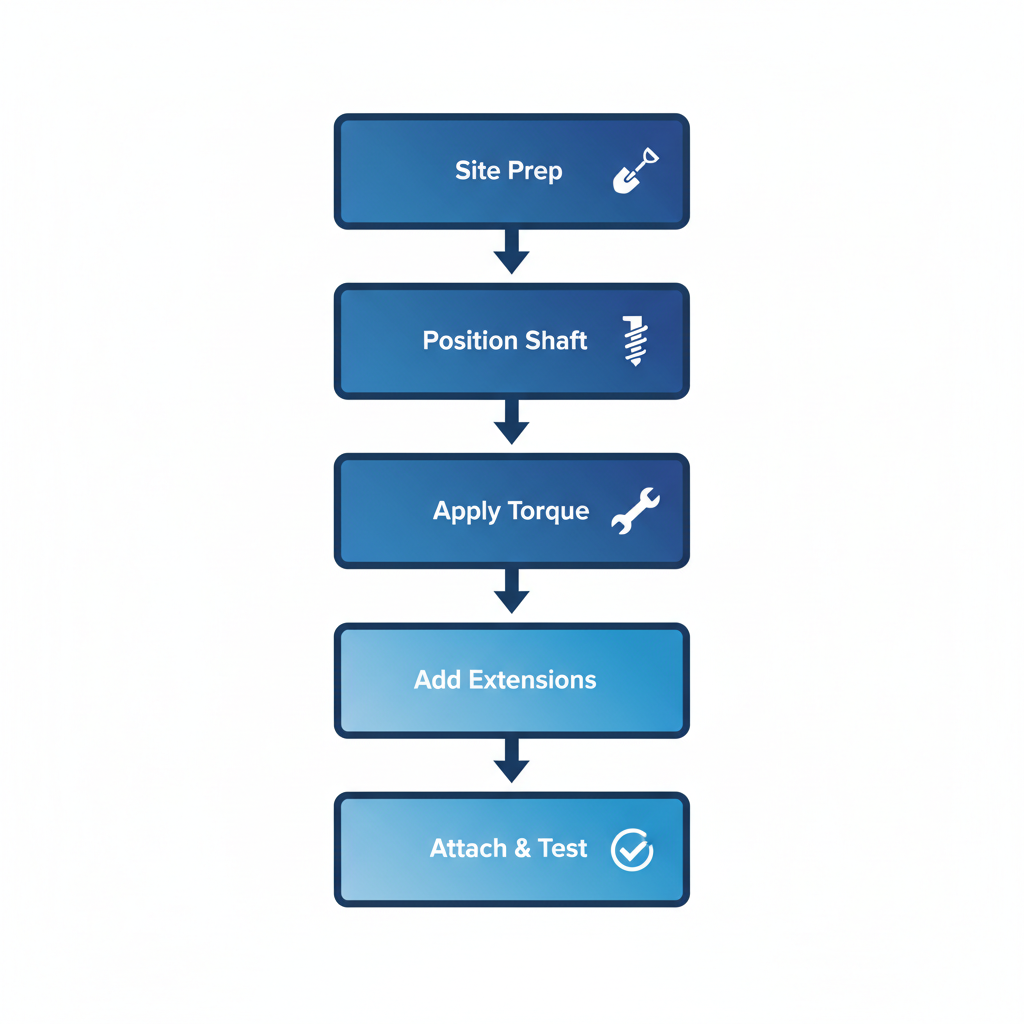
Step-by-step helical piers installation for foundation repair
Pricing for helical piers ranges from $100 to $300 per unit, depending on size and project scale, with costs per ton around $20-50 for efficient load distribution.
Pros:
- Immediate load transfer enables quick project completion without curing times.
- Vibration-free installation minimizes disruption and suits sensitive sites.
- Reusable design and no excavation reduce environmental impact and costs versus driven push piers.
Cons:
- Limited penetration in hard rock may require alternative solutions like manta ray earth anchors.
- Initial equipment for torque application adds upfront investment, though our on-site training mitigates this.
Helical piers prove best for repairs in unstable soils and new builds in expansive areas, where their screwed method outperforms pushed alternatives like push piers in cohesive grounds. We recommend consulting our network of structural engineers for project-specific guidance to ensure compliance with building codes and ICC-ES criteria, complemented by accessories such as manta ray accessories for comprehensive anchoring solutions.
Push Piers
Push piers form a key component of our advanced earth anchoring systems, serving as reliable hydraulic foundation drivers for correcting foundation settlement. These sectional underpinning systems excel in driven anchoring applications, particularly where deep penetration is required in cohesive soils. At Helical Technology, we supply push piers designed for robust performance in remediation projects, ensuring stability for structures facing uneven settling.
Key Features of Push Piers
- Hydraulic Installation: We drive push piers using powerful hydraulic jacks that clamp and push sectional steel pipes into the ground until reaching refusal on stable strata, typically achieving depths of 20-50 feet as supported by ASCE studies on driven piles.
- Load Capacity and Testing: Each pier can support up to 50 tons, with on-site load testing verifying performance and allowing incremental additions for customized support.
- Design Elements: Corrosion-resistant galvanized steel and external bracket attachments connect directly to building foundations, minimizing disruption during installation.
- Soil Compatibility: Ideal for clay-heavy soils, where frictional resistance provides reliable anchorage, drawing from field data on cohesive soil behaviors in pile driving.
Pricing for Push Pier Installation
Push pier installations typically cost between $80 and $250 per pier, including drive equipment, brackets, and basic engineering oversight. Factors like site access and depth influence the final price, making it a cost-effective option for targeted repairs.
Pros and Cons of Push Piers
Pros:
- Achieve greater depths in firm, cohesive soils compared to helical piers, offering superior load transfer for heavy commercial buildings.
- Quick installation once refusal is reached, enhancing project timelines in settlement remediation.
- Proven reliability in clay soils, as evidenced by ASCE research on driven pile capacities under tension and compression.
Cons:
- Potential for soil displacement and moderate vibration during driving, which may require precautions in sensitive areas.
- Less adaptable in loose or rocky soils where manta ray driven anchors might provide alternatives for lighter loads.
- Higher noise levels compared to torque-driven options like helical systems.
Best Applications for Push Piers
Push piers are best suited for foundation settlement in clay soil, such as a recent project we supported in a Midwest commercial warehouse where uneven settling threatened structural integrity. They outperform helical piers in dense, cohesive conditions by prioritizing depth over torque, making them ideal for heavy structures needing immediate stabilization. For specialized driven needs, we also offer hunting trapping earth anchor assemblies as complementary solutions. Consult our network of structural engineers for project-specific guidance to ensure compliance with ICC-ES criteria.
Selecting the Optimal Foundation Solution
When selecting foundation solutions, contractors must evaluate load capacity, soil suitability, installation ease, and cost-effectiveness to ensure long-term stability. At Helical Technology, we provide manta ray driven anchors alongside other engineered anchoring technologies for comprehensive stabilization options. The Advanced Earth Anchoring System offers versatile torque-based installation, while helical piers excel in screw torque for loose soils, and push piers suit sectional pushing in clays. These tools integrate seamlessly for hybrid applications, drawing from standards in geotechnical engineering for reliable performance.
The following table compares key metrics across these systems to aid decision-making:
| Feature | Advanced Earth Anchoring System | Helical Piers | Push Piers |
|---|---|---|---|
| Installation Method | Torque-based with helical integration | Screw torque | Sectional pushing |
| Soil Compatibility | Versatile (sands, clays) | Most soils, excels in loose | Cohesive/clay preferred |
| Load Capacity | Up to 200 tons | 50-100 tons | 30-50 tons |
| Cost per Unit | $50-150 | $100-300 | $80-250 |
| Best Use Case | Hybrid stabilization | New construction/unstable soils | Settlement in clays |
This comparison highlights the Advanced Earth Anchoring System’s superior versatility and capacity for complex sites, validated by helical pile references emphasizing minimal disturbance and rapid setup. Helical piers provide cost-effective options for new builds, while push piers address settlement efficiently in cohesive soils. For optimal results, we recommend hybrid configurations combining these for challenging conditions, balancing upfront costs with enhanced durability. Our ICC-ES certified specs confirm load capacities up to 200 tons in varied applications.
Interpreting these insights, contractors benefit from cost analyses showing the Advanced system’s long-term savings through adaptability. We support hybrid recommendations with real-time design software and engineering resources.
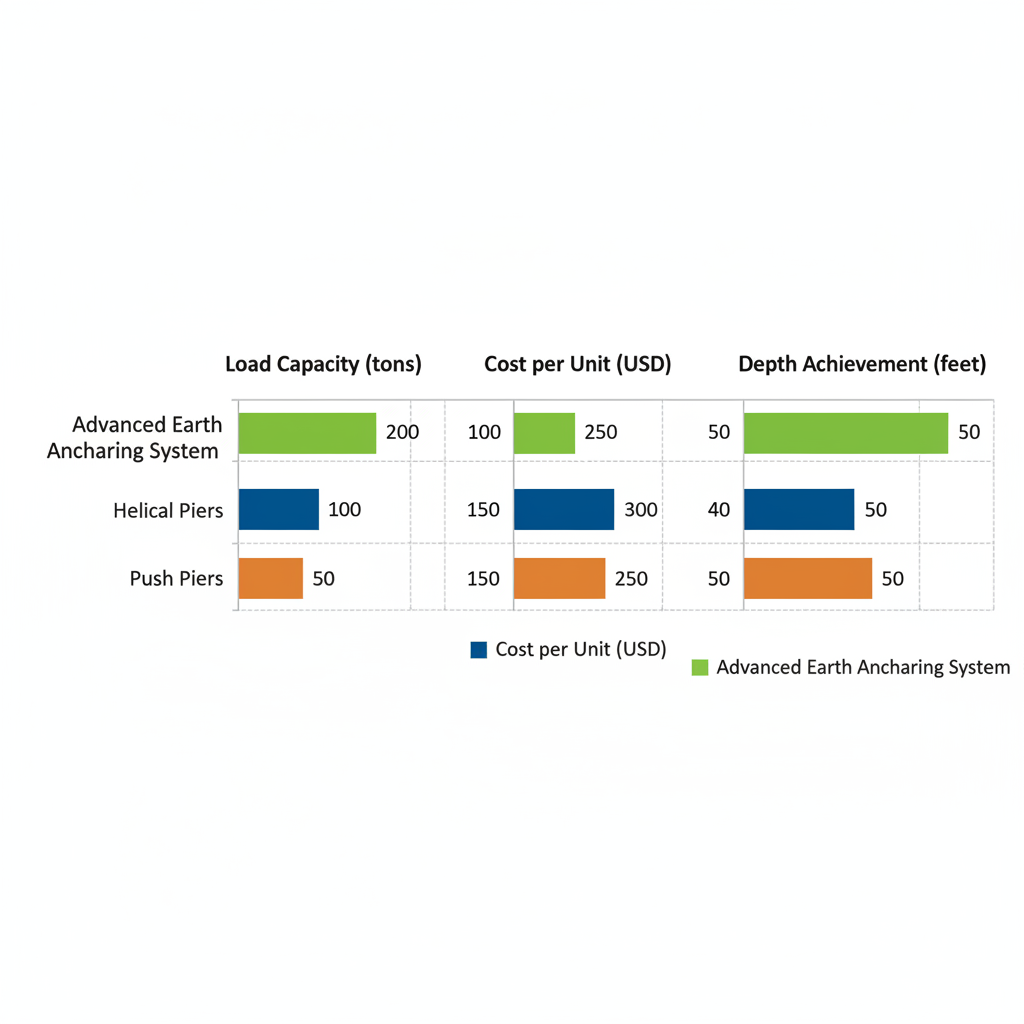
Comparison of key features for earth anchoring foundation tools
This visual underscores selection priorities for foundation repair solutions. Contact us for consultations, training, and project-specific support from our network of structural engineers.