


Jason Keefer
President
Building Foundation Reinforcement
Table of Contents
Strengthening Building Foundations Effectively
Once problems are identified, effective building foundation reinforcement begins immediately. Primary causes include soil shrinkage, poor drainage, and erosion, per expert inspector guidance from HomeInspector.org. Key warning signs are:
- Wall cracks wider than 1/4 inch
- Sticking doors
- Sloping floors
The helical pier system helical pier system offers minimal disruption: brackets attach to the home rim, then piers hydraulically drive to stable strata for immediate load transfer. In contrast, push piers drive steel sections with rams to bedrock but risk higher vibration, per Geoengineer.org benchmarks. Helical piers excel in long-term stability with lower site impact.
Selecting the right method, like our ICC-certified helical piers, ensures lasting stability.
1. Spotting Foundation Distress Signals
Beyond understanding foundations, knowing distress signals is crucial. Homeowners spotting these early can prevent extensive damage and costly repairs through timely building foundation reinforcement. According to InterNACHI, certified home inspectors’ authoritative guidance identifies key visual cues demanding attention.
Here are common warning signs, each signaling potential structural issues:
- Horizontal cracks wider than 1/8 inch in basement walls: Indicate lateral soil pressure; often require push piers for stabilization.
- Diagonal cracks in brick veneer wider than 1/16 inch: Suggest differential settling; building foundation reinforcement prevents further spread.
- Doors or windows that stick or won’t close fully: Show frame distortion from foundation shift; professional assessment is essential.
- Sloping or uneven floors, confirmed by marble roll test: Reveal settlement; helical piers in unstable soils restore levelness effectively.
- Gaps exceeding 1/4 inch between walls and ceiling: Point to separation; early intervention averts escalation.
- Water pooling in basement after rain: Signals poor drainage exacerbating movement; address to protect integrity.
Observing two or more signs warrants immediate professional inspection. At Helical Technology, we recommend solutions like helical piers for reliable reinforcement. Recognizing these leads to exploring causes and proven fixes like helical piers.
2. Assessing Reinforcement Needs
Once foundation issues are suspected, assessing needs for building foundation reinforcement is critical to prevent further structural damage. Homeowners in Littleton, CO, can start with simple checks to identify settling early, ensuring timely intervention with proven foundation repair solutions.
According to HomeInspector.org, authoritative inspector training highlights these five key warning signs of foundation settling:
- Horizontal cracks wider than 1/8 inch in basement walls
- Diagonal cracks in brick veneer exceeding 1/4 inch
- Doors and windows that stick or won’t close properly
- Sloping or uneven floors, verified by a target marble test
- Gaps around window or door frames widening over time
You can perform these three initial DIY assessment steps safely:
- Inspect crack patterns visually, noting direction and width
- Test floor levelness by placing a straightedge across rooms and measuring gaps
- Check for exterior soil heaving or erosion adjacent to foundation walls
Professional reinforcement triggers include active cracks growing over one month, multiple signs together, or vertical displacement exceeding 1 inch. Geoengineer.org engineering benchmarks recommend helical piers for compressible soils with access limits, push piers for stiff clays under heavy loads, and for bowing walls under lateral pressure, consider plate anchors as a targeted solution.
Consult our network of structural engineers at Helical Technology for soil borings and load calculations before pier-based stabilization. With needs confirmed, explore installation methods like helical piers.
3. Harnessing Helical Piers
One proven remedy is harnessing helical piers for building foundation reinforcement in challenging soil conditions. At Helical Technology, we supply ICC-certified helical pile systems, including the helical pier system, that stabilize structures with minimal disruption.
The installation process involves rotating shafts with helical plates into the ground using hydraulic torque until the target load capacity is reached–no excavation required. Key steps include:
- Site assessment for soil load-bearing potential.
- Driving the helical pier system via torque monitoring to correlate installation resistance with capacity.
- Attaching brackets to connect the pier to the foundation.
This method offers advantages over push piers, such as less site disturbance and immediate verification through torque-to-capacity correlation, as outlined in authoritative model building code standards from the International Code Council (ICC Section 1810.3.3.1.9). Industry seminars like the ADSC-IAFD CAGE Fall Seminar highlight innovations in helical piles alongside micropiles for building foundation reinforcement in expansive soils.
Beyond installation, real-world case studies demonstrate helical piers’ reliability for foundation reinforcement. Consult our engineering team for project-specific guidance and code compliance.
4. Stabilizing with Helical Piers
For effective building foundation reinforcement, helical piers provide a targeted stabilization solution for settling or shifting foundations. These galvanized steel shafts with helical plates screw into the ground, securely transferring loads to stable soil layers.
We install helical piers using a hydraulic torque motor that rotates them clockwise. Downward pressure advances the piers at 10-20 feet per minute without soil excavation. Torque until load capacity is achieved for immediate bearing strength, unlike concrete piers needing curing. Options include round shaft helical piers for high-capacity loads in heavy applications.
Helical piers suit clay, sand, and silt soils for residential and commercial foundation helical piers needs. Compared to push piers, they excel in weaker soils via helical bearing plates, as discussed in the ADSC-IAFD CAGE seminar on helical piles versus micropiles. Consult our network of structural engineers for project-specific guidance, ensuring compliance with ICC-ES criteria.
5. Helical Piers Benefits
Building on their innovative design, helical piers provide reliable building foundation reinforcement with minimal disruption to surrounding structures and landscapes. These advanced earth anchoring systems excel in various soil conditions, offering contractors efficient foundation repair solutions.
Key benefits of helical piers include:
- Vibration-free installation that minimizes risk to adjacent structures, unlike driven alternatives.
- Immediate load-bearing capacity verified by torque measurements during installation.
- Versatility for limited-access or contaminated sites, ideal for urban building foundation reinforcement.
- No soil excavation or spoils generated, reducing cleanup and environmental impact.
- Verifiable installation depths, providing superior accountability over push piers.
- Faster installation times that cut labor costs and project timelines.
- All-season usability, unaffected by weather or frozen ground.
According to Geoengineer.org’s independent engineering comparison of foundation repair methods, helical piers outperform push piers in poor soil conditions and eliminate preload requirements, ensuring predictable performance. These advantages, backed by industry insights from ADSC-IAFD events, deliver long-term structural stability for our ICC and ISO Certified products.
These benefits position helical piers perfectly for the installation processes discussed next.
6. Installing Helical Piers
Following site evaluation confirming the need for building foundation reinforcement, we install helical piers as an engineered advanced earth anchoring system using ICC-compliant procedures. These helical pile systems stabilize foundations through precise hydraulic advancement.
Key installation steps include:
- Site preparation: Position hydraulic torque motor over marked locations.
- Advance helical piers: Rotate shafts with helical plates into soil until refusal–5 ft or 100 rotations without 1 inch advancement, per International Code Council (ICC) standards.
- Monitor torque: Correlate to capacity where ultimate equals 10 times installation torque for shafts 3 inches or larger (Section 1810.3.3.1.9).
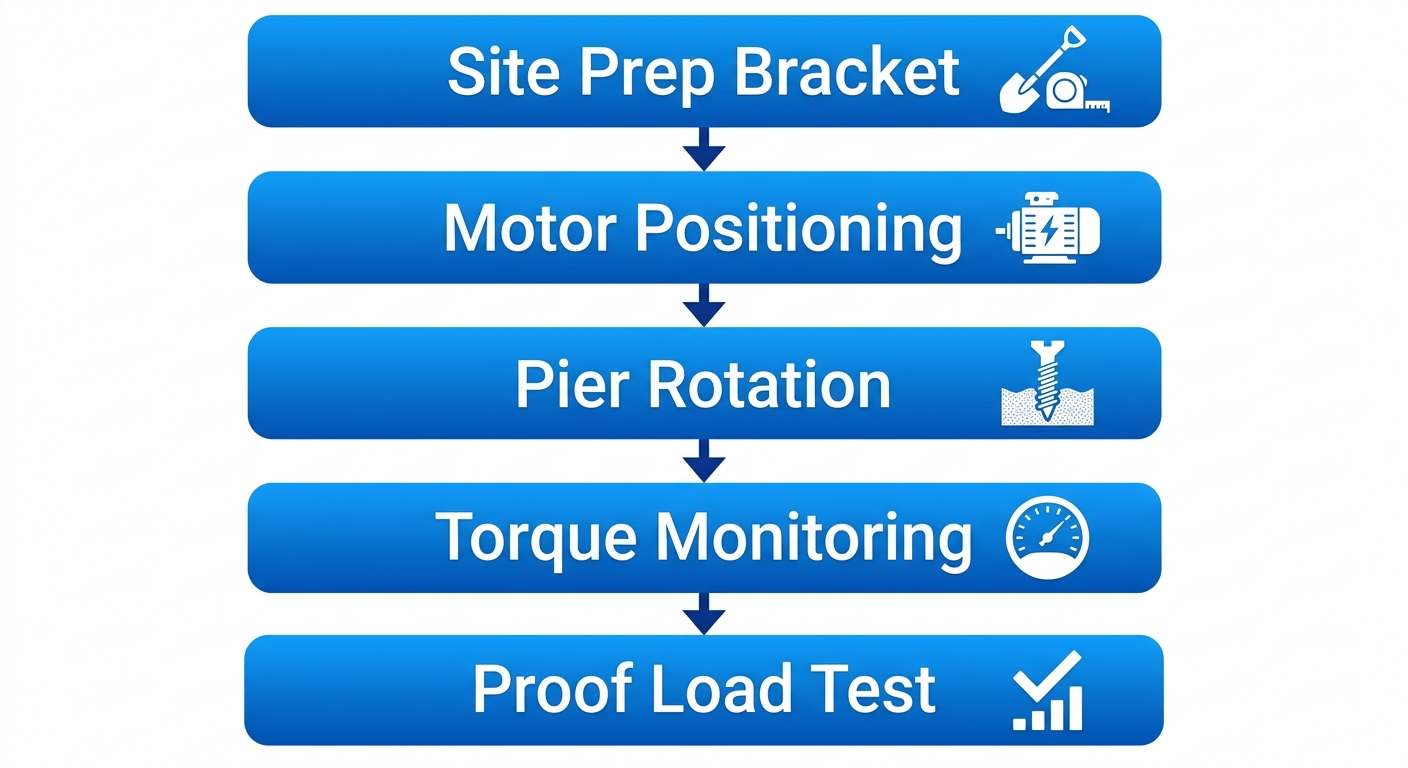
Step-by-step helical piers installation process for foundations
Post-installation, verify embedment depths via load tests to 200% design capacity, inspect alignment, and attach brackets. Certified installers must monitor for buckling. Helical piers ensure reliable building foundation reinforcement. Unlike push piers requiring heavier equipment, helical piers offer torque-verified precision. Consult our structural engineers for project-specific guidance and ICC compliance.
7. Push Piers Alternative
While push piers work in ideal conditions, alternatives like helical piers offer broader applicability for building foundation reinforcement. Push piers rely on dense soils and hydraulic pushing, risking soil disturbance and limited depth in unstable conditions. In contrast, helical piers excel through continuous torque installation, suiting poor soils without excavation, as noted in Geoengineer.org’s authoritative geotechnical benchmarks.
Helical piers, or screw piers, feature helical plates screwed into the ground until reaching a load-bearing stratum. Torque correlation directly indicates capacity, ensuring reliable foundation stabilization. Compared to hydraulic push piers, helical pile systems install 3x faster with minimal site disruption, lower costs, and superior durability across soil types.
For bowing walls, wall plate anchors provide complementary external support, integrable with helical piers for comprehensive remediation.
At Helical Technology, we recommend helical piers for most residential cases due to their proven effectiveness in load transfer and soil adaptability per industry comparisons. These alternatives have proven effective in real-world applications, as shown next.
8. Comparing Reinforcement Methods
While both helical piers and push piers strengthen foundations, key differences determine the best choice for building foundation reinforcement. At Helical Technology, we supply ICC-certified helical piers and push piers to contractors nationwide from our Littleton, CO headquarters, enabling precise selections based on site conditions.
Helical piers offer distinct advantages over push piers, as detailed in Geoengineer.org’s comparison benchmarks for foundation repair methods:
- Installation: Helical piers screw into soil with torque, minimizing vibration and disruption, while push piers require hydraulic driving and potential pre-drilling, risking soil refusal.
- Load Capacity and Soils: Helical piers provide immediate load-bearing in variable or weak soils; push piers excel in dense soils but may halt in obstructions.
- Speed and Cost: Helicals install faster with verifiable torque correlations, often lower disruption than pushed systems per industry insights.
ADSC-IAFD seminar discussions highlight helical piles alongside micropiles for deep reinforcement, confirming their versatility.
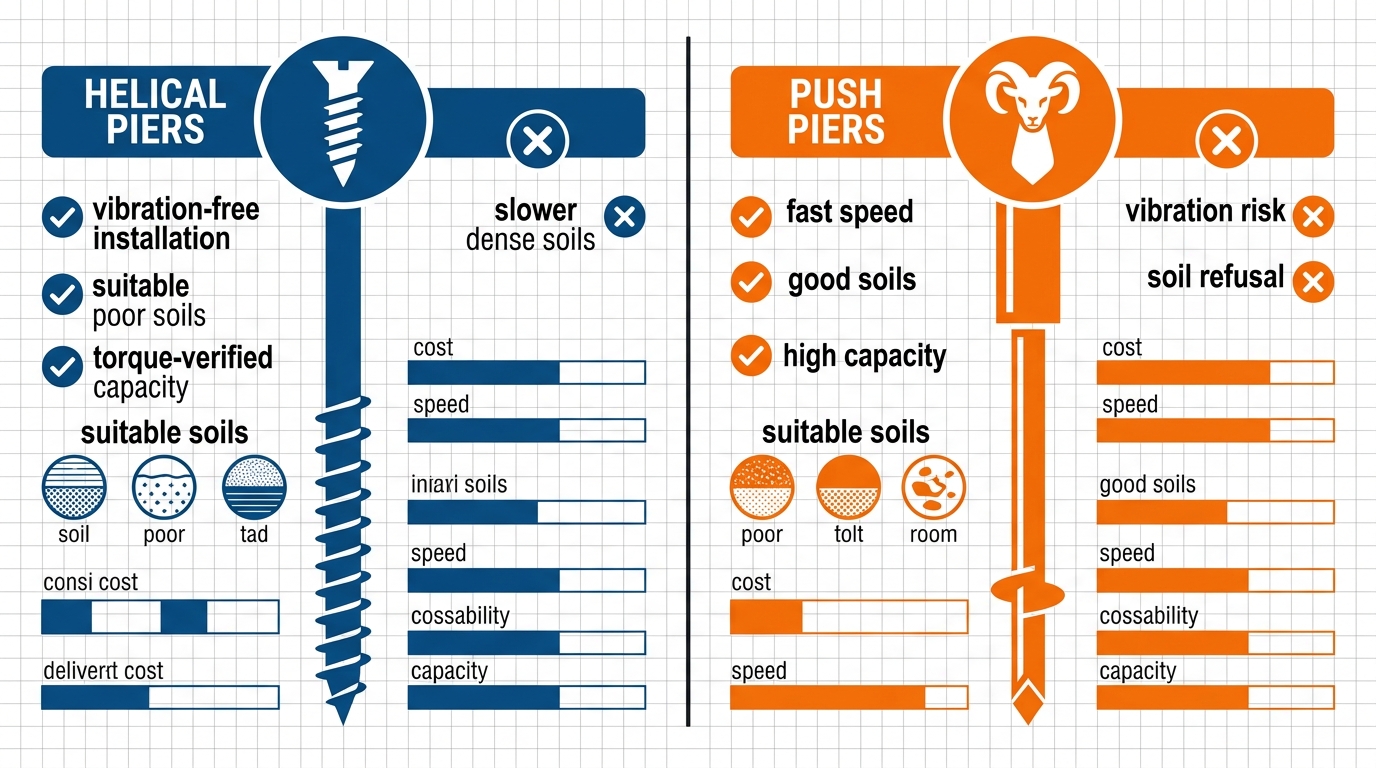
Helical piers vs push piers comparison for foundation reinforcement
Choose helical piers for access-limited sites or unstable soils, and push piers for high-capacity needs in firm ground. These comparisons inform real-world applications, as seen in the following examples. Consult our network of structural engineers for project-specific guidance.
Optimizing Foundation Reinforcement
Once issues are identified, optimizing building foundation reinforcement begins with method selection matched to soil conditions and load requirements. At Helical Technology, we prioritize solutions that deliver maximum stability and cost-efficiency for residential structures.
Helical piers excel with helical plates providing immediate load-bearing in variable soils, minimal site disruption, and faster installation than alternatives. In contrast, Geoengineer.org’s expert comparison notes push piers suit stable soils via hydraulic pushing but risk refusal in obstructions and generate higher vibration. We recommend helical piers for most residential cases due to superior versatility across soil types.
Conduct soil borings pre-installation and engage licensed contractors for precise depth placement. Detailed helical pier installation follows these optimizations. Consult our engineering team for project-specific guidance.
This article was researched and written with the assistance of AI tools.