


Jason Keefer
President
Buy Helical Tiebacks
Table of Contents
Guide to Buying Helical Tiebacks for Foundation Repair
As you’ve learned about helical tiebacks, buying the right ones ensures reliable foundation repair solutions. When you buy helical tiebacks, prioritize project needs like load requirements and soil conditions to select optimal helix diameters and shaft sizes, such as 1.5-inch or 3-inch helices.
Key selection criteria include:
- Galvanized or stainless steel construction for corrosion resistance across soil types.
- Torque-rated installation verifying capacity, with at least 10,000 ft-lbs for standard uses.
- ICC-ES AC358 certifications for compliance; we provide ICC- and ISO-certified products from Littleton, CO.
- Custom lengths (10-50 feet) and tieback terminations for headroom-limited installs using helical tieback anchors.
- Helical tiebacks for retaining walls from manufacturers like us with proven expertise, warranties, and engineering support.
Consult our network of structural engineers for project-specific guidance. Contact Helical Technology for custom quotes. Once selected, proper installation ensures long-term performance.
Essential Preparations Before Purchasing Helical Tiebacks
With helical tieback fundamentals covered, essential preparations ensure your purchase fits perfectly. Before you buy helical tiebacks, prioritize site evaluation, engineering specs, and compliance to mitigate risks and guarantee helical tiebacks for retaining walls perform reliably.
Follow these key steps:
- Obtain a professional geotechnical soil boring report. We recommend engaging certified experts to confirm soil shear strength and optimal embedment depths for helical tieback anchors.
- Perform precise load calculations. Factor in retaining wall height, soil pressures, and safety factors to determine required torque-rated capacities.
- Consult a licensed structural engineer. Specify shaft diameter, helix configuration, and extensions, especially in seismic zones–reach out to our network of structural engineers for support.
- Verify local building codes. Ensure compliance with installation standards, pull-out testing, and corrosion protection requirements.
- Assess site logistics. Measure access for skid-steer loaders, check overhead obstructions, and plan torque motor setups.
- Review supplier checklist and accessories. Evaluate warranties, lead times, custom options, and budget for helical pier terminations to secure proper connections.
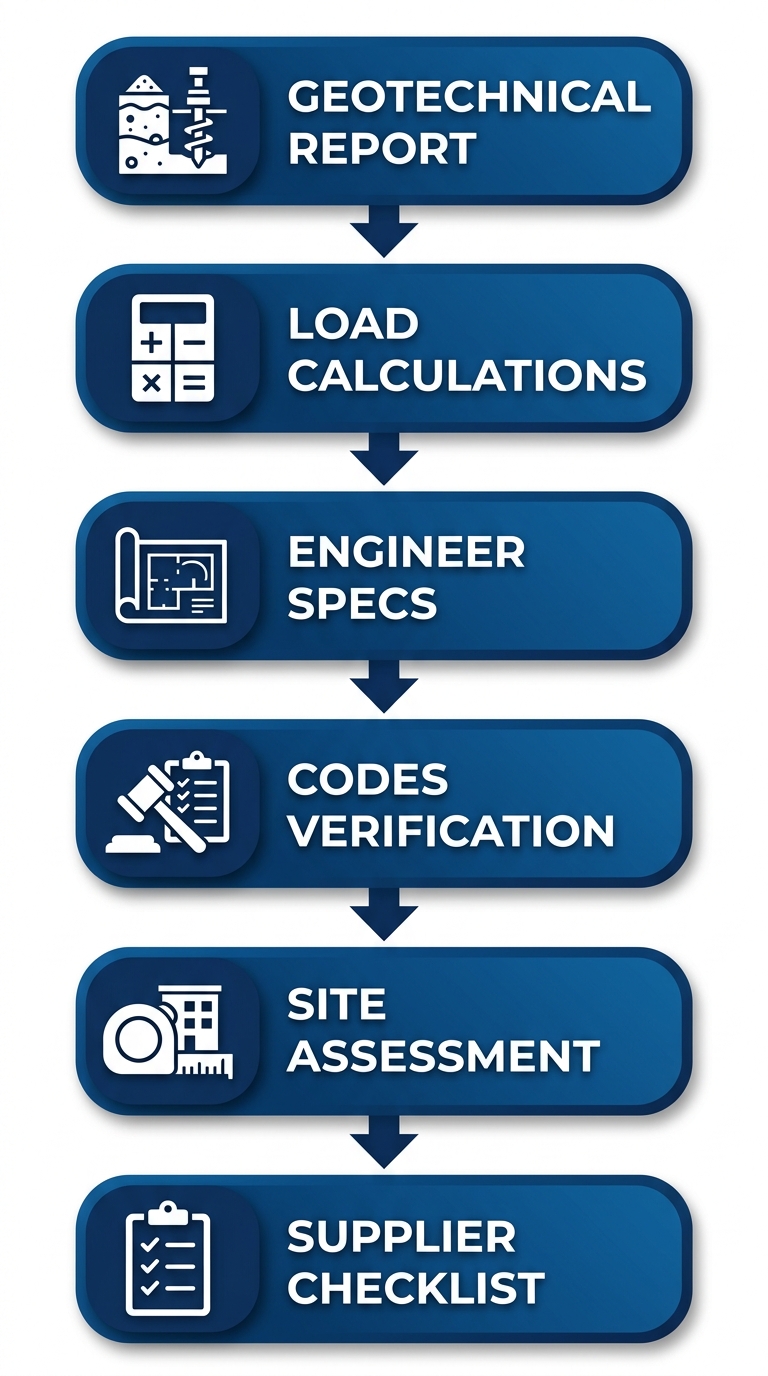
Six essential preparations before purchasing helical tiebacks
Fully prepared with these steps, you’re set to select the right helical tiebacks. Always consult a structural engineer or our team for project-specific guidance, ensuring installations comply with applicable codes and ICC-ES criteria.
Evaluate Project Requirements for Helical Tiebacks
Building on helical tieback fundamentals, we advise contractors to systematically evaluate project requirements before you buy helical tiebacks. This pre-purchase assessment of site-specific factors like soil conditions, structural loads, and installation constraints ensures advanced earth anchoring systems deliver optimal performance and safety, avoiding costly errors.
Assess Soil Bearing Capacity
Review geotechnical reports or conduct on-site testing to determine soil type and bearing capacity suited for helical tieback anchors.
Calculate Loads Precisely
Determine lateral and uplift forces using formulas like Q = K * A * S_u for helical tiebacks for retaining walls capacity, factoring wall height, batter angle, and surcharge loads to dictate spacing and size.
Evaluate Site Constraints
Check access limitations from overhead utilities or adjacent structures; pair helical tiebacks with underpinning repair brackets for foundation stabilization where needed.
Verify Compliance
Consult our helical tieback design software or ICC-ES certifications, and engage our network of structural engineers for project-specific guidance.
Always prioritize safety and code compliance. Once requirements are evaluated, proceed to sizing helical tiebacks via engineering support.
Understand Helical Tieback Specifications and Sizes
Building on the fundamentals, understanding specifications is key to selection when you buy helical tiebacks. Standard shaft diameters include 1-1/4 inch, 1-1/2 inch, 1-3/4 inch, 2 inch, 2-1/2 inch, and 3 inch. Larger diameters support higher loads for demanding applications.
Helix plate configurations vary: single helix (8-10 inch diameter), double helix (8×10 inch, 10×12 inch), and triple helix (8x10x12 inch), with 3/8 inch standard thickness and consistent pitch. These helical tieback anchors use ASTM A536 Grade 80-55-06 ductile iron, hot-dip galvanized per ASTM A153, with extensions in 3-10 foot sections.

Helical tieback specifications: diameters, helix configs, materials, torque overview
Load capacities range from 15-25 kips tension for small sizes to over 100 kips for large ones, influenced by soil type and embedment. Match sizes to project loads, soil, and torque (5,000-50,000 ft-lbs). For light-duty decks boardwalks brackets, use 1.5 inch shaft with single 8 inch helix; opt for helical tiebacks for retaining walls in heavier scenarios. We recommend consulting our engineering team for precise guidance.
With sizes chosen, explore installation methods for optimal performance.
Identify Reliable Suppliers of Helical Tiebacks
With helical tiebacks selected for your project, now identify top suppliers when you buy helical tiebacks. Prioritizing certified providers ensures advanced earth anchoring systems deliver lasting performance for foundation repair solutions.
Evaluate suppliers using these five key criteria:
- ICC-ES or equivalent certifications for helical tieback anchors, verifying compliance with building codes like AC358.
- 10+ years experience with documented retaining wall projects using helical tiebacks for retaining walls.
- In-house manufacturing with galvanized steel specs for durability.
- Customer case studies proving load capacities over 50 kips.
- Warranties exceeding 25 years, plus comprehensive support like on-site technical consultations and installation training.
Verify via BBB reviews and portfolios. Reliable suppliers, such as those offering woven seal vapor barrier for waterproofing, provide holistic solutions. Avoid red flags like pricing below $200 per unit or opaque testing data. Contact us at Helical Technology for customized quotes tailored to clay or sand soils. Consult our engineering team for project-specific guidance. Ready suppliers ensure seamless procurement.
Verify Certifications and Approvals for Helical Tiebacks
After identifying suitable helical tiebacks, confirm certifications to avoid installation issues. Before you buy helical tiebacks, verify ICC-ES evaluation reports (ESR), IAPMO Uniform Evaluation Service (UES) listings, and state Department of Transportation (DOT) approvals specific to helical tieback anchors.
Key certifications include:
- ICC-ES ESR: Validates load capacities per AC358 criteria.
- IAPMO UES: Ensures compliance for earth retention.
- State DOT approvals: Required for infrastructure projects.
Follow our 4-step verification process before you buy helical tiebacks:
- Download PDF certificates from the manufacturer’s website.
- Cross-check serial numbers in ICC-ES online directory.
- Confirm load capacities match project specs via engineer-stamped reports.
- Contact manufacturer support for custom approvals.
For helical tiebacks for retaining walls and x-mas tree fasteners, ensure seismic zone compliance per IBC Chapter 18. Avoid unverified imports lacking post-2020 U.S. certifications. Visit helicaltechnology.com or call for your project’s approval docs. With verified approvals, proceed confidently to helical tieback installation guidelines.
Analyze Costs and Pricing for Helical Tiebacks
Building on installation basics, let’s break down the financials when planning to buy helical tiebacks. Costs for these advanced earth anchoring systems vary based on project specifics, empowering contractors to budget effectively.
Key cost components include:
- Materials: Galvanized steel shafts and helices at $20-60 per foot.
- Labor: $50-100 per hour for certified installers, often 40% of total.
- Equipment: Torque motor rentals at $500-2,000 per day.
- Site prep/permits: 5-15% of project costs.
Pricing variables are:
- Shaft diameter (3-10 inches adds $10-30/foot).
- Helix count/plate size ($50/foot single vs. $100+/foot multiple).
- Embedment depth (10-20% more per 10 feet in deeper soils).
- Soil conditions (cohesive cheaper than granular).
Helical tieback anchors average $75-200 per linear foot installed (2023-2024 US data), with helical tiebacks for retaining walls in the Northeast 20% higher than Midwest. They offer 15-40% lower upfront costs than driven anchors, plus 30% faster installs.
Save with bulk quotes from us (10-25% off over 100 units), soil tests, and standard fabrication. These durable solutions recoup via 50+ year lifespans. Get a free quote tailored to your project. With pricing clear, explore why helical tiebacks deliver superior value long-term.
Plan Installation and Training for Helical Tiebacks
After you buy helical tiebacks, meticulous planning is essential for safe deployment of these advanced earth anchoring systems. At Helical Technology, we recommend a structured approach to coordinate contractors and ensure crew readiness in your project site.
Follow this 4-step installation planning timeline:
- Conduct site assessment to verify helical tiebacks for retaining walls compatibility and soil conditions.
- Select certified contractors experienced in torque monitoring.
- Procure equipment aligned with torque correlations.
- Secure permitting per local codes.
Prioritize training by mandating attendance at the premier ADSC-IAFD industry training event, the Cage Fall Seminar on Micropiles and Helical Piles. Register now for sessions on helical tieback anchors installation techniques, safety protocols, and load testing. Our on-site installation training complements this, focusing on helical pile tiebacks for retaining walls.
Use a pre-installation checklist and conduct mock installations for post-training verification. With certification complete, proceed to on-site execution confidently.
Secure Engineering and Technical Support
Beyond superior products, our engineering team ensures flawless execution. When contractors prepare to buy helical tiebacks, our licensed professional engineers offer free initial consultations. We deliver Engineering Excellence and Design Support for helical tieback installations, ensuring safety, compliance, and peak performance from the start.
Key support services include:
- Customized design calculations using site-specific soil data.
- On-site installation oversight by our network of structural engineers.
- Troubleshooting helical tieback anchors in retaining walls.
These services reduce failure risks, ensure adherence to local building codes like ICC-ES AC358, and deliver cost savings through precise engineering. In a recent project in Baltimore, our guidance stabilized a failing wall, earning praise: “Helical Technology’s team turned a potential disaster into a success.” Consult our structural engineers for project-specific advice.
Contact us today to leverage this expertise in your project.
Troubleshooting Common Issues with Helical Tiebacks
Building on proper setup techniques, even high-quality helical tiebacks can encounter issues. At Helical Technology, we recommend that buyers of helical tiebacks invest in ICC- and ISO-certified products to minimize problems from the start. This guide covers common symptoms, causes, and fixes, prioritizing safety and professional input.
Insufficient load capacity: Visible wall bowing or anchor slippage signals this problem. Causes include undersized helices or poor soil match. Safety first: secure the site before inspection. Fixes: 1. Verify torque logs against specs. 2. Add extension sections if needed. 3. Reinforce with additional helical tieback anchors.
Corrosion problems: Rust on exposed shafts or reduced capacity appears in aggressive soils. Inadequate galvanization accelerates pitting. Safety first: secure the site. Fixes: 1. Inspect coatings annually. 2. Apply cathodic protection. 3. Replace if pitting exceeds 10% depth, opting for upgrades when you buy helical tiebacks.
Installation misalignment: Uneven torque readings or anchor binding during setup. Incorrect lead angle or obstructions in rocky soil contribute. Safety first. Fixes: 1. Use alignment brackets. 2. Pre-drill if necessary. 3. Re-torque to manufacturer specs, like torque-to-turn criteria (rotation resistance indicating capacity).
Pullout failure: Sudden movement post-load in helical tiebacks for retaining walls. Helix overload or cyclic loading causes it. Safety first. Fixes: 1. Monitor with inclinometers. 2. Install redundant anchors. 3. Consult our network of structural engineers for redesign.
Prevent issues by selecting site-specific designs in Littleton, CO, adhering to torque-to-turn, and scheduling annual inspections. Routine checks prevent escalation–contact our experts for complex cases and engineering support.
Next Steps for Helical Tieback Success
With helical tiebacks securely installed, we prioritize monitoring and maintenance for enduring performance. Start by confirming installation torque logs exceed 150% of design capacity. Proactive steps like these, combined with knowing when to buy helical tiebacks for expansions, safeguard your project.
- Verify Torque Logs: Review records to ensure embedment surpasses 150% of design capacity immediately post-installation.
- Quarterly Visual Checks: Inspect helical tieback anchors for shaft corrosion, nut loosening, or deformation every three months.
- Install Inclinometers: Equip retaining walls with digital devices to detect movement over 1/4 inch annually.
- Engage Engineers: Consult a geotechnical expert for load testing if settlement exceeds 1 inch.
- Watch Failure Signs: Look for cracking in retained soil or anchor pullout, acting swiftly.
- Plan Expansions: Evaluate site growth and prepare to purchase helical tiebacks for helical tiebacks for retaining walls.
Ready to buy helical tiebacks or need support? Visit helicaltechnology.com for certified products and our engineering team.
This article was researched and written with the assistance of AI tools.