


Jason Keefer
President
Commercial Foundation Stabilization
Table of Contents
Commercial Foundation Stabilization Essentials
While residential fixes suffice for homes, commercial foundation stabilization demands robust solutions for heavier loads in warehouses and office complexes prone to differential settlement. We at Helical Technology define it as reinforcing large-scale foundations to maintain structural integrity.
LibreTexts Engineering, an authoritative academic textbook on foundation engineering fundamentals, outlines key settlement causes:
- âš ï¸ Immediate settlement from elastic soil deformation under load.
- âš ï¸ Primary consolidation as excess pore water pressure dissipates.
- âš ï¸ Secondary compression from organic matter decay and particle rearrangement.
- âš ï¸ Shrinkage settlement due to soil moisture loss, plus vibration from nearby construction.
Stabilizing commercial foundations uses methods like the helical pier system for precise load transfer in varying soils, or steel push piers as alternatives. Key techniques like helical piers address these causes effectively. Early assessment prevents costly failures.
1. Spotting Early Warning Signs
Spotting early warning signs of foundation settlement is key to effective commercial foundation stabilization, preventing costly repairs from issues like immediate elastic deformation under load or primary consolidation as pore water dissipates, per LibreTexts Civil Engineering’s detailed academic explanations.
Look for these telltale signs:
- Diagonal cracks wider than 1/4 inch in brick veneer: Signal differential immediate settlement from uneven elastic deformation.
- Sagging or sloping floors, as in warehouses: Indicate consolidation from excess soil stress; a floor stabilizer post kit provides quick interior support.
- Sticking doors and windows: Result from frame distortion due to uneven settlement.
- Gaps around door and window frames: Show ongoing consolidation shifts.
- Wall bowing or leaning: Often from lateral soil pressure amid settlement.
- Cracks in floor slabs: Stem from secondary compression or creep.
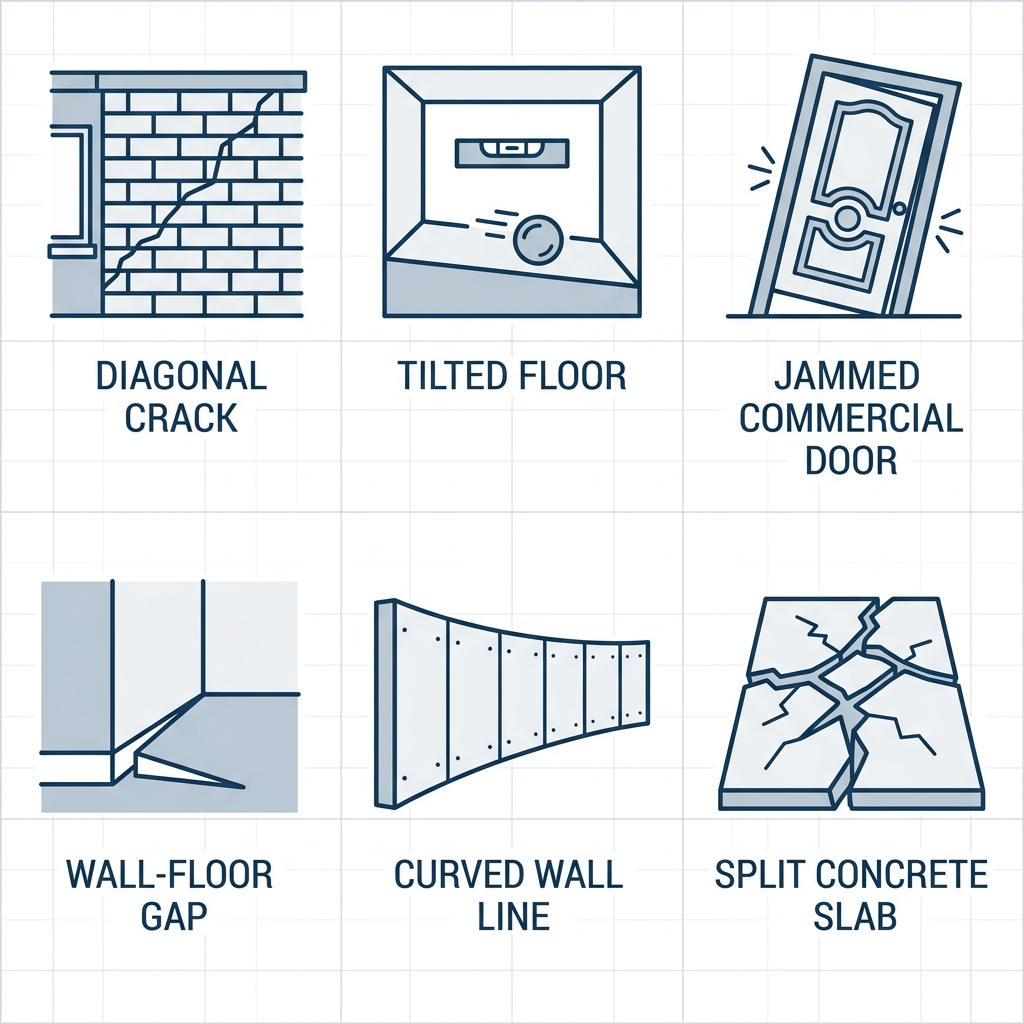
Icons of early foundation settlement warning signs
Don’t panic, but act fast: Inspect seasonally, especially after heavy rains. If multiple signs appear, consult our experts at Helical Technology for stabilizing commercial foundations early using helical piers or push piers before full pier-based stabilization.
Understanding these signs stems from settlement causes, explored next.
2. Understanding Settlement Causes
Building on foundation basics, settlement refers to the vertical downward movement of foundations due to soil compression under load. This poses significant risks for commercial foundation stabilization, as uncontrolled settlement can compromise structural integrity in commercial buildings. We at Helical Technology emphasize understanding these mechanisms to prevent costly repairs.
Settlement manifests in three primary types, as outlined in comprehensive academic explanations from LibreTexts Civil Engineering:
- Immediate settlement: Rapid elastic deformation upon load application, influenced by soil modulus and foundation dimensions.
- Primary consolidation settlement: Time-dependent compression in cohesive soils from excess pore water pressure dissipation, per Terzaghi’s one-dimensional theory. Helical piers mitigate this through targeted support.
- Secondary compression: Long-term creep or particle rearrangement in organic or plastic clays post-consolidation.
Key factors include load intensity, foundation size and shape, soil type (granular versus cohesive), groundwater levels, and construction sequence. These amplify risks in commercial settings.
Recognizing these causes guides selection of advanced interventions like push piers. An advanced earth anchoring system provides robust resistance for severe cases, as explored next.
3. Leveraging Helical Piers
To address settling and instability, leveraging helical piers offers a proven solution for commercial foundation stabilization. These screw-shaped steel shafts are torqued into the ground using a hydraulic torque motor, reaching refusal depth for immediate 100% design load capacity without concrete curing or extensive excavation.
Installation minimizes vibration and site disruption, ideal for limited-access commercial sites. Helical piers provide superior uplift resistance and lateral load capacity, available as helical anchors, outperforming concrete piles in cost and speed. As an authoritative civil engineering case study from the American Society of Civil Engineers (ASCE) demonstrates, steel piles like helical types replace concrete foundations in electrical infrastructure projects, enabling installation in days rather than weeks with reduced material use. Compared to push piers, helical piers excel in compressible soils, avoiding pre-drilling for greater versatility. We supply ICC-certified helical pile systems through our network.
Leverage helical piers for enduring structural integrity. Consult our engineering team for project-specific guidance. Beyond installation, maintenance ensures longevity.
4. Utilizing Push Piers
While various methods address settling foundations, push piers offer targeted hydraulic driving for commercial foundation stabilization. These hydraulically driven steel shafts install directly into stable soil strata below failing structures, providing robust support in warehouses and office buildings.
Installation follows a precise process:
- Excavate to expose the footing.
- Position the hydraulic extension.
- Drive the pier to refusal using the structure’s reaction.
- Load-test for 5000 psf capacity.
- Attach to the footing with a bracket.
Push piers deliver load-bearing capacities up to 50+ tons per pier with minimal site disturbance. According to the American Society of Civil Engineers (ASCE), an authoritative civil engineering magazine article highlights steel piles outperforming concrete in speed and durability for infrastructure foundations.
In commercial foundation stabilization projects, push piers rely on skin friction in competent soils, unlike torque-driven helical piles, which suit screw-in applications. Push pier systems excel in friction soils–exploring further options next.
5. Comparing Pier Options
When choosing piers for commercial foundation stabilization, we at Helical Technology recommend evaluating helical piers against push piers based on installation speed, soil displacement, vibration, and termination methods. These options suit various commercial projects, minimizing downtime.
Helical piers install quickly via torque-based advancement, causing minimal soil displacement and zero vibration, ideal for urban sites. Proper helical pier system termination achieves 10-50 kips per pier, with lower upfront costs in accessible areas. Push piers, or hydraulic resistance piers, transfer load incrementally but displace more soil and generate vibration, suiting high-load retrofits despite higher expenses.
Authoritative insights from the American Society of Civil Engineers (ASCE) Civil Engineering magazine highlight steel piles, including helical screw piles, replacing concrete foundations for electrical infrastructure, offering superior durability across soil conditions.
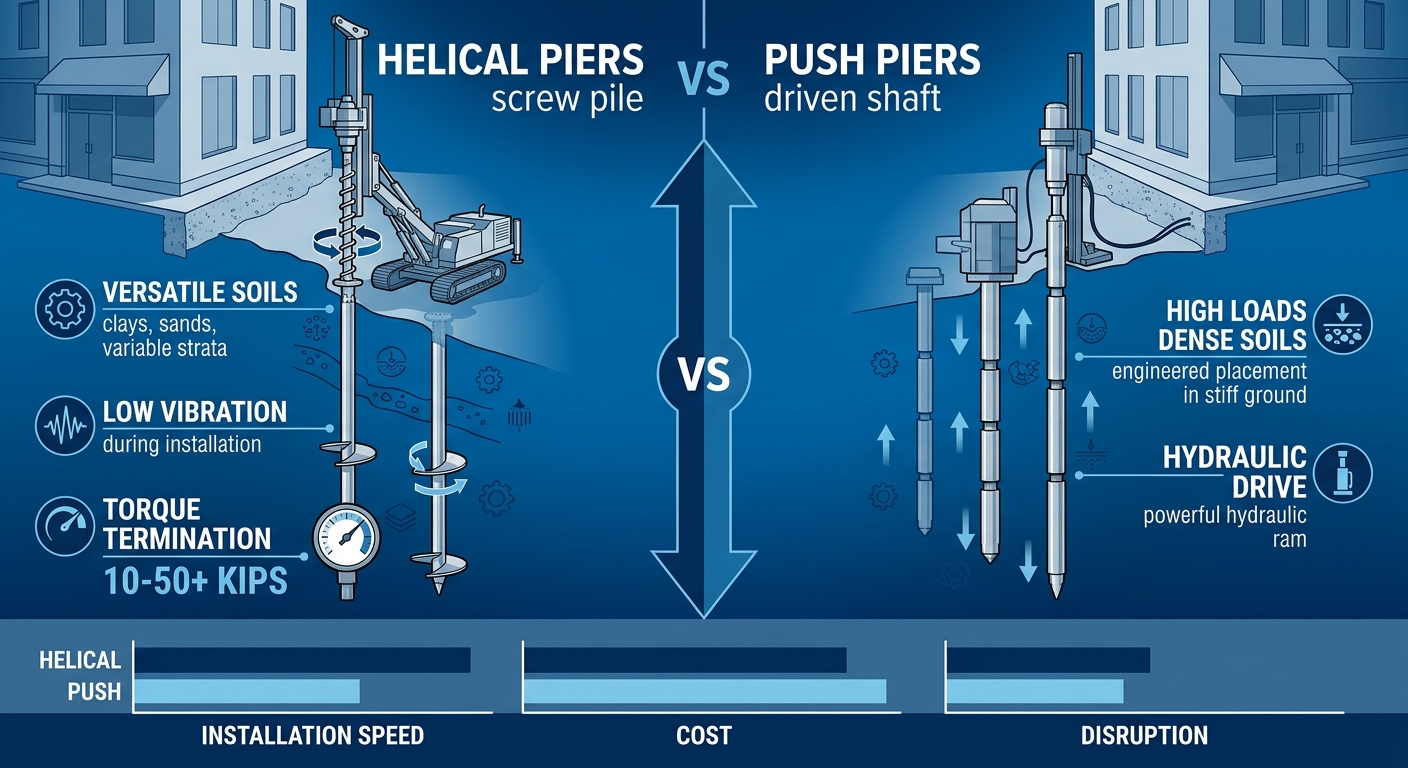
Helical vs push piers: key comparisons for foundation stabilization
Helical pile systems provide minimal site disturbance for swift commercial foundation stabilization, excelling in most scenarios. Selected pier performance in real projects confirms this edge–consult our engineering team for specifics.
6. Estimating Project Costs
Once planning is complete, accurate cost estimation ensures project feasibility for commercial foundation stabilization. At Helical Technology, we help contractors budget effectively for helical piers and push piers in commercial projects.
Key cost factors include:
- Soil conditions requiring geotechnical testing ($500-$2,000)
- Site access and mobilization ($1,000-$5,000)
- Pier quantity based on load calculations
- Installation depth (10-50 feet)
- Material and labor rates ($200-$500 per helical pier, $300-$600 per push pier)
Follow this step-by-step process:
- Assess site and soil via engineering report.
- Calculate required piers using structural load data.
- Apply unit costs from local contractors.
- Add 15-20% contingency for unforeseen issues.
- Total project range $10,000-$100,000+ for commercial jobs.
Helical piers prove cheaper in unstable soils with less excavation, while push piers cost more in dense soils needing pre-drilling. Save costs by bundling with helicaltechnology.com services; helical pile installation reduces labor by 30%.
Request a free quote from helicaltechnology.com for precise estimates. With costs estimated, proceed to procurement and installation phases.
7. Assessing Project Timelines
Building on helical piers and push piers selection, we at Helical Technology emphasize accurate timeline assessment to ensure success in commercial foundation stabilization projects. This involves evaluating mobilization, installation, and verification phases tailored to commercial sites.
Five key factors impact timelines. First, soil bearing capacity demands 2-3 days of geotechnical testing. Second, site access limitations add 1-2 weeks for permits. Third, project scale with 50+ piers requires 5-7 days installation. Fourth, weather delays in rainy seasons extend durations by 30%. Fifth, verification testing takes 1 day per 20 piers.
Helical piers suit small commercial projects in 1-2 days but need 1 week for large ones due to drilling. Push piers install faster in 3-5 days via hydraulic push, though site conditions vary. We recommend hybrid approaches for optimal stabilizing commercial foundations with helical piers and push pier systems.
Example timeline: Day 1-2 mobilization and excavation; Day 3-5 helical piers at 30 locations (4-6 hours each); Day 6 push piers if needed (2-3 hours each); Day 7 load testing and backfill.
Checklist: Review soil reports, calculate piers per linear foot, add 20% buffer. Efficient timelines directly impact budgeting. See section 8 for cost breakdowns.
8. Selecting Optimal Methods
Building on the helical piers and push piers overviews in sections 6-7, commercial foundation stabilization for properties demands a structured approach. We at Helical Technology recommend evaluating soil type, settlement severity, and structural loads to match methods effectively.
Key selection criteria include:
- Conduct geotechnical assessments with soil borings to determine bearing capacity and distinguish cohesive from granular soils.
- Assess settlement severity and commercial building loads for capacity needs.
- Consider site access and disruption tolerance in urban settings.
Helical piers excel in unstable or variable soils with torque-based installation and minimal vibration, offering faster setup and less disruption. Push piers, or hydraulic push piers, suit dense clays for deeper penetration and higher loads under heavy commercial structures. Helical piers reduce mobilization costs in tight urban sites, while push piers prove economical in uniform soils.
Engage certified contractors for load tests and pilot installations. Consult our network of structural engineers for project-specific guidance. Once selected, proceed to site preparation and installation protocols in section 9.
Achieving Lasting Stability
Once foundation failure signs are identified, achieving lasting commercial foundation stabilization requires advanced earth anchoring systems like helical piers and push piers. We at Helical Technology provide ICC-certified products engineered for long-term durability in commercial structures.
Helical piers function as screw-like steel shafts that advance into stable soil strata, enabling immediate load transfer and zero settlement over time. Push piers use hydraulic installation to preload foundations, resisting future movement in high-load applications. An authoritative industry case study by the American Society of Civil Engineers (ASCE) demonstrates steel piles replacing concrete for electrical infrastructure foundations, offering faster installation, load capacities up to 500 kips per pile, and reduced environmental impact.
Galvanized coatings ensure 50+ year service life across soil conditions. Combining helical and push piers maximizes stability for stabilizing commercial foundations long-term. These methods shine in real-world commercial projects, as shown next.
Consult our network of structural engineers for project-specific guidance.
This article was researched and written with the assistance of AI tools.