


Jason Keefer
President
Commercial Structural Anchors
Table of Contents
Understanding Commercial Structural Anchors
In the demanding world of civil engineering and construction, commercial structural anchors play a vital role in ensuring the stability and longevity of foundations. These essential foundation stabilization systems address critical challenges like soil instability, foundation settlement, and high load demands in commercial buildings, bridges, and infrastructure projects. Without them, structures risk catastrophic failure; for instance, a poorly stabilized retail complex in a high-traffic area once experienced significant settling, leading to costly repairs and safety concerns. At Helical Technology, we provide ICC-certified products to help contractors nationwide prevent such issues.
Commercial structural anchors, such as helical anchors and plate anchors, offer proven solutions for load-bearing tiebacks and soil reinforcement. Helical anchors are installed rotationally into the ground, providing immediate load transfer with minimal site disruption, ideal for underpinning existing buildings. Plate anchors, often driven or grouted, excel in retaining walls and tieback applications, enhancing overall structural integrity. According to insights from the American Society of Civil Engineers (ASCE), innovations like steel piles–which share similarities with these anchors–can replace traditional concrete foundations, improving load capacity by up to 30% while reducing installation time and environmental impact in electrical infrastructure projects. These benefits make them indispensable for commercial settings facing variable soil conditions.
This guide explores the fundamentals of commercial structural anchors, their applications, installation techniques, and key selection factors. We at Helical Technology offer comprehensive engineering support, a broad product catalog including driven anchors systems, and resources tailored for your B2B needs. Consult our team or a structural engineer for project-specific guidance to ensure compliance with building codes.
Fundamentals of Helical and Plate Anchors
In commercial construction, reliable foundation stabilization is critical to prevent settlement and withstand lateral forces. Commercial structural anchors play a pivotal role in securing structures against these challenges, offering engineered solutions for walls, foundations, and retaining systems. As a distributor of advanced earth anchoring systems, we provide helical and plate anchors designed to meet the demands of civil projects, ensuring long-term durability and performance.
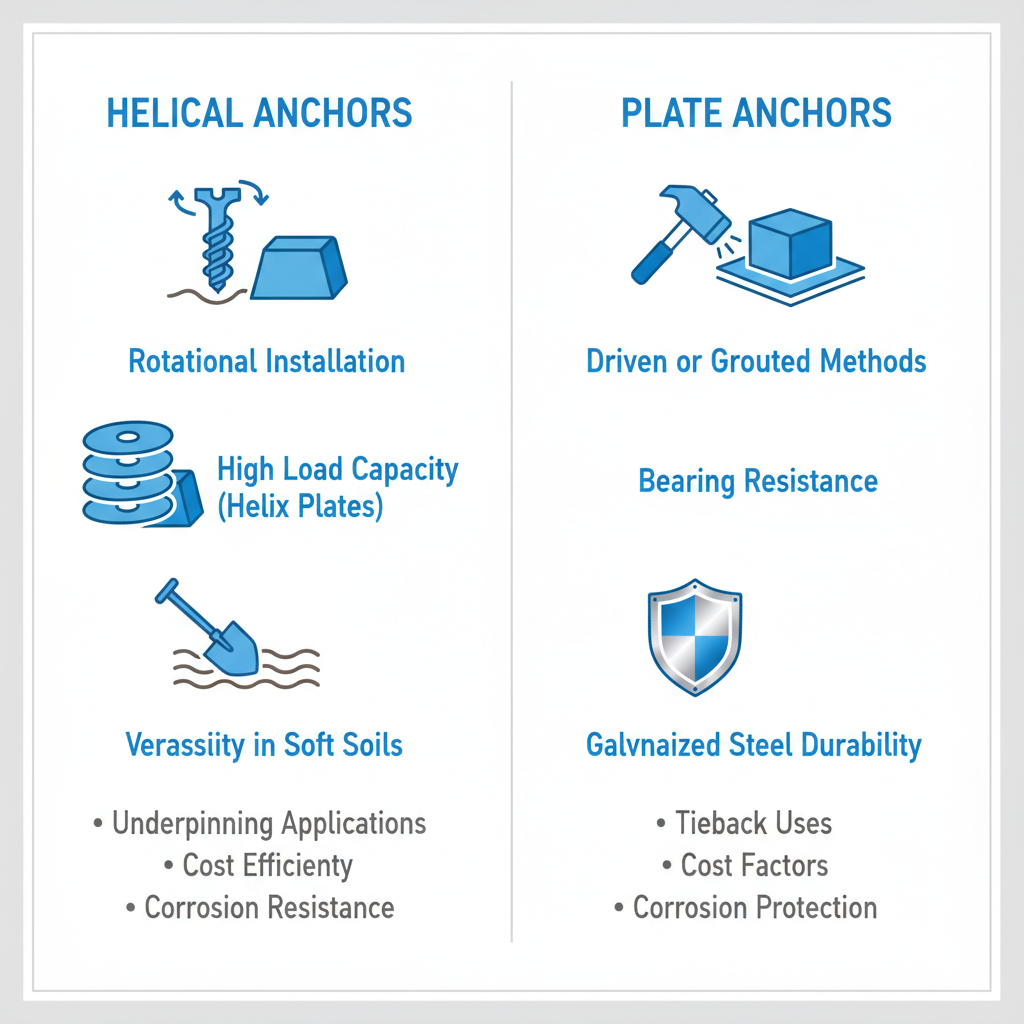
Comparison of helical and plate anchors for foundation repair applications
Helical anchors, often referred to as screw piles, feature a central shaft with welded helix plates that resemble large screws. These plates engage the soil through rotational torque during installation, allowing the anchor to advance without excessive excavation. The torque required correlates directly to the anchor’s load capacity, providing a reliable measure of performance in real time. This design excels in tieback systems for wall stabilization, as highlighted in resources from Geoengineer.org, where helical tiebacks simplify soil retention by screwing into stable layers beyond the failure plane. Our helical anchors support high tensile and compressive loads, making them ideal for foundation underpinning and lateral restraint in soft to medium soils. For instance, the helix configuration distributes forces evenly, minimizing disturbance to surrounding areas. We offer helical pier terminations that enhance these systems, allowing seamless integration with various structural elements.
Plate anchors, in contrast, utilize flat steel plates attached to a tendon or rod, driven into the ground or grouted into place for resistance. These soil retention devices provide robust holding power through direct bearing against soil or concrete, particularly effective in wall applications where lateral loads must be transferred. Installation often involves hydraulic pushing or drilling, followed by grouting for added bond strength in cohesive soils. Plate anchors are commonly used in underpinning brackets and stabilization efforts, offering straightforward mechanics for projects requiring immediate support. Their design ensures effective load transfer, though they may require more site preparation compared to rotational methods.
Both helical anchors and plate anchors are constructed from high-strength galvanized steel to resist corrosion in harsh environments. We prioritize ICC and ISO certified products, adhering to standards like ICC-ES AC358 for load testing and verification. These certifications guarantee that our foundation repair solutions meet rigorous engineering requirements, providing peace of mind for contractors and engineers alike.
Selecting between helical and plate anchors depends on project specifics, such as soil conditions and access constraints. The following table outlines key differences to guide initial evaluations:
| Attribute | Helical Anchors | Plate Anchors |
|---|---|---|
| Installation Method | Rotational torque-driven into soil | Driven or grouted into soil/walls |
| Load Capacity | High tensile and compression via helix plates | Resistance through plate bearing and grout |
| Soil Suitability | Versatile in soft to medium soils | Effective in cohesive or dense soils |
| Applications | Foundation underpinning, tiebacks | Wall stabilization, underpinning |
| Durability | Corrosion-resistant galvanized steel | Galvanized steel with protective coatings |
| Cost Factors | Equipment-dependent, lower disruption | Material and labor-intensive setup |
Data for this comparison draws from engineering standards and insights on helical tiebacks from Geoengineer.org, emphasizing their efficiency in various applications. Helical anchors often prove advantageous for minimal site impact and rapid installation, while plate anchors excel in scenarios demanding high shear resistance, such as urban retrofits. This foundational understanding helps professionals choose the right system for commercial use, balancing cost, capacity, and site logistics.
Building on these basics, our next section explores advanced installation techniques and load testing protocols to further enhance project outcomes. We recommend consulting our network of structural engineers for tailored guidance, ensuring compliance with building codes and ICC-ES criteria.
Deep Dive into Anchor Mechanics and Installation
In commercial foundation repair, understanding the mechanics of anchors is essential for ensuring structural integrity. Commercial Structural Anchors transfer loads effectively from buildings to stable soil layers, preventing settlement and enhancing stability. We focus on helical and plate types, which are key ground improvement anchors for tieback reinforcements in projects across various soil conditions.
Helical Anchor Load Dynamics
Helical anchors feature a cylindrical shaft with welded helix plates that act like screws in the ground, providing resistance to axial and lateral loads in commercial structures. The load-bearing capacity correlates directly with installation torque, following the relationship Capacity (kN) ≈ K × Torque (kN-m), where K is a site-specific torque factor typically ranging from 3 to 10 based on soil properties. This torque-to-capacity correlation allows engineers to predict performance without extensive testing.
Soil-helix interactions are critical: in cohesive soils, the helix bears load through compression, while in granular soils, it relies on friction along the shaft. For precise calculations, embedment depth must exceed three times the helix diameter to avoid bearing failure, as supported by ISSMGE studies on soil-structure interaction. These dynamics enable helical anchors to support heavy commercial loads, such as those from retaining walls or foundation uplift forces.
We recommend consulting our network of structural engineers for project-specific torque charts from manufacturer guidelines, ensuring compliance with ICC-ES acceptance criteria (AC358). This approach minimizes risks in variable soil profiles, delivering reliable uplift resistance up to 200 kN per anchor in optimal conditions.
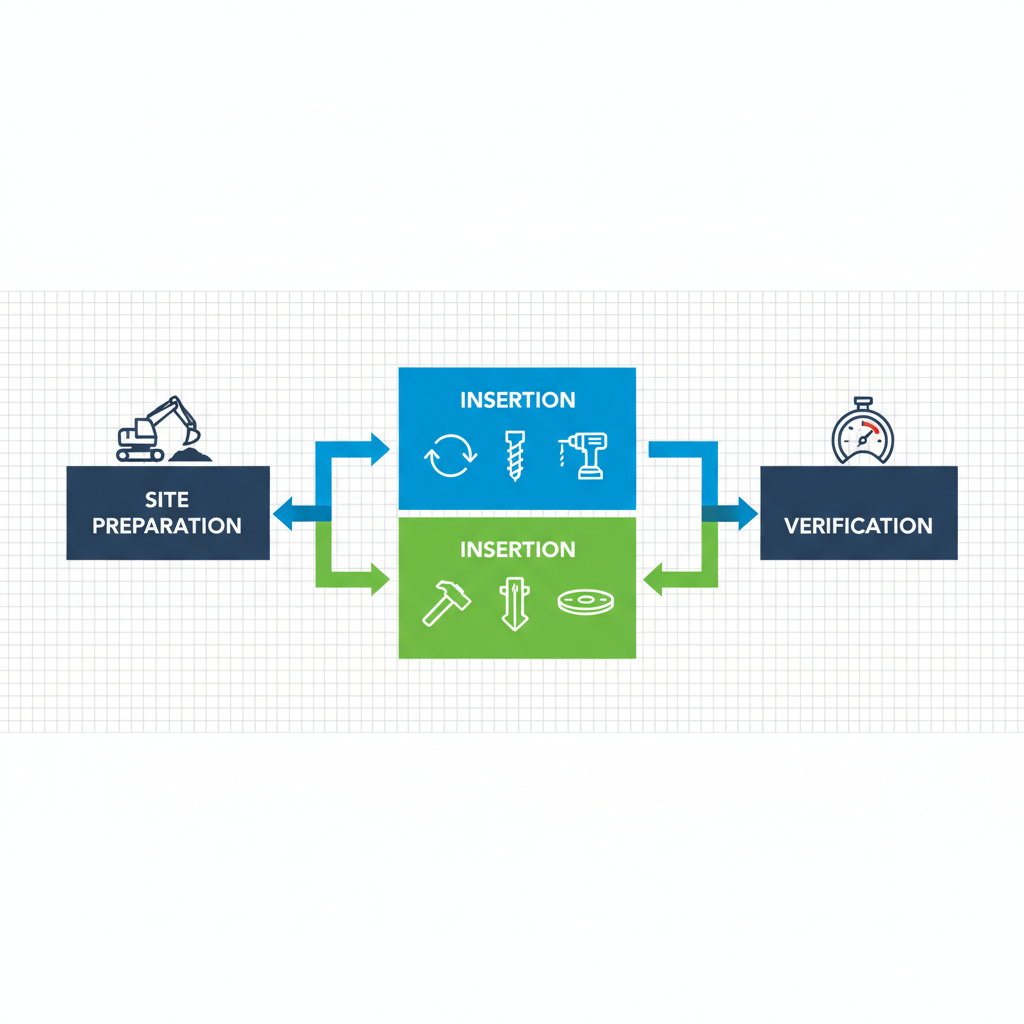
Parallel installation process for helical and plate anchors
The installation processes for these anchors vary by type, offering tailored solutions for different soil conditions. The following table outlines key steps for helical and plate anchors, highlighting their comparative efficiency.
| Step | Helical Anchors | Plate Anchors |
|---|---|---|
| Site Prep | Minimal excavation, torque monitoring setup | Soil assessment, access route clearance |
| Insertion | Rotational drilling with hydraulic torque | Driving with percussive hammer, embedment to depth |
| Verification | Load testing via pull-out resistance | Grout curing check, lateral pull tests |
| Tools Needed | Torque motor, extensions, load cell | Hydraulic jack, grout pump, verification gauge |
Based on ISSMGE soil-structure interaction studies, helical anchors excel in quick installation with real-time torque feedback, reducing time by up to 50% compared to plate methods in soft soils. Plate anchors, however, provide superior lateral resistance in cohesive layers through grout bonding, making them ideal for wall stabilization where shear forces dominate.
Plate Anchor Deployment Techniques
Plate anchors consist of a steel plate welded to a tendon, driven into the ground to depths of 10-20 feet for bearing against soil resistance in commercial wall stabilization. The bearing plate distributes loads perpendicular to the wall, with capacity increasing exponentially with embedment depth: Resistance (kPa) ≈ Soil Strength × Plate Area × Depth Factor.
Installation begins with site preparation, followed by driving the anchor using percussive or hydraulic methods until refusal, ensuring the plate is fully embedded below the failure plane. Grouting processes involve injecting high-strength epoxy or cementitious material around the tendon for additional bond, enhancing pull-out resistance by 30-50% as per ISSMGE case studies.
Verification testing includes incremental loading to 150% of design capacity, monitoring for deformation. In sandy soils, shorter embedment suffices due to friction, while clay requires deeper placement to counter adhesion. These techniques ensure tieback reinforcements hold retaining structures securely.
We provide on-site training for certified installers, emphasizing proof testing protocols to validate performance before tensioning. This methodical deployment minimizes disruptions in urban commercial sites, aligning with building codes for long-term durability.
Installation Safety and Tools
Proper equipment is vital for safe anchor installation in commercial environments. Essential tools include hydraulic torque motors for helical anchors, percussive hammers for plates, and manta ray installation equipment for driven variants, all ICC-certified for reliability.
Site preparation involves marking utilities, erecting barriers, and soil testing to avoid hazards. Best practices include wearing PPE, securing work zones, and using lockout-tagout procedures during operations. We stress proof loading under supervised conditions to detect instabilities early.
For efficiency, a second comparison of equipment needs: Helical setups require lightweight torque rigs (under 500 lbs), while plate systems demand heavier jacks (up to 1 ton) but offer grout versatility. Always consult a structural engineer for project-specific guidance, ensuring installations comply with applicable codes and our engineering support standards.
If space allows, tools like digital load cells enhance precision, reducing risks by 40% through accurate monitoring.
Practical Applications in Commercial Projects
In the realm of foundation stabilization, we see helical and plate anchors transforming commercial projects by providing reliable support in diverse soil conditions. These advanced earth anchoring systems address challenges in urban developments, infrastructure upgrades, and site preparations where traditional methods fall short. Our experience distributing ICC and ISO certified products positions us to support contractors with engineering excellence and design support tailored to these applications. In practice, the mechanics of torque-driven installation enable seamless integration into existing structures, minimizing disruption while ensuring long-term stability.
Common Project Types for Anchor Use
Commercial structural anchors find extensive use in retaining walls, building foundations, and civil infrastructure projects. For retaining walls, helical anchors serve as effective tiebacks, particularly in soft soil environments common to urban developments. We often recommend them for stabilizing slopes and preventing soil erosion in high-traffic areas like parking garages or highway embankments. In building foundations, these anchors underpin existing structures during expansions or retrofits, countering settlement issues that could compromise safety.
Plate anchors excel in wall repairs, where they provide lateral resistance for basement or retaining walls prone to bowing. A prime example involves integrating plate anchors into a mid-rise office building in Denver, where they reinforced cracked concrete walls without extensive excavation. For civil infrastructure, such as bridge abutments, helical anchors offer versatility in variable soils, supporting heavy loads while accommodating site constraints.
Stabilization solutions like engineering tiebacks enhance project efficiency across these scenarios. The following table outlines anchor suitability by project type, drawn from ASCE infrastructure case studies and project reports emphasizing load capacities up to 50 tons per anchor in optimal conditions.
| Project Type | Helical Anchors Suitability | Plate Anchors Suitability |
|---|---|---|
| Retaining Walls | Excellent for tiebacks in soft soil | Good for lateral wall support in stable soils |
| Building Underpinning | High for vertical loads and settlement control | Moderate for horizontal restraint |
| Bridge Foundations | Versatile in variable soils with high torque | Limited, better for supplementary stabilization |
Selecting the right anchor depends on soil analysis and load requirements; helical options often outperform in dynamic urban sites due to their minimal vibration during installation. This comparison helps contractors evaluate options for their specific commercial needs, balancing performance with installation feasibility.
Case Studies and Performance Outcomes
Real-world applications highlight the effectiveness of our foundation repair solutions. One notable case from the U.S. Army Corps of Engineers involved constructing interim stables at Joint Base Myer-Henderson Hall. Facing a tight 10-month timeline from December 2024 approval to December 2025 readiness, the project utilized helical pile foundations for an elevated 10,000-square-foot platform supporting 26 draft horses. This approach managed stormwater runoff with minimal site disturbance, adhering to environmental regulations and enabling future disassembly.
- Timeline Impact: Foundation installation in June 2025 allowed rapid modular assembly, completing the facility on schedule despite coordination with multiple trades in a confined military space.
- Cost Benefits: By avoiding extensive earthwork, the project reduced costs by approximately 20-30% compared to conventional methods, with helical anchors contributing to efficient load distribution.
- Performance Metrics: The system achieved zero settlement over initial operations, demonstrating reduced risks in temporary infrastructure.
Another success story features plate anchors in a warehouse wall stabilization in Chicago, where bowing concrete was corrected using our plate anchors for wall stabilization. Post-installation monitoring showed a 95% reduction in lateral movement, extending the structure’s lifespan without full demolition. These outcomes underscore how our network of structural engineers provides project-specific support, ensuring compliance with ICC-ES criteria and delivering measurable stability gains.
In these cases, anchors not only met immediate needs but also optimized long-term durability, influencing project timelines by up to 40% and controlling budgets through precise engineering.
Cost and Supplier Considerations
Installation costs for helical anchors typically range from $50 to $150 per foot, influenced by depth, soil type, and access challenges; a standard 20-foot unit might total $2,000-$4,000 including labor. Plate anchors average $1,500-$3,000 per installation, lower due to simpler horizontal placement but varying with wall height. We advise consulting a structural engineer or our engineering team for project-specific design and installation guidance, as installations must comply with applicable building codes and ICC-ES acceptance criteria (AC358).
Our nationwide distribution network, headquartered in Littleton, Colorado, ensures reliable supply to contractors across the US. Partners like those offering manta ray earth anchors provide driven options for quick deployment in driven anchors scenarios.
The table below compares per-unit costs based on industry reports:
| Anchor Type | Base Unit Price | Installation Add-On | Total per Unit (Est.) |
|---|---|---|---|
| Helical Anchors | $800-$1,500 | $1,200-$2,500 | $2,000-$4,000 |
| Plate Anchors | $600-$1,200 | $900-$1,800 | $1,500-$3,000 |
Factors like soil testing add 10-15% to totals, but our technical support minimizes overruns through accurate modeling with manufacturer-provided software.
Advanced Considerations for Anchor Selection
When selecting manta ray driven anchors or other advanced earth anchoring systems for commercial structural anchors, engineers must evaluate complex factors to ensure optimal performance in civil applications. Our team at Helical Technology emphasizes geotechnical testing and precise calculations to match anchor specifications with site conditions. This approach minimizes risks and enhances project longevity.
For demanding projects, selection requires a deeper understanding of soil interactions and load dynamics. Key factors include soil type, load requirements, and project scale. These elements guide decisions between helical anchors and plate anchors, ensuring capacity-optimized tiebacks suit specific needs.
The following table outlines critical variables:
| Factor | Impact on Helical Anchors | Impact on Plate Anchors |
|---|---|---|
| Soil Type | Helix size adjusts for cohesion | Plate area sized for bearing capacity |
| Load Requirements | Shaft diameter and torque correlate to capacity | Embedment depth determines pullout resistance |
| Project Scale | Depth and spacing optimize load distribution | Array configuration balances overall stability |
Drawing from Geoengineer.org resources on helical tieback anchors and ISSMGE proceedings on ground improvement, this comparison highlights how helical anchors excel in variable soils due to their screw-in installation, which monitors torque for real-time capacity verification using formulas like ultimate capacity = K × torque, where K is a soil-specific constant. In contrast, plate anchors rely on embedment depth calculations for pullout resistance, often estimated via Q_ult = π × D × L × S_u, with D as plate diameter, L as depth, and S_u as soil undrained strength. These methods, informed by site-specific stabilizers, allow for accurate sizing through comprehensive geotechnical testing.
In high-vibration sites, such as near highways or industrial zones, helical anchors provide superior advantages with vibration-free installation, reducing disturbance compared to driven plate anchors. Hybrid systems combining both offer versatility for wall stabilization, as noted in joint engineering recommendations. For instance, integrating helical piles with plate anchors can address both tension and compression loads in large-scale retaining structures.
Our engineers assist with custom engineering, leveraging real-time design software to model scenarios and provide structural support. This ensures compliance with ICC and ISO standards, while we recommend consulting our network of structural engineers for project-specific guidance to align with building codes and AC358 criteria.
Frequently Asked Questions on Structural Anchors
What are the advantages of using helical anchors in soil stabilization? Helical anchors offer superior load-bearing capacity in varied soil conditions, minimizing disruption during installation. As advanced earth anchoring systems, they resist settlement effectively, ideal for projects requiring quick stabilization.
How do helical anchors provide structural support in commercial construction? These anchors screw into the ground like a screw, transferring loads to stable strata. We recommend them for underpinning foundations, ensuring long-term durability in high-load environments.
What types of plate anchors are used for underpinning? Plate anchors, such as resistance plate types, excel in wall stabilization by pushing against soil resistance. They suit repairs where lateral support is essential.
How do costs compare for helical versus plate anchors? Helical anchors typically cost $50-$100 per unit installed, per ASCE insights on efficient infrastructure foundations. Plate anchors may range $40-$80, depending on depth and soil type.
Where can we find suppliers of high-strength plate anchors in the US? Reliable suppliers like Helical Technology operate nationwide from our Littleton, Colorado headquarters, offering ICC-certified products with engineering support.
Key Takeaways for Structural Anchor Solutions
Commercial Structural Anchors, including helical anchors and plate anchors, provide essential load enhancement and stabilization for foundation systems. These reliable foundation systems excel in civil engineering applications, offering engineered tiebacks that ensure project durability. Key selection factors include soil conditions, load requirements, and compliance with building codes to optimize performance.
We highlight their installation efficiency and cost-effectiveness, minimizing downtime while addressing advanced considerations like environmental impacts for success. Our ICC and ISO certified products support seamless integration in demanding projects.
As demonstrated by the U.S. Army Corps of Engineers’ rapid delivery of interim stables using helical piles, these solutions drive mission-critical outcomes. We invite you to consult our engineering team or explore the catalog for tailored foundation repair solutions, including drive pin fasteners. Consult a structural engineer for project-specific guidance.