


Jason Keefer
President
Floor Stabilizer Post Kit
Table of Contents
Floor Stabilizer Post Kits for Foundation Support
At Helical Technology, we recognize that sagging floors can compromise the safety and integrity of any home or building. A Floor Stabilizer Post Kit serves as an adjustable support system designed for basements and crawl spaces to lift and stabilize uneven floors. Common signs include noticeable sagging, creaking underfoot, or cracks in walls, often stemming from moisture damage, foundation shifts, or natural wear as highlighted in guides on residential repairs. Homeowners might first spot issues like misaligned doors, prompting immediate attention to prevent further structural concerns.
These sagging floor support systems provide reliable temporary stabilization, with load capacities typically ranging from 10,000 to 20,000 pounds per model, making them suitable for various residential and commercial applications. Costs generally start at $100 to $300 per kit, offering an accessible entry point for addressing floor problems without extensive disruption. We supply ICC-certified stabilizer post kit options that meet industry standards, ensuring contractors can implement effective basement stabilization kits. Proper assessment remains crucial, as these tools excel in immediate support but may require professional evaluation for long-term viability.
While a basement stabilization kit offers quick relief, questions arise about its permanence–can it fully resolve foundation issues? For temporary fixes, consider a jack post, but for enduring solutions, explore a helical pier installation. Our expertise guides contractors through these options, setting the foundation for detailed discussions on installation techniques, benefits, and advanced repairs ahead.
Key Components of Floor Stabilizer Post Kits
Floor Stabilizer Post Kits serve as essential tools for addressing sagging floors in basements and crawl spaces, offering reliable support to restore structural integrity. We recommend these kits for scenarios involving visible sagging over 1-2 inches or accompanying structural cracks, as outlined in guides on fixing sagging floors. By understanding their key components, homeowners and contractors can better assess their suitability for specific repair needs. These kits integrate advanced floor stabilization products designed for precision and longevity.
Materials and Design Features
Floor Stabilizer Post Kits feature robust construction tailored for demanding environments. The core consists of heavy-duty steel posts engineered for corrosion resistance, often galvanized to withstand moisture in crawl spaces. Threaded adjustment rods allow for precise height modifications, enabling installers to achieve level support without excessive force. Mounting brackets and base plates secure the assembly to floor joists and foundation slabs, ensuring a stable fit in varied spatial configurations.
These design elements prioritize durability and adaptability. For instance, the base plates distribute weight evenly, reducing stress points on uneven surfaces. We emphasize the importance of professional installation by certified contractors to leverage these features fully, as improper setup can compromise effectiveness. Bullet-pointed components include:
- Steel posts: High-tensile strength for long-term reliability.
- Adjustment rods: Threaded for incremental lifts up to 2 inches, per sagging floor assessment standards.
- Base plates: Wide footprint for enhanced stability.
This Floor Stabilizer Post Kit configuration supports targeted floor support assemblies, making it ideal for residential applications where space constraints exist.
Load Capacities and Safety Limits
Typical Floor Stabilizer Post Kits boast load capacities ranging from 12,000 to 18,000 pounds, sufficient for most residential floor stabilization needs. These ratings, validated by engineering standards in foundation repair overviews, account for distributed loads across multiple posts in a system. Factors like soil type–such as clay versus sand–affect performance, as softer soils may require deeper installation to maximize bearing capacity.
Installation depth plays a critical role in safety limits; posts embedded 4-6 feet into stable soil enhance resistance to lateral forces. We advise consulting structural engineers to evaluate site-specific conditions, including moisture levels that could degrade materials over time. Exceeding rated capacities risks failure, particularly in areas with pest infestations or water damage, common culprits in floor sagging.
For adjustable pier systems, safety margins incorporate a factor of safety exceeding 2:1, ensuring reliability under dynamic loads like foot traffic. Regular inspections post-installation help maintain these limits, preventing issues like uneven settling. By adhering to these guidelines, contractors can deliver foundation repair solutions that align with ICC and ISO certified product standards.
Differences from Jack Posts
While Floor Stabilizer Post Kits and jack posts share structural similarities in providing vertical support, their adjustability and intended use diverge significantly. Jack posts, often used for temporary scaffolding or quick lifts, feature simpler hydraulic or mechanical cranks for broad adjustments but lack the specialized mounting for floor joists. In contrast, Floor Stabilizer Post Kits emphasize semi-permanent floor-specific stabilization, with threaded rods offering finer control for ongoing adjustments without disassembly.
Jack posts typically support 8,000-12,000 pounds for residential use, making them suitable for short-term props during renovations. However, for enduring solutions, Floor Stabilizer Post Kits integrate with crawl-space configurations, providing superior alignment and load distribution. We highlight helical piers as a permanent alternative, anchoring deeper into soil for comprehensive underpinning when sagging stems from foundation shifts–unlike the surface-level focus of jack posts.
Cost factors also differ; jack posts run $50-150 each, while Floor Stabilizer Post Kits, at $200-500 depending on size, justify the investment through enhanced durability. Professional involvement remains crucial, as we offer engineering support to differentiate these options and ensure code-compliant installations. This comparison aids in selecting the right tool for temporary versus long-term floor integrity.
Advantages of Using Floor Stabilizer Post Kits
At Helical Technology, we provide innovative foundation repair solutions like the Floor Stabilizer Post Kit, designed to address sagging floors efficiently in residential settings. This sag correction system offers immediate relief for structural concerns, making it a valuable tool for contractors tackling crawl space challenges. By distributing loads evenly across support post assemblies, it minimizes further damage while allowing for seamless upgrades to more permanent fixes.
Immediate Support and Lift Capabilities
Floor Stabilizer Post Kits deliver rapid stabilization for sagging areas, preventing escalation of foundation issues in basements and crawl spaces. Ease of installation stands out as a primary benefit; our kits require minimal tools and disruption, enabling contractors to deploy them within hours without extensive excavation. This quick setup is ideal for emergency situations where floors have begun to slope, as noted in common repair scenarios involving uneven settling.
The kits excel in load distribution, reducing stress on wooden beams and joists by providing targeted uplift. Unlike basic temporary props, they offer precise adjustability to level floors incrementally, restoring usability to affected spaces. In one case study from a Midwest home, installation halted progressive sagging caused by soil erosion, buying time for comprehensive assessments.
We emphasize that while these kits provide robust temporary support, they are not intended as standalone permanent solutions. Homeowners should consult our network of structural engineers for long-term evaluations, ensuring compliance with building codes. This approach answers queries on whether such systems suit ongoing repairs, highlighting their role in transitional stabilization.
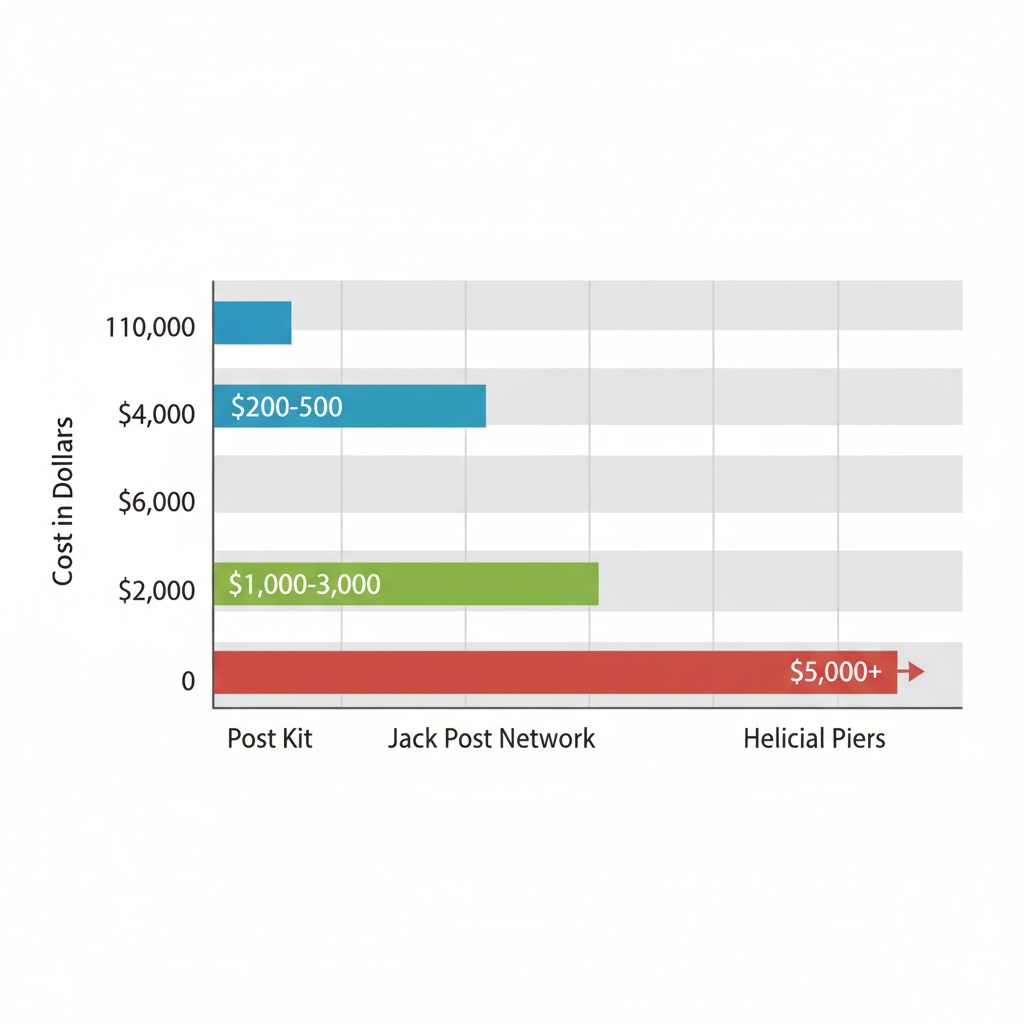
Cost comparison for foundation repair options in 2024
Cost-Effectiveness Compared to Full Repairs
Compared to excavating for helical piers or installing extensive jack post networks, Floor Stabilizer Post Kits offer significant savings, typically ranging from $200 to $500 per unit versus $5,000 or more for pier systems. This economic edge makes them accessible for budget-conscious projects, particularly in residential basements where full replacements are impractical.
Key cost advantages include reduced labor hours and no need for heavy machinery, drawing from industry data on minor repairs costing hundreds rather than thousands. For instance, while helical pier installations demand geotechnical surveys and soil testing, our kits provide upfront value without those prerequisites. A pros/cons comparison further illustrates this:
| Aspect | Floor Stabilizer Post Kit | Jack Post |
|---|---|---|
| Installation Cost | Low ($200-500) | Moderate ($300-800) |
| Disruption Level | Minimal, no excavation | Higher, requires precise placement |
| Adjustability | Precise, incremental leveling | Basic height adjustments |
| Longevity for Temp Use | Excellent, with upgrade potential | Good, but less stable over time |
| Precision in Load Distribution | Superior, even stress relief | Adequate, but prone to shifting |
Interpreting this table, kits outperform jack posts in precision and minimal site impact, leading to faster project completion and lower overall expenses. Industry overviews confirm that addressing early signs like slight slopes avoids escalating to costly underpinning, with our solutions saving up to 80% on initial interventions. However, for sites with severe soil instability, we recommend pairing with professional engineering support to optimize value.
Integration with Helical Pier Systems
Floor Stabilizer Post Kits integrate seamlessly with helical pier systems, creating hybrid solutions for enhanced long-term stability in foundation projects. This compatibility allows contractors to start with quick post deployment for immediate lift, then transition to piers for permanent anchoring, ideal for soil-dependent sites in varying climates.
Synergistic benefits include amplified load-bearing capacity; the kits’ support post assembly stabilizes upper structures while helical piers address subsurface shifts. In a real-world application for a Virginia crawl space, this combination restored a sagging floor by first using kits to level beams, followed by pier installation for enduring reinforcement. Such approaches leverage our ICC and ISO certified products, ensuring reliable performance.
We provide technical support to facilitate these integrations, including on-site training for certified installers. This answers questions on helical piers’ role in crawl space stabilization, emphasizing their synergy with temporary systems like crawl space stabilizer options. Caution is advised against over-reliance on kits alone for permanent fixes; always consult our engineering team for project-specific designs compliant with ICC-ES criteria.
Installation Process for Floor Stabilizer Post Kits
Installing a Floor Stabilizer Post Kit requires careful planning and execution to effectively address sagging floors. As part of our foundation repair solutions at Helical Technology, we advise contractors to follow a structured post installation procedure that ensures structural integrity and compliance with building codes. This process not only stabilizes the floor but also facilitates load transfer from compromised joists to solid support below. While similar to a jack post in basic support function, the Floor Stabilizer Post Kit offers superior precision in adjustments, minimizing uneven lifts. For more complex scenarios involving foundation cracks, complementary products like the concrete crack lock kit can enhance overall repairs. Labor costs typically range from $500 to $1,500, depending on site conditions and hybrid integrations.
Site Preparation and Placement
Proper site preparation forms the foundation of a successful floor lift mechanism. Begin by assessing the sagging area in the basement or crawl space, as outlined in comprehensive guides on fixing sagging floors. Visually inspect for moisture damage, rot, or pest activity, using a level to measure the sag–typically up to 2 inches. We recommend consulting our network of structural engineers for project-specific guidance, especially if helical pier integration is needed for deeper soil stabilization.
- Clear the work area of debris and ensure access to load-bearing beams.
- Mark precise positions under the beams using chalk lines for alignment.
- Level the ground with compacted gravel or a concrete base for secure footing, preventing future shifting.
This step mirrors jack post placement but emphasizes precision to avoid load imbalances. For hybrid systems, pre-install a helical pier nearby to anchor the kit against soil movement. Always address underlying moisture issues first to prevent recurrence, aligning with ICC and ISO certified product standards.
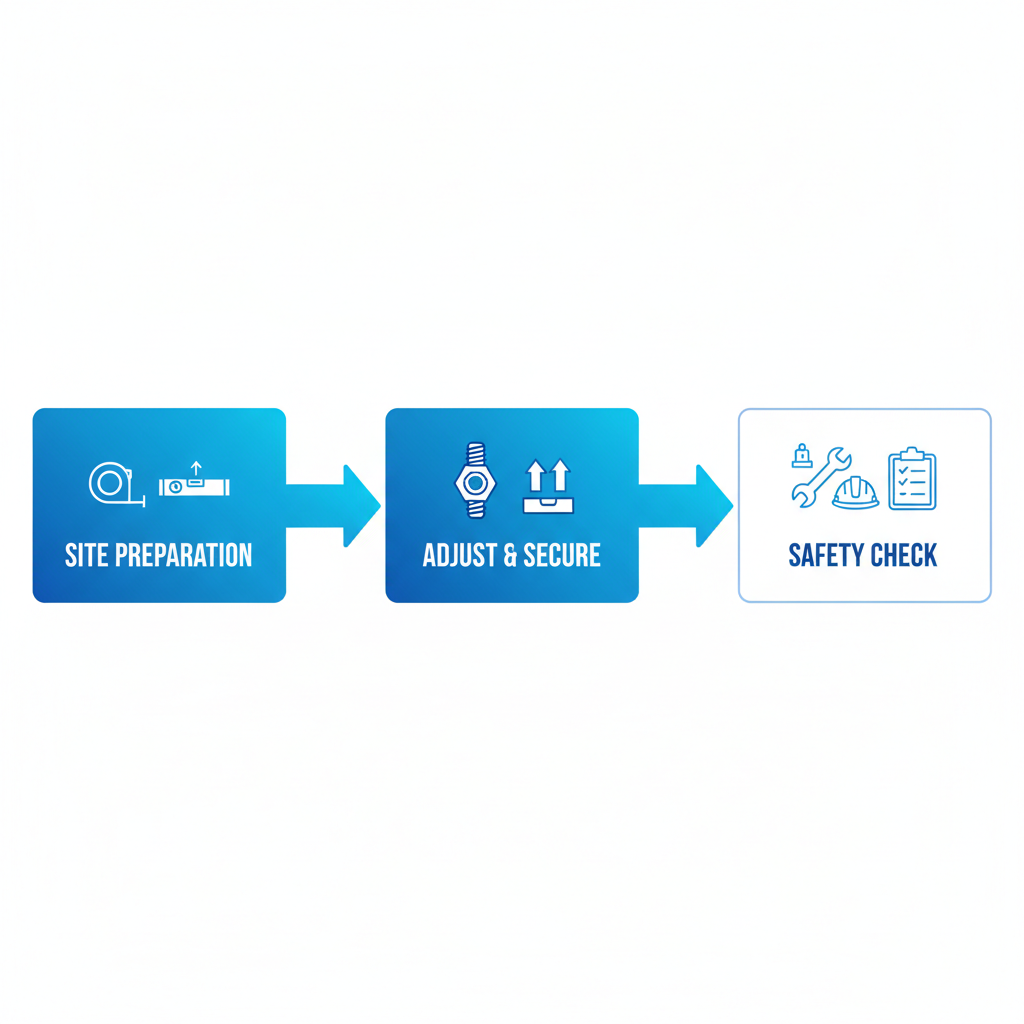
Installation process for Floor Stabilizer Post Kits in three key steps
Adjustment and Securing Steps
Once positioned, the adjustment phase activates the kit’s stabilization capabilities. Thread the adjustable post into its base plate, aligning it directly under the sagging joist for optimal load transfer. Using hydraulic or manual methods, gradually lift the floor 1 to 2 inches, monitoring with a level to achieve even elevation.
- Attach the top plate to the joist using galvanized fasteners.
- Tighten the adjustment mechanism incrementally to raise the structure.
- Secure anchoring brackets to prevent lateral shifting during settling.
Compared to a traditional jack post, this kit provides finer control, reducing bounce or creep over time. In hybrid applications, connect to a helical pier for permanent support in expansive soils. We stress that these kits suit temporary or supplemental use; for long-term fixes, combine with underpinning brackets per engineering advice. This precision ensures safety and longevity in floor stabilization efforts.
Tools and Safety During Setup
Equipping yourself with the right tools and protocols is essential for a safe installation. Required equipment includes a hydraulic jack or torque wrench for lifting, a laser level for accuracy, drill with masonry bits, and safety gear like gloves, goggles, and sturdy scaffolding.
- Conduct a pre-install safety briefing, verifying load capacities.
- Use shoring timbers to support adjacent structures during lifts.
- Monitor for hydraulic leaks or fastener failures throughout.
Safety protocols mitigate common pitfalls, such as uneven lifts that could crack joists further. Drawing from expert guides, always prioritize moisture control and pest inspections beforehand. We advise certified installers only, offering on-site training to ensure compliance with ICC-ES criteria. Avoid unsupervised DIY attempts, as improper setup risks structural failure–consult our technical support team for guidance on integrating with advanced earth anchoring systems.
Selecting and Maintaining Floor Stabilizer Post Kits
When addressing floor instability in residential or commercial structures, selecting the appropriate Floor Stabilizer Post Kit is crucial for immediate support and long-term stability. These kits provide temporary reinforcement for sagging floors, particularly in basements or crawl spaces, while allowing time for comprehensive repairs. At Helical Technology, we offer a range of ICC- and ISO-certified products designed for reliable performance. Factors such as load-bearing capacity, installation height, and compatibility with existing systems must guide your choice to ensure safety and effectiveness.
Choosing the Right Kit for Your Project
Begin by assessing your project’s specific demands, including the load requirements and available space. Floor Stabilizer Post Kits typically range from 6 to 12 feet in height and support capacities up to several thousand pounds, making them ideal for moderate stabilization needs. For instance, if your floor joists span wide areas with limited headroom, opt for adjustable models that accommodate tight clearances. Compatibility with jack post systems allows for fine-tuned leveling, while integration with helical options provides added versatility for soil-dependent sites.
We recommend sourcing from certified suppliers like us at Helical Technology to guarantee quality and compliance with building codes. Full installation costs for a basic kit average $300 to $800, including labor and materials, based on data from industry assessments like the Michigan Assessors Manual. This affordability makes them suitable for transitional use, though consulting our network of structural engineers ensures the kit aligns with your foundation’s unique conditions.
| Solution | Average Cost per Unit (Installed) | Permanence Level | Best For |
|---|---|---|---|
| Floor Stabilizer Post Kit | $300-$800 | Temporary/Transitional | Quick floor leveling in stable soil |
| Helical Pier | $1,000-$3,000 | Permanent | Severe instability or poor soil |
This comparison highlights kits as a cost-effective entry point, but helical piers offer superior longevity for demanding applications. Always verify site-specific factors, such as soil type, to avoid underestimating needs. By matching the kit to your load and space constraints, you minimize risks and maximize value in your repair strategy.
Long-Term Maintenance and Monitoring
Proper upkeep extends the lifespan of your Floor Stabilizer Post Kit and prevents escalation of structural issues. We advise conducting annual inspections to check for corrosion, especially in humid environments, and testing adjustability mechanisms for smooth operation. Look for signs like creaking floors, visible shifts in alignment, or rust on steel components, which may indicate the need for tightening or replacement parts.
Routine post maintenance routines include lubricating adjustment screws and ensuring bases remain securely anchored. Drawing from foundation repair best practices, such as those outlined in comprehensive guides, monitor for moisture intrusion that could weaken supports over time. A simple checklist can streamline this process:
- Inspect posts for rust or deformation quarterly.
- Verify load distribution and levelness biannually.
- Adjust for settling and document changes.
- Consult professionals if cracks appear in surrounding walls.
At Helical Technology, our technical support team provides guidance to maintain optimal performance. Early detection through these practices not only safeguards your investment but also aligns with safety standards, reducing the likelihood of costly failures.
When to Upgrade to Helical Piers
While Floor Stabilizer Post Kits excel in temporary scenarios, upgrading to helical piers becomes essential when facing persistent soil instability or heavy loads. Criteria for transition include ongoing settlement exceeding 1 inch annually, evidence of bowing walls (see bowed wall repair kit), or environments with expansive clays that undermine post effectiveness. Jack post alternatives may suffice initially, but for permanent foundation repair solutions, helical piers deliver deeper anchorage and load transfer unmatched by surface supports.
Consider stabilization upgrade options if inspections reveal inadequate performance, such as uneven floor slopes or water-related erosion. Helical pier installation costs range from $1,000 to $3,000 per unit, offering a worthwhile investment for long-term durability, as supported by industry cost analyses. We at Helical Technology emphasize engineering consultation to evaluate these shifts, ensuring compliance with ICC-ES criteria.
A upgrade checklist includes:
- Assess soil reports for instability indicators.
- Measure ongoing movement in supported areas.
- Review load capacities against current demands.
- Factor in environmental risks like flooding.
Transitioning proactively prevents further damage and leverages our advanced earth anchoring systems for robust outcomes. Remember, installations must comply with applicable building codes–consult a structural engineer or our engineering team for project-specific design and installation guidance.
Effective Foundation Stabilization Strategies
In this comprehensive repair overview, we’ve explored the critical role of the Floor Stabilizer Post Kit in addressing sagging floors caused by foundation settlement. These kits provide essential temporary support, bearing loads up to specified capacities while allowing for precise adjustments during installation. Key signs like uneven floors and wall cracks signal the need for intervention, and integrating best practices ensures safe, efficient stabilization.
Our key takeaways highlight the distinction between temporary solutions like jack posts and permanent options such as helical piers, which offer superior long-term durability. Floor Stabilizer Post Kits stand out for their cost-effectiveness, with unit-in-place costs underscoring value in initial repairs and upgrade paths to full underpinning. For comprehensive fixes, consider complementary methods like crack stitch repair alongside our ICC and ISO Certified products. As foundation repair solutions experts, we emphasize consulting certified contractors to evaluate site-specific needs and comply with building codes.
Looking ahead, assess your foundation promptly and reach out to Helical Technology for engineering support and reliable products. Acting now secures lasting stability and peace of mind for your property. Timely action prevents further structural damage and expenses.