


Jason Keefer
President
Foundation Repair Systems
Table of Contents
Essential Foundation Repair Systems
Among effective solutions are these essential foundation repair systems, which provide structural support for settling or cracking foundations. We at Helical Technology distribute proven options like helical piers and push piers to stabilize homes efficiently.
Helical piers feature steel shafts with helical plates that are screwed into stable soil layers. Installers use a hydraulic torque motor to apply precise torque, advancing the pier until it reaches competent strata. These are ideal for lighter structures and variable soils, offering minimal disturbance.
Push piers, or steel push pier systems, consist of pre-fabricated steel sections hydraulically driven into the ground section by section. Resistance indicates load-bearing capacity, making them suitable for heavier loads and uniform soil conditions.
Foundation drainage below grade prevents hydrostatic pressure, as per expert industry guidelines from the International Association of Certified Home Inspectors (NACHI). It involves perforated pipe surrounded by gravel at the footing base, covered with filter fabric, and sloped to daylight or a sump pump. For interior sagging floors, a floor stabilizer post kit delivers adjustable steel post support from basement to joists without excavation.
Selection depends on soil conditions, structure type, and issue severity. Understanding these systems leads to informed choices on costs and installation.
Helical Piers
Overview
Helical piers represent a cornerstone of advanced foundation repair systems, consisting of galvanized steel shafts with helical plates that are screwed into the soil to stabilize foundations. We at Helical Technology supply these ICC-certified solutions for residential and commercial repairs, eliminating the need for full excavation. This method ensures reliable support in settling structures.
These piers stand out due to their engineered precision and proven performance.
Key Features
- ICC-ES certification ensures compliance with building codes for safe installations.
- Load capacity reaches up to 100+ tons per pier, verified during installation.
- Extensions allow depth adjustments for varying soil layers.
- Corrosion-resistant galvanization protects against environmental degradation.
- Rapid installation minimizes site disruption and accelerates project timelines.
- Non-displacement method preserves surrounding soil integrity.
- Compatible with underpinning repair brackets for seamless bracketed repairs on existing foundations.
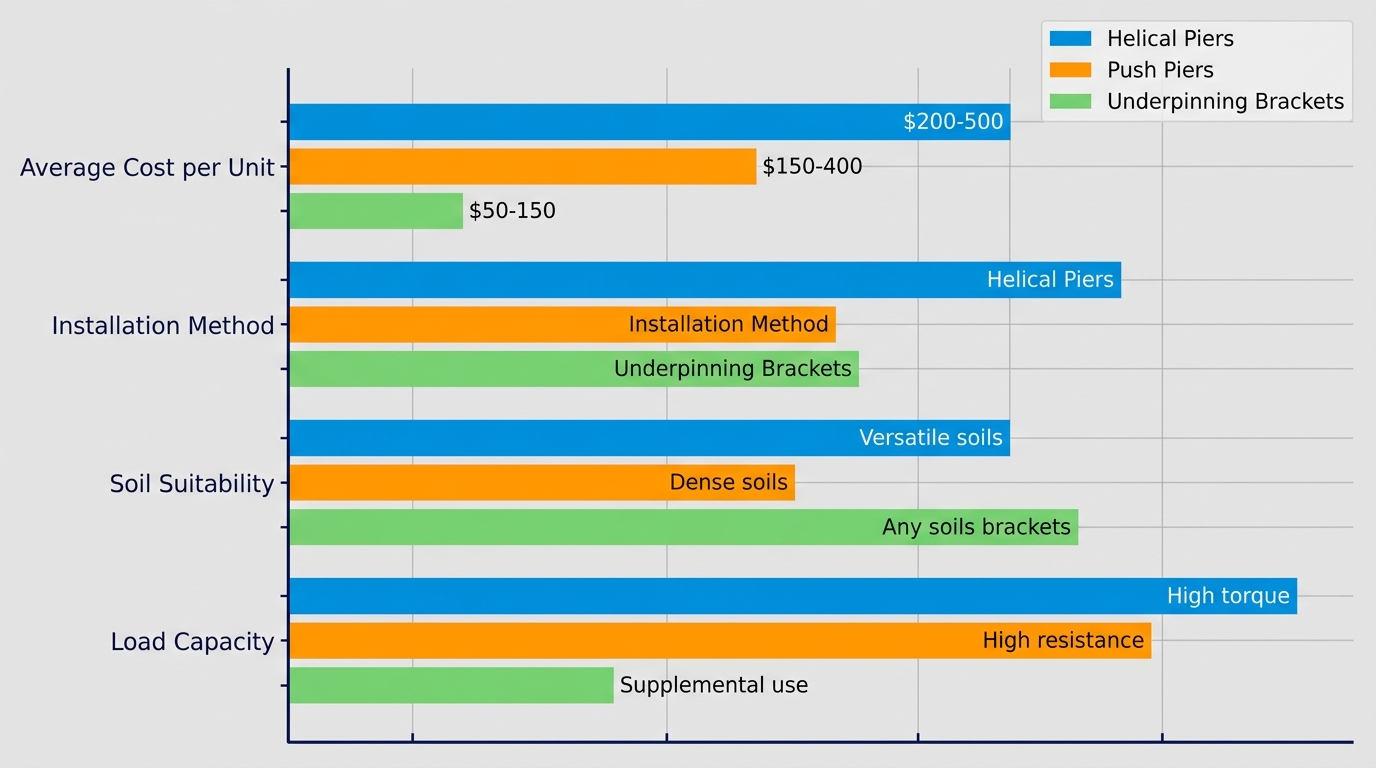
Comparison of helical piers, push piers, and underpinning brackets key features
Helical piers key features in 2×3 icon grid
These features highlight why helical piers excel in demanding foundation repair solutions, offering versatility and durability backed by our engineering support.
Pricing Information
Typical per-pier costs range from $1,000 to $3,000, with full projects spanning $10,000 to $50,000 depending on depth, quantity, soil conditions, and site access.
Cost considerations include…
Pros and Cons
Pros: Helical piers offer unmatched versatility in weak or clayey soils, provide immediate load-bearing capacity post-installation, and generate minimal vibration compared to alternatives like push piers. They enable quick, disruption-free repairs, ideal for operational sites.
Cons: Higher upfront costs than concrete alternatives, requirement for skilled installers with specialized torque-monitoring equipment, and limitations in very dense rock where drilling may be needed.
This balanced profile positions helical pile foundations as a premium yet efficient choice within foundation repair systems.
Best Use Cases
Helical piers suit expansive clay soils, lightweight structures, seismic zones, and settling existing foundations. They shine in quick-turnaround projects like substations, as detailed in an ASCE civil engineering case study on repairing aging active infrastructure with minimal operational disruption.
Push Piers
Overview
Unlike helical piers which are screwed into the ground, push piers consist of steel shafts hydraulically driven to precise depths for foundation stabilization. As a key component of foundation repair systems, we at Helical Technology supply these robust solutions that lift and level slab-on-grade foundations without excavation, minimizing disruption.
Key Features
Push piers offer several advantages in foundation repair systems:
- Hydraulic driving mechanism enables precise depth control and uniform load distribution.
- Compatibility with existing concrete slabs allows direct installation through slabs.
- Minimal site disturbance reduces impact on landscaping and structures.
- Load-bearing capacity up to 50 tons per pier supports heavy residential and commercial loads.
- Steel construction with corrosion-resistant coatings ensures long-term durability.
These features make push pier systems reliable for targeted stabilization.
Pricing Information
Push pier installation costs $1,000-$3,000 per pier, with projects typically requiring 10-20 piers ($10,000-$60,000 total). Factors include soil conditions and pier count. Consult our engineering team for accurate quotes.
Pros and Cons
Pros:
- Quick installation in 1-2 days.
- No concrete pouring required.
- Effective for heavy loads on slab foundations.
- Minimal excavation preserves site integrity.
Cons:
- Limited to stable soils; refusal possible in rocky ground.
- Higher upfront cost than some alternatives.
- Less ideal for very deep settlements compared to helical piers.
- Requires precise soil assessment.
For surface cracks, pair stabilization with a concrete crack lock kit.
Best Use Cases
Push piers excel for slab foundations, commercial buildings like substations, and clay or sandy soils, as shown in ASCE case studies on aging infrastructure repairs under live loads. Ideal for projects minimizing utility disruptions. For deeper soil access, consider helical piers as an alternative. Always consult a structural engineer.
Underpinning Repair Brackets
Brackets enhance pier systems within comprehensive foundation repair systems. Underpinning repair brackets are steel components that connect foundation walls to helical piers or push piers, enabling effective load transfer and stabilization. The Federal Emergency Management Agency (FEMA) highlights their success in Connecticut’s crumbling concrete case study.
Overview
Underpinning repair brackets provide critical structural support in foundation repair systems by linking walls to piers for stability, as demonstrated in FEMA’s real-world Connecticut project addressing crumbling foundations.
Key Features
- High load-bearing capacity of 50-100 tons
- Adjustability for precise alignment
- Galvanized coating for corrosion resistance
- Compatibility with helical piers and push piers
- Quick installation process
Pricing Information
Average cost ranges from $500-$1,500 per bracket, including installation, varying by project scale.
Pros and Cons
Pros:
- Minimally invasive approach
- Cost-effective alternative to full replacement
- Proven effective in FEMA projects
Cons:
- Requires professional installation
- Not ideal for severe lateral movement
Best Use Cases
Ideal for crumbling concrete foundations, settling walls, and crack stabilization in residential and commercial structures, like FEMA’s Connecticut homes. Pair with crack repair products and push piers for optimal results; consult our engineering team for specifics.
Comparing Foundation Repair Systems
With foundation issues identified, we compare repair options below. Comparing foundation repair systems helps contractors select the optimal solution for their projects. Helical piers excel in variable soils, push piers suit dense conditions, and underpinning brackets provide supplemental support.
Key Foundation Repair Systems Comparison
The table below compares critical factors across these foundation repair systems:
| Feature | Helical Piers | Push Piers | Underpinning Brackets |
|---|---|---|---|
| Average Cost per Unit | Scalable, $200-$500 | $150-$400 | $50-$150 |
| Installation Method | Rotary torque screwing | Hydraulic driving | Mechanical bracketing |
| Soil Suitability | Versatile, poor to good soils | Dense/compacted soils | Any, structure-attached |
| Load Capacity | High, predictable via torque | High via resistance | Supplemental stabilization |
| Engineering Needs | Project-specific design | Load testing | Structural assessment |
Data derived from ASCE engineering guidelines, FEMA concrete repair insights, Helical Technology product specifications
Helical piers offer scalable costs at $200-$500 per unit, providing value over push piers at $150-$400 and far exceeding budget-friendly brackets at $50-$150. Contractors balance initial investment with long-term reliability in foundation repair systems.
Installation varies by soil: helical piers advance via rotary torque screwing into poor to good soils, push piers drive hydraulically into dense formations, and brackets attach mechanically regardless of soil, per versatile applications.
Load capacities differ markedly. Helical piers deliver high, predictable torque-based performance according to the American Society of Civil Engineers (ASCE) authoritative civil engineering case study. Push piers achieve high resistance loads, while underpinning brackets offer stabilization, informed by Federal Emergency Management Agency (FEMA) government-backed examples of concrete repairs. Engineering demands project-specific designs for helical piers, often complemented by high strength epoxy adhesive for secure installation; push piers require load testing; brackets need structural assessments.
These insights guide decisions in foundation repair systems. Select based on soil tests and budget, with helical piers favored for versatility. Consult our network of structural engineers for project-specific guidance. Based on this comparison, helical piers often lead details follow in the installation guide.

Helical piers key features in 2×3 icon grid
Comparison of helical piers, push piers, and underpinning brackets key features
At Helical Technology in Littleton, CO, our ICC-certified products support these systems nationwide.
Selecting the Right Foundation Repair Systems
If your home shows signs of foundation settlement like cracks or shifting floors, selecting the right foundation repair systems demands careful evaluation. At Helical Technology, we provide ICC and ISO Certified products tailored to site conditions, ensuring long-term stability for residential structures.
Helical piers, or helical screw piles, excel in unstable soils. They screw directly into stable strata without heavy excavation.
- Pros: Minimal site disruption, immediate load transfer.
- Cons: Less ideal for very dense soils.
In contrast, push piers handle high-capacity loads in dense soils by hydraulically driving steel sections.
- Pros: High load-bearing in stable upper soils.
- Cons: Requires precise resistance measurement.
Below-grade foundation drainage plays a vital role in preventing future issues. According to NACHI authoritative home inspection standards, perimeter drains, sump pumps, and waterproofing manage hydrostatic pressure around foundations, as required by IRC Section R405.1. Key selection factors include soil type, structure load, site access, and budget.
We recommend consulting certified installers, such as porch builders near me, for site-specific assessments. Always consult our network of structural engineers for project guidance. Next, explore proper installation techniques.
This article was researched and written with the assistance of AI tools.