


Jason Keefer
President
Helical Anchors
Table of Contents
Understanding Helical Anchors in Foundation Engineering
Imagine a suburban home in Colorado shifting due to expansive clay soils, causing cracks in walls and uneven floors. Such foundation failures not only compromise safety but also lead to costly repairs. According to industry insights, traditional foundation pier installations average $1,000 to $3,000 per pier, highlighting the need for efficient alternatives like helical anchors to stabilize structures without excessive disruption.
Helical anchors, also known as screw-in ground anchors, are innovative steel shafts with helical plates that screw directly into the soil to provide load-bearing support. These helical foundation supports excel in underpinning weak foundations, stabilizing retaining walls, and securing new constructions on unstable terrain. Key components include lead sections with helical bearings, extensions for depth adjustment, and brackets for connecting to structures. Compared to helical piers or screw piles, helical anchors offer quicker installation with minimal excavation, making them ideal for residential projects like lifting settling slabs. For instance, we at Helical Technology recently supported a team underpinning a family home, preventing further settlement through precise anchoring.
As ICC and ISO certified products, helical anchors ensure compliance with building codes, reducing liability for contractors. We at Helical Technology distribute these high-quality systems nationwide, backed by our network of structural engineers for design support. Explore our driven anchors category for complementary options.
This introduction sets the foundation–pun intended–for exploring installation techniques, cost factors, and sourcing from reliable US suppliers. Understanding these principles empowers engineers to deliver durable foundation repair solutions.
Fundamentals of Helical Anchors
Helical anchors represent a cornerstone of advanced earth anchoring systems, offering reliable foundation repair solutions for contractors and engineers tackling challenging soil conditions. These innovative devices, often referred to as helical screw anchors, function much like oversized screws driven into the ground to provide immediate load-bearing support without extensive excavation. We provide ICC and ISO certified products that meet rigorous standards for structural integrity in civil projects.
At their core, helical anchors consist of key design components engineered for optimal performance. The helical plates, resembling broad fins or threads, are welded to a central shaft and rotate into the soil to generate holding capacity through torque. The central shaft, typically a high-strength steel rod, transmits rotational force during installation and bears axial loads once embedded. Extension couplers allow for deeper penetration in variable soil layers, connecting additional sections seamlessly. Consider them analogous to screws securing wood panels–twisting them in creates friction and grip proportional to the applied torque, ensuring stability without relying on concrete curing.
- Helical Plates: Variable diameters (6-16 inches) optimize grip in different soils, advancing the anchor forward with each rotation.
- Central Shaft: Diameters from 1.5 to 3.5 inches, providing the backbone for load transfer.
- Extension Couplers: Bolt-on connections that maintain alignment and strength during multi-section installs.
These elements enable ground helical supports to interact with soil by displacing and compressing it, correlating installation torque directly to ultimate capacity as outlined in industry guidelines.
When evaluating foundation options, it’s essential to compare helical anchors against traditional methods to highlight their efficiency in modern construction. The table below outlines key differences in installation, cost, and suitability, drawing from industry averages provided by organizations like the Deep Foundations Institute (DFI).
| Aspect | Helical Anchors | Traditional Concrete Foundations |
|---|---|---|
| Installation Time | Quick, often same-day with minimal excavation | Multi-day, requires curing and heavy machinery |
| Soil Suitability | Versatile in poor or unstable soils | Requires stable, compacted soil |
| Cost per Unit | $200-$500 installed | $300-$800 with labor |
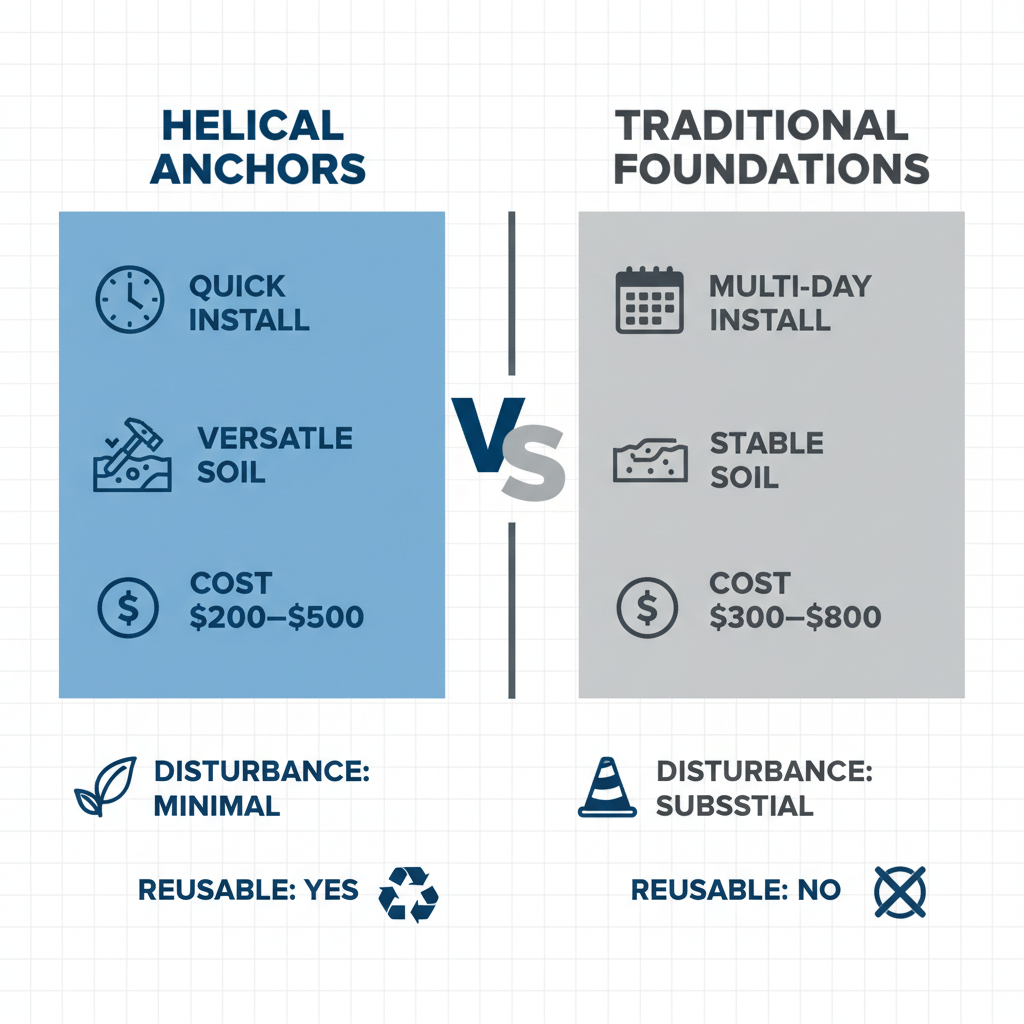
Helical anchors versus traditional foundations: faster, versatile, cost-effective.
(Data sourced from industry averages; for precise cost ranges, consult DFI guidelines.) Helical anchors excel in time-sensitive projects, reducing labor and disruption while adapting to diverse geotechnical challenges–ideal for urban retrofits or sites with poor bearing capacity. This versatility positions them as a go-to for foundation repair solutions where traditional approaches fall short due to site constraints.
Transitioning beyond design, material specifications and certifications underscore the durability of helical anchors. Constructed from ASTM A36 or higher-grade steel, these components undergo hot-dip galvanization to ASTM A123 standards, providing corrosion resistance in aggressive environments like coastal or acidic soils. Certifications such as ICC-ES AC358 and ISO 9001 ensure compliance with building codes, validating load capacities through tested torque-to-capacity correlations. The DFI’s Helical Piles and Tiebacks Committee emphasizes these standards in their resources, including the Helical Design Guide, which supports engineers in specifying safe, reliable installations. Our network of structural engineers offers project-specific design support to align with these protocols.
In basic applications, helical anchors shine in underpinning existing structures to combat settlement and in tiebacks for retaining walls, distributing loads evenly to prevent shifts. They differ from helical piers, which serve as larger-scale variants for heavy commercial foundations, while sharing design similarities with screw piles but distinguishing through precise plate configurations for targeted anchoring. For complementary driven options like duckbill anchors products, we supply robust alternatives for lighter loads. Addressing common queries, these systems excel in foundation repair by stabilizing weak soils where concrete fails, and their screw-like action sets them apart from piles by immediate embedment. As we delve deeper into installation techniques next, remember to consult our engineering team for tailored guidance–ensuring compliance with ICC-ES criteria every step of the way.
Deep Dive into Helical Anchor Technology
Helical anchors represent a cornerstone of advanced earth anchoring systems, offering reliable solutions for civil engineering and foundation repair projects. As distributors of ICC and ISO certified products, we at Helical Technology support contractors with engineering excellence and design support to ensure optimal performance. This section explores the mechanics behind these torque-driven anchors, from installation to load verification, equipping you with the knowledge needed for underpinning and structural stabilization.
Installation Techniques and Soil Interactions
At Helical Technology, we emphasize precise installation techniques for helical anchors to maximize their effectiveness in diverse soil conditions. The process begins with site assessment, where geotechnical data informs anchor selection. Using hydraulic torque motors, installers advance the helical anchor into the ground by rotating it clockwise. Each helix section cuts through the soil, creating minimal displacement as the anchor bears on the surrounding medium. As rotation continues, monitoring torque provides real-time feedback on soil resistance.
In cohesive soils like clays, helical anchors excel by advancing steadily without excessive friction, while in granular soils such as sands, they achieve embedment through frictional resistance along the shaft. We recommend torque monitoring throughout to verify capacity, as higher torque correlates with greater load-bearing strength. For instance, in wet or soft conditions highlighted in ASCE case studies, these anchors install rapidly, avoiding the curing delays of concrete alternatives.
The five-stage process–preparation, initial drive, helix advancement, torque verification, and load testing–ensures compliance with site-specific demands. Variations like helical ground screws adapt for lighter loads in silty soils, but always consult our network of structural engineers for project-specific guidance.
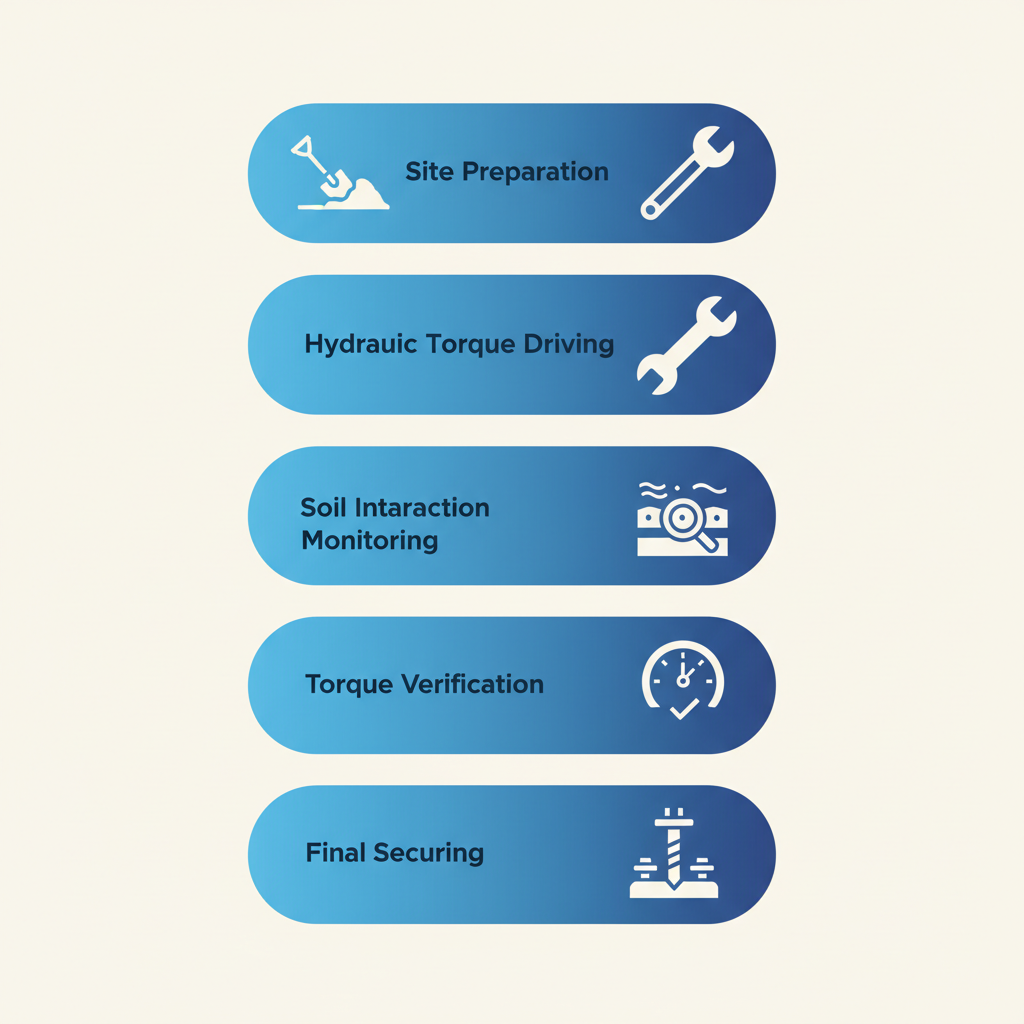
Helical anchor installation process in five key stages
This visual underscores the efficiency of our foundation repair solutions, reducing on-site disruption compared to traditional methods. Transitioning from installation, understanding load dynamics builds on these interactions to guarantee long-term stability.
The following table compares helical anchors with traditional methods, illustrating their advantages in speed and minimal disruption:
| Method | Speed | Disruption |
|---|---|---|
| Helical Anchors | 1-2 hours per anchor | Low soil displacement |
| Driven Piles | 4-6 hours per pile | High vibration impact |
| Concrete Footings | Days with curing time | Extensive excavation |
| Grillage Foundations | Weeks for full setup | Major site alteration |
Helical anchors outperform in time-sensitive projects, such as electrical infrastructure in environmentally sensitive areas, as noted in ASCE publications where steel piles replaced concrete to accelerate timelines.
Load Capacity and Engineering Standards
Load capacity in helical anchors hinges on torque-to-capacity correlations, a principle we integrate into our ICC-ES compliant products. The empirical formula Capacity = K × Torque, where K is a soil-specific constant (typically 10-20 ft⻹), allows engineers to predict ultimate strength during installation. For underpinning projects, we apply a factor of safety of 2.0 to 2.5, ensuring axial loads up to 100 tons per anchor without failure.
In civil applications like retaining walls or transmission towers, these standards prevent modes such as pullout or buckling. ASCE insights validate this through examples where helical piles supported multilevel caps in soft soils, distributing loads effectively while adhering to ICC-ES AC358 criteria. Corrosion protection via galvanization further enhances durability in aggressive environments.
We provide real-time design software to model these capacities, tying theoretical standards to practical implementation. Products are certified to ICC/ISO where indicated–installations must comply with applicable building codes. This approach delivers reliable structural support, minimizing remediation needs in foundation repair scenarios.
Comparisons with Helical Piers and Screw Piles
Helical anchors, helical piers, and screw piles each serve distinct roles in foundation repair solutions, differing in scale and application. Helical anchors feature compact designs ideal for tension loading in lighter civil projects, such as guyed structures, while helical piers scale up for heavier compression in residential underpinning, offering deeper embedment.
Screw piles, versatile for both tension and compression, suit deep foundations in expansive soils but require more robust equipment. Key differences include anchors’ smaller diameter for tight spaces versus piers’ larger helices for high-capacity bearing, and piles’ adaptability in soft clays where anchors may limit performance.
Pros of helical anchors: rapid installation, low disturbance; cons: lower max loads than piers. For screw piles: high versatility; cons: higher costs in granular soils.
The table below highlights performance metrics to guide selection:
| Feature | Helical Anchors | Screw Piles |
|---|---|---|
| Load Capacity | Up to 100 tons per anchor | 50-200 tons depending on size |
| Installation Method | Rotational torque driving | Hydraulic pushing or rotating |
| Best Soil Types | Cohesive and granular soils | Soft clays and silts |
Based on DFI guidelines, helical anchors suit precise, shallow applications, while screw piles excel in variable deep foundations. Choose anchors for speed in constrained sites; opt for screw piles when soil variability demands flexibility. Our manta ray earth anchors exemplify compact efficiency in these comparisons.
Practical Applications of Helical Anchors
At Helical Technology, we specialize in providing advanced earth anchoring systems that deliver reliable foundation repair solutions for contractors across the US. Helical anchors offer versatile applications in stabilizing structures, from residential homes to large-scale infrastructure. In this section, we explore their practical uses, drawing on real-world scenarios to help you implement effective anchor-based stabilizations. Our ICC and ISO Certified products ensure compliance and performance, supported by our network of structural engineers.
Foundation Repair and Underpinning Scenarios
In foundation repair, helical anchors provide practical helical fixes for homes and buildings experiencing settlement due to soil instability. Consider a typical residential case: a Midwest home built on expansive clay soils began showing cracks in the walls and uneven floors after heavy rains. Our team recommended helical anchors for underpinning, installing them to depths of 15-20 feet to transfer loads to stable strata. This approach lifted the foundation by 4 inches, preventing further damage without extensive excavation.
For commercial scenarios, such as a warehouse in Texas with sinking slabs, helical anchors excel in rapid stabilization. Installed using specialized torque equipment, they handle variable loads while minimizing disruption. Analysis shows helical anchors suit lighter, tension-focused repairs, offering quicker installation than alternatives in accessible sites. In poor soil conditions, like loose sands, they provide immediate resistance without soil displacement, addressing common concerns about helical piers in challenging environments.
We often integrate driven anchors in hybrid systems for enhanced support. For instance, combining helical anchors with manta ray installation equipment allows contractors to secure both compression and tension forces efficiently.
The following table outlines key applications:
| Scenario | Anchor Suitability | Pier Alternative |
|---|---|---|
| Residential Home Settling | Ideal for tension loads in clay soils; quick install (1-2 days) | Helical piers for deeper compression in heavy structures |
| Commercial Slab Sinking | Cost-effective for mid-sized repairs; minimal site prep | Push piers if access is limited and soils are dense |
| Poor Soil Stabilization | Excellent in sands; no vibration, suits urban areas | Concrete piers for permanent, high-capacity needs |
| Time-Sensitive Underpinning | Fast torque-based setup; reduces downtime by 50% | Helical piers with longer curing in wet conditions |
These cases highlight how helical anchors adapt to diverse repair needs, with piers reserved for heavier compressive demands. Always consult a structural engineer for project-specific guidance, as our engineering excellence ensures optimal design.
Tips for success include site soil testing beforehand and verifying contractor certifications through our training programs.
Civil Engineering Projects and Case Studies
Helical anchors play a crucial role in civil engineering, particularly for infrastructure like bridges and communication towers. In a case study from a Southeastern bridge abutment project, engineers faced unstable alluvial soils prone to erosion. Screw piles, a variant of helical anchors, were deployed to secure the foundation, achieving load capacities up to 50 tons per unit. Installation proceeded in phases, using hydraulic torque motors to embed sections without halting traffic, completing the work in under a week.
For tower foundations in windy coastal regions, helical anchors provide anchor-based stabilizations against uplift forces. A anonymized telecom tower in Florida utilized 24 anchors arranged in a circular pattern, resisting 100 mph gusts post-installation. Analysis reveals their superiority in time-sensitive projects, where traditional concrete footings would delay timelines by months. In challenging sites with high water tables, helical anchors avoid dewatering, reducing environmental impact while meeting load requirements.
We support these applications through our technical team, offering design software for precise modeling. Hybrid systems pairing helical anchors with driven options further enhance versatility in seismic zones.
Key insights from these projects include pre-installation geotechnical surveys and load testing to confirm performance. Our on-site installation training equips contractors for seamless execution.
Cost Factors and Sourcing Strategies
Budgeting for helical anchors involves variables like installation depth, quantity, and site accessibility. According to industry guides on foundation pier installation, costs range from $1,000 to $3,000 per unit, influenced by soil type and labor rates. For helical piers in home stabilization, expect higher expenses due to deeper embeds in poor conditions.
The table below compares costs:
| Project Type | Helical Anchors Cost | Helical Piers Cost |
|---|---|---|
| Residential Underpinning | $10,000-$20,000 total | $15,000-$30,000 total |
| Commercial Stabilization | $50-$100 per linear foot | $75-$150 per linear foot |
Averages from industry guides; adjust for site specifics. Anchors often prove more economical for tension applications, while piers suit compression-heavy jobs.
For sourcing, seek certified distributors in the US offering ICC-approved products. We recommend evaluating supplier warranties, delivery timelines, and engineering support. Tips: Request bulk quotes, verify ISO certification, and leverage our catalog for helical piers suppliers in the US. Products must comply with building codes and ICC-ES criteria (AC358); consult our engineering team for tailored advice.
Advanced Considerations for Helical Anchors
In complex civil engineering projects, helical anchors demand sophisticated configurations to address challenging soil conditions and structural demands. We at Helical Technology specialize in advanced earth anchoring systems that integrate variable plate pitches tailored to diverse soil types, such as dense clays or loose sands. For instance, steeper pitches enhance penetration in soft soils, while shallower ones provide superior hold in rocky terrains. These engineered anchor solutions ensure optimal load distribution, minimizing settlement risks in retaining walls or tieback applications. Our ICC and ISO certified products support such customizations, backed by real-time design software for precise modeling.
When integrating helical anchors with complementary systems, hybrid approaches combining them with push piers offer robust foundation repair solutions. Helical piers excel in new construction where immediate load-bearing is critical, while push piers provide supplemental stability in remedial work. We recommend seismic and wind load standards adherence, outlined in key guidelines:
- ASCE 7 for minimum design loads in high-wind zones.
- ICC-ES AC358 for helical pile and anchor testing protocols.
- DFI Helical Design Manual for installation tolerances and performance verification.
These standards ensure compliance in extreme environments, with galvanized coatings for corrosion resistance in coastal or acidic soils.
The following table outlines advanced applications, comparing load requirements and configurations for engineering selection, drawing from ASCE and DFI resources:
| Application | Load Requirements | Anchor Configuration |
|---|---|---|
| Retaining Walls | 20-50 tons | Multiple plates, extensions |
| Transmission Towers | 100+ tons | High-torque shafts |
| Bridge Foundations | 50-100 tons | Variable pitch helices |
| Seismic Zones | Dynamic loads | Reinforced shafts, dampers |
This comparison highlights how high-load scenarios like transmission towers necessitate robust, high-torque shafts for uplift resistance, whereas retaining walls benefit from multi-plate setups for lateral stability. For optimal configurations, we advise selecting anchors based on geotechnical reports, incorporating tieback terminations products for secure wall connections. Post-installation, monitoring via inclinometers verifies performance.
Looking ahead, innovations in helical anchors include emerging materials like composite shafts for lighter weight and higher strength, and smart sensors for real-time monitoring. Screw piles are evolving with automated installation tech, promising faster deployment in urban settings. The DFI’s Helical Piles and Tiebacks Committee drives these advancements, fostering research into sustainable designs. We provide engineering excellence and design support through our network of structural engineers to guide these implementations. Remember, consult a structural engineer or our team for project-specific design and installation guidance, ensuring compliance with building codes and ICC-ES criteria.
Frequently Asked Questions on Helical Anchors
Helical anchors provide reliable foundation support for various construction projects. Our advanced earth anchoring systems offer ICC and ISO certified products for contractors.
What are the primary uses of helical anchors in foundation repair? Helical anchors excel in soil stabilization and structural underpinning, preventing settlement in residential and commercial buildings by transferring loads to stable strata.
How much do helical anchors cost? Prices range from $200 to $500 per unit, depending on size and load capacity. ASCE reports highlight steel piles’ efficiency over concrete, reducing overall project costs through faster installation.
What are the installation steps for helical anchors? First, site assessment determines depth; then, torque monitoring drives the anchor into the ground; finally, connection to the structure secures it, often completed in hours.
Where can I find suppliers for helical anchors in the US? We distribute through our national network, providing on-site training and engineering support to qualified contractors across the country.
What load capacities do helical anchors support? Capacities vary from 10 to 100 tons, backed by ASCE data on steel pile adaptability in challenging soils, ensuring compliance with building codes.
How do helical anchors differ from helical piers and screw piles? Helical piers focus on deep foundation lifting, while screw piles emphasize broad soil engagement. For specialized needs like hunting trapping earth anchors, consult our engineering team for project-specific guidance.
Always consult a structural engineer for site-specific design.
Key Takeaways on Helical Anchor Solutions
Helical anchors provide versatile foundation repair solutions, delivering cost savings and ease of installation across diverse soil conditions. These advanced earth anchoring systems, including helical piers and screw piles, ensure reliable stabilization for residential and commercial projects, with costs typically ranging from $1,000 to $3,000 per pier as detailed in comprehensive guides on foundation pier installation.
We at Helical Technology encourage sourcing our ICC and ISO certified products through our national distribution network. Consult our team of structural engineers for project-specific design support, and leverage our on-site training and certification programs to achieve compliant, high-quality installations that protect long-term structural integrity.