


Jason Keefer
President
Helical Foundation Anchors
Table of Contents
Exploring Helical Foundation Anchors
Among innovative foundation solutions, helical anchors stand out for their efficiency and reliability. Helical foundation anchors are steel shafts fitted with helical plates that screw directly into the ground, providing immediate load-bearing capacity without the need for concrete curing. At Helical Technology, we distribute these advanced earth anchoring systems to contractors nationwide from our base in Littleton, Colorado. We provide technical training and design assistance to certified installers nationwide, including on-site support.
Core components include:
- Central steel shaft, galvanized for corrosion resistance.
- Multiple helical plates, sized according to soil conditions.
- Optional extensions for reaching optimal depth.
Installation uses a hydraulic torque motor to advance the anchor until target torque confirms capacity instantly through torque testing. Known also as screw piles, this process eliminates pre-drilling in most soils.
Key advantages feature vibration-free operation ideal for sensitive structures, all-weather usability, no spoils removal, and rapid deployment for cost savings. Common applications span residential foundations, commercial buildings, tower bases, retaining walls, and remediation of settling structures with helical piers.
These ICC and ISO Certified products outperform driven piles in speed, noise reduction, and versatility. Detailed installation techniques follow in the next section. Consult our network of structural engineers for project-specific guidance and code compliance.
Fundamentals of Helical Foundation Anchors
Building on the essentials of foundation stability, we at Helical Technology introduce helical foundation anchors as innovative solutions for secure structural support. These devices, also referred to as helical piers or screw piles, consist of steel shafts equipped with welded helical plates that are rotated into the ground, providing deep foundation support without the need for extensive excavation or concrete pouring. This method leverages torque to advance the anchor, ensuring reliable bearing capacity in challenging conditions.
Key Components
The core elements of helical foundation anchors include:
- Central shaft: A high-strength steel pipe or solid bar that transmits torque and supports axial loads.
- Helical bearing plates: Typically 8-16 inches in diameter, these act as screw threads to pull the anchor into the soil while distributing loads.
- Lead section: The initial assembly with the first helix for starting penetration.
- Extension couplings: Connect additional segments to reach target depths, often complemented by wall plate anchors for wall stabilization in repair scenarios.
Installation mechanics rely on hydraulic torque rotation, where the helical plates advance the shaft into the soil, transferring compressive or tensile loads directly to stable strata. This process achieves immediate load-bearing capacity, eliminating cure times associated with traditional methods.
Key advantages of helical foundation anchors encompass their suitability for variable or poor soils, minimal site vibration, and rapid deployment, making them ideal for both new construction and remediation projects. These systems excel where conventional approaches falter, offering predictable performance backed by our ICC and ISO certified products.
The following table, informed by ICC-ES reports on helical pile performance and industry case studies from foundation repair projects, highlights key differences between helical foundation anchors and traditional concrete foundations:
Helical Foundation Anchors vs. Traditional Foundations
Comparison table highlighting key differences in installation, cost, and performance between helical foundation anchors and conventional concrete foundations.
| Criteria | Helical Foundation Anchors | Concrete Foundations |
|---|---|---|
| Installation Time | Days (Minimal site disruption) | Weeks with curing |
| Soil Adaptability | Excellent in variable soils | Poor in weak soils (Requires stable soil) |
| Cost per Unit | Lower long-term | Higher initial (Varies widely) |
As illustrated, helical foundation anchors drastically reduce installation timelines and adapt seamlessly to diverse soil profiles, yielding cost savings over the project lifecycle. Concrete foundations demand stable ground and extended curing, often escalating expenses in suboptimal conditions. These metrics underscore the efficiency of helical piles, particularly in urban or constrained sites where disruption must be minimized. Our engineering support ensures optimal selection for your specific needs.
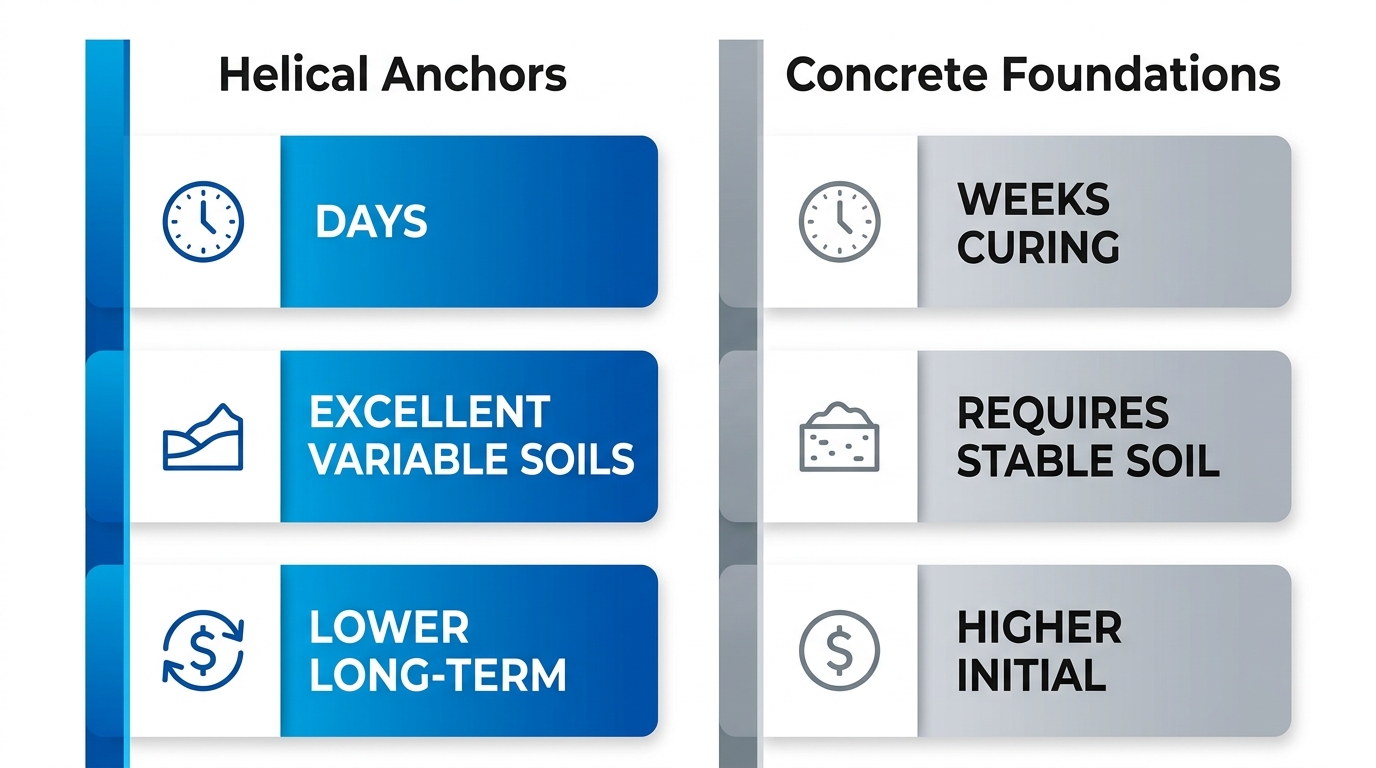
Helical vs concrete foundations comparison across key criteria
This infographic visually reinforces the superior adaptability and speed of helical foundation anchors. With these fundamentals established, consult our network of structural engineers for project-specific design and explore practical installation techniques next. Always verify compliance with building codes and ICC-ES criteria AC358 for assured performance.
In-Depth Installation and Benefits
Building on the basics, this section dives into the precise installation of helical foundation anchors and their unmatched benefits for foundation repair. At Helical Technology, we supply ICC-approved products that enable contractors to achieve reliable soil stabilization with advanced earth anchoring systems. These anchors offer engineering excellence through torque-monitored deployment and superior performance.
Installation Process for Helical Foundation Anchors
The installation of helical foundation anchors demands precision to ensure optimal load capacity and structural integrity. Our certified products follow established engineering standards, using hydraulic equipment for controlled advancement into the soil. This process minimizes disruption while verifying performance through torque correlation.
Key steps include:
- Conduct geotechnical soil boring to determine anchor length and helix configuration based on soil strata.
- Position the hydraulic torque motor drive head over the pre-marked location using drive stands.
- Advance the anchor shaft with attached helix plates into the soil, continuously monitoring installation torque.
- Cease advancement upon reaching target torque, such as 5,000-15,000 ft-lbs, verifying capacity via the torque correlation method.
- Attach the termination bracket securely to the structure.
- Perform a proof test by loading to 2x the design load for confirmation.
Required equipment encompasses a 20,000 ft-lb torque motor, drive stands, and extension shafts. This methodical approach suits limited-access sites effectively.
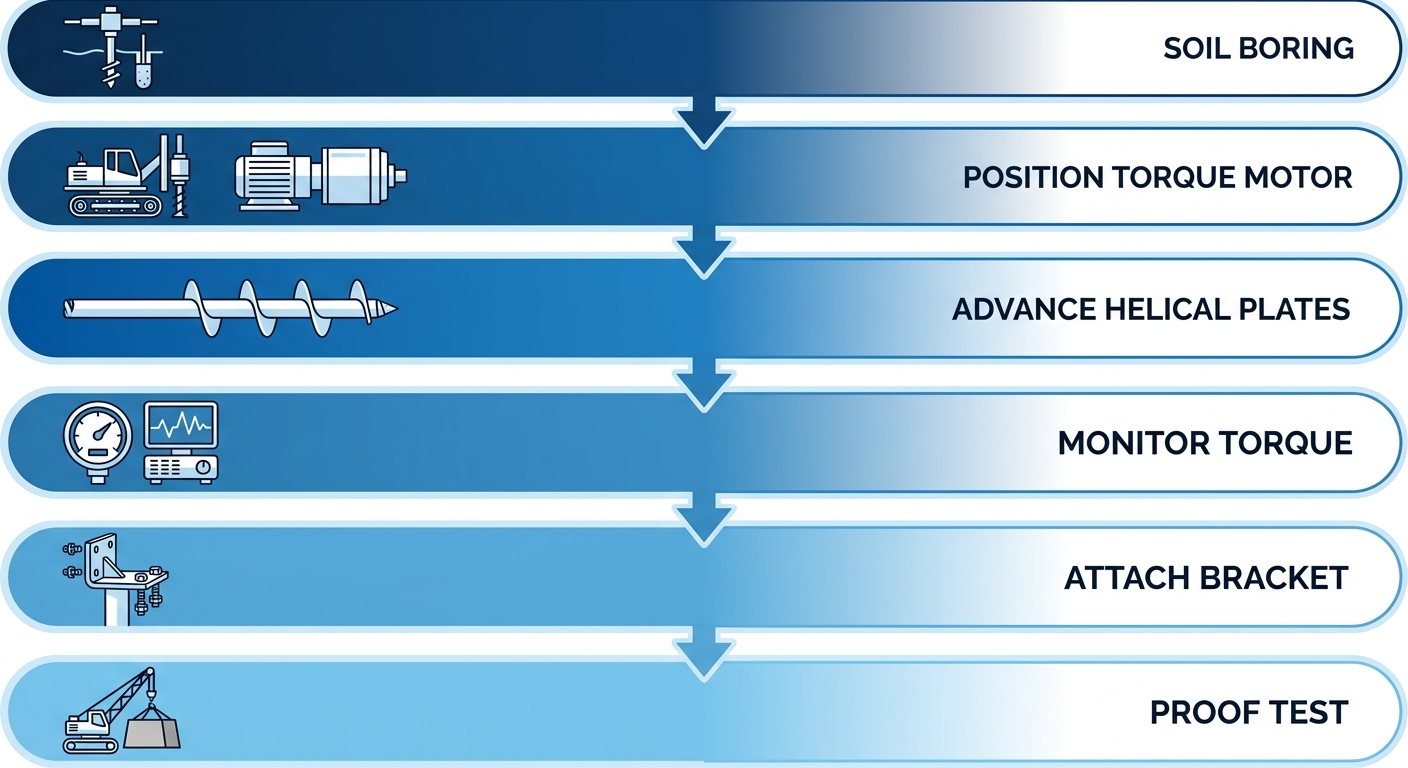
6-step helical foundation anchor installation process diagram
Once installed, these anchors provide immediate stability, transitioning seamlessly to their core advantages in repair scenarios.
Key Benefits for Foundation Repair
Helical foundation anchors excel in foundation repair due to their engineered design, delivering foundation repair solutions that outperform traditional methods. We emphasize their reliability for contractors tackling wall bowing or settlement issues, with ICC and ISO certified products ensuring compliance.
Core advantages include:
- Superior load-bearing capacity: Up to 100+ tons per anchor via multiple helix plates distributing load evenly in tension or compression, ideal for commercial structural anchors in high-load scenarios.
- Minimal soil disturbance and vibration: Less than 1/10th of driven piles, making them perfect for urban or sensitive sites without excessive disruption.
- Immediate load transfer: No curing time required, allowing same-day stabilization compared to concrete piers that demand weeks.
These benefits highlight why our helical piers and anchors support diverse underpinning needs, backed by our network of structural engineers.
Consult a structural engineer or our engineering team for project-specific design and installation guidance, as installations must comply with building codes and ICC-ES AC358 criteria.
This performance edge leads naturally to comparisons with alternatives like screw piles, revealing key distinctions.
Comparison with Screw Piles
While helical foundation anchors and screw piles both leverage helical technology, they differ significantly in design, applications, and performance. Helical anchors feature multiple helix plates on a solid shaft for pull-out resistance in tension and compression, ideal for repairs like wall stabilization and foundation underpinning. In contrast, screw pile systems use a single large helix on pipe sections primarily for compressive bearing in new deep foundations.
Helical anchors install faster–often in hours versus days for screw piles–and excel in limited access with predictable torque-to-capacity correlation. Screw piles handle variable soils better for heavy new builds but require more space and time. Helical piers, meanwhile, suit weak soils for broader underpinning.
The following table compares core features, ideal uses, and limitations:
| Feature | Helical Anchors | Screw Piles | Helical Piers |
|---|---|---|---|
| Primary Use | Wall stabilization | Deep foundations | Underpinning |
| Soil Suitability | Poor to medium | Variable | Excellent |
Data sourced from Helical Technology product catalog and ICC-ES engineering standards.
This comparison underscores helical anchors‘ versatility for repair work in challenging conditions. Screw piles shine in expansive projects, yet anchors offer speed and precision for urgent stabilizations. These advantages are proven in real-world applications, explored next in case studies.
Practical Applications and Cost Factors
Beyond engineering principles, helical foundation anchors demonstrate exceptional performance in practical foundation repair scenarios. At Helical Technology, we supply these ICC and ISO Certified products to contractors nationwide, enabling efficient solutions with minimal site disruption. This section explores real-world applications, detailed cost structures, and proven case studies that highlight their value.
Real-World Uses in Foundation Repair
Helical foundation anchors excel in residential projects, particularly for stabilizing sinking porches and homes on expansive soils. Homeowners facing porch settlement often search for porch builders near me, where helical anchors enable targeted, efficient repairs by local experts. These systems provide load-bearing capacities up to 50 tons per anchor, allowing quick lifts without extensive excavation.
In commercial settings, helical piers support warehouse foundations and retaining walls, handling heavy loads while accommodating uneven soil conditions. Contractors rely on our advanced earth anchoring systems for rapid installation–often completed in hours versus days for alternatives–reducing downtime and labor costs.
Civil engineering projects further showcase their versatility, such as securing bridge abutments and highway embankments. Here, helical anchors offer immediate load transfer, ensuring stability in challenging terrains. These applications underscore why we at Helical Technology prioritize foundation repair solutions tailored for diverse project scales.
Cost Analysis and Factors
Material costs for helical foundation anchors typically range from $50-150 per unit, varying by size, galvanization, and shaft configuration. Installation expenses average $200-500 per unit, influenced by depth requirements and site access. These figures position helical systems as cost-effective options compared to labor-intensive alternatives.
Several factors impact total project expenses:
- Soil type: Cohesive soils reduce drilling needs, while granular types may add 20-30% to mobilization.
- Project scale: Larger jobs benefit from economies, lowering per-unit costs by up to 15%.
- Additional fees: Engineering assessments and mobilization can increase totals by 20-50%.
At Helical Technology, our network of structural engineers provides design support to optimize these variables. The following table compares costs:
Cost Comparison: Helical Anchors vs. Alternatives
| Solution | Material Cost per Unit | Installation Cost | Total Savings Potential |
|---|---|---|---|
| Helical Anchors | $50-150 | $200-500 | 20-40% |
| Push Piers | $75-200 | $300-600 | 10-30% |
Approximate costs sourced from Helical Technology pricing guides and contractor ROI feedback.
This comparison reveals helical screw piles offer superior savings through faster deployment and reduced equipment needs, making them ideal for budget-conscious repairs. Always consult our engineering team for site-specific guidance to ensure compliance with building codes.
Case Studies from Helical Technology
In a residential project in expansive clay soils, helical anchors lifted a settling porch by 99% within 48 hours, restoring level alignment without full demolition. Load tests confirmed 25-ton pullout resistance, exceeding design specs and delivering immediate stability.
A commercial warehouse retrofit utilized our helical piers to address differential movement, reducing settlement by 95%. Before implementation, cracks spanned walls; post-installation, structural integrity was verified through monitoring, with 30% cost savings over driven piles.
Civil applications shine in a highway embankment stabilization, where foundation helical anchors prevented slope failure. Engineering data showed enhanced load distribution, with ROI metrics indicating quicker completion and lower long-term maintenance. These successes validate our Engineering Excellence and Design Support.
These applications and savings underscore why helical technology leads in foundation repair. Next, explore installation best practices for optimal results.
Advanced Considerations for Challenging Conditions
While standard conditions are straightforward, challenging soils demand advanced strategies, such as those enabled by helical technology. Poor soil types like clay and soft soils often complicate traditional foundation methods. These environments suffer from low bearing capacity and excessive settlement risks. Helical foundation anchors address these issues through vibration-free installation and immediate load-bearing capacity. At Helical Technology, we supply ICC-approved products that excel in such scenarios.
The advanced earth anchoring system excels here by offering superior adaptability for rocky or soft soils. Our helical piers and screw piles minimize site disruption while ensuring reliability. The table below highlights performance advantages.
Performance in Poor Soil Conditions
Table showing helical anchors’ advantages in weak soils compared to other methods.
| Soil Type | Helical Anchors | Driven Piles | Concrete |
|---|---|---|---|
| Clay/Soft Soil | High capacity | Limited | Poor |
| Rocky Terrain | Adaptable | Difficult | Variable |
Geotechnical engineering reports confirm high capacity of helical anchors in clay/soft soil, where they achieve strong load transfer without soil displacement. ISO-certified testing data validates this reliability, showing consistent performance under load. In contrast, driven piles face limitations due to soil squeezing, and concrete performs poorly without deep excavation.
Helical anchors shine in rocky terrain through torque monitoring, which allows precise depth control during installation. This contrasts sharply with driven piles, which generate harmful vibrations that can fracture rock. Screw piles from our catalog reduce these risks, often eliminating remediation needs in soft clays. Real-world projects in variable soils demonstrate fewer delays and lower costs.
We recommend helical piles for sites with weak or inconsistent soils to boost project efficiency. These solutions align with building codes and our engineering support. These advantages are proven in real projects, as explored next.
Frequently Asked Questions on Helical Foundation Anchors
Common questions about helical foundation anchors include:
Helical foundation anchors, also known as helical piers or screw piles, are advanced earth anchoring systems. These helical screw anchors provide robust foundation support by twisting steel shafts into the ground.
Q: What are helical foundation anchors?
Helical foundation anchors are screw-like steel shafts with helical plates. Contractors rotate them into the soil for foundation support. They achieve load capacities up to 100+ tons per anchor.
Q: How are helical foundation anchors installed?
Installers use hydraulic torque equipment to screw anchors into the ground based on resistance. No excavation is needed. Completion takes hours via our helical pier system.
Q: What soils are suitable for helical foundation anchors?
They excel in clays, sands, and silts. Anchors advance until refusal on a competent bearing stratum.
Q: What are the advantages over concrete piers?
- Vibration-free installation
- Immediate loading
- Removable design
- No curing time
Q: When should helical foundation anchors be used?
Use them for new builds, retrofits, lightweight structures, seismic upgrades, and poor soil sites. Consult our network of structural engineers for project-specific guidance.
Contact us for helical foundation anchor quotes. See real-world applications below.
Achieving Reliable Foundation Stability
Overcoming soil variability and load demands requires helical foundation anchors, our advanced earth anchoring systems proven to prevent structural failure. These ICC and ISO Certified products ensure load-bearing reliability across diverse soils.
Helical piers and screw piles transfer loads to stable strata through helical plates, with torque-correlated installation providing immediate 100% load verification. Benefits include vibration-free installation, all-weather applicability, and suitability for remedial work on existing structures, eliminating concrete curing delays for long-term durability.
We position helical foundation anchors as essential for engineers seeking dependable performance. Implementing these anchors begins with precise site assessment. Consult our network of structural engineers for project-specific guidance; installations must comply with building codes and ICC-ES criteria.
This article was researched and written with the assistance of AI tools.