


Jason Keefer
President
Helical Piles
Table of Contents
Understanding Helical Piles for Foundation Solutions
At Helical Technology, we specialize in distributing advanced earth anchoring systems that provide reliable foundation repair solutions for a wide range of projects. Helical piles represent a cornerstone of our offerings, serving as screw-like steel shafts equipped with helical plates that screw directly into the ground to deliver exceptional load-bearing capacity. This innovative approach eliminates the need for extensive excavation, making it ideal for residential, commercial, and infrastructure applications where minimal site disruption is essential.
Originating in the 19th century as a method for stabilizing structures in challenging soils, helical foundation systems have evolved into modern, ICC- and ISO-certified products that meet rigorous building standards. Today, these screw-in foundations, including our helical piers and screw piles, advance into various soil conditions to transfer loads immediately upon installation. For instance, in a recent foundation repair project for a settling commercial building in Colorado, we supplied helical piers that restored stability without halting operations, demonstrating their versatility and speed.
The benefits of helical piles extend far beyond traditional concrete foundations. According to ASCE insights, steel piles like these reduce environmental impact by up to 50% through decreased material use and faster installation times, often completing in days rather than weeks. This shift from concrete to steel supports sustainable infrastructure, as seen in electrical projects where helical piles ensure long-term durability with less waste. Our extensive catalog features helical piers, push piers, and accessories such as the helical pipes lead section, all backed by our network of structural engineers and on-site training programs.
As a leading distributor, we at Helical Technology provide engineering excellence and design support to help contractors integrate these pile anchoring solutions effectively. While this overview highlights the fundamentals, upcoming sections delve deeper into installation techniques and advanced considerations. Always consult our structural engineering team or a qualified professional for project-specific guidance to ensure compliance with building codes and ICC-ES criteria.
Basics of Helical Pile Technology
Helical piles represent a proven advancement in foundation engineering, offering reliable support for structures in challenging soil conditions. These torque-driven foundations consist of steel shafts equipped with helical plates that mimic the action of a large screw, providing immediate load-bearing capacity without the need for extensive site preparation. At Helical Technology, we supply ICC-certified helical piles designed for both residential and commercial applications, ensuring compliance and durability through our engineering resources.
To understand helical piles, consider a simple analogy: just as a wood screw grips tightly when twisted into material, these screw foundation piles anchor deeply into the earth by rotating under applied torque. This method transfers loads directly to stable soil strata, bypassing weaker surface layers. Our catalog features a range of helical piers and accessories, backed by ICC-ES documentation for building code adherence.
The core components of helical anchoring systems include the central shaft, helical plates, and optional extensions. We provide galvanized steel shafts in various configurations to suit different project needs. Key elements are:
- Shafts: Typically square or round steel bars that transmit torque and resist compression or tension forces. According to Geoengineer.org, square shafts excel in dense soils due to their high torque correlation, while round shafts offer better lateral stability in softer conditions.
- Helices: Welded circular plates at intervals along the shaft, acting as bearing surfaces to support axial loads. These plates compact surrounding soil, enhancing capacity.
- Extensions and Leads: Couplings and lead sections, such as our helical pipes 2-7/8 diameter lead, allow for deeper penetration and customization based on site-specific geotechnical data.
These components work together to create a robust system, with displacement effects noted in combo piles that combine shaft types for versatile soil applications, as highlighted in industry overviews.
The mechanics of helical piles involve screwing the assembly into the ground using hydraulic torque motors, where rotational force correlates directly to installation depth and load capacity. As the helices advance, they bear against soil via friction and end-bearing, distributing structural loads evenly. This process minimizes vibration and soil disturbance, unlike driven methods. Torque monitoring during installation provides real-time verification of embedment, ensuring the pile achieves design strength without curing delays.
Helical piles offer distinct advantages over traditional foundations, particularly in speed and environmental considerations. For instance, screw piles eliminate concrete curing times, enabling faster project timelines. When evaluating foundation options, key criteria include installation efficiency, site disruption, and long-term cost savings. The following table compares helical piles to concrete foundations and driven piles on these factors:
| Factor | Helical Piles | Concrete Foundations | Driven Piles |
|---|---|---|---|
| Installation Time | 1-2 days | Hours to weeks (days with curing) | Variable, vibration issues (potential delays) |
| Environmental Impact | Minimal soil disturbance | High excavation and concrete use (spoil removal required) | Noise and vibration (ground disruption) |
| Cost Efficiency | Lower upfront and maintenance | High material and labor costs | Equipment-dependent, potential overruns |
Data from ASCE underscores the reduced site impact of helical piles, with industry averages showing up to 50% cost savings in suitable applications. This makes helical piles ideal for quick projects, such as foundation repairs in urban areas, where minimizing downtime and environmental footprint is critical. Our ICC and ISO certified products further enhance these benefits through reliable performance and engineering support from our network of structural engineers.
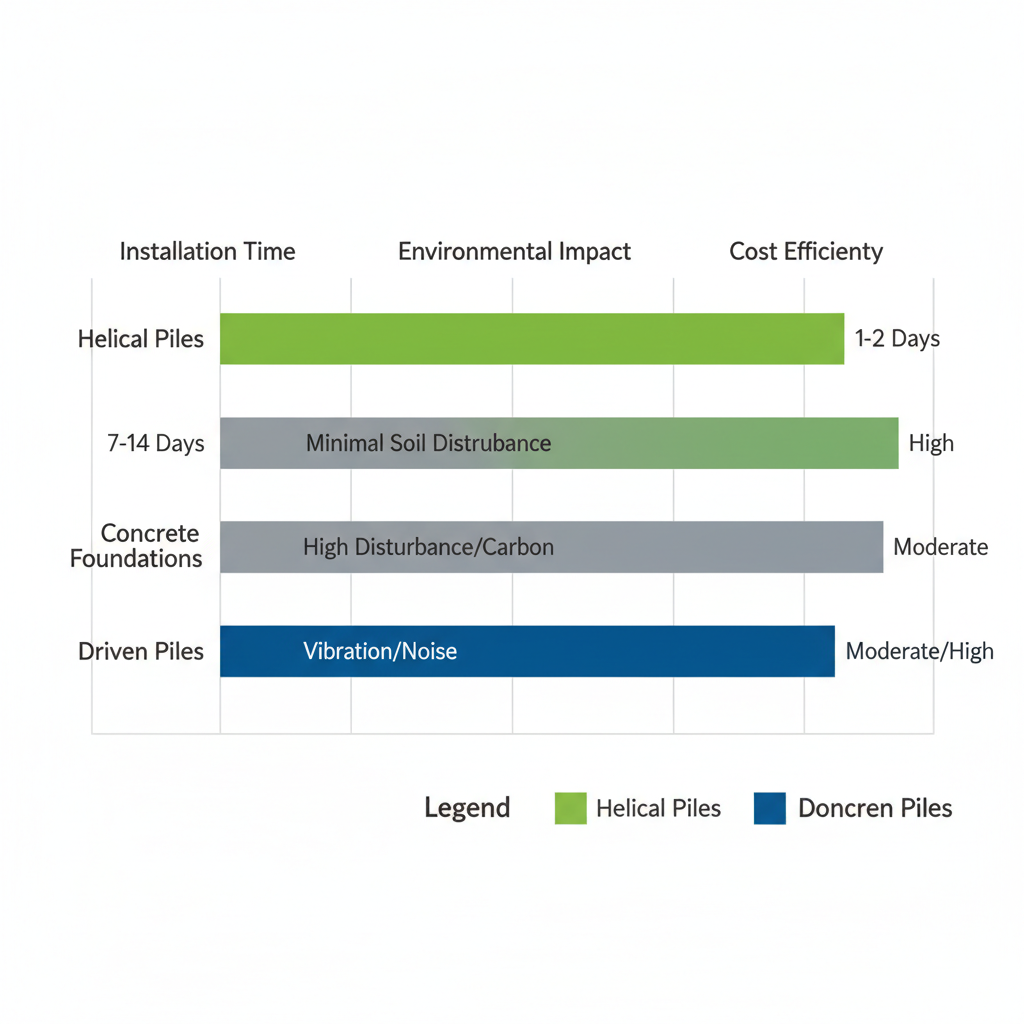
Comparison of helical piles versus traditional foundations
In summary, helical pile technology delivers efficient, versatile foundation solutions that align with modern construction demands for sustainability and speed.
In-Depth Analysis of Helical Pile Systems
Helical pile systems offer versatile solutions for foundation challenges in diverse geotechnical conditions. At Helical Technology, we provide ICC- and ISO-certified products that support engineers and contractors in selecting the right configurations for new construction and repairs. This analysis delves into shaft types, installation factors, and comparisons to ensure optimal performance using our advanced earth anchoring systems.
Shaft Types and Load Capacities
Square shaft helical piles excel in high-capacity applications, particularly in dense soils where their solid construction delivers superior compression and tension resistance. These shafts, typically made from high-grade steel, achieve load capacities up to 50 kips efficiently, as supported by industry standards from Geoengineer.org. In contrast, round shaft helical piles provide flexibility for lateral loads and are ideal for softer soils, offering consistent torque during installation to minimize buckling risks. Our helical pipes diameter extension options enhance these systems for deeper embeds without compromising integrity.
Helical piers in square configurations handle tension-only loads effectively, while round variants support reversing forces better due to their hollow design, which can be grouted for added strength. Load capacity calculations often rely on the torque correlation method, where ultimate capacity approximates K times the installation torque, with K values ranging from 10 to 20 ft⻹ depending on soil and helix configuration. For instance, PMC studies validate that piles in weathered rock exceed 600 kN under static loads, emphasizing precise torque monitoring. We recommend our real-time design software to model these capacities accurately for project-specific needs.
Selecting between shaft types depends on soil density and load demands; square shafts suit compression-heavy projects, while round shafts enhance lateral stability. Combo piles, blending both, offer hybrid advantages for varied conditions, as detailed in geotechnical references.
The following table compares key aspects of square and round shaft helical piles:
| Aspect | Square Shaft | Round Shaft |
|---|---|---|
| Load Capacity | Higher compression/tension | Better for lateral loads, consistent torque |
| Installation | Suitable for dense soils | Easier in soft soils, reduced buckling risk |
This comparison highlights how square shafts prioritize vertical loads in firm ground, whereas round shafts provide versatility in challenging terrains. Contractors benefit from consulting our network of structural engineers to match these options with site requirements, ensuring compliance with ICC-ES AC358 criteria.
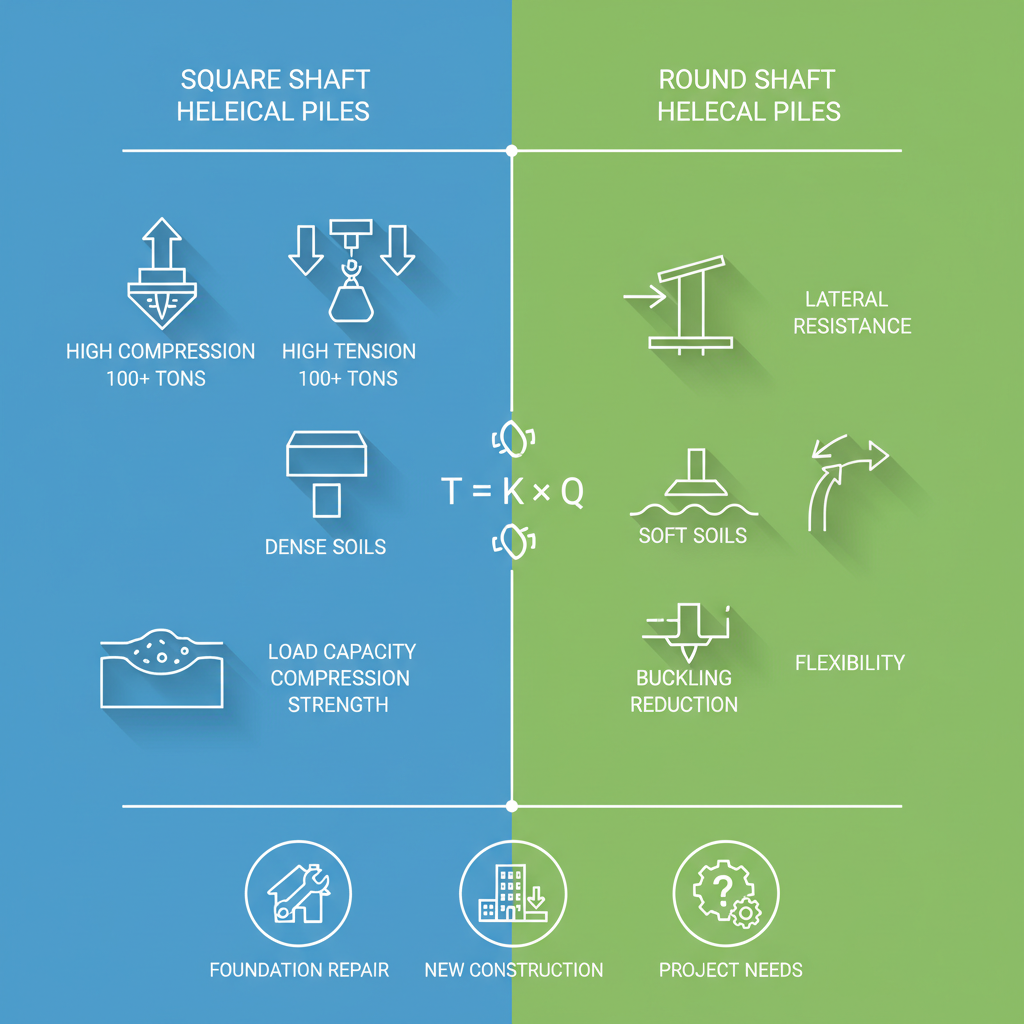
Comparison of square vs round helical pile systems for foundation projects
Visual aids like this infographic underscore the practical differences, aiding in swift decision-making during planning phases. Transitioning to installation, these choices directly influence depth strategies in varying soils.
Installation Depths and Soil Considerations
Optimal installation depths for helical piles range from 10 to 50 feet or more, determined by soil profile and load requirements. In cohesive clays, depths may extend to 30 feet to achieve sufficient embedment, while granular sands allow shallower placements around 15-20 feet due to higher friction. Factors like installation torque guide advancement; pile torque systems ensure the helix reaches refusal, where torque correlates to 50% of ultimate capacity per individual bearing methods.
Soil considerations are critical: soft soils demand deeper embeds to bypass weak layers, whereas dense profiles may limit depths to avoid excessive resistance. PMC research on soil-pile interactions shows that grouted helical piers in weathered rock boost capacities significantly, often exceeding expectations in dynamic tests. We advise using our engineering support to assess SPT values and recommend depths that align with local codes.
Torque and depth interplay via formulas like capacity = 0.5 * (sum of helix bearing + shaft friction), adjusted for site data. This approach answers how deep helical piers should be installed, preventing settlement in foundation repair solutions.
Helical vs Screw Pile Mechanics
Helical piles feature multiple helices on a central shaft, distributing loads through cylindrical shear and bearing, ideal for both new builds and repairs. Screw piles, often single-helix designs, rely more on end-bearing in softer soils but share similarities in screw anchoring mechanisms. Performance metrics differ: helical piles offer higher uplift resistance via multi-plate configurations, supporting up to 100+ tons, while screw piles excel in quick installs for temporary anchors.
Mechanics-wise, helical systems use torque for capacity prediction, as validated by field tests showing 600 kN+ in grouted setups. Screw piles may underperform in lateral loads without extensions, per Geoengineer.org insights. Applications vary; helical piers suit permanent structures, screw piles for lightweight or marine uses.
The table below outlines key differences:
| Feature | Helical Piles | Screw Piles |
|---|---|---|
| Helix Design | Multi-helix for distributed load | Often single-helix for end-bearing |
| Load Transfer | Torque-correlated shear/bearing | Primarily frictional/end-bearing |
Helical piles provide superior versatility, backed by our ICC-certified products and design software. For projects, we urge consulting a structural engineer for compliance and optimal mechanics.
This analysis equips professionals with insights to leverage helical technology effectively, bridging theory to practical implementation.
Applying Helical Piles in Real-World Projects
At Helical Technology, we specialize in providing ICC-certified products that enable contractors to apply helical piles effectively in diverse real-world scenarios. These advanced earth anchoring systems offer reliable foundation stabilization, whether for new builds or retrofits. By leveraging our engineering support and on-site training programs, installers can address site-specific challenges with confidence, ensuring compliance with building codes and optimizing project outcomes.
Installation Techniques for Challenging Sites
Helical piles excel in challenging environments, particularly where access is limited. We recommend hydraulic torque installation as the primary method, which involves rotating the pile into the ground using a torque motor attached to compact equipment. For tight or restricted spaces, such as urban sites near existing structures, adapters allow precise maneuvering without extensive excavation. Our helical pipes 4-1/2 diameter lead sections provide a strong starting point for these installations, offering durability and load capacity.
Advancements in hand-held equipment further enhance versatility, enabling practical helical anchoring in areas inaccessible to larger machinery. Here is a step-by-step process for installing helical piles in soil:
- Conduct a preliminary site survey to identify obstacles and soil conditions.
- Assemble the pile with lead sections and extensions, applying torque gradually to advance it.
- Monitor torque in real-time to verify embedment depth and capacity, avoiding pitfalls like overestimation that could lead to insufficient anchorage.
- Verify alignment and connect to the structure using brackets or caps.
This technique ensures efficient deployment of helical piles, minimizing disruption in sensitive areas. (Photo callout: Visualize compact skid steer in action for urban installs.)
Site variability often dictates installation approaches, with tight spaces requiring specialized adaptations compared to open sites. The following table highlights key differences:
| Challenge | Tight Spaces | Open Sites |
|---|---|---|
| Equipment Needs | Compact skid steers | Standard excavators |
| Time Efficiency | Slightly longer setup | Faster overall |
In tight spaces, compact equipment like skid steers reduces the footprint, though setup may extend slightly due to positioning needs. On open sites, standard excavators allow for quicker operations with minimal adjustments, as outlined in ASCE case studies on urban installations. These adaptations underscore the flexibility of our foundation repair solutions, enabling contractors to maintain timelines while achieving ICC-ES compliance.
New Construction and Repair Applications
Our helical piers prove highly suitable for both new construction and repair projects, offering versatile screw piles that adapt to varying demands. In new builds, such as load-bearing foundations for commercial buildings, helical piles provide immediate stability without curing times, accelerating timelines. For repairs, helical piers facilitate underpinning in residential retrofits, lifting and stabilizing settling structures with precision.
Consider urban case studies where screw piles addressed infrastructure challenges. As noted in the ASCE publication on steel piles replacing concrete for electrical foundations, helical systems saved up to 30% in installation time for tight-space electrical projects, demonstrating ROI through reduced labor and minimal site disturbance. We support these applications through our network of structural engineers, who offer project-specific design guidance.
To further illustrate suitability, the table below compares helical and screw piles across new and repair contexts:
| Aspect | Helical Piles (New Construction) | Screw Piles (Repair Applications) |
|---|---|---|
| Load Capacity | High axial resistance for buildings | Targeted uplift for underpinning |
| Installation Speed | Rapid torque-driven embedment | Minimal excavation for retrofits |
| Cost Efficiency | Long-term savings on deep foundations | Quick ROI via reduced downtime |
Helical piles in new construction deliver robust support for expansive projects, while screw piles in repairs focus on targeted stabilization, as validated by reference examples. These distinctions help contractors select optimal systems, enhancing project efficiency.
Consult a structural engineer or our engineering team for project-specific design and installation guidance; all installations must comply with applicable building codes and ICC-ES acceptance criteria (AC358).
Best Practices for Soil and Load Assessment
Before any helical pile installation, thorough pre-site assessments form the cornerstone of success. We advocate comprehensive soil testing, including borehole sampling and dynamic probing, to evaluate bearing capacity and variability. Load assessments should incorporate geotechnical reports to predict settlement risks accurately.
Compliance with ICC standards remains paramount; our ISO-certified products meet AC358 criteria, ensuring structural integrity. During our on-site training programs, we emphasize torque monitoring and proof testing to confirm pile performance post-installation.
By integrating these practices, contractors mitigate risks and achieve reliable project-based screw foundations. This approach not only aligns with engineering excellence but also prepares for more complex scenarios in advanced applications.
Advanced Techniques and Considerations
At Helical Technology, we elevate foundation solutions beyond basic installations by offering advanced techniques that ensure long-term structural integrity. Our expertise in helical pile systems supports contractors tackling complex projects, from high-load commercial builds to challenging soil conditions. This section delves into certification pathways, sophisticated load calculations, and seamless integrations with complementary technologies.
Certification Pathways
Becoming a certified installer for helical piles requires a structured approach that combines rigorous training, practical exams, and field verification. We provide comprehensive programs at our facilities, starting with hands-on workshops where participants learn precise installation methods for helical piles. These sessions cover torque monitoring, alignment verification, and compliance with building codes. Following classroom instruction, candidates undergo written exams on geotechnical principles and then demonstrate skills in supervised field installations. Our certification, recognized by ICC standards, equips installers with the confidence to handle diverse site conditions. To contrast, general industry training often lacks this depth.
The following table compares our certification against typical general training options:
| Aspect | Helical Technology Certification | General Industry Training |
|---|---|---|
| Duration | 2-3 days on-site | Varies, often online |
| Support | Engineering + toolkit | Basic guidelines |
This pathway not only meets ICC compliance requirements but also includes access to our marketing toolkit for certified installers. After certification, we verify field performance through project audits, ensuring adherence to ISO standards. For those seeking helical piers in the US, our nationwide distribution network facilitates procurement and delivery.
When installers join our program, they gain immediate access to engineering consultations, enhancing project outcomes. This certification differentiates professionals in competitive markets, fostering reliability in advanced applications.
Advanced Load Calculations
For experienced teams, mastering torque-capacity correlations is essential in advanced pile engineering. We recommend using software modeling tools, such as our real-time design platform, to simulate load distributions accurately. Drawing from geotechnical research, including field tests on helical piles under static and dynamic loads, torque measurements during installation provide reliable bearing capacity estimates. For instance, studies show piles in weathered rock can exceed 600 kN with gravity grouting, far surpassing softer soils.
Key calculation methods include:
- Individual Bearing Method: Sums capacities of each helix based on soil shear strength.
- Cylindrical Shear Method: Accounts for shear resistance along the pile shaft.
- Torque Correlation: Kt factor multiplies installation torque (T) by empirical coefficient (Kt ≈ 10 m⻹) to derive ultimate capacity (Qu = Kt × T).
These approaches, validated by PMC research on load dynamics, allow precise predictions for complex sites. Our helical pipes 4-1/2 diameter extension components integrate seamlessly into these models, supporting customized extensions for deeper embeds.
Consulting our network of structural engineers ensures calculations align with site-specific data, preventing underestimation in variable conditions.
System Integrations
Integrating helical piers with push piers creates robust hybrid systems for comprehensive foundation repair solutions. In scenarios demanding both tension and compression resistance, we pair helical piers for initial uplift control with push piers for downward stabilization, optimizing load transfer in expansive clays or seismic zones.
Waterproofing integrations further enhance durability; our certified helical systems incorporate sump pumps and vapor barriers directly into pile layouts, mitigating moisture ingress. For specialized screw techniques involving screw piles, advanced applications in waterfront or flood-prone areas benefit from these hybrids, ensuring ISO-compliant waterproofing.
We emphasize engineering consultations for hybrid designs, providing on-site support to blend technologies effectively. This holistic approach positions our advanced earth anchoring systems as leaders in engineering excellence and design support, ready for demanding projects nationwide.
Frequently Asked Questions on Helical Piles
Q: How much do helical piers cost for foundation repair?
A: Costs for helical piles typically range from $200 to $500 per pile, depending on project size, soil conditions, and installation depth. According to ASCE publications, these cost-effective helical solutions provide long-term savings compared to concrete foundations by reducing labor and material expenses over time. Always consult our engineering team for precise estimates.
Q: Where can we buy helical piers in the US?
A: As a national distributor, we offer helical piers and related foundation repair solutions through our comprehensive catalog. Our ICC and ISO certified products, including helical pipes 4-1/2 124 extension, are available to contractors nationwide, supported by our network of structural engineers for design assistance.
Q: Can screw piles be used for residential foundations?
A: Yes, screw piles are ideal for accessible screw foundations in residential applications, providing stable support for homes on challenging soils. They offer advanced earth anchoring systems that minimize disruption and ensure durability, compliant with building codes when installed by certified professionals.
Q: What is the load capacity of screw piles?
A: Load capacity varies by design and site conditions, often ranging from 10 to 100 tons per pile. Our helical piers deliver reliable performance for foundation repair solutions. For project-specific guidance, consult a structural engineer or our manufacturer’s engineering team to comply with ICC-ES criteria.
Key Takeaways on Helical Pile Solutions
Helical piles offer efficient and versatile foundation solutions for diverse soil conditions, ensuring reliability in construction projects. As proven screw systems, these helical piers minimize noise and vibration during installation, providing superior bearing capacities as validated by field studies on torque-based estimation methods. At Helical Technology, our ICC and ISO certified products, backed by advanced engineering support, deliver reliable helical foundations for residential and commercial needs.
We invite you to contact our team for expert guidance and leverage our network of structural engineers to achieve durable, code-compliant outcomes with confidence.