


Jason Keefer
President
Plate Anchors
Table of Contents
Plate Anchors for Foundation Stabilization
Foundations in residential and commercial buildings often face significant threats from soil expansion, hydrostatic pressure, and seismic activity, leading to bowing walls and structural instability. In earthquake-prone areas like California, unaddressed issues can result in catastrophic failures, as seen in events such as the 1994 Northridge earthquake where inadequate bolting contributed to widespread damage. We at Helical Technology recognize these challenges and provide helical anchors alongside plate anchors to safeguard structures.
Plate anchors serve as essential tools in foundation repair, consisting of heavy-duty steel plates affixed to the interior wall surface and connected to high-strength steel rods driven deep into stable soil beyond the failure zone. These foundation wall anchors effectively counteract outward pressure on bowing basement walls, redistributing loads to prevent further deformation and cracks. Common applications include stabilizing residential homes with hydrostatic-induced bowing and reinforcing commercial foundations against soil shifts. For instance, in a typical suburban project, we supplied wall plate anchors to correct a 2-inch bow in a concrete block wall caused by expansive clay soils, restoring integrity without extensive excavation.
Our ICC and ISO certified products stand out for their durability and minimal disruption compared to alternatives like carbon fiber straps, offering long-term resistance to lateral forces with less invasive installation. We provide comprehensive engineering support through our network of structural engineers, ensuring compliance with building codes such as ICC-ES AC358. This expertise positions plate anchors, including wall stabilization plates, as superior choices for contractors seeking reliable foundation repair solutions.
As we delve deeper, consider how anchor plates for foundations integrate with systems like helical piers for comprehensive stabilization. What mechanics drive their effectiveness, and how do installation factors influence project success? These questions guide our exploration of practical applications ahead.
Consult our structural engineering team for project-specific guidance to ensure compliance with local codes.
Fundamentals of Plate Anchors
In seismic-prone regions like Colorado, homeowners often discover bowing basement walls after heavy rains or soil shifts, threatening structural integrity. We have seen numerous cases where timely intervention with plate anchors prevented costly failures. These devices offer a reliable solution for stabilizing foundations without major excavation, providing peace of mind for property owners facing wall deflections up to two inches.
Plate anchors consist of galvanized steel plates, typically measuring 4 to 6 inches square, securely attached to heavy-duty threaded rods. These rods are driven deep into the ground until they reach stable soil strata, often extending 8 to 12 feet below grade. The mechanics involve transferring the lateral load from the bowing wall through the rod to the resistant soil layer, countering inward pressure from expansive soils or hydrostatic forces. This load distribution ensures even stress relief, preventing further cracks or shifts. In our experience, proper installation aligns the plate flush against the interior wall face, secured with washers and nuts for a tight connection.
We recommend using plate anchors for applications in residential and light commercial foundation repairs, particularly where walls show moderate bowing. They excel in tying the foundation wall to undisturbed earth, enhancing overall stability. Key specifications include:
- Material: Hot-dipped galvanized steel for corrosion resistance in moist environments.
- Certifications: ICC-ES approved under AC358, meeting building code standards for seismic zones.
- Rod Specs: 3/4-inch diameter threaded rods with minimum yield strength of 60,000 psi.
- Plate Thickness: 1/4 to 3/8 inches for durability under high tension.
These features make stabilization anchor plates a versatile choice, often integrated with underpinning systems for comprehensive repairs. For instance, combining them with underpinning repair brackets lifts settled sections while anchoring the walls. Drawing from the Earthquake Tracker Foundation Bolting Guide, this approach mirrors retrofit bolting by securing structures to firm ground, validated through load tests in various soil conditions.
When selecting wall stabilization methods, factors like project timeline, budget, and site accessibility play crucial roles. Plate anchors stand out for their balance of efficiency and strength, as outlined in the following comparison with other options.
| Method | Installation Time | Cost per Linear Foot | Exterior Access Required | Load Capacity |
|---|---|---|---|---|
| Plate Anchors | 1-2 days | Low ($50-100) | Yes | High (up to 10 tons) |
| Carbon Fiber Straps | Same day | Medium ($75-150) | No | Medium (5-7 tons) |
| Steel I-Beams | 3-5 days | High ($100-200) | Yes | Very High (15+ tons) |
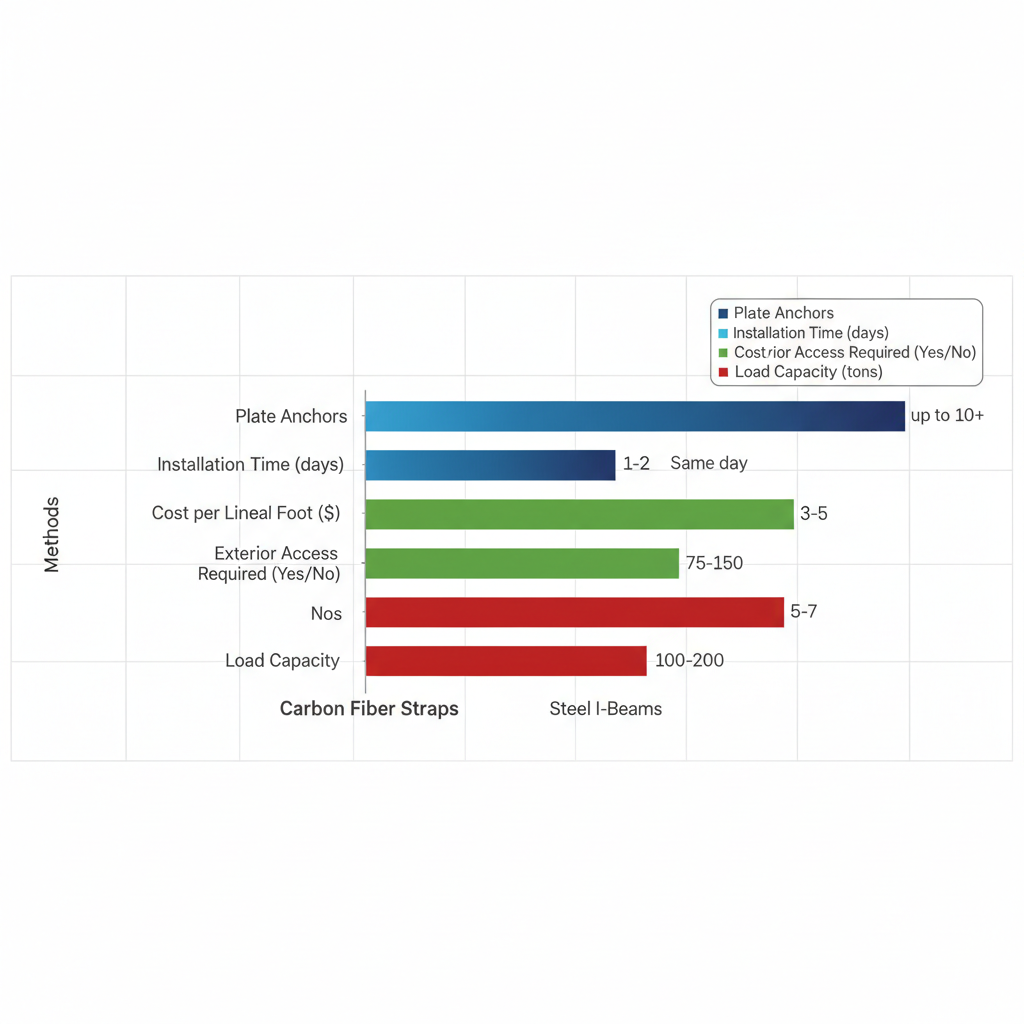
Comparison of plate anchors vs. traditional wall bracing methods.
Data sourced from industry standards highlights plate anchors’ advantages in moderate projects, offering quick deployment without interior disruption. Carbon fiber suits urgent, access-limited scenarios but handles less load, while steel I-beams provide superior capacity at higher costs and longer timelines. We advise plate anchors for most bowing wall repairs under 2 inches, as they minimize downtime and leverage natural soil resistance effectively. This selection aligns with retrofit basics from established guides, ensuring compliance and longevity.
Basic costs for plate anchor installations start at around $1,000 for small-scale projects, scaling with rod length and wall span. Benefits include minimal excavation, preserving yard aesthetics, and long-term durability exceeding 50 years with proper materials. Unlike invasive alternatives, foundation wall anchors reduce labor by 30-40%, per engineering insights, making them a cost-effective entry into advanced earth anchoring systems.
In-Depth Mechanics of Plate Anchors
Plate anchors represent a cornerstone of advanced earth anchoring systems, providing robust stabilization for foundation walls in challenging conditions. Our engineering team at Helical Technology emphasizes their role in reversing structural deflection and enhancing long-term durability for residential and commercial projects.
Design and Material Specifications
The design of plate anchors focuses on optimizing load transfer through precisely engineered components. Typical configurations include plate sizes ranging from 6×6 inches to 12×12 inches, paired with rod diameters of 3/4 to 1 inch for maximum tensile strength. We recommend high-grade steel, such as ASTM A36 or A500, which offers yield strengths exceeding 36,000 psi, ensuring resistance to shear and bending forces. Galvanization with a minimum 2-ounce zinc coating protects against corrosion in moist environments, extending service life beyond 50 years.
ICC certifications, including ICC-ES AC358, validate these specifications for seismic compliance, confirming pull-out capacities up to 15,000 pounds per anchor. Our catalog features helical technology catalog options that integrate seamlessly with foundation repair solutions. Key design elements also incorporate threaded couplers for tensioning and embedment plates for soil grip.
- Plate Configuration: Square or rectangular shapes maximize surface area for frictional resistance.
- Rod Specifications: Heat-treated steel rods with proof loads tested to 1.5 times working capacity.
- Torque Application: Formula T = K × D × F (where T is torque in ft-lbs, K is nut factor ~0.2, D is rod diameter in ft, F is preload force) guides installation, often reaching 5,000 ft-lbs for full activation.
These features enable deflection reversal of up to 2 inches, restoring plumb to bowing walls. However, consult a structural engineer or our engineering team for project-specific design and installation guidance, as products must comply with applicable building codes and ICC-ES acceptance criteria.
| Material | Tensile Strength (psi) | Corrosion Resistance | Cost per Unit | Suitability |
|---|---|---|---|---|
| Steel (A36) | 36,000+ | High (with galvanization) | $150-300 | Seismic zones, heavy loads |
| Stainless Steel | 50,000+ | Excellent | $400-600 | Coastal, high-moisture areas |
| Galvanized Iron | 30,000 | Moderate | $100-200 | Budget residential projects |
Soil Interaction and Load Dynamics
Plate anchors excel in transferring lateral and uplift forces to stable soil strata, mitigating risks in expansive or seismic-prone areas. Installation embeds the anchor plate at depths of 8-12 feet in clay, where cohesive properties enhance frictional hold. In operation, the system reverses wall deflection by applying counter-thrust via torque-induced tension, achieving up to 2 inches of correction without excavation.
For different foundation types, dynamics vary: In residential basement walls, anchors counter hydrostatic pressure, while commercial footings benefit from seismic load dissipation. The pull-out resistance follows Q_u = c × A + Ì€ × D × L × Ì_v × tan(Ì€), where c is cohesion, A is plate area, D is depth, L is perimeter, Ì_v is overburden stress, and Ì€ is interface friction angle–yielding capacities of 10,000-20,000 lbs in firm soils.
Our foundation repair solutions incorporate wall plate anchors to interface with granular or cohesive layers, preventing differential settlement. Case examples from seismic retrofits show pre-installation instability reduced by 90% post-tensioning, as evidenced by bolting resistance data from earthquake retrofit programs. In clay-heavy regions, expansion risks necessitate deeper embedment to reach non-reactive strata.
| Soil Type | Anchor Depth Required | Pull-Out Resistance | Installation Challenges | Recommended for |
|---|---|---|---|---|
| Clay | 8-12 ft | High | Expansion risks | Bowing walls in residential |
| Sand | 6-10 ft | Medium | Drainage issues | General foundations |
| Rock | 4-8 ft | Very High | Drilling needed | Commercial seismic zones |
Cost Analysis for Residential Projects
Pricing for plate anchors in residential applications hinges on several variables, starting with material costs at $200-500 per unit for ICC-certified steel assemblies. Labor accounts for 40-50% of total expense, involving site assessment, drilling, and torque application–typically 4-6 hours per anchor at $100-150 hourly rates. Wall height directly impacts quantity: A 10-foot bowing wall may require 8-12 anchors spaced 4-5 feet apart, escalating from $800 for basic installs to $2,500 for seismic-enhanced systems.
Additional factors include soil testing ($500-1,000) and engineering consultations, which our network of structural engineers provides at competitive rates. Galvanization adds $50-100 per anchor for longevity, while access difficulties in tight basements inflate mobilization fees by 20%. Overall, a standard project for a 1,000 sq ft foundation runs $5,000-10,000, aligning with retrofit grant programs that offset up to $3,000.
To illustrate, compare a clay soil install (deeper embeds, higher torque) versus sand (shallower, faster setup): The former adds 15-20% to labor due to soil resistance. We advise budgeting 10% contingency for variables like permit fees or epoxy sealing. Earth plate systems offer value through proven stability, but always verify with site-specific analysis to avoid undersizing, which could compromise safety.
Breakdown of cost components:
- Materials: 30-40% ($800-2,500 total, depending on rod and plate specs)
- Labor: 40-50% (installation and tensioning)
- Overhead: 10-20% (engineering, permits, soil variables like wall height)
Practical Installation of Plate Anchors
At Helical Technology, we specialize in providing foundation repair solutions that contractors can implement with confidence. Our plate anchors offer reliable wall stabilization for residential and commercial structures, particularly in seismic-prone areas. This section bridges theoretical understanding with fieldwork, detailing the installation of wall plate anchors to address foundation issues effectively. By following these guidelines, teams can achieve secure, long-lasting results while adhering to ICC and ISO certified standards.
Step-by-Step Installation Process
We recommend a systematic approach to practical anchor installation, ensuring precision from initial site preparation to final verification. Begin with a thorough assessment of the foundation wall, identifying stress points and confirming soil conditions through testing. For poured concrete walls, mark anchor locations at intervals of 4-6 feet, while concrete block structures may require 5-8 feet spacing due to varying load distributions.
- Site Preparation: Clear the area around the foundation, excavating minimally if exterior access is needed. In many cases, we support excavation-free options via interior access through basements or crawl spaces, reducing disruption and costs. Use a laser level to ensure accurate alignment.
- Auguring Holes: Employ a hydraulic auger to drill holes into the soil adjacent to the wall, typically 4-6 feet deep, depending on soil type and load requirements. This step secures the anchor rods firmly without compromising the structure.
- Driving Rods: Insert galvanized steel rods into the augured holes and drive them to the required depth using a hydraulic driver. Connect the rods to the wall plate through drilled holes in the foundation.
- Attaching Plates: Secure the bearing plates to the interior wall face with bolts, ensuring tight contact. Our foundation wall anchors distribute loads evenly to prevent further cracking.
- Torquing and Testing: Apply torque using a calibrated wrench, targeting 4,000-6,000 ft-lbs to achieve optimal tension. Conduct pull-out tests to verify hold strength, adjusting as necessary.
This process, drawn from best practices in the Earthquake Tracker Foundation Bolting Guide, typically spans 2-3 days for poured concrete and 3-4 days for block walls. For visual guidance, explore our training videos on installation techniques.
| Wall Type | Prep Time | Anchor Spacing | Excavation Needed | Total Project Time |
|---|---|---|---|---|
| Poured Concrete | 1 day | 4-6 ft | Minimal | 2-3 days |
| Concrete Block | 2 days | 5-8 ft | Moderate | 3-4 days |
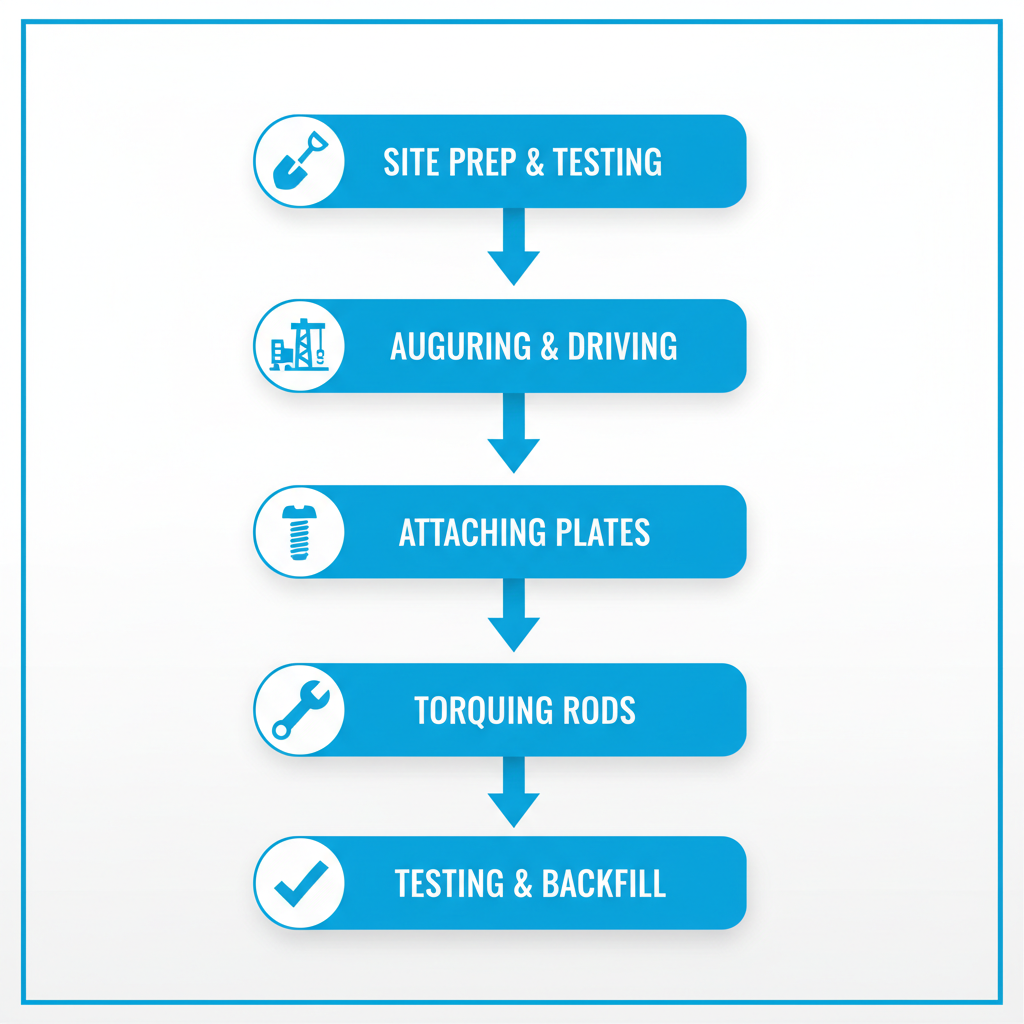
Step-by-step guide to installing plate anchors for foundation repair
Tools and Safety Considerations
Equipping your team with the right tools is essential for efficient and safe deployment of field wall stabilizers. We supply ICC and ISO certified products, including hydraulic torque wrenches for precise tensioning and laser levels for alignment accuracy. Other essentials include augers, drivers, and torque multipliers. Contractors can view compatible products in our driven anchors catalog.
| Tool Type | Pros | Cons | Best For |
|---|---|---|---|
| Hydraulic | High torque, speed, precision | Higher cost, requires power | Large-scale retrofits |
| Manual | Portable, no power needed | Labor-intensive, lower torque | Small jobs, remote sites |
Maintenance After Installation
Post-installation care extends the life of wall plate anchors, safeguarding against shifts in soil or structural stress. We advise regular monitoring, starting with visual inspections every six months for signs of movement, such as new cracks or plate displacement. Use a torque gauge to recheck tension annually, aiming to maintain 4,000-6,000 ft-lbs as per initial specs.
- Routine Checks: Scan for corrosion on rods and plates; apply protective coatings if exposed to moisture.
- Load Monitoring: Install settlement gauges near anchors to detect subtle foundation shifts early.
- Professional Inspections: Schedule certified evaluations every 2-3 years, especially in seismic zones, following Earthquake Tracker Guide checklists for post-install verifications.
Our products come with warranties up to 25 years when installed per guidelines, providing peace of mind. Address issues promptly to prevent escalation; for instance, retighten loose fittings before they impact stability. Through our network of structural engineers, we provide design support for ongoing assessments. Remember, proper maintenance not only ensures compliance but also upholds the engineering excellence of advanced earth anchoring systems.
Advanced Applications of Plate Anchors
Plate anchors serve critical roles beyond standard installations, particularly in demanding conditions such as seismic zones, expansive clay soils, and poured concrete foundations. Our foundation repair solutions, including ICC and ISO certified products, enable contractors to address these challenges with precision. For instance, in areas prone to earthquakes, advanced earth anchoring systems like plate anchors enhance structural stability by resisting lateral forces, drawing from established bolting standards outlined in resources like the Earthquake Tracker Foundation Bolting Guide.
In seismic regions, plate anchors require enhancements such as higher torque applications and mandatory ICC-ES reports to ensure compliance with building codes. These seismic wall plates often feature thicker gauges and deeper embedding to withstand dynamic loads, preventing slippage during tremors. The guide emphasizes foundation bolting with 1/2-inch or 5/8-inch steel bolts, similar to how our wall plate anchors secure sill plates to concrete, a vital retrofit for pre-1980 homes as seen in events like the 1994 Northridge earthquake. For clay soils, pre-drilling mitigates expansion risks, allowing foundation wall anchors to maintain consistent tension without soil heave issues. In poured concrete walls, high-tensile rods paired with plate anchors provide superior pull-out resistance, ideal for commercial retrofits where uniform load distribution is essential.
| Zone Type | ICC Approval Needs | Anchor Specs | Warranty Considerations | Engineering Support |
|---|---|---|---|---|
| Seismic | Mandatory ESR reports | Thicker plates, deeper rods | Extended monitoring | Project-specific calcs |
| Non-Seismic | Basic certification | Standard 3/4-inch rods | Standard 10-25 years | General guidelines |
Warranties for plate anchors typically range from 10 to 25 years, with extended options in high-risk zones including periodic monitoring to detect shifts early and prevent cracking. Case studies from commercial retrofits, such as bolting upgrades in California crawl spaces, demonstrate reduced failure rates post-installation, underscoring the value of professional oversight. For complex projects involving manta ray installation equipment, we recommend consulting our team for site-specific guidance. Consult a structural engineer or our engineering team for project-specific design and installation, as products must comply with ICC-ES criteria like AC358.
Common Questions on Plate Anchors
Plate Anchors address common stabilization queries for foundation repairs.
How long does it take to install foundation wall anchors?
Installing each foundation wall anchor typically requires 2-4 hours, depending on site access and soil conditions. Our trained installers ensure efficient, code-compliant work.
Where can suppliers of wall plate anchors be found?
As a national distributor headquartered in Littleton, Colorado, we supply wall plate anchors to contractors across the U.S. through our extensive network.
Do plate anchors prevent wall cracking?
Yes, plate anchors stabilize bowing walls and prevent further cracking by reversing pressure through exterior plates and interior rods.
What benefits do foundation wall anchors offer over alternatives?
They provide cost-effective stabilization with minimal interior disruption compared to full wall rebuilding, ideal for residential retrofits.
Which companies offer warranties on wall plate anchors?
We provide comprehensive warranties on our ICC-certified plate anchors, ensuring long-term performance backed by engineering support.
Are plate anchors suitable for seismic zones and various soil types?
Drawing from the Earthquake Tracker Foundation Bolting Guide, plate anchors enhance seismic resilience in high-risk areas like California, adaptable to diverse soils with proper design.
Enhancing Stability with Plate Anchors
In foundation repair, Plate Anchors stand out as a cornerstone for achieving long-term structural integrity, providing reliable foundation solutions that contractors trust for demanding projects. Our advanced earth anchoring systems, including manta ray earth anchors, effectively reverse wall bowing while minimizing excavation and costs, typically ranging from $5,000 to $10,000 for comprehensive stabilization that prevents further cracking in concrete walls.
We offer ICC and ISO certified products alongside on-site training and our network of structural engineers for tailored support. Contact us to elevate your projects with these stable wall systems. As affirmed by the Earthquake Tracker Foundation Bolting Guide, such retrofits boast high success rates in enhancing resilience against seismic events.
Consult a structural engineer for project-specific guidance to ensure compliance with building codes.