


Jason Keefer
President
Residential Foundation Repair
Table of Contents
Residential Foundation Repair Essentials
In residential settings, foundation issues demand targeted essentials of foundation repair. Homeowners often spot horizontal cracks wider than 1/8 inch or uneven floors sloping over 1 inch in 20 feet, signaling distress in residential homes.
Key signs include these cracks requiring foundation crack repair and settlement stabilization. What demands action? Helical piers offer minimally invasive solutions, compliant with ICC-ES AC358 standards from the International Code Council (ICC-ES) for load-bearing in homes.
Essential steps: Certified engineers assess, install helical piers to refusal depth, and monitor hydraulic torque to 14,500 ft-lbs per AC358. Benefits feature immediate load transfer and durability for slab-on-grade and crawlspace foundations.
Act swiftly with professionals to avert failure. Advanced techniques like helical piers, detailed next, ensure stability.
1. Detect Issues Early
The first step in residential foundation repair is early detection. Identifying issues promptly prevents expensive structural damage and maintains your home’s integrity. We at Helical Technology stress proactive vigilance to safeguard residential foundations before problems escalate.
Key warning signs include:
- Horizontal cracks wider than 1/8 inch in basement walls, signaling soil pressure and potential failure.
- Diagonal cracks in brick exteriors wider than hairline, often from settling or shifting.
- Sticking doors or windows that previously operated smoothly, due to frame distortion.
- Uneven or sloping floors, testable by placing a marble on suspected areas.
- Gaps around window or door frames exceeding 1/4 inch, indicating separation.
- Water pooling in yard near foundation after rain, promoting erosion.
- Musty odors in basement, from moisture intrusion.
- Stair-step drywall cracks above doorways, a classic shear sign.
If multiple signs appear, schedule immediate professional inspection. Once detected, a helical pier system offers reliable stabilization for foundation crack repair. Monitor seasonally, document changes with photos, and consult experts.
2. Master Helical Piers
When traditional methods fall short, helical piers provide a superior alternative for residential foundation repair. These steel shafts with helical plates act like giant screw anchors, transferring structure loads to stable soil layers.
Key components include the lead section with helices, extension shafts for depth, and termination brackets that connect to foundations. Helical pile systems excel in residential applications like settling slabs and bowing walls.
Installation starts with excavating to the bracket location. Technicians screw in the lead section using torque monitoring, adding extensions until load capacity meets ICC-ES AC358-2024 criteria, the authoritative industry standard from the International Code Council (ICC-ES) for design, torque correlation, and lateral load testing. For foundation crack repair, we often combine them with structural injection epoxy for comprehensive fixes.
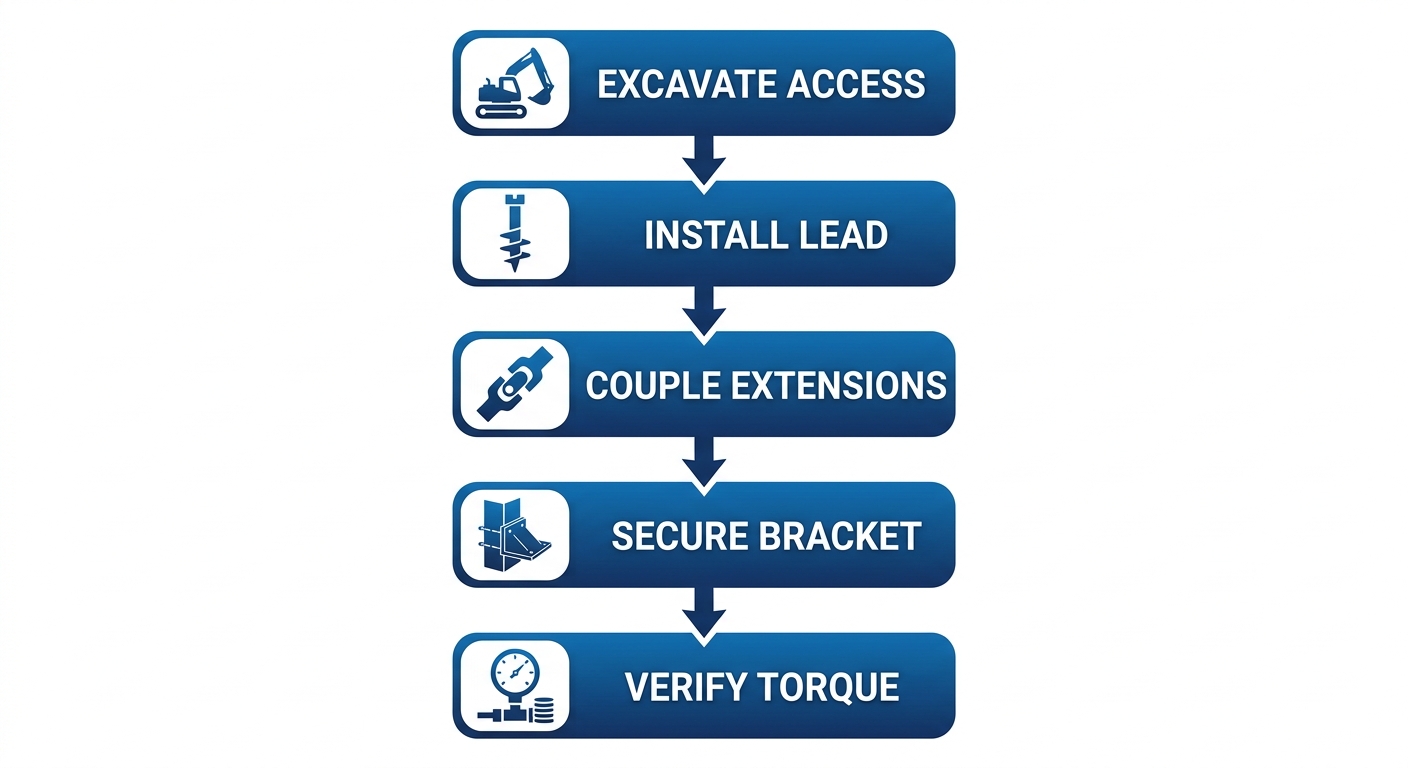
Helical pier installation process: 5 essential steps for foundation repair
Screw piers offer vibration-free installation, immediate load transfer, and access to tight sites, outperforming driven piers. Always consult our network of structural engineers for project-specific guidance compliant with ICC-ES acceptance criteria. Understanding these basics sets the stage for exploring real-world applications in foundation repair solutions.
3. Understand Pier Mechanics
Building on foundation issue diagnosis, grasp helical pier mechanics for targeted residential foundation repair. Helical piers function as screw-like foundations, advancing into soil via torque without excavation. These advanced earth anchoring systems distribute loads effectively to competent strata.
Helix plates provide primary bearing capacity, with multiple configurations per ICC Evaluation Service (ICC-ES) AC358-2024 acceptance criteria–the authoritative industry performance standards for helical pile systems. These standards mandate minimum helix pitch, plate thickness, and corrosion protection. The central shaft transfers structural loads axially, while brackets connect to foundations, resisting settlement laterally. Torque correlation during installation verifies capacity, linking applied torque directly to ultimate strength.
Helical piers pair with tools like the concrete crack lock kit for comprehensive foundation crack repair. Installation follows this sequence:
- Drive lead helix to penetrate soil.
- Add extension sections using hydraulic torque motor.
- Achieve target torque for proof testing, enabling immediate load transfer with minimal disturbance.
These mechanics ensure reliable outcomes in repairing residential foundations. With these principles understood, explore installation best practices to ensure success.
4. Compare Pier Options
Building on pier types, here’s how our helical piers stack up against alternatives for residential foundation repair. Helical piers offer superior performance in installation, durability, and cost for home foundation fixes.
Installation: Helical piers screw into the ground without digging, providing immediate load-bearing capacity and minimizing site disruption like impacts on yard drainage. Concrete piers require pouring, vibrations, and curing time, while push piers use hydraulic force prone to soil refusal in rocky conditions.
Cost and Durability: Helical piers range from $1,200-$3,000 per pier with galvanized steel lasting 50+ years, versus concrete’s $2,000-$5,000 and 25-30 years prone to cracking. They excel in soil adaptability through torque-testing across soil types, addressing foundation crack repair needs effectively.
These advantages make helical piers our proven choice for residential foundation repair before diving into installation details. They provide predictable settlement control, simplified logistics, and long-term proven reliability benefits.
5. Calculate Repair Costs
Once you’ve assessed the damage from foundation cracks, calculating costs for residential foundation repair becomes crucial for budgeting effectively. We at Helical Technology guide contractors through this process, focusing on reliable helical piers for stabilization.
Key cost factors include:
- Extent of foundation crack repair needs
- Soil conditions demanding helical piers
- Site accessibility
- Regional US labor rates, averaging $75-$150 per hour
Typical ranges: $10,000-$30,000 per home for helical pier installations and $300-$800 per pier. For instance, an advanced earth anchoring system offers cost-effective stabilization.
Follow these three steps:
- Measure affected square footage.
- Choose method like helical piers and multiply by unit costs.
- Add 20-30% for permits and mobilization.
Simple formula: Total Cost = (Number of Piers × $500) + Labor ($5,000) + Extras. Get three quotes from certified installers and request our free consultation for precise estimates, leading seamlessly to contractor selection.
6. Fix Cracks Effectively
Once cracks are identified, effective repair is essential. We at Helical Technology emphasize timely residential foundation repair to prevent structural failure and escalating damage. Acting promptly safeguards your home’s integrity.
Follow these professional steps for foundation crack repair:
- Assess the damage. Visually inspect the crack. If wider than 1/4 inch, call experts. Use a level to check for settlement.
- Install helical piers for stability. We drill these advanced earth anchoring systems adjacent to the foundation. Attach brackets and torque to load-bearing capacity. Our ICC-certified helical piers ensure long-term support.
- Repair hairline cracks with injection. Clean the crack thoroughly. Apply epoxy or polyurethane sealant under pressure using our crack repair products.
Consult certified contractors for helical piers installation. Always seek our network of structural engineers for project-specific guidance.
Monitor post-repair. Check quarterly for new cracks. Maintain proper drainage. Ongoing monitoring sustains your repairs.
7. Plan Installation Timeline
Building on site assessment results, we at Helical Technology develop an efficient timeline for residential foundation repair projects using helical pile systems. This structured approach ensures minimal disruption while addressing issues like foundation crack repair triggered by soil movement.
Here is our typical numbered timeline:
- Pre-installation phase (3-6 weeks): Conduct soil borings and geotechnical analysis (1-2 weeks), followed by permit applications (2-4 weeks).
- Mobilization (1-2 days): Deliver equipment and crew to the site.
- Installation sequence (1-2 days for 4-12 piles): Excavate access points, then install lead helical piers and extensions (15-30 minutes per pile).
- Load testing (1 day per group): Apply compressive loads to verify capacity, informed by International Society for Soil Mechanics and Geotechnical Engineering (ISSMGE) research on helical pile group performance.
- Site restoration and handover (2-3 days): Restore landscaping and provide documentation.
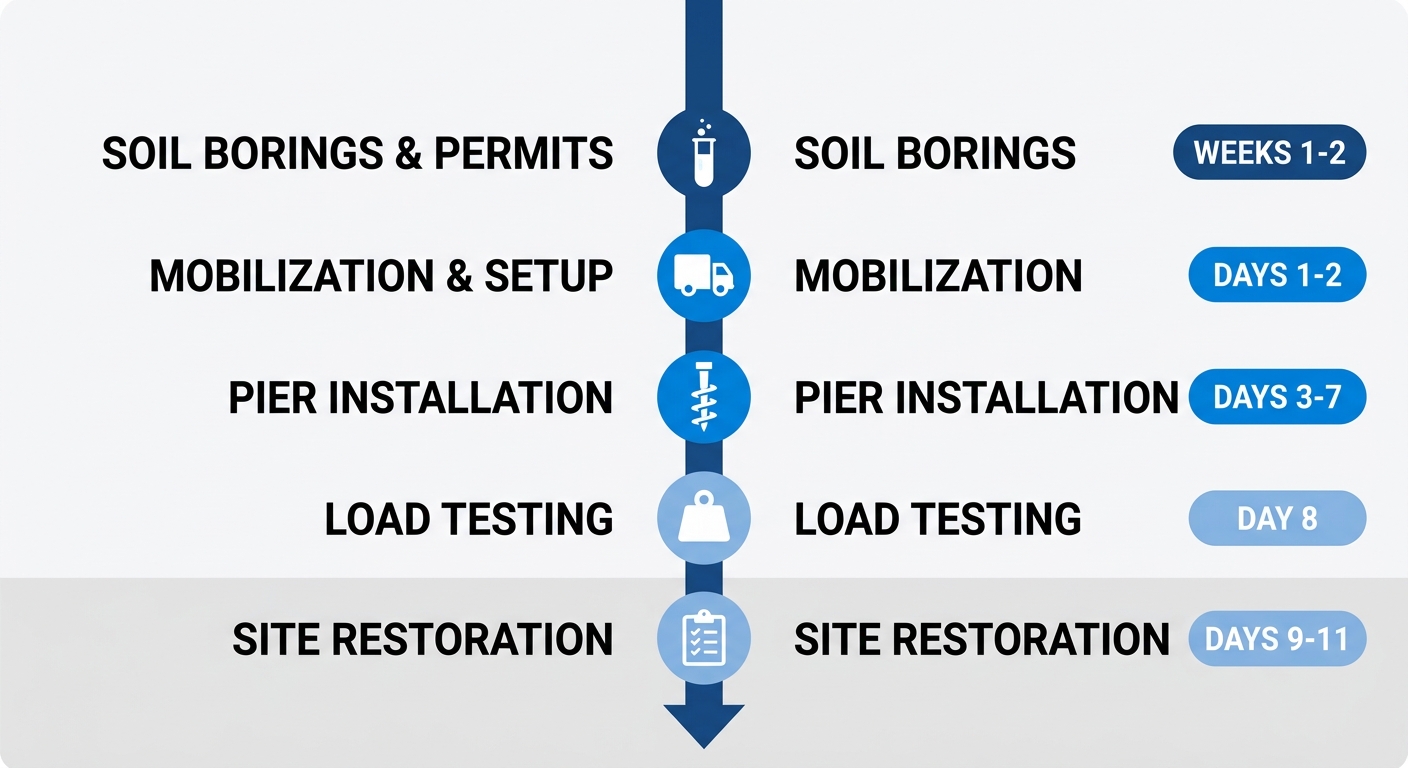
Vertical timeline outlining helical pier installation for foundation repair projects
Factors like soil conditions, pile group size, and access constraints can extend timelines by 20-50%. Consult our network of structural engineers for project-specific adjustments. With timeline confirmed, proceed to mobilization for seamless residential foundation repair execution. Consult a structural engineer for site-specific guidance and ensure compliance with building codes.
8. Select Top Contractors
With helical piers selected for your residential foundation repair, now vet top contractors to ensure durable pier-supported repairs. At Helical Technology, we emphasize qualifications that guarantee quality workmanship using our ICC and ISO certified products.
Key must-have criteria include:
- State Licensing for Foundation Work: Confirm active license specific to foundations. This ensures code compliance.
- 2M+ Liability Insurance: Verify proof protects your property during installation.
- 10+ Years Installing Helical Piers: Experience minimizes errors in helical pier systems.
- ICC-ES Certification for Products Used: Products must meet AC358 standards for safety.
- 20+ Google Reviews Averaging 4.8+ Stars: Look for mentions of helical piers and foundation crack repair.
- 3 Local References from Past 2 Years: Call for feedback on residential foundation repair jobs.
- Membership in Foundation Repair Association: Signals professional commitment.
Compare 3-5 bids focusing on specs like 30-ft galvanized shafts, not lowest price. Avoid red flags: no warranties, pressure sales, missing before-after photos.
Contact our certified helical pier specialists for free assessments. Consult our engineering team for project guidance.
Secure Lasting Stability
Once installed, our helical piers deliver secure lasting stability in residential foundation repair. These advanced earth anchoring systems distribute loads evenly, preventing settlement and ensuring homes remain solid for decades.
Helical pile groups excel under compressive loads, as shown in a numerical investigation by the International Society for Soil Mechanics and Geotechnical Engineering (ISSMGE). Authoritative findings confirm even load distribution and settlement control, even with eccentric or inclined forces. This performance safeguards repairing residential foundations against future shifts.
For foundation crack repair, helical pier systems offer immediate load transfer, resisting movement effectively. Homeowners benefit from reduced long-term maintenance in residential foundation repair.
This stability underpins proven results in real-world applications.
This article was researched and written with the assistance of AI tools.