


Jason Keefer
President
Retaining Wall Anchors
Table of Contents
Retaining Wall Anchors: Essential Stabilization Solutions
Retaining wall anchors address the soil pressure challenges discussed earlier, providing critical stabilization for structures holding back earth. These tensioned rods or helical systems embed into stable soil or rock behind the wall, resisting lateral forces that could cause bulging or failure. At Helical Technology, we supply advanced earth anchoring systems like plate anchors tailored for such demands in Littleton, CO, and beyond.
Helical tieback anchors screw into the ground without soil removal, ideal for rapid deployment in highway embankments and bridge abutments. Ground anchors retaining wall systems handle high loads in commercial excavations over 10 feet or residential basements. These tieback systems for retaining structures offer active restraint, preventing overturning while enhancing integrity for temporary or permanent use.
Key benefits include minimal site disturbance, adjustable tensioning, and cost savings over deadman methods. Our ICC and ISO Certified products ensure rapid installation and reliability, reducing risks like the 20% of collapses from poor lateral support. We provide engineering excellence and design support to optimize performance.
Proper retaining wall anchors safeguard projects. Consult our network of structural engineers for site-specific guidance. Dive deeper into helical tieback anchors and their installation next.
Types of Retaining Wall Anchors and Their Applications
To counteract retaining wall failures like those from active earth pressure or sliding, retaining wall anchors offer proven stabilization. At Helical Technology, we distribute advanced earth anchoring systems tailored for diverse soil conditions and project scales.
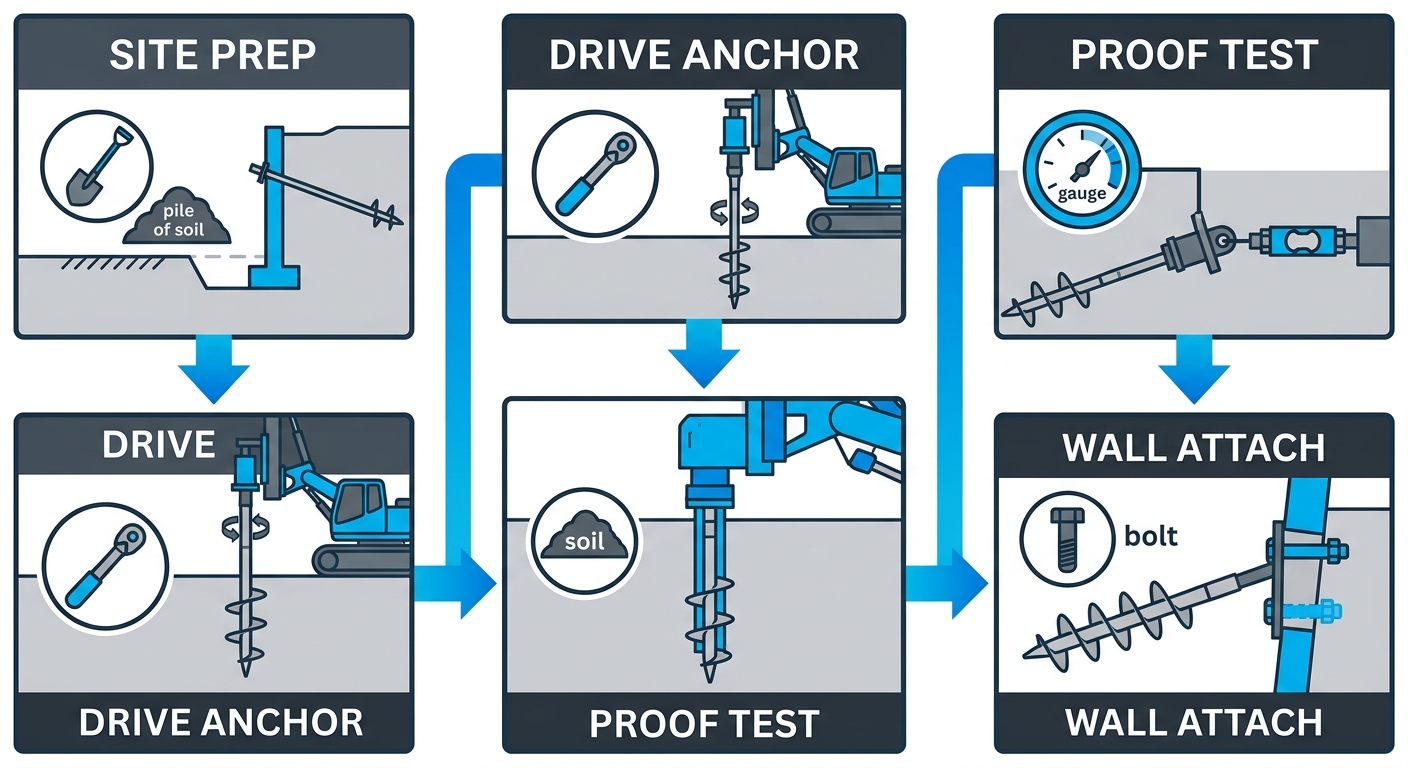
Comparison of four main retaining wall anchor types and applications
This visual highlights how these solutions address specific challenges, with helical options often leading due to their versatility. We transition now to detailed breakdowns, starting with our flagship helical tieback anchors.
Helical Tieback Anchors
Helical tieback anchors feature a multi-helix steel shaft designed to advance by rotation into stable soil strata, providing immediate load resistance without grout. These anchors excel in tension capacities of 30-200 kips, making them ideal for walls 8-40 feet high in cohesive or granular soils. Their step-by-step installation–torque monitoring during advancement, coupling extensions, and nut tightening–offers advantages over grouted systems by minimizing site disruption.
- Design advantage: Helices screw into soil like a giant bolt, achieving 100% embedment efficiency.
- Load performance: Up to 200 kips in tension, suitable for seismic zones.
- Applications: Residential tilt-up repairs to commercial highway barriers; helical tieback anchors install in hours versus days for alternatives.
Helical tiebacks from Helical Technology deliver engineering excellence and design support, ensuring reliable performance across projects.
Ground Anchors and Deadman Alternatives
Ground anchors use prestressed tendons grouted in boreholes, achieving capacities over 50 kips and suiting sandy soils, while deadman systems employ buried concrete blocks for uniform clay backfill on walls under 20 feet. Plate anchors, such as wall plate anchors, provide quick-driven or helical-pulled options for variable soils, serving as efficient deadman alternatives.
- Ground anchors: Ideal for ground anchors retaining wall in granular backfill; high capacity but require drilling and curing time.
- Deadman systems: Cost-effective for short, cohesive walls; limited by excavation needs.
- Plate anchors: Rapid install in mixed soils; ICC-certified for tension and compression.
These alternatives complement retaining wall anchors portfolios, though helical solutions often outperform in speed and predictability.
Selecting Anchors for Specific Conditions
Choosing retaining wall anchors depends on failure modes, soil types, and scale. For active earth pressure on tall walls, prioritize helical tiebacks; granular sliding favors ground anchors; short cohesive walls suit deadmans.
- Residential (<$10k budget): Helical tiebacks for quick, minimal excavation.
- Commercial (>$100k scale): Ground anchors or plate systems with our network of structural engineers.
- Variable soils: Wall plate anchors for adaptability.
Consult our structural engineering team for project-specific guidance, as ICC and ISO Certified products ensure code compliance. Proper selection guarantees longevity–next, explore installation best practices.
Key Benefits of Helical Tieback Anchors for Wall Stability
Helical tieback anchors outperform traditional retaining wall anchors in load-bearing capacity, long-term economy, and adaptability for diverse retaining wall projects. At Helical Technology, we supply these advanced earth anchoring systems to ensure wall stability with minimal disruption. Contractors benefit from their superior performance in demanding conditions.
First, their unmatched strength sets them apart.
Superior Load Capacity and Durability
Helical tieback anchors deliver exceptional load capacity through innovative design tailored for high-stress environments. Their helical plates distribute loads evenly, excelling in seismic zones where cyclic forces challenge lesser systems.
- Helical plates screw into soil, providing torque-correlated capacities that resist pullout forces far better than driven anchors, which often fail under repeated loading.
- Corrosion-resistant galvanized steel ensures durability, with lifespans exceeding 50 years even in harsh conditions, backed by our ICC and ISO certified products.
- Secure connections via tieback terminations transfer loads efficiently to the wall structure, enhancing overall integrity.
We recommend consulting our network of structural engineers for site-specific designs. This reliability makes helical tieback anchors the preferred choice for enduring wall support.
Adding to their appeal, cost savings make them a smart investment.
Cost-Effectiveness Over Time
Helical tieback anchors prove more economical than concrete alternatives over their lifecycle, starting with efficient installation. Minimal equipment needs reduce project timelines and expenses.
- Installation costs range from $50-100 per anchor, compared to over $200 for concrete methods, offering immediate savings.
- Minimal site disruption cuts labor by 30 percent, as vibration-free installation avoids soil compaction issues common with driven options.
- Over 20 years, zero maintenance requirements yield substantial returns, eliminating repair downtime and costs associated with degrading alternatives.
Our engineering support optimizes these efficiencies for contractors. These factors position helical tieback anchors as a financially superior solution for retaining walls.
Their flexibility extends to challenging applications.
Versatility for Tall Walls and Varied Soils
Helical tieback anchors, including ground anchors retaining wall configurations, adapt seamlessly to tall structures and diverse soil profiles. Customizable lengths and configurations handle complex demands.
- Support walls over 20 feet high with sectional extensions, stabilizing structures in urban or sloped terrains.
- Thrive in soils from dense clay to loose sand, where torque readings confirm precise capacities for reliable performance.
- Case studies demonstrate success on 30-foot walls in mixed soils, using helical ground anchors for walls to prevent failure.
Tieback anchors for retaining structures integrate easily with our plate anchors for comprehensive stabilization. This versatility underscores their role in achieving robust, code-compliant wall stability, always with professional engineering guidance.
Installation Process for Retaining Wall Anchors
Building on anchor selection, our team at Helical Technology provides detailed guidance on installing retaining wall anchors to ensure structural stability in residential and commercial projects. These wall anchor installations demand precision, specialized equipment, and adherence to safety protocols. We recommend consulting a structural engineer or our engineering team for project-specific design and installations must comply with applicable building codes and ICC-ES acceptance criteria.
Step-by-Step Helical Tieback Installation
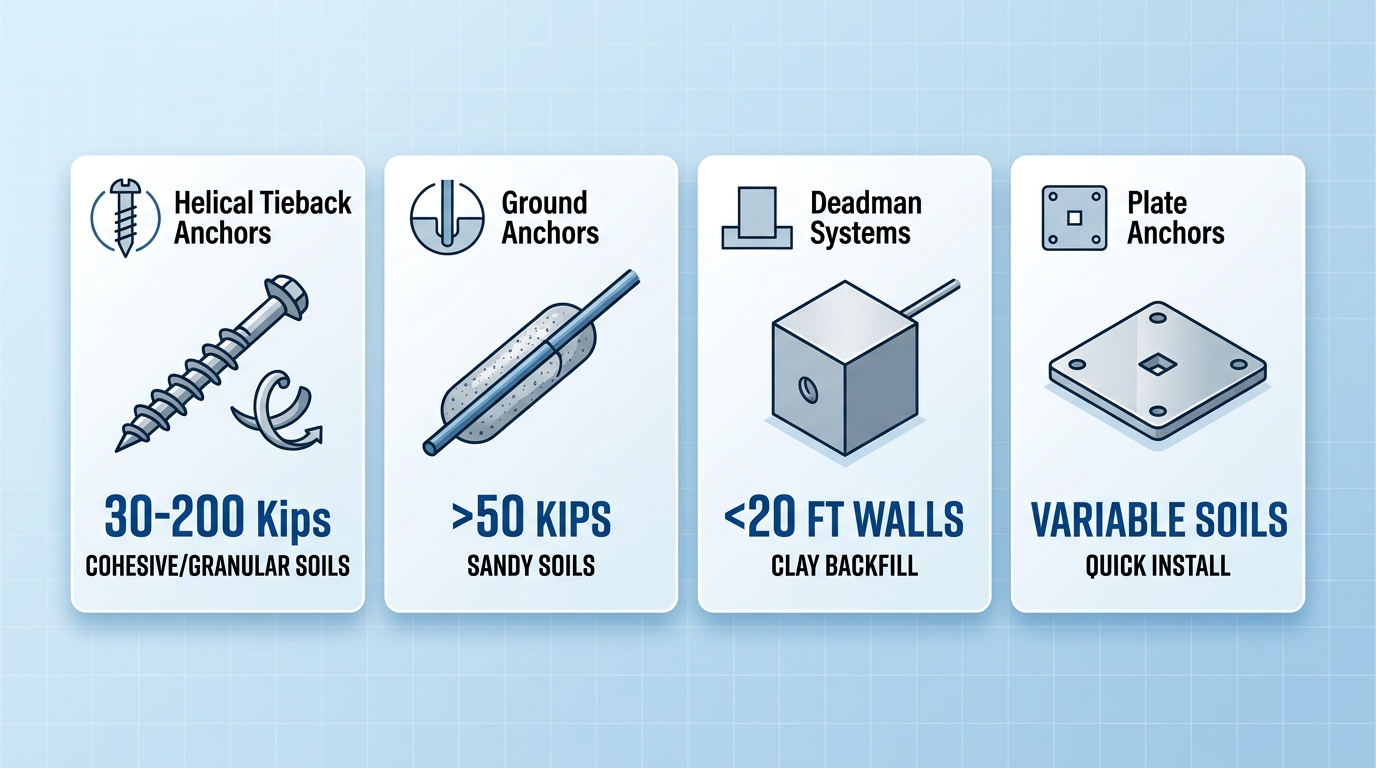
Helical tieback anchors require torque-based installation using high-capacity drivers and monitoring tools. Essential equipment includes torque motors, hydraulic extensions, load cells, and manta ray installation equipment for efficient driving in various conditions. Safety first: Wear PPE including hard hats, gloves, and eye protection; establish clearance zones around the site.
- Pre-drill pilot holes if soil resistance is high to guide the lead section.
- Drive the helical tieback anchor using a torque motor until reaching 10,000 ft-lbs minimum torque, monitoring continuously for capacity verification.
- Attach to the wall cap with galvanized plates and nuts, ensuring proper alignment and tensioning.
- Verify installation with pull-out testing to confirm load capacity.
This process delivers reliable helical tieback anchors for retaining walls, leveraging our ICC and ISO certified products for optimal performance.
Comparison of four main retaining wall anchor types and applications
Step-by-step installation process for retaining wall anchors using helical tiebacks
Once installed, adapt for soil variations by selecting appropriate techniques to maintain anchor integrity across diverse geotechnical conditions.
Adapting to Different Soil Conditions
Soil type dictates installation adjustments for retaining wall anchors, ensuring embedment depth and holding capacity. Key equipment includes hydraulic torque drivers, coring tools, and pressure grouting rigs. Bold safety warning: Secure the site with barriers and monitor for soil instability during operations.
- For clay soils, apply hydraulic crowding to displace cohesive material and achieve full embedment.
- In sandy soils, use high-torque drivers to prevent anchor rotation and ensure frictional resistance.
- For rocky terrains, create rock sockets with coring tools before inserting the anchor section.
- Test and adjust based on site-specific probe data for consistent performance.
These adaptations enhance the versatility of our advanced earth anchoring systems in challenging environments.
Ground Anchor Systems Deployment
Ground anchors retaining wall applications involve prestressing and grouting for permanent stabilization. Required tools encompass grout pumps, pressure meters, jacks, and shims. Prioritize safety: Use lockout/tagout procedures and maintain minimum distances from excavations.
- Install the tendon through pre-drilled holes into competent strata.
- Grout with cement-bentonite mix under pressure to bond the tendon securely.
- Proof test to 150% design load to validate performance before lock-off.
- Lock off with shims and nuts, releasing tension while monitoring elongation.
Post-installation monitoring ensures long-term efficacy of ground anchors retaining wall setups, transitioning seamlessly to routine maintenance protocols at Helical Technology.
Best Practices and Maintenance for Retaining Wall Anchors
Implementing best practices for retaining wall anchors prevents costly failures in civil construction projects. We at Helical Technology emphasize proper engineering, cost evaluation, and reliable sourcing to ensure lateral stability and longevity. These strategies build on foundational construction techniques from prior sections.
Engineering Considerations for Civil Projects
Proper design starts with load calculations tailored to site conditions. For retaining walls over 10 feet, use active earth pressure formulas like Ka = tan²(45° – φ/2), where φ represents soil friction angle. We recommend geotechnical borings to determine φ accurately, ensuring helical tieback anchors stabilize steep slopes effectively. We also verify anchor spacing, corrosion allowances and load-sharing for multi-row systems to optimize lateral resistance.
Key certifications include:
- ICC-ES AC358 for helical anchors, verifying performance under cyclic loading.
- ASTM D1143 standards for pile load testing to confirm capacity.
Select suppliers with 20+ years in helical systems. Prioritize those offering on-site installation training programs. Our network of structural engineers provides project-specific support, aligning with ICC and ISO certified products for compliance.
Cost Comparisons and Long-Term Maintenance
With design finalized, evaluate economics via comparisons. Helical retaining wall anchors cost $40-80 per linear foot installed, outperforming sheet piling at $100-150 per foot and concrete deadman anchors at $60-120. These savings stem from faster installation and minimal excavation. Life-cycle analyses show lower downtime and faster project turnover, further improving return on investment.
Ground anchors retaining wall demand routine upkeep:
- Conduct annual torque checks; re-tension if capacity drops 10%.
- Inspect galvanization every 5 years for corrosion.
- Monitor settlement with inclinometers quarterly.
Consult a structural engineer for project-specific guidance. Installations must comply with building codes and ICC-ES AC358 criteria. Our advanced earth anchoring systems reduce long-term costs through durability.
To realize these savings, select suppliers who deliver quality consistently.
Sourcing Reliable Anchors in the US
Contractors should prioritize FHWA-approved helical products for US projects. Request pull-out test reports exceeding 20 kips capacity to verify performance. Look for nationwide distribution with hubs in Texas and California for timely delivery. Request engineering stamped reports and confirm delivery timelines to avoid schedule delays on site.
Vet suppliers using these steps:
- Confirm ISO certifications and engineering support.
- Review case studies from similar civil works.
- Ensure custom options like galvanization thickness.
Helical Technology excels here, offering foundation repair solutions and on-site training. For demanding civil projects, explore commercial structural anchors from specialized providers like Helical Technology. Contact our Littleton, CO team for design assistance and quotes to advance your installation phase securely.
Optimizing Retaining Wall Stability with the Right Anchors
Building on foundation design principles, selecting the right retaining wall anchors is crucial to prevent failures like bulging or collapse in challenging soil conditions. At Helical Technology, we emphasize helical anchors for their superior load-bearing capacity and adaptability across soil types.
Three key factors guide anchor selection:
- Soil composition: Clay soils demand anchors with high pullout resistance, unlike sandy soils that suit low-displacement options.
- Wall height and load: Walls under 10 feet benefit from lighter anchors, while taller structures over 10 feet require robust tension systems.
- Installation method: Hand-installed for small projects versus machine-torqued for efficiency in larger applications.
Helical tieback anchors excel in tension resistance, offering a direct torque-to-capacity correlation and corrosion-resistant galvanization for longevity. Unlike driven anchors that cause soil displacement, our ground anchors retaining wall solutions provide immediate stability.
We recommend consulting our network of structural engineers for project-specific guidance. Our technical team can assist with customized anchor selection today. For niche applications like temporary wildlife structures, explore hunting and trapping earth anchor assemblies. Once anchors are selected, explore installation techniques in the following section.
This article was researched and written with the assistance of AI tools.