


Jason Keefer
President
Steel Foundation Underpinning
Table of Contents
Steel Foundation Underpinning Essentials
Addressing these issues requires proven methods like steel foundation underpinning. This technique uses high-strength steel piers to transfer foundation loads to deeper, stable soil strata. We offer foundation repair solutions such as push piers and helical piers, which provide reliable stabilization without full replacement.
Push piers consist of sectional steel piers hydraulically driven into the ground until refusal. They achieve resistance through skin friction and end-bearing, making them ideal for cohesive soils. This method minimizes excavation and enables rapid installation.
Helical piers feature steel shafts with helical plates screwed into the soil. Load-tested during installation, they confirm capacity immediately via torque correlations. A reliable helical pier system ensures torque-correlated capacity, meeting International Code Council standards in Section 1810.3.3.1.9 for anchorage, embedment, and corrosion protection.
Helical piers suit variable or poor soils unable to support driving, while push piers excel in cohesive conditions. Both deliver minimal disruption, permanent stability, and code compliance. Professional assessment via soil tests determines the optimal steel underpinning solution. Understanding these essentials leads to proper selection and expert implementation steps. Consult our engineering team for project-specific guidance by experienced, certified professionals onsite.
Understanding Steel Foundation Underpinning
At Helical Technology, we specialize in steel foundation underpinning as a reliable method to stabilize sinking or shifting structures using robust steel piers. This technique transfers foundation loads to deeper, stable soil layers, preventing further settlement and ensuring long-term structural integrity. Our ICC and ISO certified products support contractors nationwide with proven foundation repair solutions.
Types of Steel Underpinning Systems
Push piers consist of interlocking steel pipe sections driven hydraulically into the ground until they reach competent load-bearing strata. These systems feature external sleeves for corrosion protection and use powerful hydraulic rams to advance the piers incrementally. Key components include:
- Steel pipe sections (typically 3-inch diameter)
- Hydraulic drive heads and rams
- Load transfer brackets connecting piers to the foundation
Push piers excel in dense soils where resistance allows precise depth control.
In contrast, helical piers, also known as helical piles, feature steel shafts with welded helical bearing plates that are screwed into the soil using torque from hydraulic equipment. Components comprise lead sections with helical plates, extension shafts, and brackets for load transfer. Installation torque correlates directly with capacity, as outlined by authoritative International Code Council (ICC) standards in Section 1810.3.3.1.9, which detail methods like torque correlation and load testing for axial design loads.
Applications in Foundation Repair
Steel foundation underpinning proves essential for lifting and stabilizing sinking foundations by driving piers to stable strata, then hydraulically raising the structure to level. We supply push piers for these scenarios, enabling precise adjustments with minimal disruption to surrounding areas.
For slab-on-grade repairs, underpinning with push piers targets interior columns or beams under slabs affected by expansive soils or erosion. Piers are installed through small excavations, transferring loads without full slab removal.
In civil projects, such as bridge abutments or retaining walls, helical steel piers provide deep support in challenging conditions. Our network of structural engineers offers design support to ensure compliance with ICC standards, making these systems ideal for heavy-load infrastructure.
Soil and Site Considerations
Push piers suit cohesive clays and dense sands, where high frictional resistance during driving confirms load capacity. These conditions allow piers to penetrate reliably without excessive deflection.
Helical piers perform best in variable or soft soils, including loose sands and silts, as helical plates advance via torque rather than end-bearing. ICC guidelines emphasize torque correlation for verifying ultimate capacity in such profiles.
Avoid sites with large obstructions like boulders, which can deflect push piers, or high groundwater without dewatering adaptations. Always consult our engineering team or a structural engineer for site-specific assessments to comply with building codes and optimize advanced earth anchoring systems. This careful selection maximizes the benefits of steel underpinning for durable results.
Benefits of Steel Foundation Underpinning
Beyond mere repair, steel foundation underpinning offers transformative benefits for stabilizing settling foundations. This method uses high-strength steel piers to transfer loads to stable soil layers, delivering exceptional durability, long-term cost savings, and superior performance over traditional concrete options. At Helical Technology, we supply ICC-certified products that ensure reliable results for contractors nationwide.
The following table outlines key differences between steel underpinning and concrete foundations, highlighting why steel excels in demanding conditions.
| Feature | Steel Underpinning (Push/Helical Piers) | Concrete Foundations |
|---|---|---|
| Load Capacity | High, adjustable | Fixed, limited |
| Installation Time | Days | Weeks |
| Durability | 50+ years | Prone to cracking |
| Disruption | Minimal | Extensive excavation |
Steel underpinning minimizes site disruption and adapts to variable soils, while concrete often requires extensive excavation. According to International Code Council standards in Section 1810.3.3.1.9, helical piles meet rigorous load transfer requirements through bearing plates and shaft resistance, confirming their superior engineering. These metrics position steel as the preferred choice for efficient, resilient repairs, reducing long-term ownership costs through proven longevity.
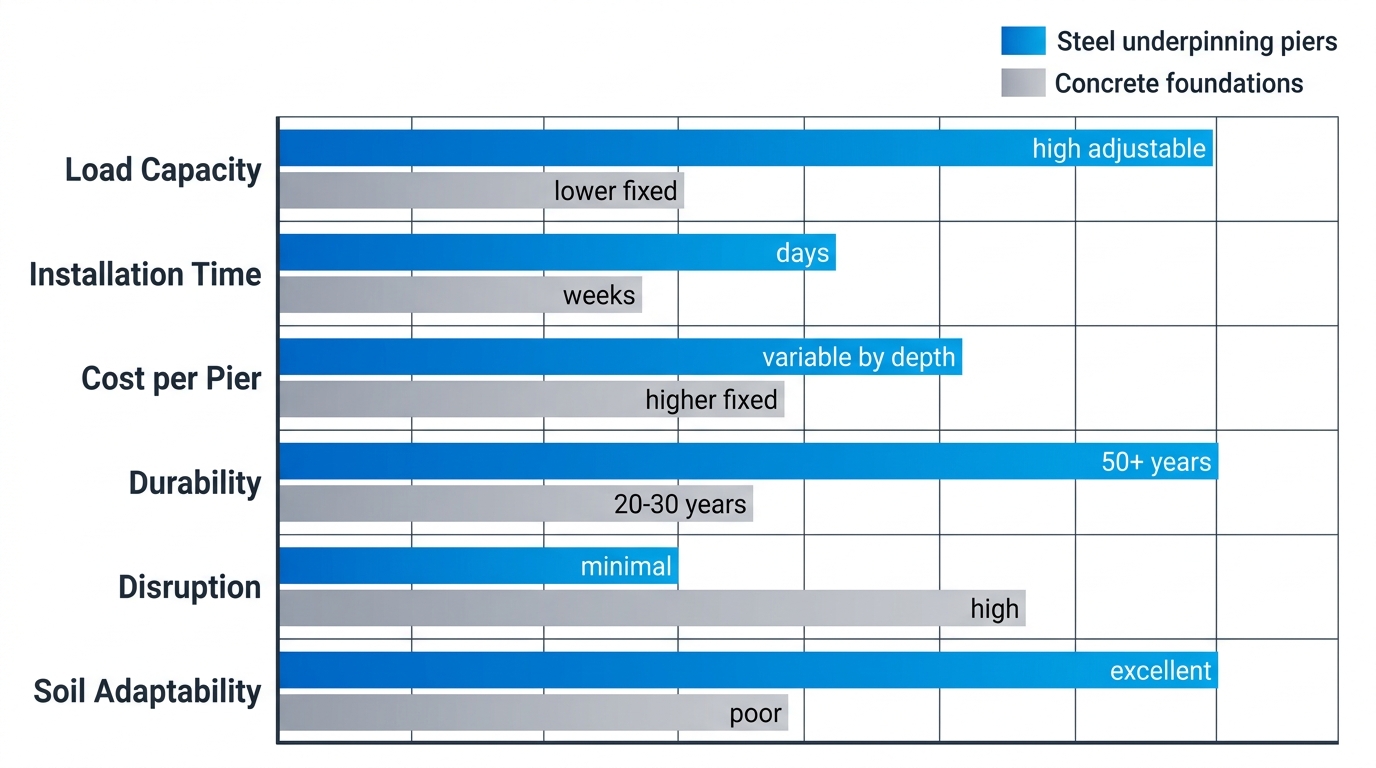
Steel underpinning vs concrete: key performance advantages chart
This visual underscores steel’s edge in critical areas, guiding contractors toward solutions that align with project timelines and budgets. Building on these comparisons, steel systems provide unmatched reliability.
Durability and Longevity Advantages
Steel piers in foundation underpinning boast a lifespan exceeding 50 years, far surpassing concrete alternatives prone to cracking under soil shifts. Galvanized coatings protect against corrosion, while high-tensile steel resists expansive clays and seismic activity. International Code Council building code standards affirm this through verified axial load capacities for helical piles, calculated via bearing plates and torque correlations.
Key advantages include:
- Resistance to soil movement via deep penetration to bedrock.
- Use of plate anchors for enhanced lateral stability in walls.
- Minimal degradation, backed by ICC-ES reports and manufacturer specifications from Helical Technology.
Homeowners and contractors benefit from reduced future interventions, ensuring structures remain safe for generations. Our ICC and ISO certified products support these outcomes with engineering excellence.
Cost-Effectiveness Over Time
Push piers offer upfront costs of $1,000-$3,000 per pier, significantly lower than full concrete replacement exceeding $10,000 per section. Installation speed cuts labor expenses, with minimal site disruption avoiding temporary relocations. Long-term ROI shines through negligible maintenance, as steel withstands environmental stresses without frequent repairs.
Benefits encompass:
- Faster deployment in days, preserving project budgets.
- No excavation waste disposal fees common in concrete pours.
- Energy-efficient load transfer reducing utility strain on settled structures.
At Helical Technology, our foundation repair solutions deliver value through durable steel push pier systems, optimizing costs for residential and commercial applications while complying with building codes.
Superior Performance vs Concrete
Steel underpinning achieves adjustable load capacities up to 50+ tons per pier, dwarfing concrete’s fixed limits and enabling precise adjustments during installation. Helical piers install in days versus weeks for concrete, thriving in expansive soils where concrete fails due to poor adaptability.
Standout features:
- Torque-based capacity verification per ICC guidelines.
- Seamless integration with underpinning brackets for comprehensive stabilization.
- Advanced earth anchoring systems handling dynamic loads effortlessly.
These advantages make steel underpinning ideal for swift, reliable installation processes, empowering contractors with our network of structural engineers for project-specific support.
How Steel Foundation Underpinning Works
At Helical Technology, we specialize in steel foundation underpinning solutions that stabilize structures by transferring loads to deeper, competent soils. This process addresses settlement issues common in weak soils, using push piers and helical piers for reliable support.
Installation Process Step-by-Step
First, the installation process begins with site preparation and bracket attachment. Technicians excavate small access holes at foundation corners and secure heavy-duty brackets to structural elements.
- Hydraulic pushing setup: Position an external hydraulic ram manifold connected to pier sections.
- Drive initial section: Apply hydraulic force to push interlocking steel pier through friction soils until refusal on load-bearing stratum.
- Add extensions: Couple additional 3-4 foot sections sequentially as resistance builds.
- Helical screwing transition: For helical method, attach lead section with plates and rotate under torque to advance into stable soil.
- Monitor and lock: Use instrumentation to verify capacity, then transfer load by adjusting brackets.
- Backfill and test: Restore site and perform load verification.
This steel underpinning process ensures precise depth control. According to International Code Council standards, such methods meet performance criteria for deep foundations.
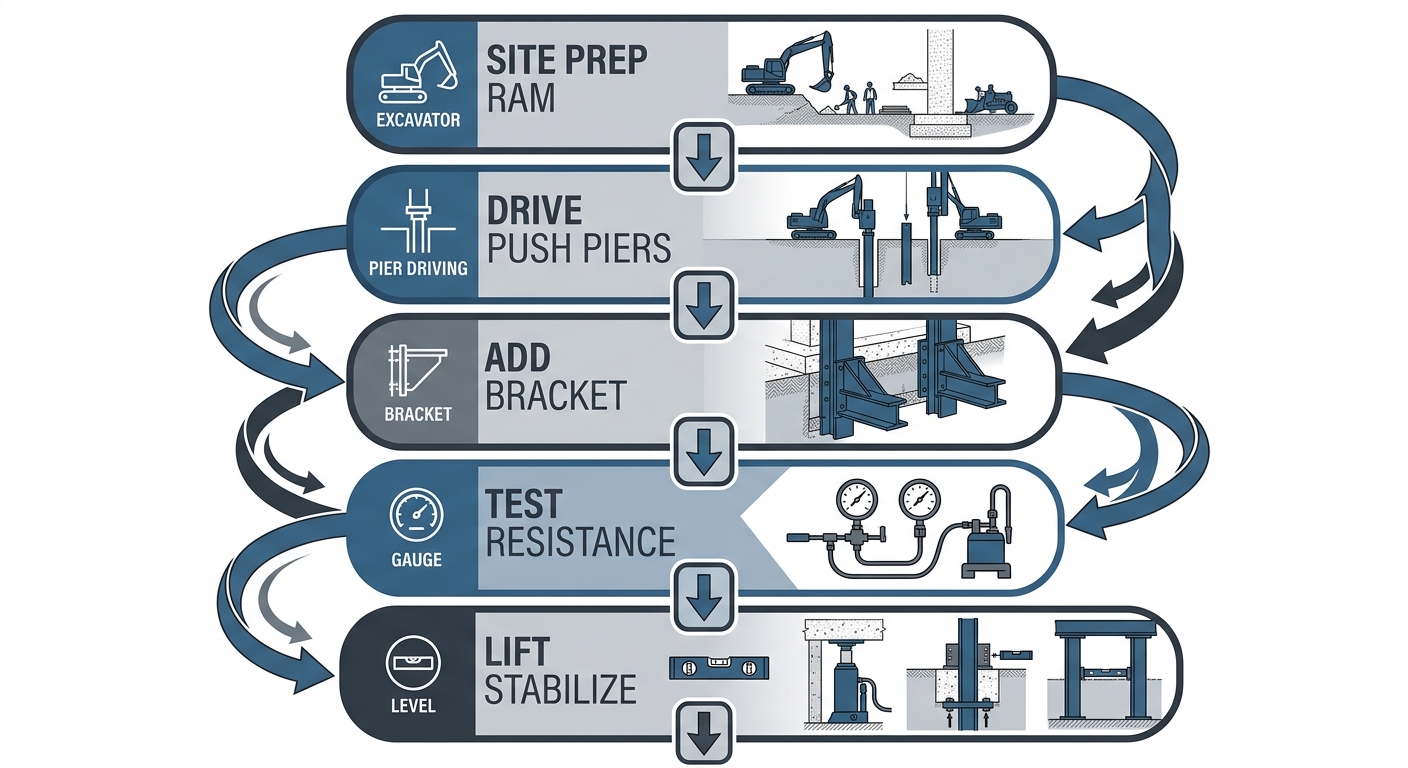
Steel foundation underpinning process: site prep to stabilization with helical option
The diagram illustrates both paths, highlighting our ICC-certified products for seamless integration.
Push Piers Mechanics
Push piers operate on resistance-based driving principles. The pier advances only when external hydraulic force exceeds surrounding soil friction.
We drive the initial steel section downward until it meets competent stratum, typically achieving 6,000-12,000 psf end-bearing resistance. Technicians add extensions via hydraulic coupling, monitoring skin friction along the shaft. Load transfer occurs through friction along the pier length and direct end-bearing at the tip.
This method suits cohesive soils where displacement drives piers to refusal. Our push pier installation provides immediate stability, transferring structure loads below expansive clays. Push piers excel in high-load commercial applications, ensuring minimal vibration during steel foundation underpinning.
Helical Piers Torque Correlation
Helical piers use torque correlation for capacity verification. The lead helix advances at 1 foot per 3 rotations under continuous torque applied via a drive head.
Installation torque directly correlates to ultimate capacity by a factor of 10, as per well-documented standards; for example, 10,000 ft-lbs torque equates to 100 kips capacity. International Code Council building code standards affirm this for helical pile design, incorporating torque-to-capacity relationships alongside base and shaft resistance.
Load transfer happens as helical plates compress soil upward, creating helical-shaped bearing zones that anchor to the foundation. In steel foundation underpinning, commercial structural anchors enhance this helix-based anchorage. We recommend consulting our network of structural engineers for site-specific torque monitoring and compliance with ICC-ES criteria.
Both push piers and helical piers deliver engineering excellence, supporting lasting structural stability.
Best Practices for Steel Foundation Underpinning
At Helical Technology, we emphasize best practices for steel foundation underpinning to safeguard structures against settlement and ensure long-term stability. These methods, compliant with International Code Council (ICC) standards, minimize risks in unstable soils and deliver durable solutions for residential foundations. Effective site assessment starts with thorough geotechnical evaluations.
Site Assessment and Planning
Proper site assessment forms the foundation of successful steel underpinning for foundations, identifying soil conditions and load requirements before installation. We recommend comprehensive geotechnical evaluations to inform precise helical pier designs.
Geotech Testing
- Conduct soil borings to at least 30 feet depth to profile strata and bearing capacities.
- Analyze groundwater levels and soil corrosivity to select appropriate steel coatings.
- Use design software like LPILE for helical pier capacity calculations, modeling torque-to-capacity ratios per ICC guidelines.
Design and Permitting
- Compare helical piers versus push piers, noting helical piers’ superior performance in variable soils due to continuous advancement without soil displacement.
- Engage our network of structural engineers for project-specific plans meeting ICC Section 1810.3.3.1.9 depth and load criteria.
These steps, as outlined in authoritative ICC building code standards, prevent under-design and ensure compliance. Once planned, installation requires rigorous quality controls.
Installation and Quality Control
Installation demands certified expertise and real-time verification to achieve optimal embedment for steel pier underpinning. Our training programs equip teams for precise execution.
Installer Training
- Require certification from organizations like the Deep Foundations Institute, with on-site sessions from Helical Technology in Littleton, CO.
Monitoring Protocols
- Employ real-time torque monitoring during helical piers installation to verify 20-40 feet embedment, correlating to ultimate capacity per ICC correlations.
- Perform load testing on push piers to refusal, confirming axial design loads via base and shaft resistance methods.
- Integrate advanced earth anchoring system features for enhanced torque-monitored advancements.
According to International Code Council (ICC) standards in Section 1810.3.3.1.9, these protocols validate helical pile performance through torque, proof testing, and shaft capacities. Post-installation, ongoing maintenance ensures longevity.
Maintenance and Long-Term Monitoring
Long-term monitoring sustains helical pile systems integrity, detecting issues early for proactive adjustments. We advocate structured schedules leveraging precise instruments.
Inspection Routine
- Conduct annual visual checks for corrosion on steel elements, documenting galvanic protection integrity.
- Perform settlement surveys with inclinometers every 2-5 years to track movements.
Adjustment Procedures
- Address displacements exceeding 1/2 inch through supplemental piers or hydraulic jacking.
- Consult our engineering team for site-specific guidance, ensuring ICC compliance.
These practices yield 100+ year durability, as ICC codes affirm when properly executed. By following these best practices, contractors achieve reliable steel foundation underpinning outcomes, backed by our ICC and ISO Certified products and design support.
Achieving Stable Foundations with Steel Underpinning
To counteract settlement, steel foundation underpinning provides a permanent fix. This method transfers structural loads from unstable soils to deeper, competent layers using high-strength steel elements. At Helical Technology, we supply ICC and ISO Certified products like helical piers and push piers for these foundation repair solutions.
Installers advance helical piers by rotating steel shafts with helical plates into stable soil via torque. This action creates load transfer through bearing on plates and shaft friction. In contrast, push piers involve hydraulically driving steel sections for end-bearing or friction resistance in cohesive soils. Benefits include:
- Minimal site disturbance during installation
- Rapid deployment with immediate load capacity
- Proven longevity for settling structures
- Versatile application in varied soil conditions
The International Code Council mandates design standards in ICC 1810.3.3.1.9, specifying minimum embedment, connections, and corrosion protection. We recommend combining exterior work with interior supports, such as a floor stabilizer post kit for comprehensive stabilization during both new construction and retrofit work. Consult our network of structural engineers for project-specific guidance. Following these code-guided practices ensures durable results, as seen in real projects.
This article was researched and written with the assistance of AI tools.