


Jason Keefer
President
Structural Foundation Supports
Table of Contents
Understanding Structural Foundation Supports
As foundation problems escalate from settlement and soil movement, structural foundation supports provide critical stability. We at Helical Technology define these as engineered systems, such as helical piers and push piers, that transfer building loads to deeper, stable soil layers. This prevents cracking, uneven floors, and structural damage in residential and commercial projects.
Poor soil conditions often cause foundations to shift and settle over time. What happens when unstable soils cannot bear the load? Helical piers address this effectively. These screw-like steel shafts are rotated into the ground using hydraulic torque motors. They excel in variable soils with minimal vibration and site disruption. Key advantages include:
- Immediate load transfer upon installation
- Versatility across soil types, including soft or loose ground
- Long-term durability with our ICC-certified products
Push piers offer another proven option for structural foundation supports. High-strength steel sections are hydraulically driven next to the foundation. They rely on skin friction for secure load transfer to competent strata. Benefits mirror helical systems:
- Minimal disturbance to existing structures
- Rapid installation for urgent repairs
- Reliable performance in dense soils
These foundation repair solutions suit diverse applications. Consult our network of structural engineers for project-specific guidance. These supports are installed via proven methods detailed next, ensuring code compliance and lasting results.
Fundamentals of Structural Foundation Supports
Building on foundation challenges, here are the fundamentals of structural foundation supports. These essential systems transfer building loads from unstable surface soils to deeper, stable layers below. At Helical Technology, we supply ICC and ISO Certified products like helical piers and push piers as key foundation repair solutions. They stabilize residential and commercial structures against settlement caused by shifting soils, expansive clays, or poor initial compaction. Homeowners and engineers rely on these foundation piling systems to ensure long-term structural integrity.
Helical piers, also known as screw piers, represent a versatile option in structural foundation supports. We install them by rotating steel shafts with helical plates into the ground using hydraulic torque motors. This method requires no pre-drilling, even in cobbles or obstructions. Helical piers excel in variable soils, providing high torque-based load capacity that directly correlates to installation resistance. According to our Helical Technology product catalog and ICC-ES reports, this approach delivers reliable performance for both new construction and repairs.
Push piers offer another approach within structural foundation supports. These consist of interlocking steel shafts driven into the ground using powerful hydraulic rams. Pre-drilling becomes necessary when encountering underground obstructions. Push piers depend on friction-based end-bearing for load capacity, performing best in consistent soil profiles. While effective, they may face limitations in highly variable conditions compared to helical piers.
The following table offers a high-level comparison of helical piers and push piers for foundational understanding.
Basic Comparison: Helical Piers vs. Push Piers
A high-level comparison of helical piers and push piers for foundational understanding.
| Feature | Helical Piers | Push Piers |
|---|---|---|
| Installation Method | Screwed into ground | Hydraulically driven |
| Requires Pre-drilling | No | Yes |
| Soil Suitability | Variable soils | Consistent/Cohesive soils |
| Load Capacity | High torque-based | Friction-based |
Supporting data: Helical Technology product catalog, ICC-ES reports.
This comparison underscores key differences that guide selection for specific sites. Helical piers stand out for their adaptability in variable soils without pre-drilling, reducing time and costs while leveraging torque for precise capacity verification during installation. Push piers suit projects with predictable friction, but may require additional steps. Our network of structural engineers recommends helical piers for challenging conditions, aligning with Engineering Excellence and Design Support. Always consult a structural engineer or our team for project-specific guidance, ensuring compliance with building codes and ICC-ES criteria.
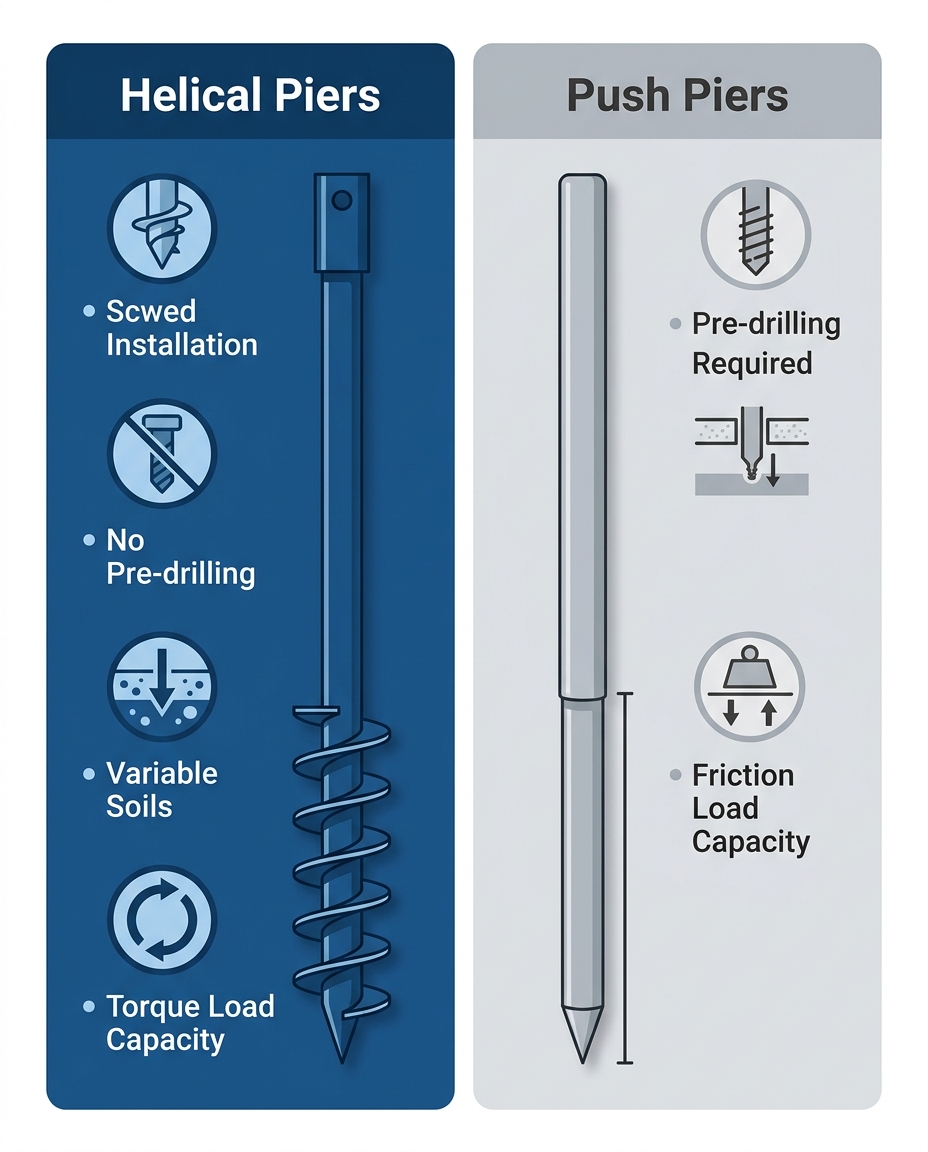
Helical piers vs push piers structural supports comparison
As shown, structural foundation supports like these prevent differential settlement, safeguarding buildings. Next, explore installation techniques for helical piers in detail.
Deep Dive into Pier Technologies
Pier technologies represent advanced structural foundation supports essential for stabilizing structures on unstable or settling soils. At Helical Technology, we distribute ICC- and ISO-certified helical piers and push piers that deliver engineering excellence through precise design and proven performance. This section delves into their mechanics, resistance factors, and advantages over traditional methods.
Helical Piers Design and Mechanics
Helical piers, also known as helical piles, feature engineered helix plate configurations tailored to diverse soil conditions. These consist of single or multiple galvanized steel plates with diameters ranging from 8 to 16 inches, allowing optimal soil adaptation during installation. The central extension shaft, constructed from high-strength Schedule 80 pipe or 150 ksi steel, provides structural integrity and connects multiple helix sections as needed.
Load capacity correlates directly with installation torque, typically ranging from 20,000 to 150,000 ft-lbs, enabling real-time verification of torque-to-capacity ratios. This dual load transfer mechanism operates through helix bearing for end-bearing resistance on competent strata and shaft friction along the steel-soil interface, ensuring reliable uplift, compression, and lateral support. Our foundation repair solutions leverage these principles for durable applications.
Push Piers Resistance and Depth
While helical piers advance by rotation, push piers–often called resistance piers–employ a hydraulic push process using synchronized manifolded jacks positioned on the structure and pier extensions. This method incrementally drives steel pipe sections downward, overcoming skin friction resistance at the pile-soil interface through calculated bond strength.
Advancement ceases at end-bearing refusal criteria, defined as 1/8 inch per foot or achievement of target structural load, confirming capacity. Typical depths span 20 to 50 feet, determined by soil stratigraphy and load demands. These systems excel in cohesive soils where friction dominates, providing robust underpinning for our certified installer network.
The following table outlines key technical specs for helical piers versus push piers, based on engineering standards and Helical Technology specifications:
| Aspect | Helical Piers | Push Piers |
|---|---|---|
| Torque Rating | 20,000-150,000 ft-lbs | N/A (Hydraulic Pressure) |
| Ultimate Strength | Up to 500 kips | Friction driven / Load refusal |
| Installation Speed | Faster in variable soils | Depends on resistance |
| Minimal Vibration | Low | Moderate |
Helical piers offer torque-correlated capacities ideal for variable soils, while push piers provide friction-based strength suited to uniform profiles. These distinctions guide selection for optimal structural foundation supports.
Comparison to Traditional Foundations
Beyond pier types, how do helical piers and push piers stack against traditional concrete foundations? Pier systems complete installation in one day with minimal excavation, no curing time, and vibration-free processes, eliminating weather delays common in concrete pours that require 2 to 4 weeks for curing and 4 to 6 feet of dig depth.
Durability further favors piers: our galvanized helical piers and push piers boast 75+ year service lives resistant to corrosion, contrasting concrete’s vulnerability to cracking, heaving, and spalling from soil movement or freeze-thaw cycles. As advanced earth anchoring systems, piers support immediate loading post-installation, accelerating project timelines for residential and commercial foundation repair solutions.
Our network of structural engineers and real-time design software ensure precise modeling compliant with ICC-ES AC358 criteria. Consult a structural engineer or our engineering team for project-specific guidance, as installations must adhere to local building codes. These superior structural foundation supports set the stage for exploring installation techniques and case studies ahead.
Practical Applications in Foundation Repair
Building on foundation principles, practical applications of structural foundation supports involve targeted installation of helical piers and push piers adapted to specific soil challenges. At Helical Technology, we supply ICC-certified helical pile systems and pushed pier foundations that deliver reliable foundation repair solutions for contractors. These techniques stabilize structures efficiently, ensuring long-term durability.
Installation Processes for Various Soils
Our helical piers excel in unstable soils, where shifting conditions demand torque-driven advancement. Installation follows these steps:
- Conduct site assessment to evaluate soil layers and load requirements.
- Position the lead section with helical plates at the foundation edge.
- Advance the pier using hydraulic torque, monitoring rotation per foot.
- Continue extension sections until target torque confirms capacity.
- Perform load testing to verify settlement resistance.
- Connect to structure via bracket and backfill.
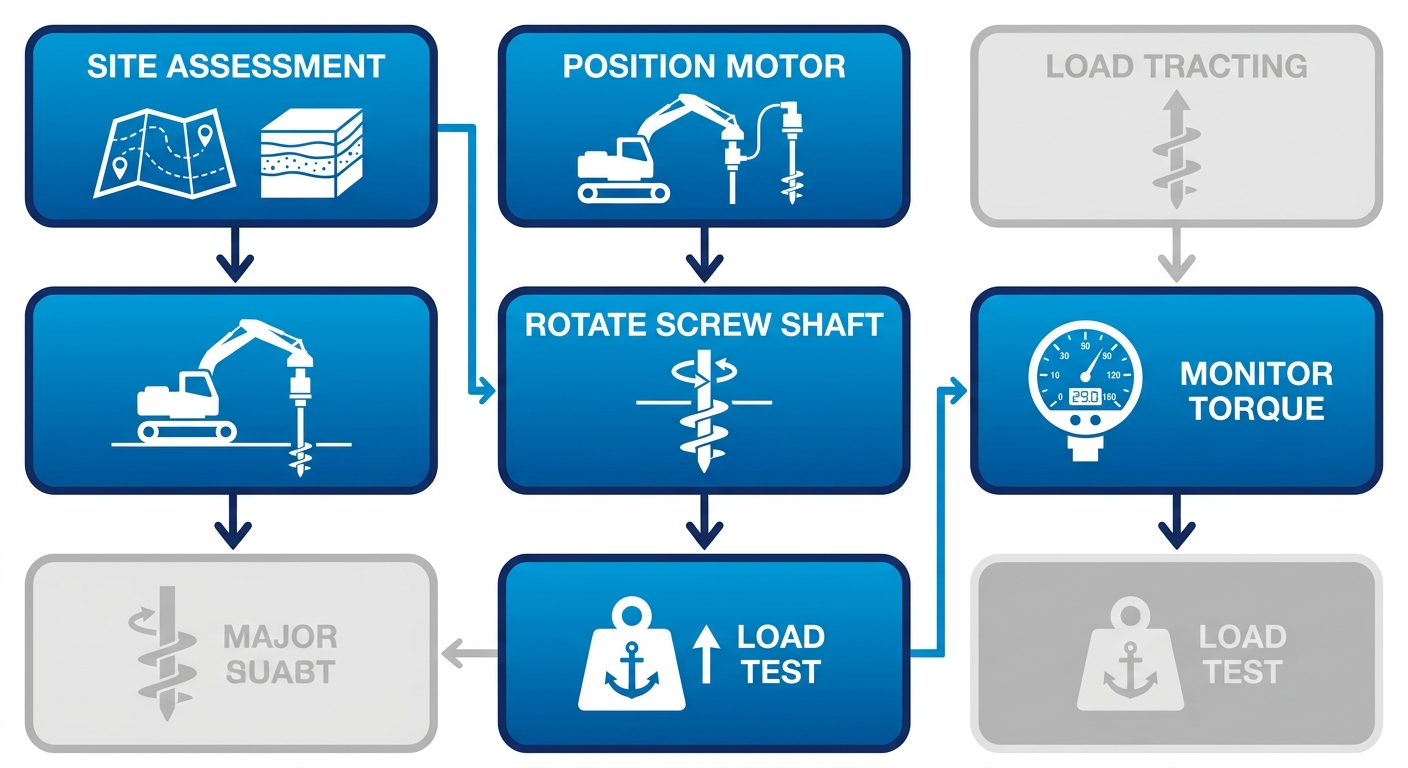
Step-by-step helical pier installation process visualization
This process leverages rotational resistance for precise depth control. For clay soils prone to expansion, push piers provide hydraulic force:
- Excavate access near the foundation.
- Install drive stand and hydraulic rams.
- Push steel pier sections incrementally.
- Monitor drive pressure and settlement.
- Verify depth with refusal criteria.
- Secure with underpinning bracket.
We emphasize engineering support to comply with ICC-ES AC358 standards. Consult our structural engineers for project-specific guidance.
Beyond installation, costs vary significantly by project scale and site factors, helping contractors budget accurately.
Cost Estimates and Factors
Residential projects typically require fewer piers, with helical piers ranging from $1,000-$3,000 per pier and push piers $800-$2,500 per pier. Commercial applications demand higher capacities, pushing helical costs to $2,500+ per pier and push piers to $2,000+ per pier. Key factors include soil type, site access difficulty, pier count, and depth requirements.
The following table summarizes cost comparisons based on industry averages and Helical Technology quotes:
| Project Type | Helical Piers Cost | Push Piers Cost |
|---|---|---|
| Residential Home | $1,000-$3,000 per pier | $800-$2,500 per pier |
| Commercial | $2,500+ per pier | $2,000+ per pier |
Helical piers often prove cost-effective long-term due to minimal excavation and immediate load transfer. Access challenges in urban settings or expansive clays add 20-30% to totals. Our design software aids precise estimating. Products comply with building codes; installations must follow ICC and ISO certifications.
These estimates inform decisions, as demonstrated in real-world deployments.
Real-World Case Scenarios
In a Littleton, CO residential home, settling cracked the slab foundation. We supplied 12 helical piers installed over six weeks, advancing to refusal in unstable fill soils. Torque monitoring ensured 30-kip capacity per pier, lifting the structure 2 inches with no further movement after one year.
A commercial warehouse faced differential settlement under load-bearing walls. Push piers stabilized the foundation, with 20 sections hydraulically driven into clay. Depth verification prevented heave, restoring levelness and averting closure. Outcomes included zero callbacks and enhanced safety.
Another helical pier application in a similar home used our advanced earth anchoring systems for rapid stabilization amid expansive soils.
These methods pave the way for long-term maintenance strategies, underscoring the reliability of our foundation repair solutions.
Advanced Considerations for Foundation Stabilization
Building on core techniques, advanced evaluation of suppliers ensures optimal outcomes for structural foundation supports. When stabilizing foundations with helical piers or push piers in complex soil conditions, key factors include certification compliance and tailored engineering support. These elements enhance load-bearing capacity and long-term performance. We prioritize ICC and ISO certified products to meet rigorous standards.
Supplier and Contractor Evaluation
The following table outlines criteria for selecting suppliers and contractors, drawing from Company resources and Certification docs.
| Criteria | Helical Technology | Generic Suppliers |
|---|---|---|
| ICC Certification | Yes | Varies |
| Engineering Support | Project-specific | Limited |
ICC Certification guarantees adherence to International Code Council standards for structural foundation supports installations, as detailed in Certification docs. This ensures helical piers and foundation stabilization piers comply with ICC-ES acceptance criteria (AC358). Certified products reduce installation risks and support code-compliant outcomes.
Our project-specific engineering support sets us apart. Drawing from Company resources, we deliver comprehensive assistance unlike limited generic options. Key features include:
- Site-specific designs tailored to soil conditions.
- Precise load calculations using real-time design software.
- On-site installation oversight by our network of structural engineers.
These advantages provide engineering excellence and design support, boosting reliability for helical piers projects. Our engineers also conduct comprehensive soil profiling and settlement risk assessments to inform customized installation plans that optimize load transfer, reduce settlement, and improve durability under variable environmental loading conditions.
Advanced earth anchoring systems like ours minimize failures, ensuring foundation repair solutions endure. Consult our structural engineering team for project-specific guidance, as installations must comply with building codes.
Certified suppliers mitigate risks in helical piers and push piers projects, promoting long-term durability. These considerations pave the way for case-specific implementations.
Frequently Asked Questions on Structural Supports
What are structural foundation supports?
Structural foundation supports like helical piers and push piers anchor sinking foundations to deeper, competent strata in unstable soil layers, preventing further settlement and ensuring long-term stability.
What is the difference between helical piers and push piers?
Helical piers screw into the ground via rotating torque with direct brackets for load transfer. Push piers, or steel push piers, drive hydraulically into soil using external sleeves to grip via skin friction.
How are structural supports installed?
Installation starts with site preparation and load testing. Helical piers advance until refusal on stable soil, then brackets attach securely to the structure. We provide training for precise execution.
When should I use helical piers vs. push piers?
Choose helical piers for variable soils or lighter structures. Use push piers for heavy loads where soil capacity is known.
What are the benefits of these supports?
- Immediate stability and load transfer
- Minimal site disruption
- Long-term durability
- Certified performance from our network of structural engineers
Contact us at Helical Technology for a free assessment and project-specific advice.
Selecting Optimal Foundation Supports
With issues identified, optimal support selection prevents recurrence. What risks do inadequate structural foundation supports pose to your foundation repair solutions?
We outline three key selection criteria:
- Analyze soil conditions using geotechnical reports to match pier type.
- Calculate load requirements via structural engineer specs, favoring helical piers for torque-correlated capacity.
- Evaluate site access, as helical piers enable vibration-free installation.
Helical piers outperform push piers:
- Versatile in all soils versus cohesive soils only.
- No hydraulic risks, ensuring reliability.
Opt for helical piers from certified installers for reliability. Consult our network of structural engineers for project-specific guidance. Once selected, professional helical pier installation ensures success.
This article was researched and written with the assistance of AI tools.