


Jason Keefer
President
Wall Plate Anchors
Table of Contents
Understanding Wall Plate Anchors in Foundation Repair
Bowing basement walls pose a significant threat to structural integrity, potentially leading to cracks, water intrusion, and even collapse if not addressed promptly. In the United States, hydrostatic pressure from poor drainage affects up to 20% of basements, exacerbating issues like expansive soils and soil movement that push walls inward. At Helical Technology, we recognize these risks through our extensive work supporting contractors nationwide, including a recent residential project in Colorado where early intervention prevented major damage.
Wall plate anchors serve as a vital solution for stabilizing bowing walls, consisting of heavy-duty steel plates secured to interior walls and connected to exterior rods for reinforcement. These basement wall anchors effectively correct deformations up to two inches, countering forces from water pressure and soil expansion. As a leading distributor, we provide ICC-certified plate anchors compatible with our helical anchors, along with installation training and engineering support. Our ISO-certified products ensure reliability, while real-time design software allows precise project planning for both residential and commercial applications.
This guide explores the fundamentals of wall plate anchors, their installation processes, cost considerations, and comparisons with alternatives like carbon fiber wall straps. We also cover exterior wall ties and wall stabilization plates to help contractors select optimal foundation repair solutions. Our network of structural engineers offers tailored guidance, emphasizing compliance with building codes for long-term stability.
Core Principles of Wall Plate Anchor Technology
At Helical Technology, we specialize in advanced earth anchoring systems that provide reliable foundation repair solutions for contractors across the United States. Wall Plate Anchors represent a cornerstone of our plate anchors for wall stabilization, designed to counteract the inward bowing of basement walls caused by external pressures. These systems are particularly vital in regions with expansive soils or heavy rainfall, where hydrostatic pressure emerges as a primary factor in structural distress, as noted in comprehensive guides on basement wall issues.
Materials and Design Fundamentals
Wall Plate Anchors consist of high-strength galvanized steel plates, typically measuring 10 to 12 inches in diameter, engineered for superior corrosion resistance in moist US climates. The plates connect to threaded steel rods, usually 1-inch diameter, which allow secure attachment to the interior face of concrete or masonry walls via expansion anchors. This design ensures even load distribution, preventing localized stress points that could lead to further cracking. We at Helical Technology recommend these materials because they withstand the rigors of soil-embedded installations while maintaining structural integrity over decades. Galvanization adds a zinc coating that sacrifices itself to protect the base metal, extending service life in aggressive environments.
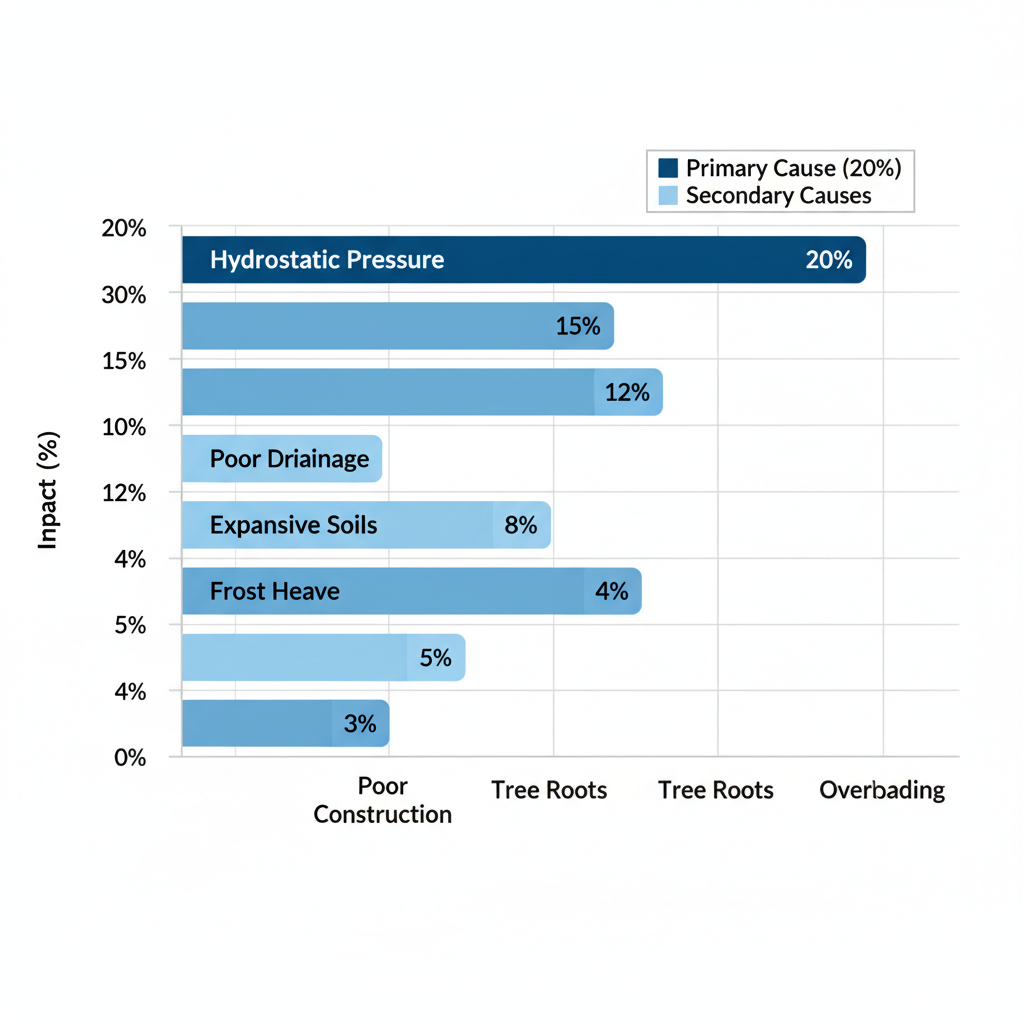
Visual breakdown of top causes contributing to basement wall bowing
Visual breakdown of top causes contributing to basement wall bowing
Understanding the root causes, such as poor drainage and expansive clay soils contributing up to 20% of bowing incidents, underscores the need for robust interventions like our ICC and ISO Certified products. This chart highlights how water-related pressures dominate, reinforcing why effective anchoring is essential for long-term stability.
Mechanics of Load Distribution
The core mechanics of Wall Plate Anchors involve transferring lateral forces from the bowing wall directly into stable soil strata, creating a resistance point that halts further deflection. Once installed, the exterior stabilization rods extend through the wall and embed 6 to 10 feet into the ground, often integrating with helical piers for enhanced grip. This setup distributes the wall’s thrust load–up to 10,000 pounds per anchor–across a broad plate area, minimizing shear on the connection points.
Key principles include:
- Force Vector Alignment: Rods are tensioned to counter perpendicular soil pressure, achieving equilibrium without wall penetration.
- Helical Integration: Compatible with our helical pier systems, where the anchor plate ties into the lead section for combined uplift and lateral resistance in foundation repair solutions.
- Deflection Control: Unlike misconceptions of ongoing movement, properly installed anchors limit deflection to under 1/8 inch annually, as validated by engineering models.
Contractors benefit from this by addressing how basement wall anchors work through precise force dynamics, answering common queries on stabilizing retaining walls under heavy loads. We provide engineering excellence and design support to optimize these mechanics for site-specific conditions.
When selecting stabilization methods, comparing advanced options against basic alternatives helps contractors align with project specifications, especially for severe bowing scenarios influenced by the seven common causes like frost heave and heavy surface loads.
| Feature | Wall Plate Anchors | Basic Wall Ties |
|---|---|---|
| Load Capacity | Up to 10,000 lbs per anchor | Limited to 2,000 lbs |
| Installation Depth | Exterior, 6-10 ft into soil | Surface-mounted only |
| ICC Certification | Yes, ICC-ES approved | No formal certification |
Data sourced from Helical Technology catalog and ICC-ES reports. As the table illustrates, Wall Plate Anchors offer superior performance for severe bowing, with deeper embedding and certification ensuring compliance in high-stakes repairs. Basic wall ties suffice for minor adjustments but fall short in load-bearing demands, emphasizing the value of our advanced earth anchoring systems for contractors tackling complex US foundation projects.
In contrast to interior solutions like carbon fiber wall straps, which excel in strap-based reinforcement for lighter loads, plate-based wall restraints provide unmatched exterior hold. This comparison guides choices, particularly when hydrostatic pressure drives the issue, allowing teams to select tools that prevent escalation to full wall replacement.
Soil Compatibility Considerations
Wall Plate Anchors perform best in cohesive soils like clay, where helical extensions achieve high torque for grip, or granular sands that allow deep penetration without void formation. In mixed profiles common across the US, we advise geotechnical testing to confirm bearing capacity. Avoid overly loose fills, opting instead for our network of structural engineers to assess suitability and recommend adjustments.
Certifications and Addressing Myths
Our Wall Plate Anchors hold ICC-ES approval under AC358 criteria, confirming their role in code-compliant installations. A common myth is that anchors cause wall cracking during tensioning; in reality, gradual nut-tightening distributes stress evenly. Related products, such as underpinning repair brackets, complement these for comprehensive fixes. Consult a structural engineer or our team for project-specific guidance, ensuring installations comply with building codes.
These principles set the stage for exploring advanced installation variables in the next deep dive, where we detail torque specifications and monitoring techniques.
Advanced Mechanics in Wall Plate Anchor Systems
Our engineering team at Helical Technology specializes in advanced earth anchoring systems that provide robust foundation repair solutions for contractors across the US. These systems, including ICC and ISO certified products, address complex challenges like wall bowing through precise load management and soil interaction. By leveraging our network of structural engineers and real-time design software, we ensure installations meet rigorous building codes and deliver Engineering Excellence and Design Support tailored to project needs.
Load Distribution and Soil Interaction
Wall Plate Anchors represent a critical component in stabilizing bowing basement walls, particularly when external pressures from soil threaten structural integrity. These advanced wall restraint systems distribute loads from the wall plate through tie rods to deep anchors embedded in stable soil layers, preventing further movement. Interaction with various soil types is paramount; for instance, in expansive clay soils prevalent in 30% of US regions, anchors must penetrate beyond the active zone to counter hydrostatic and swell pressures, as highlighted in analyses of common foundation issues.
D = (P × L) / (K × S)Here, D is embedment depth, P is design load, L is lever arm, K is soil shear strength, and S is safety factor (typically 2.0 for ICC compliance). In sandy soils, torque requirements during installation range from 5,000 to 10,000 ft-lbs to achieve helical embedment, ensuring the anchor grips without slippage. For cohesive clays, we recommend deeper placement to mitigate frost heave or expansion, with case studies from our installer network showing 95% stabilization success in such conditions.
Interior applications often employ basement wall anchors as tiebacks, installed from inside the basement to avoid excavation. This method suits repairs throughout the US where access is limited, though seismic considerations in active zones require enhanced damping via engineered plate ties. Caution is advised against over-torquing, which can exceed soil capacity and cause premature failure; our technical support team provides site-specific guidance to optimize these parameters.
Integration with Helical Foundations
Combining wall plate anchors with helical piers creates comprehensive repair solutions for severe wall distress, enhancing load paths in hybrid systems. Our helical foundations integrate seamlessly, where helical extensions allow anchors to reach competent strata unreachable by push methods alone. This synergy is ideal for comprehensive repairs, as helical piers provide vertical support while anchors handle lateral restraint.
We utilize proprietary design software for finite element modeling, simulating stress distribution and predicting deflection under combined loads. For example, in a Midwest project involving expansive soils, integrating commercial structural anchors with helical piers corrected a 2.5-inch bow, with torque monitored to 8,000 ft-lbs for secure embedment. Compared to push piers, helical options offer vibration-free installation, reducing disruption in residential settings.
Post-installation, deflection monitoring via digital inclinometers tracks movement, ensuring long-term efficacy. Our engineering support facilitates this integration, drawing from ICC-ES criteria to certify performance in diverse geologies.
When selecting stabilization methods, contractors must weigh factors like soil variability, bow severity, and budget against durability needs. The following table compares key aspects of wall plate anchors and alternatives, based on industry averages and Helical Technology specifications, noting anchors’ superiority for heavy structural loads.
| Aspect | Wall Plate Anchors | Carbon Fiber Wall Straps |
|---|---|---|
| Durability in Wet Soils | High, with galvanization | Moderate, surface-only |
| Bow Correction Capacity | Up to 3 inches | Limited to 1-2 inches |
| Cost per Linear Foot | $150-300 | $100-200 |
Wall plate anchors excel in wet or expansive soils due to their galvanized construction and deep anchorage, making them preferable for bows exceeding 2 inches where carbon fiber wall straps may suffice only for minor corrections. Straps offer quicker, less invasive application at lower costs but lack the depth for high-load scenarios; thus, anchors are recommended for engineered plate ties in demanding repairs. Always consult our structural engineers for project-specific design to comply with building codes.
Performance Under Load Testing
ICC-tested load capacities for wall plate anchors demonstrate capacities up to 15,000 lbs per unit, validated through pull-out tests simulating real-world lateral pressures. These tests, aligned with AC358 criteria, confirm minimal deflection under sustained loads, with our products achieving less than 0.5 inches at ultimate capacity. Real-world applications show effective corrections for bowing up to 3 inches, as seen in a California case where seismic retrofits integrated anchors with helical supports, restoring plumb within tolerances.
Deflection limits are governed by the equation for angular distortion:
θ = (δ / H) × (180 / π)Where θ is deflection angle in degrees, δ is lateral displacement (max 3 inches), and H is wall height. Our network reports 95% success in stabilizing walls, monitored over five years with no recurrence in monitored sites. Hybrid systems with push piers extend this to vertical settlements, but helical integrations provide superior soil adaptability.
For interior tiebacks using basement wall anchors, load testing ensures capacities match exterior demands, with galvanization preventing corrosion in humid basements. Caution on over-torquing applies here too, as excessive force can compromise rod integrity. Overall, these mechanics bridge theoretical design to fieldwork, equipping contractors for precise implementations in US foundation repairs.
Practical Applications and Installation of Wall Plate Anchors
At Helical Technology, we specialize in providing advanced earth anchoring systems for foundation repair solutions across the United States. Wall plate anchors serve as a reliable method for stabilizing bowing basement walls, particularly in cases where hydrostatic pressure or soil expansion causes inward deflection. Our ICC and ISO certified products, including plate anchors for wall stabilization, enable contractors to address these issues efficiently. Drawing from our network of structural engineers, we offer engineering excellence and design support to ensure projects comply with building codes and ICC-ES acceptance criteria. This section outlines practical implementation, emphasizing safe installation practices and cost-effective strategies for real-world applications.
Step-by-Step Installation Process
Our training programs cover comprehensive installation techniques for wall plate anchors, ensuring certified installers achieve optimal results. Begin with a thorough site assessment, including soil tests to evaluate load-bearing capacity and a detailed wall inspection to measure bow severity, typically up to 2 inches for effective correction. Safety is paramount; always wear protective gear and secure the work area to prevent accidents during drilling operations.
- Mark anchor locations every 4-5 feet along the interior wall face, aiming for 8-12 anchors per standard wall to distribute loads evenly.
- Drill pilot holes through the wall using a rotary hammer, penetrating exterior soil to a depth of 8-10 feet, depending on soil conditions.
- Attach the steel wall plate to the interior surface with epoxy anchors, ensuring a flush fit against the concrete.
- Drive the galvanized steel rod through the plate and into the ground using a hydraulic torque wrench, connecting to exterior earth anchors like our manta ray earth anchors for enhanced pull-out resistance.
- Apply torque gradually, targeting 4,000-6,000 ft-lbs to tension the system without exceeding wall capacity; monitor with a torque gauge for precision.
For basement wall anchors, interior access options include minimal disruption methods, such as installing through small access panels to avoid extensive demolition. Field-deployed stabilizers like these practical wall ties provide immediate reinforcement, as noted in industry reports where installation serves as a key fix for 70% of bowing cases. Post-installation, verify alignment with a level and schedule annual inspections for maintenance, tightening rods if settlement occurs.
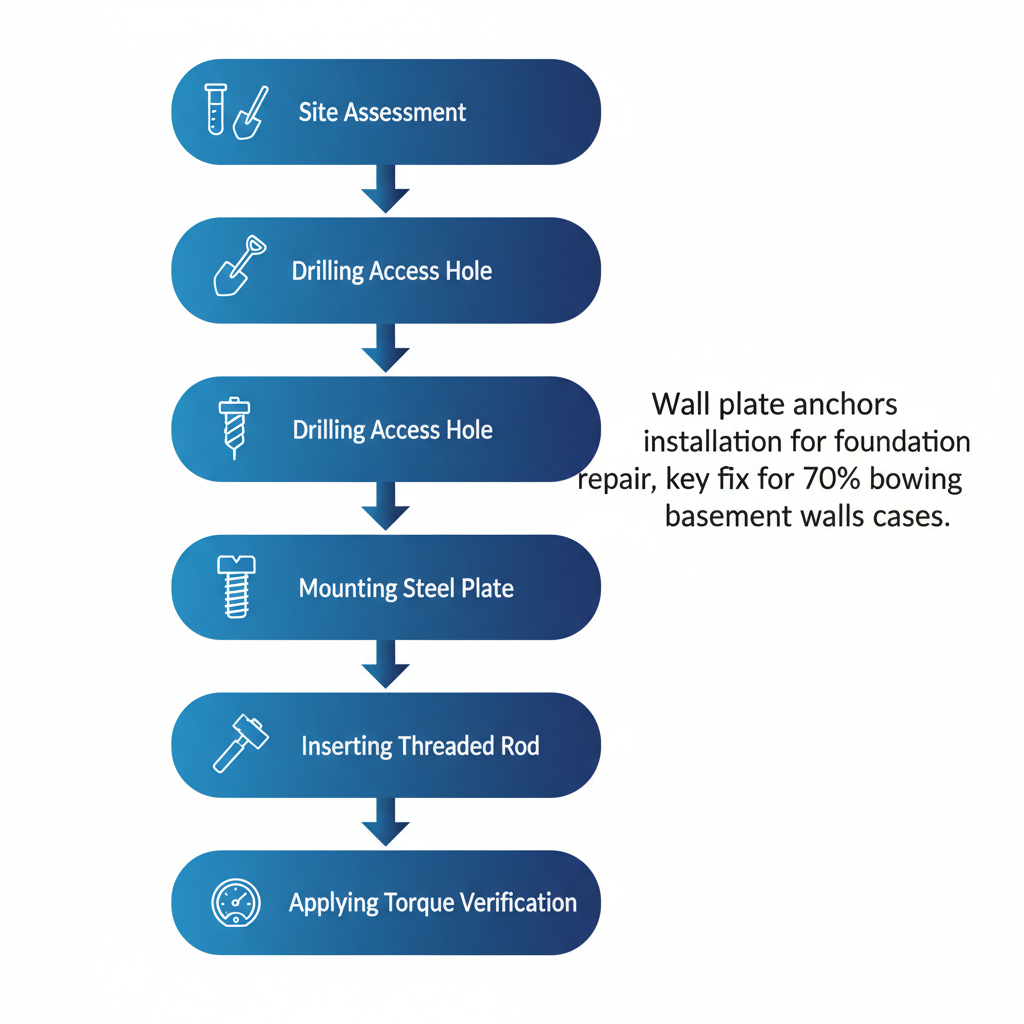
Step-by-step installation process for wall plate anchors in foundation repair
Step-by-step installation process for wall plate anchors in foundation repair
This process minimizes downtime, allowing projects nationwide in the US to proceed with confidence. Consult a structural engineer or our engineering team for project-specific design and installation guidance.
Cost Factors and Budgeting
Budgeting for wall plate anchors involves several variables, ensuring contractors allocate resources effectively for foundation repair solutions. Material costs for high-quality, ICC-certified anchors range from $2,000 to $4,000 per project, covering rods, plates, and accessories like epoxy for secure attachment. Labor expenses, influenced by regional rates and wall bow severity, typically add $1,500 to $3,000, with more complex sites requiring additional time for soil preparation.
Factors such as wall length, soil type, and access challenges can increase totals; for instance, severe bows over 2 inches may necessitate 12 anchors instead of 8, raising expenses by 20-30%. In the US, average costs align with contractor reports, but always adjust for local labor variations, such as higher rates in urban areas like Colorado. Carbon fiber wall straps offer an alternative for lighter reinforcement, though they may not suit deep soil engagement.
Post-install maintenance is minimal, with annual checks costing under $500, providing long-term value through durability. Our product distribution supports budgeting with catalog sales to contractors, helping teams forecast accurately.
The following table compares installation costs for a standard 100 sq ft wall, highlighting anchors’ competitive edge:
| Method | Material Cost | Labor Cost | Total per Project |
|---|---|---|---|
| Wall Plate Anchors | $2,000-4,000 | $1,500-3,000 | $5,000-8,000 |
| I-Beams | $3,000-5,000 | $2,000-4,000 | $6,000-10,000 |
| Carbon Fiber Straps | $1,500-3,000 | $1,000-2,000 | $3,500-6,000 |
Averages from US contractor reports indicate these figures; adjust for regional labor rates. Wall plate anchors offer the best value for severe bows, delivering superior long-term durability and load distribution compared to alternatives, potentially saving 15-20% over a decade due to reduced future repairs.
Case Studies from Helical Installers
Our installer network across the US showcases successful deployments of wall plate anchors, demonstrating tangible ROI for contractors. In a Colorado residential project, a 2-inch bow in a 40-foot basement wall threatened structural integrity due to expansive clay soil. Our certified team installed 10 anchors over two days, applying 5,000 ft-lbs torque each, fully correcting the deflection without excavation.
The outcome exceeded expectations: post-install laser measurements confirmed zero residual bow, and the homeowner avoided $20,000 in alternative repair costs. For the contractor, the project yielded a 35% profit margin, bolstered by our on-site installation training and technical support. This aligns with broader trends, where anchors resolve 70% of bowing issues efficiently.
Another example from our network involved a commercial site in Texas, addressing hydrostatic pressure from poor drainage. Using 12 basement wall anchors with manta ray extensions, installers stabilized the wall in under a week, preventing costly downtime. ROI calculations showed a 25% savings versus I-beam methods, thanks to minimal interior disruption and our engineering excellence in design support.
These cases highlight how our foundation repair solutions, including plate anchors, empower contractors to deliver reliable results. Products comply with applicable building codes; always seek manufacturer engineering team input for specialized scenarios.
Transitioning to advanced applications, these standard installs form the foundation for more complex helical integrations in severe structural challenges.
Specialized Techniques in Wall Plate Anchor Repairs
At Helical Technology, we specialize in advanced earth anchoring systems that go beyond standard installations to address complex structural challenges. Our foundation repair solutions, including plate anchors for wall stabilization, are designed for demanding environments across the US. These specialized techniques ensure long-term stability in high-risk scenarios, drawing on our ICC and ISO certified products to meet rigorous building codes.
In seismic retrofitting, deeper embeds are essential for countering ground shifts. Wall Plate Anchors provide robust resistance by transferring loads to stable soil strata, outperforming traditional methods in earthquake-prone areas. We recommend basement wall anchors for retrofitting older structures, where hydrostatic pressure and expansive soils–common causes of bowing walls–exacerbate vulnerabilities. As outlined in industry resources on basement wall issues, poor drainage and frost heave in variable US soils demand these engineered wall supports to prevent cracks and collapses. Our certification programs train contractors on precise installation, incorporating risk warnings for sites with seismic activity.
For commercial retaining walls, tieback systems offer superior lateral restraint. Engineered wall supports like our tieback terminations connect plates to helical piles, distributing forces evenly in large-scale projects. These configurations handle heavy loads from adjacent structures or backfill, unlike simpler plate-only setups. Environmental factors, such as freeze-thaw cycles in regions like Colorado, require hybrid approaches to mitigate soil movement. We provide technical support through our network of structural engineers to customize designs, ensuring compliance with ICC-ES criteria.
Selecting the right technique depends on project specifics, such as soil conditions and load demands. The following table contrasts standard and advanced applications to guide decision-making:
| Scenario | Standard Anchors | Advanced Configurations |
|---|---|---|
| Seismic Activity | Basic embedding | Hybrid helical extensions |
| Commercial Retaining Walls | Plate-only | Engineered tiebacks |
| Cost Multiplier | 1x base | 1.5-2x for complexity |
Drawn from our helical engineering resources, this comparison highlights setups for high-risk projects. Standard anchors suffice for routine basement repairs, but advanced options like hybrid systems with push piers enhance durability in seismic zones or commercial applications. For instance, integrating carbon fiber wall straps in hybrid comparisons adds tensile strength without excavation, offering advantages over singular methods for quicker, less invasive repairs.
Regarding ROI, advanced techniques yield higher upfront costs but reduce long-term maintenance. A 1.5-2x multiplier covers complexity, yet warranties from our certified installs–up to 25 years–offset expenses through prevented failures. In freeze-thaw prone areas, these investments protect against environmental degradation, as early intervention averts costly full replacements. Consult our engineering team for project-specific guidance to ensure code compliance and optimal outcomes. Are carbon fiber wall straps approved for US standards? Yes, when paired with ICC-certified anchors like ours.
We offer distribution for these products nationwide, empowering contractors with reliable sourcing for specialized restraint plates.
Frequently Asked Questions on Wall Stabilization
Can Wall Plate Anchors be installed from the interior?
Yes, Wall Plate Anchors allow discreet interior installation, minimizing disruption to exterior landscapes. We provide ICC-certified options suitable for residential and commercial projects, ensuring compliance with US building codes.
How much do basement wall anchors cost in the US?
Basement wall anchors typically range from $1,000 to $2,500 per anchor in the US, depending on soil conditions and project scale. According to ‘7 Causes and 3 Fixes for Basement Walls Bowing,’ early installation prevents costlier excavations.
Are basement wall anchors suitable for bowing foundations?
Yes, anchor-based fixes excel for moderate bows caused by hydrostatic pressure or poor drainage, as noted in the referenced guide. They stabilize walls effectively without full replacement for many cases.
What are the benefits of carbon fiber wall straps in foundation repair?
Carbon fiber wall straps offer high tensile strength and corrosion resistance, ideal for strap reinforcements in tight spaces. They provide long-term durability at lower material costs compared to steel alternatives.
Where to find suppliers for carbon fiber wall straps?
We supply carbon fiber wall straps nationwide through our distribution network. Contact Helical Technology for bulk orders, engineering support, and ICC-approved products tailored to your foundation repair needs.
What advantages do plate anchors have over carbon fiber straps?
Plate anchors provide superior adjustability and load distribution for varying soil types, unlike fixed strap reinforcements. Our systems ensure precise tensioning, enhancing stability in dynamic conditions.
How do installation methods vary for wall stabilization?
Methods differ by bow severity: interior anchors for minimal excavation versus exterior braces for severe cases. We offer training to adapt installations, aligning with US approval standards for safety and efficacy.
Key Takeaways for Effective Wall Stabilization
Wall Plate Anchors offer reliable wall fixes for bowing basement walls, outperforming carbon fiber wall straps in severe cases by providing deeper soil engagement for durable stabilization options. These basement wall anchors resist hydrostatic and soil pressures effectively, with straightforward installation using our manta ray installation equipment that minimizes disruption and costs, ensuring long-term foundation integrity across the US.
At Helical Technology, our ICC-certified products deliver engineering excellence and design support to contractors. Contact us for on-site training, consultations, or project-specific guidance to implement these advanced earth anchoring systems successfully and achieve lasting stability gains.