

Table of Contents
- Understanding Foundation Repair Essentials
- Foundation Repair Basics and Causes
- Exploring Foundation Repair Methods
- Applying Foundation Repair in Projects
- Advanced Foundation Repair Strategies
- Foundation Repair Frequently Asked Questions
- Securing Your Projects with Reliable Foundation Solutions
Understanding Foundation Repair Essentials
Foundation failure poses significant risks to buildings across the United States, where shifting soils and moisture fluctuations often lead to costly structural issues. At Helical Technology, we recognize the urgency of addressing foundation repair to safeguard lives and investments. Early detection can prevent minor problems from escalating into major disruptions, ensuring long-term stability for residential and commercial properties.
In regions with expansive clay soils, such as parts of Texas and Colorado, foundation settlement affects up to 25% of homes annually, according to industry reports on foundation problems identification. Common warning signs include uneven floors, sticking doors, and visible wall cracks, signaling potential basement foundation repair needs. Water damage and poor drainage exacerbate these defects, compromising safety and reducing property values if ignored. Our ISO-certified products, including helical piers and push piers, provide reliable structural stabilization through proven underpinning techniques that reinforce the base against soil movement.
We at Helical Technology stand out with ICC-certified helical piers, push piers, and comprehensive engineering support from our network of structural engineers. Our on-site training programs equip contractors with the expertise to execute foundation crack repair and other solutions efficiently, minimizing downtime and costs for commercial projects.
This guide explores foundation repair fundamentals, from identifying causes to advanced applications for commercial decision-making. We will delve into evaluation methods, product comparisons, and installation best practices, starting with the core principles of soil dynamics and failure prevention in the next section.
Foundation Repair Basics and Causes
At Helical Technology, we specialize in foundation repair solutions that address the root causes of structural instability in commercial projects. Foundation repair is essential for maintaining the integrity of buildings, especially when soil conditions and environmental factors lead to settlement or erosion. Our ICC and ISO certified products, such as helical piers, provide reliable stabilization to prevent costly escalations. Understanding these basics empowers contractors to identify issues early and select appropriate interventions.
Common causes of foundation failure often stem from soil dynamics and water management challenges. Soil expansion and contraction, particularly in expansive clays, create uneven pressure that results in cracks and shifts. Water infiltration exacerbates these problems, leading to basement foundation repair needs by weakening the soil base and causing hydrostatic pressure buildup. Poor drainage allows moisture to accumulate, undermining the structure over time. According to industry data, failure rates can reach 25% in vulnerable US regions without proactive measures.
US soils vary significantly by region, influencing foundation vulnerabilities. Expansive clays dominate in the Midwest and South, while sandy compositions in coastal areas heighten erosion risks. In the Rocky Mountains, freeze-thaw cycles compound settlement issues, demanding robust base settling solutions. These variations underscore the need for tailored assessments before implementing repairs.
The following table compares prevalent causes of foundation issues, their impacts, and initial mitigation strategies to help contractors assess risks.
| Cause | Impact on Structure | Prevalence in US Soils | Basic Mitigation |
|---|---|---|---|
| Soil Settlement | Uneven sinking leading to cracks | Common in expansive clays | Stabilize with deep anchors |
| Water Erosion | Undermining base stability | Widespread in wet regions | Redirect water flow |
This comparison highlights how soil settlement poses a high risk in clay-heavy areas, often requiring immediate underpinning, while water erosion demands drainage enhancements to avert progressive damage. Prevention costs vary, with basic drainage fixes averaging $5,000-$10,000 per site, per engineering reports, but investing in our helical pier systems reduces long-term expenses by up to 30% through durable stabilization. Early intervention aligns with our engineering excellence and design support, ensuring compliance with building codes.
Assessment techniques begin with visual inspections for signs like foundation crack repair indicators, including diagonal cracks wider than 1/4 inch or sticking doors. We recommend crack monitoring using simple tools to track progression, supplemented by level surveys for detecting settlement. Professional diagnostics, informed by our network of structural engineers, involve soil borings to evaluate bearing capacity. These methods answer whether repairs are needed by quantifying risks—addressing issues at the first sign prevents escalation, as untreated cracks can lead to $20,000+ in damages annually.
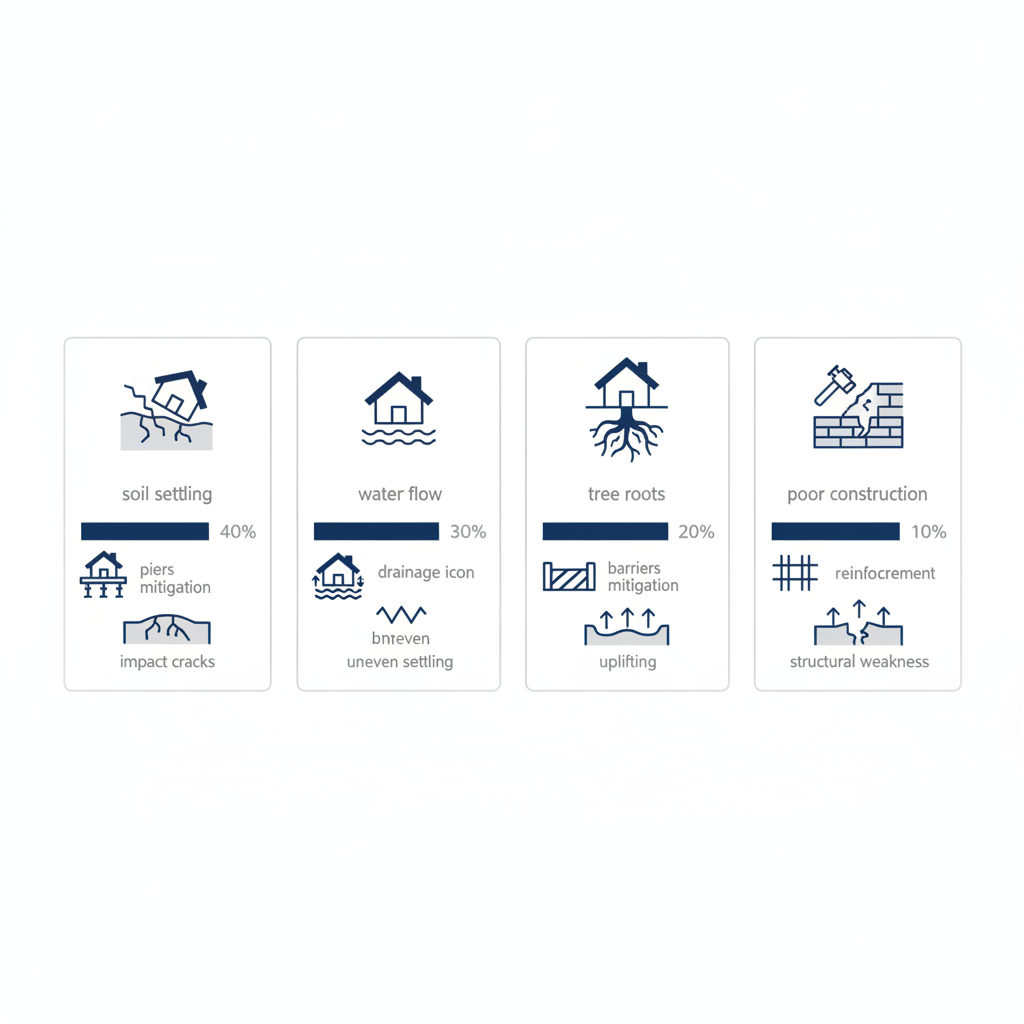
Visual guide to common foundation failure causes and mitigations
Basic repair concepts focus on underpinning and crack stabilization techniques to restore stability. For instance, our concrete crack lock kit offers an effective solution for securing fissures in concrete slabs. Helical piers drive deep into stable strata, providing load-bearing support without extensive excavation. These methods, backed by our technical support, suit commercial applications and minimize disruption.
Regional considerations are critical; in Colorado’s Rocky Mountain soils, expansive shales require advanced earth anchoring systems to counter seasonal shifts. We provide on-site installation training to navigate these challenges, ensuring our products meet ICC-ES criteria. Consult our structural engineering team for project-specific guidance to comply with local codes and optimize outcomes.
Exploring Foundation Repair Methods
We at Helical Technology specialize in advanced earth anchoring systems and foundation repair solutions, providing contractors with ICC and ISO certified products to address structural challenges effectively. This section delves into key foundation repair methods, from pier-based stabilization to injection sealing methods, highlighting how our offerings ensure long-term performance and compliance. By understanding these techniques, contractors can select optimal solutions for diverse project needs, such as settlement in commercial buildings or moisture-related issues in basements.
Helical and Push Pier Techniques
Helical piers and push piers represent cornerstone approaches in foundation repair, particularly for deep stabilization in unstable soils. Helical piers, part of our comprehensive helical pier system, involve twisting steel shafts with helical plates into the ground using torque monitoring to achieve precise depth and load capacity. This method excels in softer soils like clay or sand, where the screw-like action provides immediate support without extensive excavation. Installation typically follows these steps:
- Assess soil conditions via geotechnical testing.
- Advance the pier using hydraulic torque equipment until the specified torque is reached, indicating adequate embedment.
- Connect the pier to the foundation structure with brackets for load transfer.
Our helical piers boast high load capacities of 50-100 tons, making them ideal for lifting and stabilizing settled structures. In contrast, push piers suit denser soils and heavy loads, driven hydraulically into the ground until resistance confirms stability, with capacities ranging from 30-60 tons. We support contractors through on-site installation training and our network of structural engineers to customize these systems for specific site conditions.
Choosing between helical and push piers depends on soil type, load requirements, and project timeline. For instance, helical piers minimize disruption in urban commercial settings, while push piers handle high-compression scenarios efficiently.
| Method | Installation Time | Load Capacity | Best For | Cost Range |
|---|---|---|---|---|
| Helical Piers | 1-2 days | High (50-100 tons) | Settlement | $200-400 per pier |
| Push Piers | 2-3 days | Medium-High (30-60 tons) | Heavy Loads | $150-300 per pier |
As shown in the table, helical piers offer faster installation and higher capacities for settlement issues, though at a slightly higher cost, providing excellent ROI for expansive projects. Our engineering team at Helical Technology offers project-specific design support, including real-time modeling software, to ensure these methods align with ICC-ES criteria and local codes. This expertise helps contractors avoid common pitfalls and achieve durable results.
Underpinning and Bracket Systems
Underpinning and bracket systems are essential for basement foundation repair, supporting walls and floors in failure scenarios like bowing or shifting due to hydrostatic pressure. Our underpinning brackets lift and stabilize settled concrete slabs by transferring loads to deeper, stable soil layers. These systems use steel brackets secured to the foundation and connected to piers below, counteracting settlement effectively.
Wall plate anchors, from our ISO-certified lineup, address bowing walls by installing galvanized steel plates exteriorly, linked via rods drilled through the interior. Tensioning these anchors distributes forces, correcting deformations up to two inches. Key steps include:
- Evaluate wall movement and soil pressures.
- Install interior plates and exterior anchors.
- Tighten rods gradually to realign the wall.
With ICC-ES approvals, our wall plate anchors provide superior corrosion resistance and load-bearing strength, ideal for commercial applications. We emphasize integration with geotechnical assessments to optimize performance, drawing from our installer network’s case studies where these systems prevented further damage in expansive soil regions.
Crack and Waterproofing Solutions
Foundation crack repair is crucial for preventing water intrusion and structural weakening, often paired with waterproofing to ensure comprehensive protection. Epoxy injections seal cracks using our high strength epoxy adhesive, such as SET-3G, which offers exceptional tensile strength and bonds in cracked concrete under extreme temperatures from -40°F to 176°F. This two-component adhesive provides sustained load performance, making it suitable for seismic areas and high-moisture environments.
The process involves:
- Cleaning and injecting low-viscosity epoxy into cracks.
- Allowing curing to restore structural integrity.
- Monitoring for full adhesion.
For waterproofing, our drainage products and sump pumps redirect moisture away from foundations, complementing crack repairs. These systems include perimeter drains and vapor barriers to manage hydrostatic pressure, reducing risks in wet climates.
Analysis of trade-offs reveals epoxy’s quick sealing for immediate strength versus waterproofing’s preventive focus for long-term dryness. Epoxy excels in high-load scenarios but requires precise application, while drainage systems demand more upfront installation but yield ongoing ROI through reduced maintenance.
Our structural engineers recommend combining these for optimal results, ensuring compliance with building codes. Consult our team for tailored guidance on integrating these solutions.
Applying Foundation Repair in Projects
We apply foundation repair principles to real-world commercial projects by integrating advanced techniques with our comprehensive support resources. Our training programs and technical expertise help contractors navigate the complexities of project stabilization, ensuring durable outcomes for structures like warehouses and office buildings. This section outlines practical steps for budgeting, selecting partners, and executing installations, emphasizing how our ICC- and ISO-certified products streamline the process.
Cost Estimation and Budgeting
Accurate cost estimation is essential for successful foundation repair projects, particularly in commercial settings where budgets impact timelines and ROI. Factors influencing pricing include site access challenges, soil conditions, and the scale of repairs, such as addressing settlement in expansive areas. For instance, labor costs can vary by region, with urban sites adding 20-30% due to logistical hurdles, while material expenses depend on product quality and load requirements.
Our real-time design software assists in precise calculations, factoring in variables like these to generate reliable estimates. Reference the Floor Stabilizer Post Kit for stabilization costs, which offers load capacities from 10,000 to 20,000 pounds at $100 to $300 per unit, providing cost-effective temporary support.
The following table compares key repair methods, highlighting average costs, timelines, and long-term value for commercial applications:
| Strategy | Complexity | Engineering Needs | Applicability |
|---|---|---|---|
| Helical Extensions | High | Project-specific design | Commercial deep loads |
| Plate Anchors | Medium | Standard support | Wall stabilization |
Helical piers excel in high-durability scenarios, ideal for deep soil stabilization, while epoxy injections provide quick sealing for cracks. Following these comparisons, we recommend budgeting tips like allocating 15% contingency for unforeseen site issues and leveraging our engineering support for ROI projections, which can yield 20-40% savings through optimized material use. For foundation crack repair, epoxy options from our catalog, with tensile strengths over 5,000 PSI, restore integrity efficiently.
Contractor Selection Criteria
Selecting the right contractor is crucial for executing foundation repair effectively, and we guide our network in evaluating certified installers through structured criteria. Begin with verifying ICC and ISO certifications to ensure compliance with building codes, followed by assessing years of experience in commercial projects. Our certification programs equip installers with hands-on training, enabling them to handle complex installations like helical pier systems.
Key frameworks include reviewing warranties, typically 10-25 years for our products, and checking references from similar jobs. We provide case studies and co-branded marketing tools to verify expertise.
To aid decision-making, the table below outlines essential criteria for contractor evaluation:
| Criteria | Importance | Action Item |
|---|---|---|
| Certifications | Critical | Verify ICC/ISO status |
| Warranty | High | Check for 10-25 year coverage |
These criteria help prioritize partners aligned with our standards, reducing risks in basement foundation repair tasks. By choosing certified installers from our network, projects benefit from on-site training and design support, ensuring seamless integration of solutions like plate anchors for wall stabilization.
Consult a structural engineer or our team for project-specific guidance to comply with ICC-ES criteria.
On-Site Implementation Tips
On-site implementation demands meticulous workflows to achieve safe and effective foundation repair. Start with site preparation: clear debris, assess soil stability using laser levels, and mark pier or injection locations precisely. Our technical support team, led by experts like Jason Keefer, offers real-time advice to adapt to variables such as moisture levels.
Follow safety protocols rigorously, including PPE usage, equipment checks, and perimeter securing to prevent accidents. For helical pier installation, drive anchors to refusal depth with hydraulic torque motors, then attach extensions; for injections, clean cracks and apply low-viscosity epoxy under controlled pressure for optimal bonding.
Integrate accessories like sump pumps for waterproofing during encapsulation, enhancing indoor air quality. Step-by-step: 1) Mobilize certified crew; 2) Install supports like the floor stabilizer post kit; 3) Test loads and adjust; 4) Final inspections. These steps, combined with our vapor barriers and dehumidifiers, promote long-term project stabilization while minimizing downtime in commercial environments.
Advanced Foundation Repair Strategies
In our experience at Helical Technology, addressing complex foundation issues in commercial projects demands innovative approaches beyond standard methods. We specialize in advanced earth anchoring systems and foundation repair solutions that tackle geotechnical challenges like deep settlement, expansive soils, and multi-story loads. These techniques ensure long-term stability for high-stakes structures, leveraging our network of structural engineers for project-specific guidance.
For variable soil depths, we employ helical pipe extensions, which allow helical piers to reach stable strata efficiently. These screw-like steel shafts with helical plates provide immediate load-bearing capacity, often up to 200 kips, with minimal vibration during installation. In tension applications, driven anchors such as Manta Ray anchors excel, offering corrosion-resistant galvanized coatings that integrate seamlessly with our ICC and ISO Certified products. For basement foundation repair, we incorporate vapor barriers and encapsulation systems to prevent moisture intrusion, combining anchors with waterproofing sump pumps and drain products.
When standard repairs fall short for intricate scenarios, advanced needs arise, such as custom stabilization in commercial deep-load environments. Our solutions scale effectively for these demands, providing superior performance over basic underpinning.
The following table compares advanced strategies with traditional methods:
| Strategy | Complexity | Long-Term Value |
|---|---|---|
| Helical Extensions | High | Superior for deep loads |
| Plate Anchors | Medium | Exemplary wall support |
These comparisons highlight how helical extensions handle high-complexity projects requiring tailored engineering, while plate anchors offer reliable medium-level support for wall issues. Following implementation, our real-time design software enhances accuracy, allowing contractors to model loads and soil interactions precisely. This Engineering Excellence and Design Support tool minimizes errors and optimizes configurations for multi-story buildings.
In practice, integrating plate anchors with helical systems has stabilized bowing walls in expansive clay regions, correcting deformations up to two inches and distributing lateral forces effectively. For foundation crack repair, we use structural injection epoxy and crack stitch products alongside anchors, ensuring compliance with building codes. Our certification programs and on-site training further empower installers, delivering performance metrics like AASHTO-standard compliance. We recommend consulting our structural engineering team for site-specific designs, as installations must adhere to ICC-ES criteria for optimal results.
These advanced methods not only resolve immediate concerns but also provide enduring geotechnical reinforcement, benefiting commercial endeavors with cost-effective, reliable outcomes.
Foundation Repair Frequently Asked Questions
What causes foundation problems?
Foundation issues often stem from soil movement, poor drainage, or expansive clays, as outlined in the ‘Foundation Problems and Identification’ guide. Water infiltration and tree roots exacerbate settling in commercial structures.
What signs indicate the need for foundation repair?
Look for cracks in walls, uneven floors, or sticking doors, per the ‘Foundation Problems and Identification’ reference. These symptoms signal urgent intervention to prevent structural failure.
What types of foundation repair methods exist?
Methods include helical piers for stabilization, push piers for lifting, and underpinning brackets. For basement foundation repair, we offer ICC-certified products tailored to deep soil conditions.
How much does foundation repair cost?
Costs range from $5,000 to $30,000, depending on method and site size. Helical systems provide cost-effective alternatives for commercial applications.
How should contractors choose foundation repair partners?
Select certified providers with engineering support. Our network ensures compliance and expertise in foundation crack repair using structural epoxy.
How can we support your projects?
Contact our technical team at Helical Technology for design assistance and training. We deliver foundation repair solutions with ISO-certified reliability.
Securing Your Projects with Reliable Foundation Solutions
In summary, effective foundation repair addresses common causes like soil shifts and water damage through advanced methods such as helical piers for basement foundation repair and epoxy injections for foundation crack repair. By considering costs and selection tips, contractors can choose durable base fixes that ensure long-term stability. Our ICC and ISO Certified products deliver unmatched reliability, backed by comprehensive training and our network of structural engineers.
We invite you to partner with us for your next project—contact our team today for Engineering Excellence and Design Support, including the proven Helical Pier System. Together, we commit to innovative foundation repair solutions that secure success and safety for every structure.
Resources
- Get Concrete Crack Lock Kit for Slab Repairs
- Acquire SET-3G High-Strength Epoxy for Concrete Anchoring
- Stabilize Sagging Floors with Adjustable Post Kits
- Repair Cracks Using Structural Injection Epoxy
- Secure Bowing Walls with Heavy-Duty Plate Anchors
- Install Helical Pier Systems for Foundation Support
- Utilize Advanced Earth Anchoring for Soil Stability
- Identify Foundation Problems with Expert Guidance