

Table of Contents
Choosing the Right Foundation for Parking Lot Light Poles
Parking lot light pole foundations demand a system that resists overturning moments and can be installed efficiently without extended curing. Helical piles, deep foundations consisting of a steel shaft with helical bearing plates, deliver immediate load-bearing capacity the moment installation is complete, eliminating concrete’s multi-day wait. The bearing plates engage the soil in both compression and tension, so the foundation resists wind and vibration forces right away. Proper selection depends on site-specific soil conditions and structural loads; as Structural Engineering Basics notes, every design must start with a geotechnical investigation and professional engineering. Our ICC-approved helical pile products, supplied by Helical Technology, meet rigorous code requirements and provide a fast, reliable alternative to cast-in-place concrete.
Key Takeaways
- A helical pier doesn’t need time-consuming formwork, pouring concrete in forms, and curing.
- Unlike traditional foundations made of concrete, our helical piles don’t require excavating.
- Helical piles provide dependable support in soft clay, loose sand, silt, and fill by transferring loads to competent strata without excavating the unstable surface.
- Helical piles’ ability to work well in bad soil means they’re easy to install as well.
- The longevity of foundations for parking lot light poles depends on their corrosion resistance, and helical piles deliver exceptional durability through galvanized steel construction.
1. Quick Installation and Instant Load-Bearing
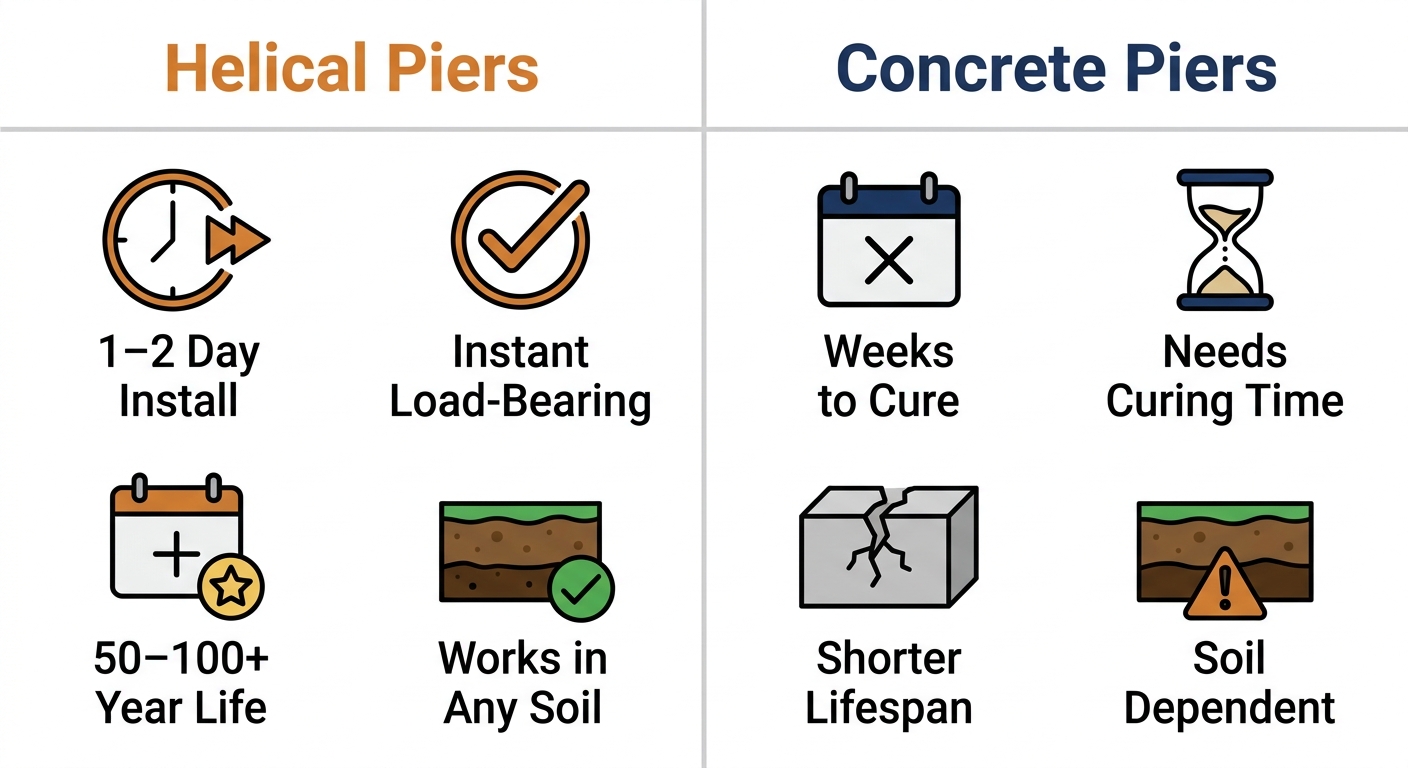
A helical pier doesn’t need time-consuming formwork, pouring concrete in forms, and curing. Once installed to achieve its designed torque, a helical pier can immediately support structural loads. That allows contractors to place new light posts and pull electrical the same day they install helical piers. A galvanized steel helical pile has a design life of 50–100+ years, extending that advantage beyond the initial installation window.
| Feature | Helical Piers | Concrete Piers |
|---|---|---|
| Installation Time | 1–2 days | 2–4 weeks (including curing) |
| Load-Bearing Readiness | Immediate | Requires 7–28 days of curing |
| Lifespan | 50–100+ years (galvanized steel) | 20–50 years (subject to cracking) |
| Soil Adaptability | Suitable for varied soils; square shaft preferred in cohesive soils | Requires proper compaction and formwork |
2. Minimal Excavation and Reduced Site Impact
Unlike traditional foundations made of concrete, our helical piles don’t require excavating. Instead, we simply screw them right in place. They leave the surrounding soil and landscaping undisturbed. Conventional foundation projects require removing spoil, creating and fitting a formwork structure and a curing period that can extend the project timeline by weeks. Furthermore, once our ICC-certified and ISO-certified helical piles reach the design torque, they’re instantly ready to bear their full weight.
According to Helical Technology’s installation guide, the screw-in process does not disturb the soil much at all, and the entire process will take only one day to two days. Since there is no soil to remove, there is little if any debris and site cleanup is quick, a critical factor for commercial light-pole projects where parking lots must remain operational and pavement repairs are unwanted. The steel piles are designed to last between 50-100+ years, according to the installation guide. Furthermore, this is also a great solution when soil quality is poor because you can advance the helical plates into the ground without having to change the ground itself.
3. Effective in Poor or Unstable Soils
Helical piles provide dependable support in soft clay, loose sand, silt, and fill by transferring loads to competent strata without excavating the unstable surface. Because the piles are screwed into the ground, they minimize disturbance and rely on friction or end-bearing of undisturbed earth. Following the manufacturer’s engineering-practice recommendations, we verify capacity in variable soil profiles by monitoring installation torque every second per ICC-ES AC358, using the empirical Q = Kt × T relationship to confirm load-bearing in real time. For loose sand or deep silt, friction piles offer stable support; end-bearing piles reach bedrock or dense sand. When lateral loads dominate, battered piles can be angled to increase stiffness. According to manufacturer guidance, galvanized steel construction yields a 50- to 100-year service life, even in corrosive soils. These engineering advantages directly apply to foundations for parking-lot light poles, where soil variability is common and dependable bearing is critical. In these conditions, our compact equipment navigates soft ground without heavy machinery, keeping site disturbance low.
4. Lightweight Equipment and Easy Access
Helical piles’ ability to work well in bad soil means they’re easy to install as well. No bulky machinery is required for construction. We can often use mini-excavators or skid-steer loaders with hydraulics because they fit through small spaces which traditional vehicles aren’t able to get into.
According to the technical installation reference, the entire process is routinely completed in one to two days. There is no need for excavation, concrete trucks, or curing time—the all-steel shaft screws into the ground and is ready to accept design loads immediately. The equipment’s lightweight footprint becomes especially practical when installing foundations for structures in confined spaces, such as those located between rows of parked vehicles, where preserving surface integrity and maintaining traffic flow are non-negotiable constraints.
The galvanized construction of each shaft provides long-term corrosion protection, a critical feature that ensures this neat solution, when we fit it on site, also delivers lasting structural performance.
5. Long-Lasting Corrosion Resistance
The longevity of foundations for parking lot light poles depends on their corrosion resistance, and helical piles deliver exceptional durability through galvanized steel construction. As our technical guide details, helical piles are manufactured from galvanized steel, a material that inherently resists rust and corrosion. This built-in corrosion protection eliminates the need for additional coatings or treatments over the installation’s lifespan, significantly reducing long-term maintenance requirements. The galvanized coating forms a durable barrier against moisture and soil-borne chemicals, maintaining structural integrity in aggressive outdoor environments. This corrosion resistance contributes to an estimated service life of 50 to 100 years or more, enabling helical piles to serve as a permanent foundation solution. Such durability is critical for commercial applications where premature foundation failure can disrupt operations and create safety hazards. That inherent protection directly supports design flexibility, enabling our piles to adapt to varying pole loads and soil conditions without structural degradation over time.
6. Design Flexibility for Varying Pole Loads
We engineer corrosion-resistant helical piles that can support varying pole loadings and take into account different parking lot light pole foundation details. To make sure all those details comply with standard AC358, we measure their pile capacities via the empirical relation Q = Kt x T using continuous data that’s being monitored every second throughout its final penetration load test stage. That means the information will let us adjust piles types & depths accordingly before installing them to all other individual poles’ foundations. parking lot light pole foundation details Q=Kt×T
If loads on the piles arise due to lateral forces caused by wind or seismic effects, we specify raked (battered) piles, which provide superior lateral stiffness without increasing the number of piles. If the site has sufficient bedrock or dense sand beneath the pile tip, end-bearing piles transfer loads directly to the bearing stratum. If not, we’d need friction piles to support shaft resistance along their lengths. All designs are validated through our ICC-approved, ISO-certified products and supported by our structural engineering team, ensuring consistent quality from the design desk to the field.
7. ICC- and ISO-Certified Quality Assurance
For any commercial foundation, third party certification demonstrates code compliance. All of our helical pile systems are ICC and ISO certified with select products being NSF/ANSI 61 listed. ISO certification is the hallmark of consistent manufacturing quality, while ICC-ES evaluation reports give documentation that our piles comply with building code, allowing the engineer to use them on their plans when doing plan checks. Third party certification makes this entire approval process much easier as well as reassuring everyone who wants to put their faith in the foundation’s integrity.
We capture all torques during the install process in accordance with ICC-ES AC358 by taking readings every second throughout final penetration. We then compare our results against the empirical formula Q=Kt x T. These calculations are done using the live readings that were taken during the install to determine if each pile achieved its required ultimate capacity prior to loading being applied.
They deliver the code-compliant, stable foundations commercial projects require and directly support the real-time torque verification performed on every job.
8. Engineering Support and Real-Time Torque Verification
The ICC- and ISO-certified quality assurance also applies to onsite verification in addition to engineering support for construction as well as real time torque monitoring. The purpose of this process is to ensure that every helical pile foundation achieves the design capacity and long-term stability contractors require.
The actual capacity can be verified in real time with the equation Q = Kt x T, where this equation yields the ultimate capacity based on the installation torque. The torque needs to be recorded at one second interval while penetrating the last bearing as prescribed in the ICC-ES AC358. This procedure enables us to effectively verify the capacity of piles.
Pile selection depends on the ground conditions: if there’s bedrock or dense sand, end-bearing piles are chosen; if it’s deep silt or clay, friction piles are chosen instead. Battered piles, set at an angle, deliver high lateral stiffness for seismic or wind loads, essential for helical pile foundations like those under light poles.
The real-time construction tool we provide along with our network of structural engineers ensures that you get project specific advice regarding code compliance as well as long term stability. When installers have gone through capacity verification and had their engineering work carried out they go off to perform their jobs with all confidence.
FAQs
Why are helical piers a better choice for parking lot light pole foundations compared to traditional concrete piers?
Helical piers are a better choice for parking lot light pole foundations because they install without concrete curing and provide immediate load-bearing capacity. Their helical plates engage soil in compression and tension to resist wind and vibration right away, eliminating the multi-day wait, formwork, and excavation required by traditional concrete piers.
How quickly can helical pile foundations for light poles be installed compared to poured concrete?
A helical pile foundation for a light pole can be installed in one to two days, while a poured concrete foundation typically requires two to four weeks including curing. The piles are ready for load immediately after installation, allowing contractors to place posts and pull electrical the same day.
Can helical piers for light pole foundations be installed in poor or unstable soil conditions?
Yes, helical piers for light pole foundations can be installed in poor or unstable soil conditions such as soft clay, loose sand, silt, and fill. They screw into the ground to transfer loads to competent strata without disturbing the unstable surface, using friction or end-bearing piles depending on the soil profile.
Do helical pier foundations for light poles require heavy excavation or large machinery on-site?
No, helical pier foundations for light poles do not require heavy excavation or large machinery. The piles are simply screwed into place, leaving surrounding soil undisturbed. Lightweight equipment such as mini-excavators or skid-steer loaders with hydraulic attachments is used, fitting easily into confined spaces between parked vehicles.
Start Your Parking Lot Light Pole Foundation Project
When you have real time torque verification and dedicated engineering support available, starting your parking lot light pole foundations project can be an informed and self-confident procedure. Correct helical piles require that there’s real time torque monitoring per the AC358 and the formula Q=Kt x T for verification of pile capacity. We provide project specific engineering assistance as well as ICC and ISO certified products that help ensure your light pole foundations meet building codes and deliver long-term stability.
For more information, contact us for a custom quote or speak directly with an engineer. Please discuss this option with an independent structural engineer or our company’s own engineering team. All installs need to be code compliant with applicable local requirements and ICC-ES acceptance criteria (AC358).
Start Your Helical Pier Project
Now that you’ve compared helical piers and concrete bases for parking lot light pole foundations, you know the advantages of faster installation, no excavation, and a 50-to-100-year lifespan. The next step is to design a solution that fits your specific soil conditions and pole loads. Our engineering design tools and real-time torque monitoring software allow you to model helical piles with precision and confidence. Contact our structural engineer network for project-specific guidance and a custom quote. Your parking lot project deserves a reliable, code-compliant foundation. Let’s start the conversation today.
Start Your Helical Pier Project