

Table of Contents
- Rapid Foundation Stabilization After Disasters
- Helical Pier Depth Requirements for Load-Bearing Soil in Disaster Zones
- Cost Drivers for Helical Pier Installation in Disaster Relief
- Limitations and Considerations When Using Helical Piles for Emergency Foundation Repair
- Helical Piers vs. Concrete Piles: A Comparison for Disaster-Resistant Foundations
- Certified Helical Pier Installation for Disaster Relief: Engineering Support and Quality Assurance
- Partner with Helical Technology for Disaster-Resistant Foundation Solutions
Rapid Foundation Stabilization After Disasters
When urgent helical pier installation for disaster relief is required, depth is determined by the local subsurface soil profile rather than a fixed measurement, and real-time torque monitoring immediately confirms load-bearing capacity in the field. Disasters can alter ground composition unpredictably, leaving foundations compromised and structures vulnerable to further damage. In these scenarios, we deploy advanced earth anchoring systems that transfer structural loads to competent soil without the curing delays that slow traditional concrete methods.
The geotechnical investigations were conducted through the collection of soil borings and test pits to determine the installation depths, as well as measuring the hydraulic torque, which would verify that each pile had reached load bearing strata during the construction process. In addition to verifying installation torque using the Torque Factor Method, which accounts for various factors such as soft clays or gravels, the piles must also reach load bearing soil at the proper depth to ensure they have achieved the necessary stability in the highly variable subsurface conditions often associated with disaster debris zones.
Once emergency stabilization is underway in disaster zones after an earthquake or flood, determining the correct installation depth for helical piers is critical in the altered soil conditions common after such events. We start our work using this basic rule: there’s no magic number that says “this is how deep.” It all depends on the subsurface soil makeup where you live. To locate load-bearing layers in the ground, we take two steps before digging any holes: performing a thorough investigation of the geology prior to installing the helical pier and then applying real-time torque readings as they’re inserted into the ground.
As explained earlier in the Engineering FAQ, geotechnical investigations, including soil borings, test pits, and Standard Penetration Tests (SPT), play a crucial role in defining the soil profile and finding competent bearing layers below weak surface soils. Such tests help identify the water table level and certain key soil properties, such as cohesion in clays or angle of internal friction in sand and gravel. Geotechnical investigation can show that load-bearing strata could be found in soft clay up to 5-15 ft., in silty clay from 8-20 ft., and gravel from 12-30 ft. Thus a site-specific profile is essential. Geotechnical testing should be done before installing a new foundation to define the soil profile because in disaster-affected areas where ground strata may have shifted or become saturated, this pre-installation evaluation provides the only reliable blueprint for pier depth and eliminates guesswork. We don’t want to just guess the depth of the piers based on what was done previously, but we need to know exactly how much foundation needs to go down into the ground.
The technical method we use is based on the Torque Factor Method described by Qult= Kt x T where Qult is the ultimate soil capacity, T is the installation torque measured at the hydraulic motor, and Kt is a soil specific coefficient. For example if Qult = Kt * T then: For Soft Clay – Kt will be 3 to 5 ft⁻¹; for Loose Sand – it would be 6 to 10 ft⁻¹; and for Gravel it would be between 10 and 15 ft⁻¹. When the torque being measured at the hydraulic motor reaches that indicated for the design capacity of the foundation, the helix plates can then be placed into more stable soil conditions. Our design software integrates real-time data with the geotechnical model to verify compliance with ICC-ES AC358 and structural performance requirements.
They also need to go deep enough below the frost line for seasonal freeze-thaw cycles. Even though the earth has been changed due to disasters, this principle still applies. As each site’s depth varies, the evaluation dictates how much money and labor will be used in the process. This is where cost considerations arise.
Key Takeaways
- Achieving proper depth for helical piles in disaster-affected terrain requires a range of technical measures that naturally affect overall project costs.
- A professional emergency foundation repair must be performed in quick order without losing sight of long-term results.
- These types of solutions would require speedy deployments as well as the capability to verify themselves at the moment.
- The success of any foundation in a disaster relief context depends on a meticulously managed installation process that accounts for local soil conditions and rigorous quality assurance.
- A dependable helical pier installation for disaster relief must be monitored in real-time for quality control purposes.
Cost Drivers for Helical Pier Installation in Disaster Relief
Achieving proper depth for helical piles in disaster-affected terrain requires a range of technical measures that naturally affect overall project costs. In emergency response scenarios, where both speed and structural integrity are critical, several key cost drivers shape the final investment. Other cost drivers also apply.
Our projects usually start out with a geotech investigation which will provide information on site bearing capacity. This includes site-specific soils reports, standard penetration tests, and lab tests. These site-specific soils reports add upfront expense but are essential for identifying competent bearing strata below weak surface layers, and often involve Standard Penetration Tests and laboratory analysis. The testing helps prevent the risk of pier failure if the ground has been flooded, eroded, or shaken due to earthquake activity. If the depth of the piers has not been correctly determined, this may result in piers being installed too shallow and failing due to excessive loading.
During installation, our Torque Factor Method provides real-time capacity verification. By correlating installation torque with ultimate bearing capacity (Qult = Kt × T), we confirm that each pier meets its design load without the need for time-consuming static testing. Monitoring torque values on-site adds some operational cost, but it enables us to optimize pier sizing and reduce material waste, especially important when mobilizing large numbers of piers for disaster relief. Torque factors are adjusted for different soil types: lower Kt values for soft clay (3 to 5 ft⁻¹) require different pier configurations than the higher values used in gravel (10 to 15 ft⁻¹). These soil-dependent adjustments may call for additional field testing or alternate pier lead sections, influencing total installation cost.
We also run structural models through our design software to establish all relevant parameters prior to the construction team being on-site. The engineering costs for these activities result in additional charges, however they ensure that codes are followed and reduce the likelihood of foundation failure under the extreme conditions experienced during disasters. Similarly, our ICC and ISO Certified products go through extensive third party testing and quality control activities, which are reflected in the costs incurred when purchasing those products. In disaster relief scenarios, the reliability of using only certified materials is essential rather than optional.
While all sites are unique in their own way, we will be providing you with our quote based on your soil type, depth required as well as any special certificates you may need. Regardless, there are a few things that need to be taken into consideration if using helical piles for emergency foundation repairs. Understanding each of these factors will help ensure a sound project plan is made.
Limitations and Considerations When Using Helical Piles for Emergency Foundation Repair
A professional emergency foundation repair must be performed in quick order without losing sight of long-term results. Since distressed foundations rarely occur under ideal site conditions, every emergency project requires careful evaluation of subsurface characteristics, installation logistics, and verification protocols.
Soil conditions have a major impact on helical piles in terms of helix configuration, shaft size, and how deep you need to bury them. Loose sands often require larger helix plates and deeper embedment to develop adequate bearing capacity, while expansive clay soils may demand longer shafts to reach stable strata below the zone of seasonal moisture fluctuation. If shallow bedrock is present, you’ll need to terminate based on refusal rather than torque-based capacity verification.
Real time torque monitoring provides the critical data needed to confirm load capacity during emergency installations. The documentation describes how an inline pressure transducer installed in the hydraulic circuit converts pressure measurements into torque outputs. Electronic dataloggers record continuously to generate installation logs for each pier. Torque numbers are then correlated to load capacity according to the methodology defined by ICC-ES Acceptance Criteria AC358, allowing crews to verify that every pile meets its target capacity before moving to the next.
Emergency sites often have restricted access, adjacent structures, and sensitive utilities that preclude heavy excavating equipment. Helical piles may be installed here utilizing compact hydraulic drive heads, causing minimal vibration. Structural engineering data from our network of structural engineers confirms as built conditions conform with project specific design requirements. This adds an independent layer of quality assurance.
While helical piles are beneficial in certain emergency situations, this does not imply that the option will be suitable all times. There may be reasons to look elsewhere: subsurface debris, boulder fields, or karst formations can obstruct installation and prevent consistent torque readings, making capacity verification unreliable. Recognizing these limitations ahead of time — through thorough geotechnical investigation and engineering review — is essential before you weigh helical piles against alternatives like concrete piles for disaster-resistant foundations.
Helical Piers vs. Concrete Piles: A Comparison for Disaster-Resistant Foundations
These types of solutions would require speedy deployments as well as the capability to verify themselves at the moment.
| Feature | Helical Piers | Concrete Piles |
|---|---|---|
| Installation speed and equipment requirements | Fast installation with compact hydraulic equipment; no excavation or concrete curing | Heavy drilling rigs, large-scale excavation, and weeks of curing required |
| Soil adaptability and load-bearing verification | Adapts to variable soil profiles; real-time torque monitoring confirms bearing capacity to ICC-ES AC358 standards | Relies on pre-construction borings; capacity verification only after concrete curing via static load tests |
| Structural strength under lateral and uplift loads | Helical plates provide excellent uplift resistance; shaft bracing adds lateral capacity | Primarily compressive strength; requires steel reinforcement for tension or lateral forces |
| Environmental impact and site disturbance | Minimal soil displacement, no spoil; removability supports site reuse | Large spoil volumes, permanent concrete mass, and heavy site disturbance |
| Suitability for rapid disaster response | Installed immediately in almost any weather; no cure-time delay | Delayed by equipment mobilization, drilling, and concrete cure time |
| Long-term durability and maintenance needs | Hot-dip galvanized steel provides corrosion resistance; minimal maintenance | Susceptible to cracking, sulfate attack, and freeze-thaw damage; requires ongoing inspection |
According to Helical Technology’s technical personnel, they can be adapted to varying soil conditions through the use of real-time torque monitoring, which corresponds to rotational resistance as an indication of soil bearing capacity. The field test verifies its ability to meet specifications set forth by ICC-ES AC358.
The main use of concrete piles is compressive action; unless heavily reinforced, it can be vulnerable to tension loads generated by wind, flood, or seismic forces.
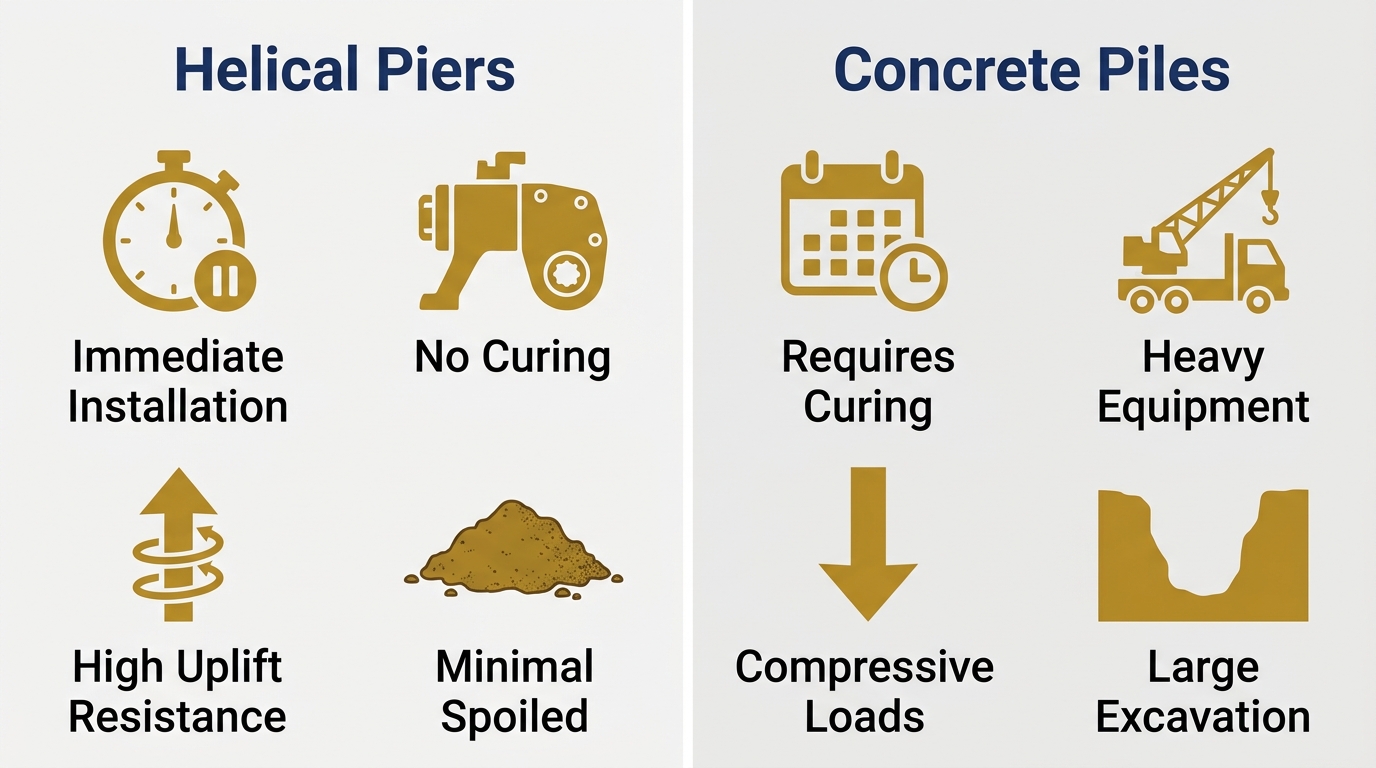
This construction method leads to large quantities of excavated soil as well as to permanent remains of cement that make land-use planning difficult later.
Hot dip galvanised helical piers offer resistance to corrosion caused by moisture present or chemicals found in wet or chemically active soil.
Helical piers need to be installed correctly in order to function as intended during disasters. This means only being placed by experts using accurate torque values will provide fast acting foundation protection.
Certified Helical Pier Installation for Disaster Relief: Engineering Support and Quality Assurance
The success of any foundation in a disaster relief context depends on a meticulously managed installation process that accounts for local soil conditions and rigorous quality assurance. We approach every certified helical pier installation with a focus on geotechnical precision, real-time monitoring, and engineering oversight to ensure long-term structural integrity.
Before driving any pier, our team conducts geotechnical investigations through soil borings to characterize the subsurface profile at the disaster relief site. This analysis determines the precise depth required to reach load-bearing strata and ensures that every installation extends below the frost line. By anchoring piers beyond the freeze-thaw zone, we eliminate the risk of seasonal ground movement that could compromise temporary or permanent disaster recovery structures. The required depth varies with soil composition—from soft clay to dense gravel—and our technical guidance ensures each pier is advanced until competent bearing is confirmed.
During this time, real-time torque monitoring allows us to verify loads as the pier drives forward, since there are inline pressure transducers in the hydraulic system converting the pressure to torque readings, and they’re being captured continually by the electronic datalogger. This information is then compared against the pier’s load capacity per ICC-ES AC-358 criteria, which are accepted across the industry as standards for helical piles. In essence, torque values are tracked throughout the driving operation, and the installation crews will be able to notice if anything deviates from the original design specification. If so, they’ll adjust driving parameters to prevent under-driven piers. Since torque is measured in real time, the installation becomes fully monitored and quality assured, with every single pile having its own report to ensure full structural integrity is achieved.
A network of structural engineers reviews torque logs and installation reports to confirm compliance with project design mandates. We provide our certified installers with manufacturer-provided real-time design software that models load conditions specific to disaster relief applications. Because our products are ICC-approved and ISO-certified, clients receive a foundation system backed by stringent quality and performance standards. This integrated approach—combining geotechnical investigation, monitored installation, and engineering review—delivers the reliability that disaster relief operations demand. Our certified helical pier installation process offers the assurance that every foundation is built on solid, tested ground. Contractors and relief organizations can rely on our engineering resources to execute complex projects with confidence.
Foundation Strength FAQs
How deep should helical piers go?
Helical pier depth is determined by soil profile, not a standard number, and must reach load-bearing strata below the local frost line. Depth ranges from 5 to 15 feet in soft clay up to 12 to 30 feet in gravel. Geotechnical investigation and real-time torque monitoring verify load-bearing capacity at the achieved depth.
What are the Disadvantages of Helical Piles?
Helical piles are not suitable where subsurface debris, boulders, or karst formations obstruct installation and make torque-based capacity verification unreliable. Slim shafts may be at risk of buckling in very soft soils unless properly braced. In coastal saltwater environments, steel corrosion requires hot-dip galvanizing for protection.
Are Helical Piers Stronger than Concrete?
No, helical piers are not universally stronger than concrete piles. Helical piers excel in uplift and lateral resistance, while concrete piles provide high compressive strength. The choice depends on project-specific forces such as tension from wind or seismic events and the need for immediate load capacity without curing.
Partner with Helical Technology for Disaster-Resistant Foundation Solutions
A dependable helical pier installation for disaster relief must be monitored in real-time for quality control purposes. Helical Technology uses pressure transducers mounted to hydraulic systems, feeding torque readings from piers into the system’s electronic dataloggers as they’re being installed. The live data then correlates to load capacity as set forth in ICC-ES AC358, allowing the installer to adjust the process immediately if there aren’t enough twists during installation and preventing any under-driven helicals. Each helical pile installation yields a detailed report for structural engineers to verify, and we provide our engineering staff and their structural engineer counterparts access to these torque logs for complete validation of installations. Our ICC-approved and ISO-certified products support designs compliant with applicable codes and acceptance criteria. Always check with your structural engineer or with us before proceeding. Send us a project inquiry and we will return a quotation, together building you the disaster-resistant foundation you need.
Request Your Custom Quote
Now that you understand the importance of proper depth determination and real-time torque monitoring for helical pier installation in disaster relief, the next step is to ensure your project benefits from certified engineering support. Our advanced earth anchoring systems deliver rapid, reliable foundation stabilization without curing delays. Our team provides site-specific geotechnical assessments and verifies load-bearing capacity through inline pressure transducers and electronic dataloggers, meeting ICC-ES AC358 criteria. With ICC-approved and ISO-certified products, we ensure structural integrity that stands up to post-disaster conditions. Whether you’re comparing helical piers to concrete piles or evaluating cost drivers, our network of structural engineers can guide you to the most effective solution. Request a custom quote to discuss your disaster-resistant foundation needs with our expert team. Partner with us to bring the reliability of certified helical pier installation to your next project.