

Table of Contents
- Understanding Foundation Repair Cost: A Contractor’s Guide
- Foundation Repair Cost Factors for Contractors
- Comparing Foundation Repair Near Me Cost Options
- Foundation Crack Repair Cost vs. Value for Contractors
- Engineering Support to Optimize Repair Cost
- Building Accurate Foundation Repair Cost Estimates
Understanding Foundation Repair Cost: A Contractor’s Guide
Understanding foundation repair cost is critical for contractors planning any project, as each job presents unique challenges. Variables such as soil conditions, foundation type, the extent of damage, and even foundation crack repair requirements influence the overall project expense. Local building codes and the need for advanced earth anchoring systems like helical piers further shape repair pricing in your region.
Because helical pier systems demand an engineering assessment for ICC-ES AC358 compliance, we provide access to our network of structural engineers. This essential step must be factored into every budget; our engineering team offers a custom-quote model rather than fixed pricing to ensure accuracy. To understand specific cost components, read on. Contractors seeking industry-standard pricing practices can consult the foundation repair association. Consult a structural engineer or the manufacturer’s engineering team for project-specific design and installation guidance.
Foundation Repair Cost Factors for Contractors
When estimating foundation repair cost factors, contractors must evaluate soil behavior, structural demands, and the selected repair method. While foundation repair near me can vary by region, the universal cost drivers include expansive soils, building dimensions, and technical installation requirements that influence material quantity and labor time.
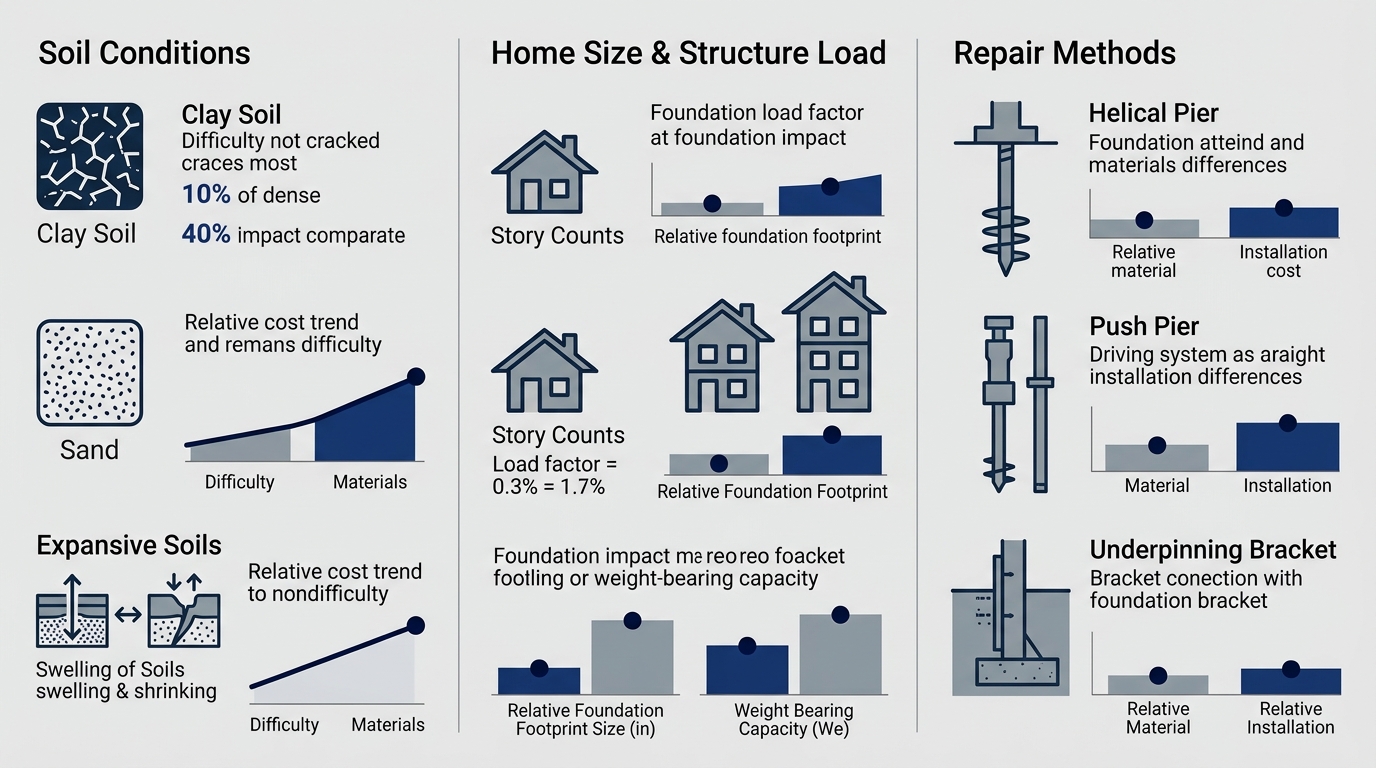
Key cost factors for foundation repair contractors: soil, structure, and methods.
Soil Conditions and Their Impact on Pricing
Soil type directly dictates the repair strategy and its associated difficulty. Expansive clay soils swell and shrink with moisture changes, generating movement that demands deep-load solutions like helical piers—a method governed by ICC-ES AC358 criteria for capacity verification. Sandy soils, lacking cohesion, often require underpinning to reach stable bearing strata. Proper yard drainage helps mitigate soil moisture changes, which in turn can reduce the need for deep foundation repairs. We always recommend an on-site soil assessment to accurately define the load requirements.
Home Size and Structural Load Variables
Foundation dimensions and structural load significantly affect material counts and installation hours. A larger square footage increases the linear feet requiring support, while multiple stories add dead load that demands deeper pier embedment or tighter bracket spacing. More load-bearing walls translate directly into a higher pier quantity, extending labor time. These structural load variables shape bid preparation, which is why our network of structural engineers evaluates each project against ICC-ES AC358 to determine the precise support profile needed.
Repair Method Cost Comparison
Each repair method carries distinct cost sensitivities. Helical piers are depth-driven—deeper installations require more extensions and longer equipment time. Push piers rely on skin friction resistance, making soil consistency the primary variable for drive time. Underpinning brackets are sensitive to structural load, which dictates bracket quantity and spacing. For foundation crack repair, material volume and access difficulty drive pricing; epoxy injection or crack stitching cost depends on lineal footage and crack depth. Plate anchors for wall stabilization are most influenced by excavation scope and anchor embedment depth. Consult a structural engineer or our engineering team for project-specific design and installation guidance, ensuring that our advanced earth anchoring systems meet all ICC-ISO requirements.
Once the cost factors are understood, contractors can evaluate the most suitable repair method for each project.
Comparing Foundation Repair Near Me Cost Options
Once you have identified the type of foundation issue, the next step is comparing repair cost options. When comparing foundation repair cost options, it helps to understand typical ranges for each method. If you are searching for foundation repair near me, the table below offers a useful baseline for discussions with local installers.
The table below summarizes typical cost ranges for the most common foundation repair methods, using ICC and ISO Certified products as the benchmark.
Foundation Repair Cost Comparison by Method
| Repair Method | Typical Cost Range (National Estimate) | Key Cost Drivers | Best For |
|---|---|---|---|
| Helical Piers | $1,000 – $3,000 / pier | Depth to stable soil, load requirements, number of piers | Settling foundations, new construction, heavy structural loads |
| Push Piers | $1,200 – $2,500 / pier | Bearing capacity of soil, pier depth, access limitations | Existing residential foundations with moderate settlement |
| Underpinning Brackets | $800 – $2,000 / bracket | Wall height, foundation type, bracket spacing | Crawl-space foundations, slab repair |
| Foundation Crack Repair (Epoxy / Polyurethane) | $400 – $1,500 / crack | Crack length, width, structural vs. cosmetic classification, product (epoxy vs. polyurethane) | Wall stabilization, water leakage prevention |
| Plate Anchors (Wall Stabilization) | $300 – $800 / anchor | Wall dimensions, soil conditions, number of anchors | Basement wall bowing, retaining wall repair |
These national estimates, based on authoritative industry benchmarks provided by the Foundation Repair Association, offer a starting point for understanding foundation repair pricing. Actual repair method costs can vary significantly based on site-specific factors like soil conditions, pier depth, and access limitations. For example, the cost of foundation crack repair depends heavily on whether a crack is structural or cosmetic and the type of epoxy or polyurethane resin selected.
Ultimately, the cost of foundation repair is determined by an individual project’s specific requirements. To get an accurate price for your situation, you must request a custom quote from our engineering team. We provide Engineering Excellence and Design Support through our network of structural engineers, ensuring you get a reliable solution. Consult a structural engineer or the manufacturer’s engineering team for project-specific design and installation guidance. To get a precise cost estimate for your specific situation, request a custom quote from our engineering team.
Foundation Crack Repair Cost vs. Value for Contractors
Understanding foundation repair cost begins with identifying the type of foundation crack — a decision that drives whether the solution is a simple seal or an engineered permanent repair. We help contractors make confident, cost-effective choices that deliver lasting value for residential and commercial projects.
Structural vs. Cosmetic Crack Identification
Cracks wider than 6 mm, horizontal or stair-step patterns, and active movement indicate a structural problem requiring engineered foundation crack repair. Hairline vertical cracks are usually cosmetic and can be sealed with less intensive methods. Correct identification determines whether the scope of work stops at surface sealing or moves into structural restoration — directly influencing the cost-to-value equation and long-term performance.
Epoxy vs. Polyurethane Injection Cost Factors
Epoxy is preferred in foundation crack repair for structural cracks; polyurethane expands to seal active, water-bearing gaps and reduces water seepage.
Crack Stitching: When Is It Worth the Investment?
Stitching for foundation crack repair uses helical anchors and the crimper tool. Consult a structural engineer or the manufacturer’s engineering team for project-specific design and installation guidance.
Engineering Support to Optimize Repair Cost
Beyond product quality, our engineering support is key to controlling costs in foundation repair cost optimization. Smart design and thorough training help contractors and property owners avoid unnecessary expenses before installation begins.
Our manufacturer-provided real-time design software delivers accurate load calculations that eliminate over-engineering and material waste. When contractors rely on this tool, they specify precisely what each project requires rather than building in costly safety margins. Our network of structural engineers reviews site conditions and produces project-specific drawings at no additional charge, removing the guesswork that leads to expensive rework. For contractors searching for foundation repair near me, our team provides local code-compliant designs that streamline the entire process.
Even projects focused on foundation crack repair benefit from our design optimization. Our installer training and certification programs teach crews to avoid common on-site mistakes, reducing the callbacks and structural failures that inflate budgets. When paired with ICC and ISO Certified products, this training helps installations pass inspections faster, saving time and administrative expense.
All of this engineering support comes standard with our foundation repair solutions, never as a separate line item. This comprehensive support ensures every installation is both code-compliant and cost-efficient.
Consult a structural engineer or the manufacturer’s engineering team for project-specific design and installation guidance.
Building Accurate Foundation Repair Cost Estimates
Estimating foundation repair cost requires evaluating the foundation type, damage extent, soil conditions, and local labor rates. For instance, solutions for foundation crack repair vary in scope from epoxy injection to full underpinning. Location-specific factors in foundation repair near me also affect project pricing.
- Foundation type (slab, crawl space, basement) and damage severity strongly influence the estimate.
- Our ICC-ES certified products and real-time design software produce project-specific over generalized per-square-foot figures.
- Contractors should factor in permits, site access, and structural engineering reports for an accurate quote.
We encourage you to contact Helical Technology for a custom, engineered estimate. Consult a structural engineer or the manufacturer’s engineering team for project-specific design and installation guidance.
Resources
- Get Certified Foundation Crack Repair Solutions
- Get Certified Crimper for Earth Anchoring Systems
- Get Certified Yard Drainage and Foundation Repair
- Learn When Foundation Cracks Require Professional Repair
- Get Expert Pier and Beam Repair in Austin
- Explore Foundation Repair Costs in San Antonio
- Get Expert Helical Pier Installation Training
- Find Foundation Repair Association Resources and Training