

Table of Contents
- Underpinning Brackets for Helical Piers: What Contractors Need to Know
- Choosing the Right Underpinning Bracket for High-Capacity Hydraulic Push Piers
- Selecting Brackets for Commercial Foundation Stabilization Projects
- Specialized Attachments: Plates and Brackets for Existing Concrete
- Corrosion Resistance Standards for Foundation Repair Brackets
- Wholesale Purchasing of Underpinning Brackets for Contractor Inventory
- Strengthen Your Foundation Portfolio with Reliable Underpinning Brackets
Underpinning Brackets for Helical Piers: What Contractors Need to Know
Beyond the pier itself, underpinning repair brackets are the critical load-transfer component contractors count on for foundation stabilization. As the essential connection between the helical pier and the structure, these bracket systems redirect the building’s weight down to the pier shaft, making them indispensable for permanent repairs.
Our helical pier retrofit brackets are engineered to support demanding loads, with capacities typically ranging from 10,000 to 40,000 lbs depending on the model and application. Designed for compatibility with standard pier pipe diameters—from 2⅞″ to 4½″—these brackets work seamlessly with both new installations and existing foundation retrofits. Each unit we supply is manufactured to ICC and ISO standards, backed by verified ICC-ES documentation that gives engineers and code officials full confidence in the design.
We pair every bracket sale with direct access to our network of structural engineers for project-specific design and installation support. Browse our full line of specifications and request a custom quote to equip your next job with reliable, code-compliant load-transfer hardware. With the right bracket in place, proper installation is the next key step—covered below.
Consult a structural engineer or the manufacturer’s engineering team for project-specific design and installation guidance.
Choosing the Right Underpinning Bracket for High-Capacity Hydraulic Push Piers
When selecting underpinning brackets for helical piers or hydraulic push pier systems, the bracket itself becomes the critical link between a compromised foundation and the deep, load-bearing soil. These engineered components transfer the full structural weight into the pier shaft, making your choice of bracket as important as the pier itself. For high-capacity applications, using the correct underpinning bracket ensures long-term stability and system integrity.
The primary selection criteria for any foundation repair solution include the following:
- Load Capacity: The bracket’s rated capacity must meet or exceed the hydraulic push pier capacity and site soil conditions.
- Bracket Geometry: The shape and reach of the bracket, such as an L-bracket design, determines how it engages the existing footing.
- Adjustability: Precise, on-site adjustment features are essential for a tight fit against uneven or deteriorated concrete.
- Corrosion Resistance: Galvanized steel or similar protective coatings are vital for longevity, especially in aggressive soil environments.
Matching the underpinning bracket load capacity to your pier specification is non-negotiable. A bracket with a rating lower than the pier’s driven capacity becomes the weak point in the entire system. You must account for the soil’s ultimate bearing capacity and then select a bracket whose design load rating aligns perfectly, ensuring the assembly handles the structure’s demands without risk of deformation or failure.
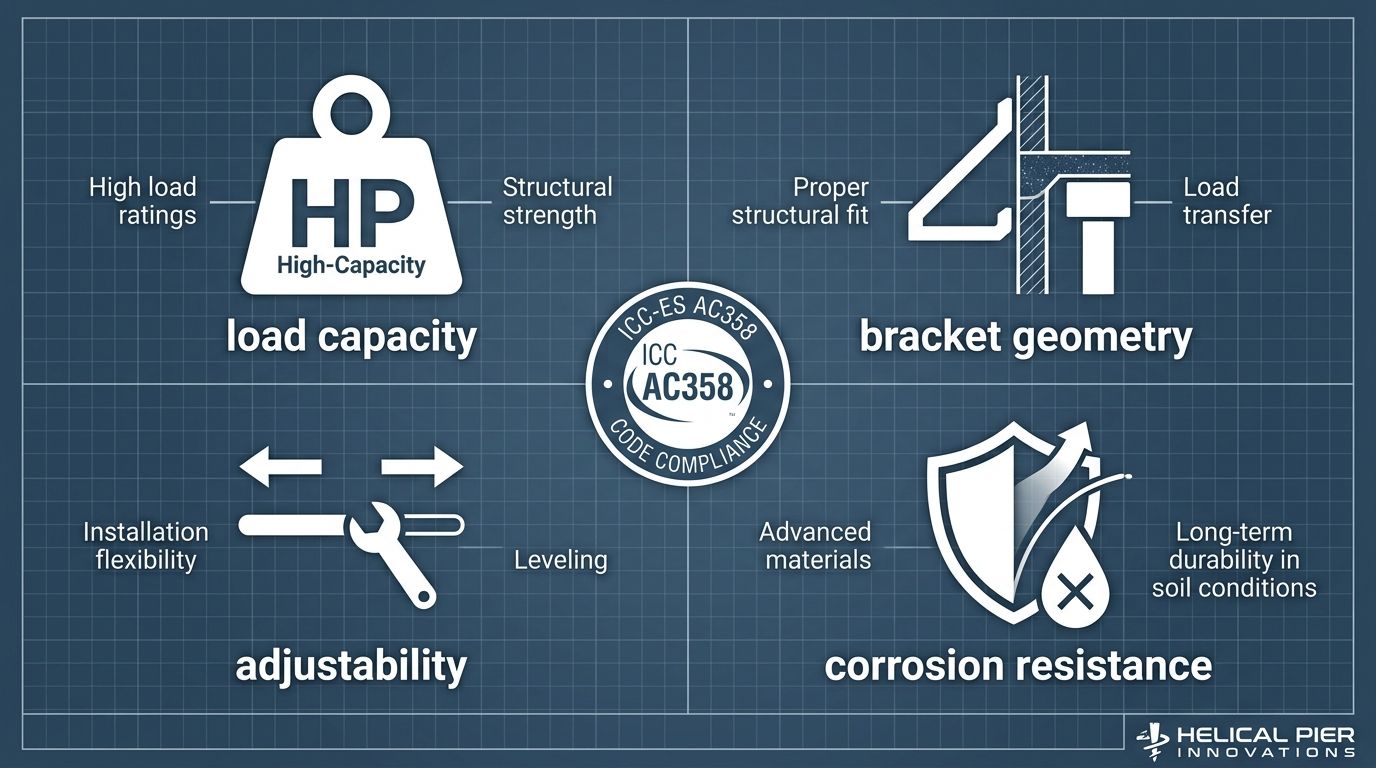
Selection criteria infographic for hydraulic push pier underpinning brackets.
Common designs like fixed L-brackets suit straightforward foundation repairs, while adjustable brackets provide versatility for varied footing thicknesses. Helical pier retrofit brackets from our advanced earth anchoring systems catalog are engineered with this modularity in mind. Choosing a product that is ICC-ES AC358-certified gives you documented assurance of code compliance and performance, a standard our engineering team prioritizes.
With the role of the bracket defined, remember that successful, high-capacity underpinning hinges on precise specification. Our team of structural engineers provides real-time design software and direct consultation for your foundation repair solutions. As you prepare to order components, we recommend you reach out to our team or a trusted helical pier distributor to review your project’s specific requirements. Consult a structural engineer or the manufacturer’s engineering team for project-specific design and installation guidance.
Selecting Brackets for Commercial Foundation Stabilization Projects
Selecting the right underpinning brackets for helical piers is a critical step in any commercial foundation stabilization project. These components form the physical connection between the helical pier system and the building’s foundation, directly influencing structural integrity and long-term performance. Our team understands that each commercial project presents unique challenges — from variable soil conditions to substantial structural loads — requiring a methodical approach to bracket specification. Proper selection ensures that the entire foundation repair system functions as a cohesive unit, providing the stability and durability commercial structures demand.
When evaluating bracket options, a primary consideration is underpinning bracket load capacity, which must align with both the structural demands of the building and the geotechnical characteristics of the site. Our ICC and ISO certified products undergo rigorous testing and are documented with ICC-ES evaluation reports that verify their compliance with acceptance criteria AC358. This certification provides engineers and contractors with the confidence that bracket load ratings meet or exceed industry standards for commercial applications. Products are certified to ICC/ISO where indicated; installations must comply with applicable building codes and ICC-ES acceptance criteria (AC358). Reviewing these technical specifications against project requirements helps prevent undersized selections that could compromise foundation performance.
For retrofit scenarios involving existing foundations, helical pier retrofit brackets offer specialized solutions designed to interface with established structural elements without extensive demolition. Unlike new construction where bracket embedding options are flexible, retrofit applications demand brackets engineered to transfer loads effectively through existing concrete or masonry. Consult a structural engineer or the manufacturer’s engineering team for project-specific design and installation guidance. Our network of structural engineers provides project-specific support — from soil analysis review to bracket design verification — ensuring the selected underpinning brackets integrate correctly with the broader foundation repair system, including push piers or plate anchors if specified. This collaborative approach minimizes installation risks and optimizes system performance.
Beyond individual component selection, bracket compatibility with the complete helical pier assembly is essential for commercial installations. We recommend engaging our engineering team early in the planning phase to access manufacturer-provided design software and specification resources. For additional best practices in commercial foundation repair, consult the foundation repair association. To receive a custom quote tailored to your project’s specifications, contact our technical support team directly.
Specialized Attachments: Plates and Brackets for Existing Concrete
Connecting helical pier systems to existing concrete structures requires specialized attachments engineered for load transfer and long-term stability. For projects involving foundation settlement repair, underpinning brackets for helical piers provide a critical interface between the existing footing and the helical pier, while tieback termination plates serve a different but equally important role in wall stabilization applications. We supply a comprehensive range of helical pier retrofit brackets and tieback hardware manufactured to the highest industry standards.
Tieback termination plates are helical anchor attachments designed to stabilize existing concrete walls by transferring tensile loads into competent soil. These plates secure helical tieback anchors to basement or retaining walls, with various plate sizes and bolt patterns available to accommodate different wall conditions and load requirements. As internal product documentation details, our termination plates are compatible with 1-1/2 inch and 1-3/4 inch RCS square shaft anchors, providing versatility across residential and commercial applications.
Underpinning repair brackets function as load-transfer devices that connect existing foundation footings to helical piers for settlement repair. When foundation soils can no longer support a structure’s weight, these brackets lift and stabilize the foundation by directing structural loads down to load-bearing strata through the helical pier shaft. The underpinning bracket load capacity depends on bracket configuration, pier size, and soil conditions — our engineering team evaluates these variables to specify the appropriate assembly for each project.
Both attachment types are available with ICC-ES certification and are manufactured under ISO quality standards, providing documentation that satisfies building code requirements. As part of our commitment to engineering excellence, we offer real-time design software and a nationwide network of structural engineers to assist with project-specific bracket selection. For additional industry resources, the deep foundation drilling association provides technical guidance on anchoring methodologies.
- Standard and heavy-duty underpinning brackets for different footing widths and load demands
- Tieback termination plates with multiple bolt patterns for diverse wall thicknesses
- Corrosion-protected assemblies for long-term performance in aggressive soil conditions
We encourage you to leverage our engineering design support when specifying attachments for your project. Every site presents unique challenges, and proper bracket selection is a critical first step before installation begins. Consult a structural engineer or the manufacturer’s engineering team for project-specific design and installation guidance.
Corrosion Resistance Standards for Foundation Repair Brackets
Beyond structural design, corrosion resistance is a critical performance factor that ensures the long-term integrity of underpinning brackets for helical piers. These brackets operate in aggressive subterranean environments where constant exposure to soil moisture, varying pH levels, and chemical compounds can degrade unprotected steel over time. We understand that contractors and structural engineers require foundation repair solutions that deliver predictable, code-compliant durability. The two primary bodies governing corrosion protection for these components are the International Code Council and ASTM International, whose standards collectively define the minimum requirements for coating thickness, material performance, and design life in below-grade applications.
The ICC building code platform establishes the enforceable minimums that repair brackets must satisfy. According to the International Code Council, IBC Section 1808.8 explicitly addresses corrosion protection for steel elements in soil, requiring sacrificial thickness or a protective coating that maintains structural capacity for the intended design life. Acceptance Criteria AC358 for helical pile systems further specifies that brackets in ground contact must resist section loss from corrosion, and hot-dip galvanizing to ASTM A123 or A153 is the industry-accepted method. As an ICC and ISO Certified products distributor, we ensure our underpinning brackets for helical piers are hot-dip galvanized to meet or exceed these ASTM standards. ICC building code platform documentation confirms that properly galvanized brackets satisfy the code mandate, and through our own ICC-ES evaluation reports, we provide verifiable evidence that these assemblies comply with AC358 and local building codes across a wide range of project conditions.
When assessing underpinning bracket load capacity, corrosion allowances factor directly into the engineering calculations. Progressive section loss from corrosion can diminish the effective cross-sectional area of steel, reducing the bracket’s ability to sustain design loads, particularly in aggressive soils with high chloride or sulfate concentrations. Our technical team works closely with a network of structural engineers to evaluate whether standard hot-dip galvanizing is sufficient or whether the addition of epoxy overcoats or high-performance paint systems is appropriate for specific project environments, including coastal installations or contaminated fill. Products are certified to ICC/ISO where indicated — installations must comply with applicable building codes and ICC-ES acceptance criteria (AC358). With corrosion standards satisfied, we recommend consulting a structural engineer or our in-house engineering team to confirm the proper coating specification and bracket configuration for your site before installation.
Wholesale Purchasing of Underpinning Brackets for Contractor Inventory
At Helical Technology, we empower contractors to maintain stock of underpinning brackets for helical piers with a wholesale program built for the foundation repair industry. Our custom-quote pricing model ensures you receive competitive rates tailored to your volume requirements, helping you keep essential components on hand without tying up excess capital.
Our helical pier retrofit brackets are offered in a range of sizes and configurations to match diverse project conditions. Available dimensions include 2-inch RCS, 3.5-inch, and 4½-inch pipe connections to integrate with our helical pier lead sections, giving you flexibility across various retrofit scenarios. Each bracket is fabricated from heavy-gauge steel and coated for corrosion resistance, ensuring reliable performance in demanding below-grade environments. When evaluating underpinning bracket load capacity, it is crucial to refer to our product documentation or consult with our engineering team, who can help you select the bracket that meets the structural demands of each job. All our brackets are ICC-approved and ISO-certified, with ICC-ES reports available to support compliance and permitting processes.
We make ordering straightforward: you can browse our catalog and contact our sales team to receive a custom quote for your desired quantities. Once your order is confirmed, we ship directly from our Littleton, CO facility to jobsites nationwide, ensuring timely access to certified products. Beyond product delivery, our network of structural engineers provides design assistance and project-specific guidance, helping you integrate underpinning brackets into complete helical pier systems that adhere to the latest building codes and AC358 acceptance criteria.
Contractors often round out their inventory by adding complementary products like the vapor barrier termination bar, which simplifies the installation of vapor barriers in encapsulation projects. By stocking these related items, you can serve a wider range of foundation and moisture management needs from a single supplier.
We encourage you to reach out to our team for a personalized wholesale quote and start building a reliable inventory of foundation repair solutions. Consult a structural engineer or the manufacturer’s engineering team for project-specific design and installation guidance. Beyond brackets, contractors can also stock complementary products such as vapor barrier termination bars for a complete foundation repair solution, discussed in the following section.
Strengthen Your Foundation Portfolio with Reliable Underpinning Brackets
When specifying components in helical pier systems, certified underpinning brackets serve as the critical connection between the pier and the structure. These engineered components transfer a foundation’s structural load onto the helical pier shaft, making their reliability fundamental to any successful foundation repair or new-construction project. We supply underpinning brackets for helical piers in multiple configurations, each designed to address specific structural conditions and load requirements. Using ICC- and ISO-certified brackets with ICC-ES documentation — backed by our in-house engineering team and proprietary design software — demonstrates a verifiable commitment to quality that sets a contractor’s portfolio apart.
Every helical pier retrofit bracket we provide is supported by our network of structural engineers, ensuring project-specific designs that align with the calculated underpinning bracket load capacity. This level of technical support and manufacturer-certified reliability strengthens your professional credibility on every job, from residential repairs to commercial installations. Consult a structural engineer or our engineering team for project-specific design and installation guidance. Our products are certified to ICC/ISO where indicated, and installations must comply with applicable building codes and ICC-ES acceptance criteria (AC358).