

Table of Contents
- Stair-Step Cracks in Brick: A Guide for Foundation Contractors
- Understanding Stair-Step Cracks in Brick Veneer
- Foundation Settlement and Stair-Step Crack Patterns
- Repairing Stair-Step Cracks in Brick Veneer
- Distinguishing Settlement from Shrinkage in Brickwork
- Common Questions About Stair-Step Cracks
- Ensuring Long-Term Stability of Brick Veneer
Stair-Step Cracks in Brick: A Guide for Foundation Contractors
Following our earlier overview of foundation crack types, we narrow our focus to stair-step cracks in brick—diagonal fractures that follow mortar joints in a step-like pattern. These cracks commonly indicate differential foundation settlement or heave, making them a priority for professional evaluation.
Unlike horizontal foundation cracks, which signal lateral pressure, stair-step cracking in brick masonry usually points to vertical movement. As one of the primary signs of foundation problems, these cracks require careful monitoring. Record baseline width and length during your initial inspection, then use a crack monitor to track changes over time. Stable cracks may be cosmetic, but progressive widening often calls for structural intervention.
Diagonal brick cracks can also appear in brick veneer over wood-frame construction. In those cases, framing movement, not foundation distress, might be the root cause. Not every stair-step pattern demands a helical pier or push pier solution. For deeper classification guidance, consult a resource like the Foundation Repair Organization.
In our next section, we explore repair approaches involving helical piers, push piers, and other engineered methods. Always consult a structural engineer or our engineering team for project-specific design and installation advice. Document occurrences thoroughly using dated photos, precise measurements, and detailed location notes.
Understanding Stair-Step Cracks in Brick Veneer
Stair-step cracks in brick veneer are a distinctive crack pattern that follows mortar joints diagonally. These cracks often raise immediate concern because they can be signs of foundation problems, particularly differential settlement. Understanding why these cracks form and how to evaluate their severity is essential for homeowners and building professionals alike.
Stair-step cracks develop when a foundation settles unevenly, creating stress that transfers through the wall assembly. The brick veneer, being rigid and brittle, cracks along the weakest points — the mortar joints — rather than through the bricks themselves. This results in a pattern that resembles a staircase, stepping up or down diagonally across the wall face. While such cracks are frequently associated with foundation movement, they can sometimes result from mortar shrinkage or minor thermal cycling and may remain stable and largely cosmetic over time. However, because the underlying cause can be structural, stair-step cracks are considered a moderate-to-high severity indicator.
Homeowners should regularly monitor stair-step cracks for changes in width or length. Active cracks — those that continue to grow — signal ongoing foundation movement that may require professional intervention. In contrast, stable hairline cracks that do not evolve are often benign and may be left untreated or sealed for aesthetic reasons. The key distinction lies in the underlying stability of the foundation. When evaluating stair-step cracks, a structural engineer can determine whether the cause is active settlement or an isolated incident of past movement.
The following table provides a quick reference for distinguishing stair-step cracks from other common crack patterns in brick veneer:
| Crack Pattern | Orientation | Typical Cause | Severity Indicator |
|---|---|---|---|
| Stair-Step | Diagonal along mortar joints | Foundation differential settlement | Moderate to High – possible structural issue |
| Horizontal | Along a single mortar joint | Lateral soil pressure on foundation wall | High – indicates wall bowing |
| Vertical | Straight through bricks or mortar | Material shrinkage or thermal movement | Low to Moderate – typically cosmetic |
As the table illustrates, stair-step cracks sit between vertical cosmetic cracks and horizontal foundation cracks that often indicate wall bowing due to lateral pressure. For stair-step cracks, the severity depends heavily on whether the foundation settlement is ongoing. A structural assessment is the best way to rule out significant foundation issues and provide peace of mind. While some homeowners may be tempted to fill stair-step cracks with mortar or caulk, such cosmetic fixes do not address the root cause and can trap moisture, accelerating deterioration.
If foundation movement has stopped, structural integrity can often be restored with products such as concrete crack repair epoxy. Our advanced foundation repair solutions, backed by ICC- and ISO-certified products, ensure repairs align with site conditions and building codes. Consult a structural engineer or Helical Technology’s engineering team for project-specific evaluation and repair design.
Foundation Settlement and Stair-Step Crack Patterns
Stair-step cracks in brick are one of the most telling signs of foundation settlement in residential and commercial structures. When we examine these distinctive patterns, we often find that the structural integrity of the entire foundation system requires immediate professional assessment.
The Link Between Foundation Movement and Crack Formation
Differential settlement occurs when portions of a foundation subside at different rates due to varying soil conditions, moisture levels, or load distributions. This uneven movement generates shear forces that translate through the foundation and into the masonry veneer above. Brick veneer, being rigid and brittle, cannot flex to accommodate these stresses. Instead, the shear forces cause the mortar joints—the weakest points—to crack in a predictable stair-step fashion. The resulting stair-step cracks in brick typically follow the path of least resistance, stepping diagonally along the mortar both horizontally and vertically. In cold climates, freeze-thaw cycles can worsen these cracks by expanding moisture within the masonry. We see these patterns most frequently in concrete block foundations and slab-on-grade systems where soil movement is pronounced.
Horizontal vs. Stair-Step Cracks: What Each Pattern Tells You
Not all wall cracks are created equal. While stair-step crack patterns trace the mortar joints and strongly indicate foundation settlement, horizontal foundation cracks are often a sign of lateral earth pressure pushing against the wall. Step cracks in brick veneer typically emanate from corners and openings, widening toward the bottom where settlement is greatest. In contrast, horizontal cracks run more or less parallel to the floor, frequently appearing in basement walls subject to expansive soil pressure. We must differentiate these patterns because their root causes and remediation strategies diverge significantly. Our industry colleagues at the Foundation Repair Organization confirm that settlement cracks are characterized by their stair-step progression and uneven width, whereas shrinkage cracks are hairline and stable.
To further clarify these distinctions, the following table compares settlement cracks with harmless shrinkage cracks.
| Feature | Settlement Cracks | Shrinkage Cracks |
|---|---|---|
| Pattern | Typically stair-step, wider at bottom | Fine vertical or diagonal, uniform width |
| Location | Often near corners, windows, doors | Random distribution, mid-wall areas |
| Progression | Active, widening over time | Stable after initial curing |
| Foundation Impact | Directly linked to foundation movement | No foundation involvement |
This comparison illustrates that while shrinkage cracks are generally cosmetic and non-progressive, settlement-related stair-step cracks demand professional evaluation. Notice that shrinkage cracks show no association with foundation movement, whereas settlement cracks directly correlate with differential settlement patterns.
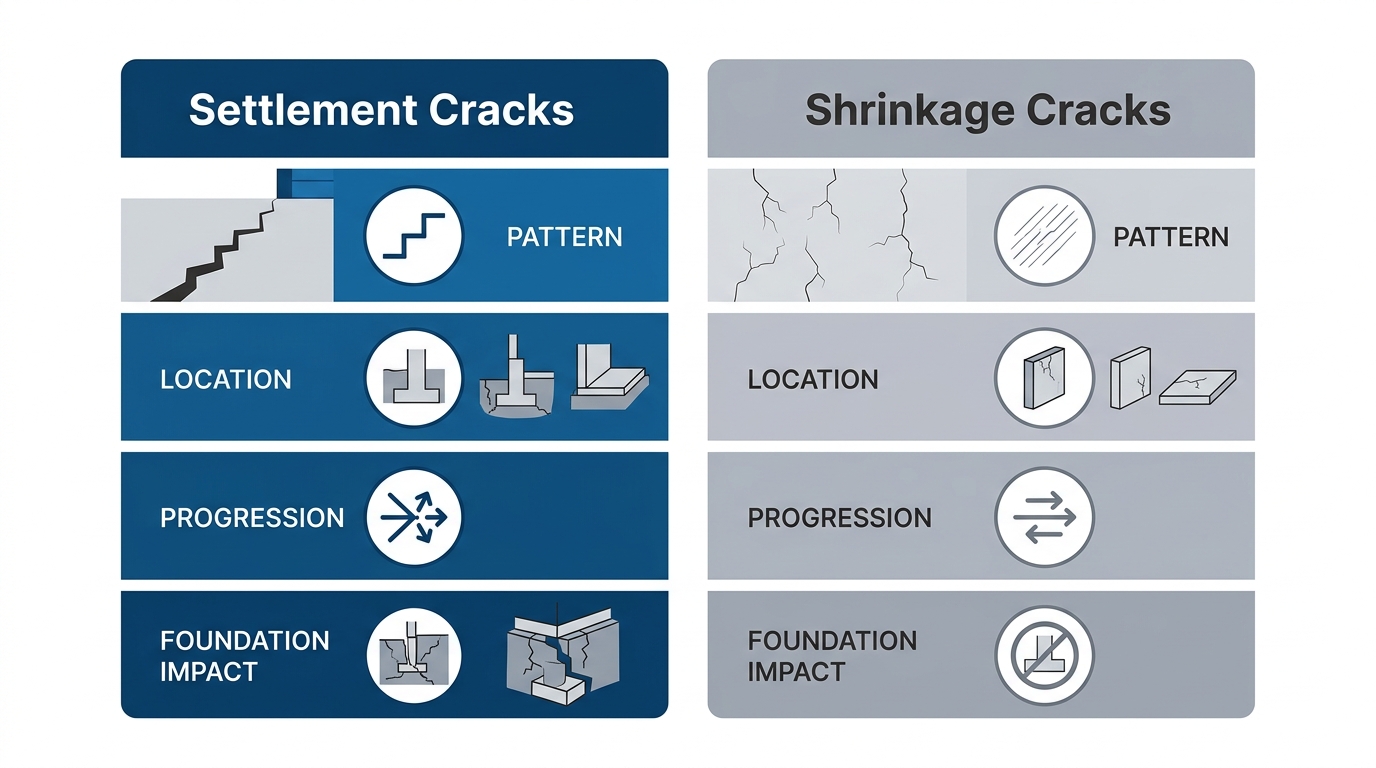
Comparison of foundation settlement and shrinkage crack patterns
While shrinkage cracks are seldom a structural concern, the same cannot be said for active stair-step brick cracks that signal pressing foundation problems.
When Stair-Step Cracks Signal Urgent Foundation Issues
- Cracks wider than 1/4 inch that continue to grow
- Active widening or new step cracks forming in adjacent areas
- Displaced or bulging bricks that shift under pressure
- Sticking doors and windows that no longer close properly
When any of these indicators are present, we strongly recommend consulting a structural engineer. Our ICC- and ISO-certified crack stitch system provides a reliable helical-based repair option for reconnecting cracked brick wythes, but proper diagnosis is essential before any repair begins. Professional installation by a trained contractor ensures that the system’s patented ReGrid technology performs as designed. Consult a structural engineer or the manufacturer’s engineering team for project-specific design and installation guidance. After identifying these urgent issues, the next logical step is to explore crack repair options including the crack stitch system.
Repairing Stair-Step Cracks in Brick Veneer
Stair-step cracks in brick are one of the most visible signs of foundation settlement. While horizontal foundation cracks often indicate lateral soil pressure, these zigzag mortar-joint cracks signal differential sinking of the foundation. In the previous section, we touched on general settlement indicators; here we focus on this warning sign and the systematic repair approach.
Professional Inspection and Crack Diagnosis
Before any repair, a professional inspection must determine whether the crack is active and if the brick veneer has displaced. We often use crack monitors or precise measurements to track movement. An experienced contractor also evaluates the entire structure for signs of foundation problems, such as sticking doors or sloping floors, to confirm that settlement — not thermal expansion or minor mortar shrinkage — is causing the stair-step cracking in brick veneer. This thorough diagnosis prevents wasted effort and ensures repairs target the root cause. They check soil conditions and footing depth, probing for voids beneath the foundation. If active movement is confirmed, only then can a proper foundation stabilization plan be developed.
Foundation Stabilization with Helical Pier Systems
When active settlement is confirmed, the foundation must be stabilized before any masonry repair. Our helical pier systems — advanced earth anchoring systems — drive steel shafts with helical plates deep into load-bearing soil, bypassing unstable layers. The installation is monitored with torque and depth readings to confirm stable bearing. Once installed, the piers transfer the structure’s weight downward, stopping foundation movement and preventing crack widening. This step is critical; crack repair on an unsettled foundation will fail. Consult a structural engineer or Helical Technology’s engineering team for project-specific design and installation guidance. Our engineers can evaluate soil reports and specify the correct pier configuration, bracket, and depth to provide a lasting foundation repair solution. Helical piers achieve immediate load transfer, eliminating the progressive settlement that created the stair-step cracks.
Crack Repair Techniques: Epoxy, Stitching, and Lock Systems
Once the foundation is stable, attention turns to the brick veneer. Three proven techniques — epoxy injection, crack stitching, and concrete crack lock kits — address different crack conditions. The sequence is critical: crack repair must follow stabilization. The table below summarizes the methods.
| Method | Best For | Limitations | Typical Application |
|---|---|---|---|
| Epoxy Injection | Non-moving, narrow cracks; structural bonding | Ineffective if foundation settlement is active | Cosmetic or minor structural repair after stabilization |
| Crack Stitching | Bridging cracks across mortar joints; redistributing stress | Does not address root cause (settlement) | Supplemental reinforcement after foundation repair |
| Helical Pier Stabilization | Active settlement causing crack progression | Requires engineering design and heavy equipment | Permanent foundation underpinning; stops foundation movement |
Each method suits specific crack types. Epoxy injection bonds narrow, dry cracks between 0.002 and 0.25 inches, restoring structural capacity, but it fails if settlement continues. Crack stitching with carbon/Kevlar grid spans mortar joints to redistribute stress and prevent re-opening, though it does not address settlement. The Concrete Crack Lock Kit locks cracks permanently with 2,900 lbs of tensile strength, making it ideal for slabs and masonry where extra reinforcement is needed. Together, these methods repair the veneer only after the foundation is stable. By combining these techniques with foundation stabilization, a comprehensive repair strategy tackles both cause and effect.
Following this three-step process — inspect, stabilize, and repair — ensures stair-step cracks are fixed at the root. Next, we’ll explore post-repair monitoring and preventive measures to maintain long-term stability.
Distinguishing Settlement from Shrinkage in Brickwork
When evaluating stair-step cracks in brick, distinguishing between settlement and shrinkage is critical. As noted in the overview, cracks in brickwork can result from various sources, but understanding the root cause—whether structural movement or material drying—determines the appropriate path forward. Settlement cracks typically indicate that a foundation is shifting under the weight of the structure, while shrinkage cracks are a natural result of materials curing and drying over time. Expansive clay soils and seasonal moisture changes commonly trigger settlement, while concrete curing and mortar drying account for most shrinkage patterns.
At-a-Glance: Settlement vs. Shrinkage
| Diagnostic Cue | Settlement Indication | Shrinkage Indication |
|---|---|---|
| Crack width variation | Wider at bottom, tapering up | Uniform width throughout |
| Associated wall displacement | Wall out-of-plumb or sagging | No wall displacement |
| Crack activity | Active under load changes (rain, dry spells) | Stable after initial drying |
According to the National Foundation Repair Association (NFRA), crack width variation is one of the most reliable visual indicators. Stair-step cracks in brick that are wider at the base and narrow as they climb often point to settlement, while uniform-width cracks suggest shrinkage. Similarly, wall displacement—such as out-of-plumb or sagging—is a strong sign of foundation settlement and may be accompanied by other signs of foundation problems like sticking doors or windows. Horizontal foundation cracks sometimes obscure this distinction; if the crack shows uniform width and no wall movement, shrinkage is more likely.
Because the consequences of misdiagnosing cracking can be severe, we strongly recommend involving a structural engineer. Helical Technology’s network of structural engineers provides specialized guidance to confirm whether settlement is the underlying issue and to develop appropriate foundation repair solutions. Consult a structural engineer or the manufacturer’s engineering team for project-specific design and installation guidance.
Common Questions About Stair-Step Cracks
What are stair-step cracks in brick? Stair-step cracks in brick are diagonal breaks following mortar joints in a stair-like pattern. They appear when a foundation settles, transferring stress to the veneer.
Are stair-step cracks a sign of foundation problems? Stair-step cracks are early signs of foundation problems. Horizontal foundation cracks indicate lateral soil pressure. Have any crack evaluated if it widens or appears with sticking doors.
Should I worry about stair-step cracks in my brick wall? Take them seriously; cracks worsen. Helical Technology recommends a structural engineer inspection. Our certified products and engineering network provide solutions. Always consult a structural engineer or the manufacturer’s engineering team for project-specific design and installation guidance. Avoid DIY.
What should I do next? Contact a local structural engineer for a stabilization plan. Helical Technology can connect you with a qualified engineer and supply certified repair products. For a custom quote, reach out to our team.
Ensuring Long-Term Stability of Brick Veneer
Stair-step cracks in brick are one of the clearest signs of foundation problems, caused by uneven settlement. Preventing stair-step cracks in brick from worsening requires stopping the underlying movement to ensure long-term stability, not just filling the cracks.
Helical piers—ICC and ISO certified foundation repair solutions—transfer structural loads to competent, stable soil. Our real-time design software lets a structural engineer determine precise pier depth and spacing for a custom stabilization plan. Proper drainage and soil moisture control prevent future movement. Always consult our engineering team or a structural engineer for project-specific design that complies with ICC-ES AC358 and local codes. Next, we’ll detail the helical pier installation process for brick veneer applications.