

Table of Contents
- Crawl Space Encapsulation Cost Breakdown for Foundation Repair Contractors
- Key Factors That Drive Crawl Space Encapsulation Costs
- Material Specifications and Certification Requirements
- Using Encapsulation to Improve Energy Efficiency and Prevent Mold
- Engineering Design Support and Custom Quotes for Large-Scale Projects
- Frequently Asked Questions About Crawl Space Encapsulation
- Next Steps for Sourcing ICC-Certified Encapsulation Products
Crawl Space Encapsulation Breakdown for Foundation Repair Contractors
Building on the moisture issues and encapsulation benefits discussed previously, understanding crawl space encapsulation cost is the next critical step for any foundation repair contractor planning a project. The total encapsulation cost depends on a combination of materials, labor, and project-specific variables, which is why we always provide a custom-quote rather than a flat price. At Helical Technology, we supply ICC- and ISO-certified products directly to your crew, helping you manage your cost breakdown with greater control.
The primary cost categories contractors should evaluate include:
- Vapor Barrier Materials: The thickness and mil rating of the barrier directly impacts material cost. Reinforced, high-mil barriers offer superior durability and longevity but represent a larger upfront investment compared to standard options.
- Sealing Accessories: WB tape, fasteners, and sealants are essential for a complete, airtight installation. These costs scale with the crawl space perimeter and the number of seams.
- Moisture Management Systems: Dehumidifiers or ventilation systems are often necessary and their capacity requirements depend on the crawl space’s baseline humidity level.
Crawl space size and complexity are the main drivers of both labor hours and material quantities. Obstructions, tight access points, and severe existing moisture all add to project time. As a result, encapsulation pricing considerations always hinge on a detailed job assessment. The national foundation repair association provides industry benchmarking that confirms these core cost components align with standard breakdowns across the country.
To help you minimize errors and on-site rework costs, we provide professional installation training and real-time design software backed by our network of structural engineers. This support ensures your cost estimation is accurate before the project begins. For an accurate budget on your specific project, we encourage you to consult our engineering team for project-specific design and installation guidance and request a custom quote to explore our full line of encapsulation products. All installations must comply with applicable building codes and ICC-ES acceptance criteria (AC358).
Key Factors That Drive Crawl Space Encapsulation Costs
Understanding the variables that influence the crawl space encapsulation cost is essential for contractors and engineers planning a project. While every structure presents unique challenges, several core factors consistently impact the final investment. We believe that a clear grasp of these elements helps you make informed decisions and select materials that balance performance with budget. At Helical Technology, our team provides engineering support to help you navigate these choices for every encapsulation project cost.
Vapor barrier thickness is a primary driver of both material expense and long-term system performance. Selecting the appropriate mil thickness depends heavily on the crawl space conditions and intended use. The following table outlines common vapor barrier options and their relative cost considerations.
| Thickness | Material Type | Typical Application | Relative Cost |
|---|---|---|---|
| 6-mil | Polyethylene | Rodent barrier or temporary sheeting | Lowest |
| 15-mil | Reinforced polyethylene (e.g., StegoCrawl Wrap) | Standard encapsulation for dry crawl spaces | Moderate |
| 20-mil | Heavy-duty reinforced (e.g., Superseal) | High-traffic or damp crawl spaces | Highest |
The 6-mil polyethylene option serves well as a basic rodent barrier but offers limited durability for full encapsulation. For standard dry crawl spaces, a 15-mil reinforced material like our stegocrawl wrap vapor barrier strikes an excellent balance between moderate cost and robust performance. When conditions demand the highest level of protection, such as in high-traffic or persistently damp environments, a 20-mil heavy-duty barrier is recommended, and this choice reflects in a higher overall cost of crawl space encapsulation.
Beyond material selection, other critical factors contribute to the total encapsulation project cost. The square footage of the crawl space and the complexity of its layout directly influence the quantity of materials and the labor hours required. Accessibility issues, such as low clearance or obstructed entry points, can also increase installation time. Finally, regional labor rates and the need for any preparatory work, like debris removal or grading, will affect the final budget.
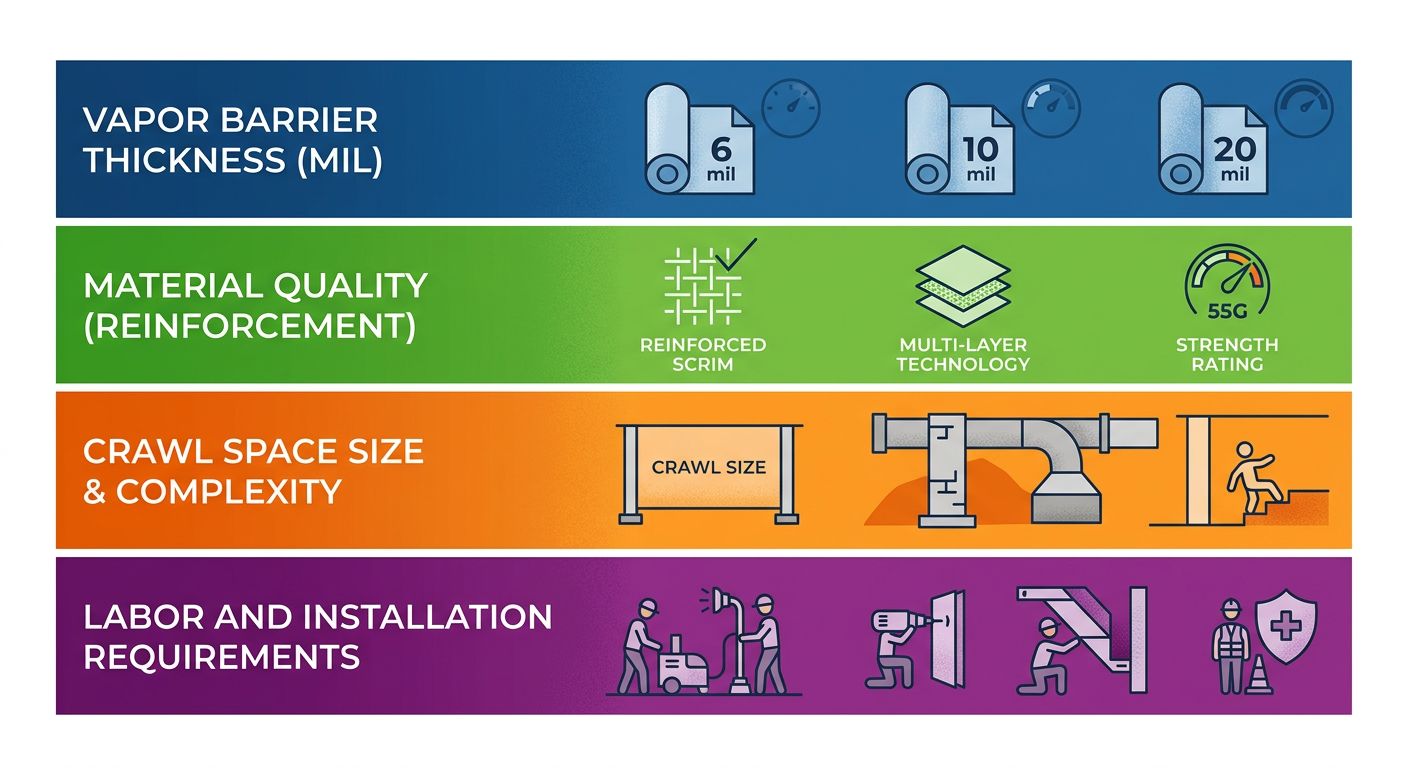
These cost drivers, from material thickness to installation logistics, highlight why a one-size-fits-all price is not feasible. We emphasize that our StegoCrawl Wrap and other encapsulation products feature ICC-ES certified compliance, giving you confidence in their quality and performance. Our network of structural engineers offers project-specific design support to ensure you select the optimal system for your needs.
For an accurate and tailored assessment of your project, we encourage you to reach out to us directly. Contact Helical Technology for a custom quote that accounts for your specific crawl space conditions and performance requirements. Consult a structural engineer or the manufacturer’s engineering team for project-specific design and installation guidance.
Material Specifications and Certification Requirements
When evaluating crawl space encapsulation cost, material specifications and certification standards are the foundation of a successful project. The thickness, reinforcement, and compliance of a vapor barrier directly determine its ability to resist moisture, endure installation stresses, and meet building code mandates. At Helical Technology, we engineer our encapsulation products to exceed these requirements, ensuring that every installation delivers lasting performance and code-compliant protection.
Vapor Barrier Thickness and ICC Compliance
ICC-ES acceptance criteria AC358 establishes the performance benchmarks for crawl space vapor barriers, including minimum thickness, tensile strength, and permeance ratings. In practice, the relationship between thickness and durability is direct: a 15-mil reinforced barrier like our StegoCrawl Wrap offers high puncture resistance and low vapor transmission, meeting the standard for residential encapsulation. For environments subject to heavier traffic or construction loads, a 20-mil product such as our Superseal provides an additional margin of toughness and long-term stability, fully complying with the same AC358 criteria while delivering enhanced tear and puncture resistance.
Thickness is only one factor; material composition and reinforcement determine real-world behavior. Our barriers utilize multi-layer polyethylene or woven polypropylene constructions that resist both immediate damage and gradual degradation. Because our products are ICC-ISO certified and come with ICC-ES documentation, specifiers and contractors can rely on verified performance data rather than nominal claims alone. By aligning product selection with AC358, we help ensure that every encapsulated crawl space remains dry, energy-efficient, and code-compliant for the life of the structure.
Comparing Certified Encapsulation Products
Our catalog includes several ICC-ISO certified vapor barriers, each purpose-built for specific project conditions. The following comparison highlights key products to help you identify the right solution for your crawl space encapsulation needs.
Helical Technology Encapsulation Product Comparison
| Product | Thickness | Material | Key Features | Best Use |
|---|---|---|---|---|
| StegoCrawl Wrap 15-mil | 15-mil | Reinforced polyethylene | High puncture resistance, low permeance | Standard residential encapsulation |
| Superseal | 20-mil | Heavy-duty reinforced | Extreme durability, UV resistant | Commercial or high-traffic areas |
| Flexi-Foil Eco Duo | Varies (multilayer) | Reflective foil laminate | Radiant barrier, energy savings | Energy-focused encapsulation |
| Woven Seal | Varies (woven) | Woven polypropylene | Tear resistant, breathable options | Custom applications |
For high-moisture or commercial applications, our Superseal vapor barrier provides 20-mil heavy-duty reinforced protection with antimicrobial additives and UV stabilization. In energy-conscious projects, Flexi-Foil Eco Duo’s multilayer reflective design blocks 97% of radiant energy while maintaining an excellent vapor barrier, effectively reducing condensation by up to 95%. Woven Seal, with its woven polypropylene build, offers outstanding tear resistance and can be tailored for unique crawl space geometries.
Beyond the primary vapor barrier, achieving a complete seal requires robust finishing products. Our Flexi-Seal is a reinforced 14-mil membrane designed specifically for sealing seams, penetrations, and wall transitions. It exceeds ASTM E-1745 requirements and works in concert with our barrier systems to create an airtight, code-compliant envelope. When installed with the recommended tapes and fasteners, Flexi-Seal ensures that every junction maintains the same low-permeance standard as the main barrier.
Ultimately, the investment in certified materials influences the long-term crawl space encapsulation cost by reducing the risk of callbacks and moisture-related damage. All of our vapor barrier products are ICC-ISO certified and include ICC-ES documentation, giving engineers and contractors the confidence that each installation meets or exceeds applicable building code requirements. Consult a structural engineer or the manufacturer’s engineering team for project-specific design and installation guidance. Products are certified to ICC/ISO where indicated — installations must comply with applicable building codes and ICC-ES acceptance criteria (AC358).
With the right material selected, attention turns to the installation process and the accessory products that complete the system—topics we explore in the next section on tapes, fasteners, and best practices for durable encapsulation.
Using Encapsulation to Improve Energy Efficiency and Prevent Mold
While the problems of a damp, drafty crawl space are clear, the dual solution of proper encapsulation delivers compelling returns. For many property owners, the initial crawl space encapsulation cost is best understood as an investment that pays for itself through ongoing energy savings and the elimination of costly mold remediation. By creating a sealed, conditioned envelope, we transform the crawl space from a liability into an asset that enhances whole-building performance. This section explores how a properly installed system provides these critical benefits.
Energy Efficiency Gains from Proper Crawl Space Sealing
A foundational benefit of a sealed crawl space investment is a dramatic improvement in home energy efficiency. In an unencapsulated space, outdoor air freely infiltrates through foundation vents and cracks, forcing your HVAC system to work constantly to offset the temperature and humidity differences. This uncontrolled air leakage, described by the Department of Energy as the stack effect, can account for a significant portion of a home’s energy loss. By sealing the crawl space envelope, we effectively stop this cycle.
Installing a robust vapor barrier on the floor and walls, and sealing it to the foundation, creates an airtight boundary that prevents conditioned air from escaping and outside air from entering. This directly reduces the heating and cooling load on the HVAC system. The following table contrasts the stark differences in performance between an encapsulated and a traditional vented crawl space.
| Factor | With Encapsulation | Without Encapsulation |
|---|---|---|
| Energy Efficiency | Reduced HVAC load, lower utility bills | Uncontrolled air leakage, higher energy costs |
| Mold Growth Risk | Significantly reduced with proper vapor barrier | High moisture levels promote mold and mildew |
| Dry Crawl Space Suitability | Maintains dry conditions, prevents future moisture | Vulnerable to condensation and groundwater seepage |
The impact on your utility bills is immediate. With the thermal boundary now located at the crawl space walls, the space and the mechanical equipment within it stay closer to the indoor temperature, reducing the strain on the system. Our network of structural engineers frequently observes that this simple change leads to consistent, noticeable reductions in monthly heating and cooling expenses, making a home’s energy profile more stable and predictable year-round. This stability is a core element of the return on your encapsulation investment.
Mold Prevention and Moisture Control with Certified Barriers
While energy savings are quantifiable for any home, the ability of a properly sealed crawl space to prevent mold is where its true protective value lies. Mold requires moisture to grow, and an open, earthen crawl space is a primary source for that moisture through both groundwater evaporation and seasonal condensation. Our line of ICC and ISO Certified products, including vapor barriers like Flexi-Seal and SuperSeal, is specifically engineered to block this intrusion, creating a physical barrier that keeps the structural wood framing dry.
According to EPA guidelines for moisture control, the first step in mold prevention is to stop water from entering the structure. Our vapor barriers achieve this across the entire floor area, but the true integrity of the seal depends on the details of the installation. This is where a product like Flexi Seal Tape becomes essential. This specialized tape is used to permanently join overlapping sheets of barrier material and to seal the barrier to foundation walls, columns, and any pipe penetrations. Without these meticulous seams, moisture-laden air would find a path into the space.
This comprehensive approach ensures a consistently dry crawl space, eliminating the damp conditions that support mold, mildew, and wood rot. The space becomes suitable for storage or housing mechanical equipment without the fear of corrosion or degradation. By achieving an airtight, moisture-free environment, the encapsulation system protects the structural integrity of the building and actively contributes to healthier indoor air quality. We always recommend consulting a structural engineer for project-specific design to ensure the entire system, from barrier selection to seam sealing, is specified correctly and installed according to building codes and ICC-ES criteria for maximum performance.
Achieving these benefits in energy efficiency and mold prevention sets the stage for a successful, long-lasting solution. The key, as we will see next, lies in a methodical installation process that pays close attention to every seam, fastener, and penetration.
Engineering Design Support and Custom Quotes for Large-Scale Projects
While our standard helical piers and foundation repair solutions serve most residential needs, large-scale commercial and multi-family projects often require dedicated engineering support and project-specific pricing. For large-scale projects, understanding crawl space encapsulation cost is a common concern—our engineering team provides custom quotes tailored to your needs. Our advanced earth anchoring systems and ICC and ISO Certified products provide the reliability that large-scale demands require.
Helical Technology provides comprehensive design support through our structural engineer network. Our engineers review project plans, determine load requirements, and specify appropriate helical pile, push pier, or underpinning configurations. With ICC-ES documentation verifying product performance, contractors gain confidence in system reliability and code compliance. We also offer real-time design software to model your project, ensuring accurate sizing and optimal material selection.
The custom-quote process begins when contractors submit project details, including soil reports and structural drawings. Our team evaluates the scope and develops a tailored proposal for helical pier systems, push piers, or related foundation repair solutions. For example, when evaluating crawl space encapsulation cost for a large development, our engineers consider vapor barrier materials, drainage design, and dehumidification as part of a comprehensive estimate. This approach—reflecting standards advocated by the National Foundation Repair Association—ensures your quote accurately captures true project demands, not generic pricing.
Consult a structural engineer or the manufacturer’s engineering team for project-specific design and installation guidance.
Products are certified to ICC/ISO where indicated — installations must comply with applicable building codes and ICC-ES acceptance criteria (AC358).
Contact us today to submit your project details and receive a free, no-obligation custom estimate. Our engineering team is ready to discuss how our advanced earth anchoring systems and certified products can effectively meet your project’s unique demands.
Frequently Asked Questions About Crawl Space Encapsulation
Understanding crawl space encapsulation cost is a common first step. Here are quick answers.
How much does crawl space encapsulation cost?
Costs vary. We quote based on crawl space size and condition. Contact us for a personalized estimate.
What factors affect encapsulation pricing?
Size, existing damage, local labor rates, and materials like vapor barriers and fasteners influence pricing. We assess each variable to deliver an accurate quote.
Is encapsulation worth the investment?
Yes. It improves energy efficiency, indoor air quality, and structural longevity. Savings often offset the initial cost over time.
Should I hire a professional or DIY?
Professional installation ensures correct sealing and code compliance. Consult a structural engineer or our engineering team for design guidance.
How can I get a custom quote?
Contact Helical Technology for a custom quote. We’ll specify the right products and connect you with an engineer if needed.
Next Steps for Sourcing ICC-Certified Encapsulation Products
When you’re ready to proceed with crawl space encapsulation, understanding crawl space encapsulation cost matters, but sourcing ICC-certified encapsulation products ensures code compliance and long-term durability. Helical Technology’s ICC and ISO Certified products meet strict ICC-ES acceptance criteria.
- Contact our product specialists to review ICC-ES documentation for your project.
- Consult our network of structural engineers for free design support.
- Request a custom quote—pricing depends on specifics.
- Ensure installation meets local codes and ICC-ES AC358.
We provide Engineering Excellence and Design Support to help you succeed. Visit our product catalog or reach out to get started.
Resources
- Get Flexi-Seal Tape for Crawl Space Encapsulation
- Use StegoCrawl Wrap 15-Mil Vapor Barrier for Moisture Protection
- Select SuperSeal Vapor Barrier for Under-Slab Applications
- Choose Flexi-Seal Vapor Barrier for Clean Encapsulation
- Get Flexi-Foil Eco Duo for Crawl Space Energy Savings
- Browse Helical Technology Vapor Barrier Products
- Select Woven-Seal Vapor Barrier for Crawl Space Protection
- Explore National Foundation Repair Association Resources