

Table of Contents
Understanding Helical Anchors
At Helical Technology, we specialize in helical anchors, also known as Helical Foundation Anchors, helical piers, or screw piles. These are steel shafts with welded helical bearing plates that are rotated into the ground to support structures, distinguishing them from driven piles that require hammering or pressing.
The anatomy includes a central shaft with a minimum diameter of 2.5 inches for piles, per International Code Council (ICC) Sec. 1810.3.3.1.9 standards. Configurations feature single or multiple helical plates with specified diameters and thicknesses. Load transfers through end-bearing on plates and friction along the shaft, with capacity correlated to installation torque, as determined by base capacity, shaft resistance, and load tests cited in ICC guidelines.
Helical pile anchors advance via torque-induced rotation, producing no spoils or vibrations, ideal for limited-access sites in areas like Littleton, CO. They minimize disturbance, allowing precise installation in confined work sites. ICC Sec. 1810.3.3.1.9 mandates minimum embedment depths, plate spacing of at least three times the diameter, and corrosion protection to ensure durability and compliance.
Compared to concrete foundations, these screw-in anchors offer faster installation and immediate load testing through torque verification. For project-specific designs, consult our network of structural engineers, as installations must comply with applicable building codes and ICC-ES criteria.
Fundamentals of Helical Anchors
Building on these principles, helical anchors offer a specialized solution for tension resistance in foundation stabilization. At Helical Technology, we distribute helical anchors as steel shafts with welded helical plates, engineered primarily for resisting uplift and lateral forces. These advanced earth anchoring systems excel in applications requiring reliable tension capacity across diverse soil conditions.
Key Components
Helical anchors consist of a lead section featuring one or more helices that provide bearing plates for soil engagement, plain extensions to achieve target depth, and terminations such as brackets for connecting to retaining walls or structures. According to Deep Foundations Institute standards, these components ensure predictable performance by correlating installation torque directly to ultimate capacity, as outlined in their guidelines for helical pile fundamentals and best practices.
We emphasize the precision of these elements in our ICC and ISO Certified products, supporting contractors with engineering excellence and design support for optimal configurations.
Installation and Applications
Installation involves torque-based screwing using hydraulic equipment, advancing the anchor into the ground until the specified torque is achieved, which verifies load capacity per DFI methods. Helical anchors suit most soils with a tension focus, ideal for retaining wall tiebacks, uplift resistance in structures like transmission towers, and light tension loads.
These systems install quickly with minimal site disturbance, making them versatile for projects in Littleton, CO, and beyond our service area.
The following table compares helical anchors with related technologies, highlighting key differences in design, applications, and installation:
Helical Anchors vs. Helical Piers vs. Screw Piles
Comparison table highlighting key differences in design, applications, and installation.
| Aspect | Helical Anchors | Helical Piers | Screw Piles |
|---|---|---|---|
| Wall stabilization, tiebacks | Foundation underpinning, new builds | Deep foundations, heavy loads | |
| Most soils, tension focus | Compression, poor soils | Cohesive soils like clay | |
| Torque-based screwing | Hydraulic torque | Direct embedment |
Data from DFI guidelines and ICC codes, Helical Technology product specs.
This comparison underscores how helical anchors prioritize shallow tension applications, distinguishing them from helical piers and screw piles. Helical piers, like the Helical Pier System, excel in compression for foundation underpinning in poor soils, often using hydraulic torque for deeper embeds in new builds. In contrast, screw piles target heavy compression loads in cohesive soils through direct embedment, while helical anchors provide efficient, torque-verified solutions for tiebacks and stabilization. These distinctions guide contractors in selecting the right foundation repair solutions based on project demands, load types, and site conditions.
Understanding these variations enhances decision-making for civil engineering projects. For instance, when tension dominates, helical anchor systems deploy rapidly without extensive excavation, aligning with industry standards from the Deep Foundations Institute for capacity determination and best practices.
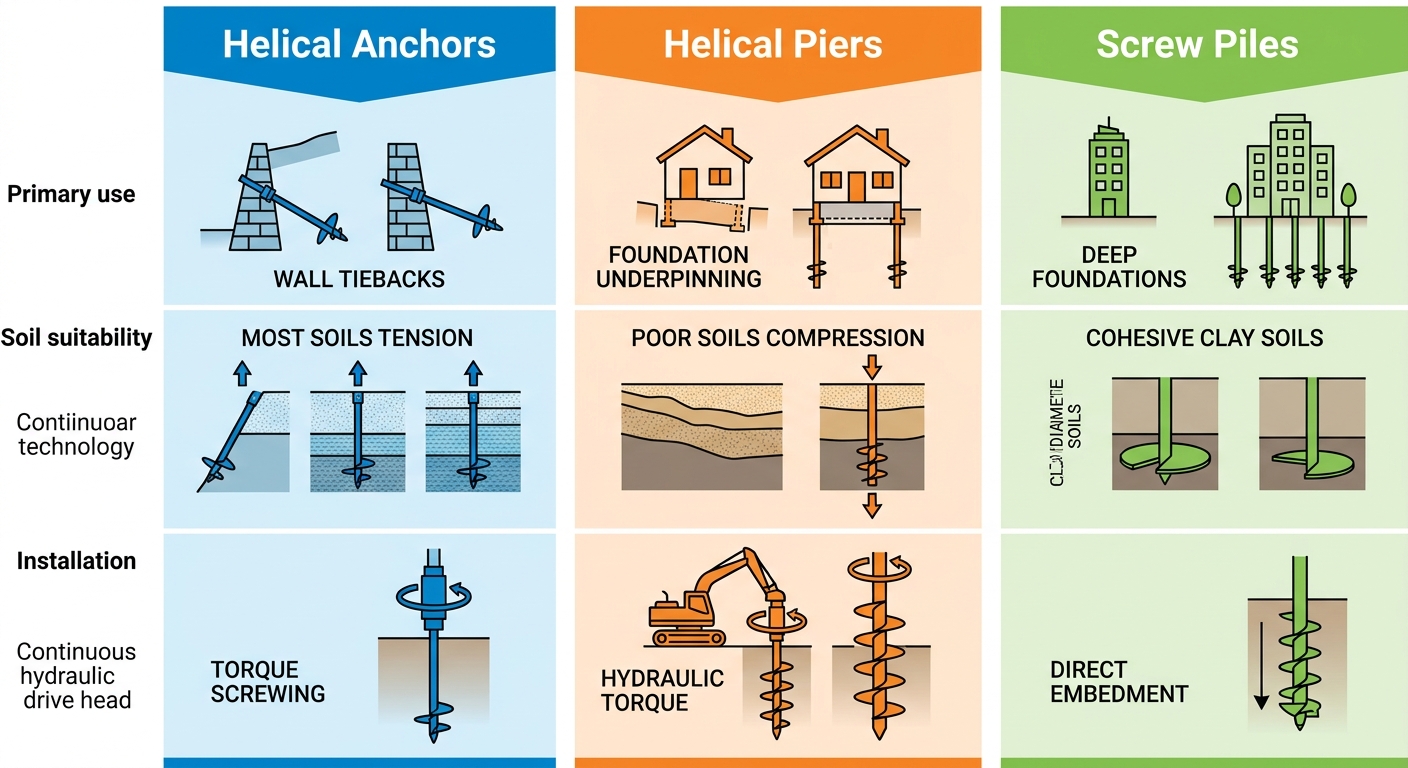
Comparison of helical anchors, piers, and screw piles
Helical piers handle compression in challenging soils, supporting our network of structural engineers in providing project-specific guidance. Always consult a structural engineer or our engineering team for site-specific design, ensuring compliance with ICC-ES criteria like AC358.
With these fundamentals established, explore specific applications and case studies ahead.
In-Depth Helical Anchors
Building on helical anchor fundamentals, we at Helical Technology provide advanced earth anchoring systems tailored for demanding civil projects. Our ICC and ISO Certified products ensure reliable performance, and helical anchors deliver versatile foundation repair solutions nationwide from our Littleton, CO headquarters.
Installation Methods for Helical Anchors
Helical anchors employ torque-based installation, ideal for civil projects requiring precise embedment. We supply hydraulic torque motors ranging from 10,000 to 50,000 ft-lbs, drive heads, and extensions, including specialized manta ray installation equipment for efficient drive tools.
- Pre-drill if obstructions or dense soils are present.
- Advance the shaft using a hydraulic torque motor while continuously monitoring torque.
- Continue until target torque is achieved, verifying minimum embedment depth per project specifications.
This method minimizes vibration and ensures immediate load transfer, aligning with industry standards for quick project timelines.
Proper installation ensures reliable load capacities, calculated through established engineering correlations.
Load Capacities and Engineering Design
Helical anchor load capacities derive from torque correlation, typically 10 ft-lbs per kip of ultimate capacity, alongside individual bearing plate analysis. International Code Council (ICC) building code standards in Section 1810.3.3.1.9 outline allowable axial design loads, factoring base capacity, shaft resistance, and load tests.
Key design elements include:
- Quick load tests per ASTM D1143 for short-term verification.
- Creep tests for long-term settlement assessment.
- Our Helical Technology software for precise modeling of helical piers and anchor configurations.
These tools, supported by our network of structural engineers, enable accurate project-specific designs. Deep Foundations Institute (DFI) testing data reinforces these protocols for optimal performance.
These capacities vary by soil conditions, where helical anchors adapt effectively.
Soil Conditions and Performance
Helical anchors excel in diverse soils, leveraging friction in granular types like sand and end-bearing in cohesive clays. In granular soils, high frictional resistance drives capacities up to 100 kips; cohesive soils emphasize plate bearing, often exceeding 120 kips.
Performance highlights:
- Poor conditions, such as expansive clays or organics, require capacity adjustments but outperform screw piles in variable profiles.
- Granular sands provide consistent uplift resistance.
- Cohesive clays suit compression loading with minimal settlement.
Helical anchoring solutions maintain stability across site challenges, as validated by industry testing.
The following table compares load capacities:
| Soil Type | Helical Anchors (kips) | Push Piers (kips) |
|---|---|---|
| 50-100 | 40-80 | |
| 60-120 | 50-90 |
Supported by ICC-ES reports and DFI testing data.
Helical anchors consistently demonstrate superior capacities over push piers in both sand and clay, per Deep Foundations Institute (DFI) industry association testing data and best practices. This edge stems from helical plates distributing loads efficiently, reducing settlement risks in civil applications. Factors like soil density and moisture influence results, underscoring the need for site-specific geotechnical analysis. Our Engineering Excellence and Design Support aids contractors in selecting optimal configurations.
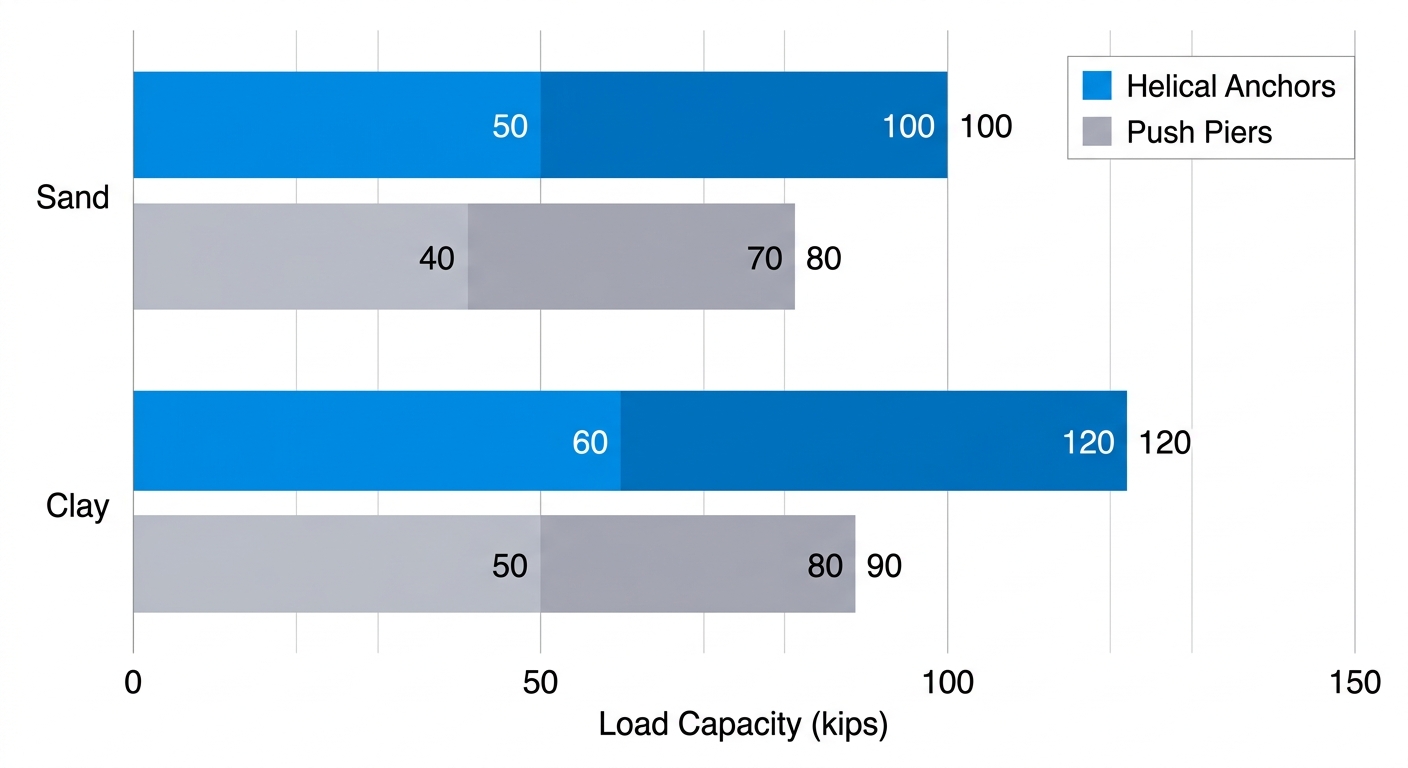
Load capacity comparison: helical anchors vs push piers by soil type
These comparisons highlight helical anchors’ versatility, paving the way for broad civil engineering uses.
Civil Engineering Applications
Leveraging soil adaptability, helical anchors excel in infrastructure demanding high reliability. Common uses include:
- Temporary and permanent retaining walls with soldier piles and helical tiebacks.
- Shoring tieback anchors for excavations.
- Bridge abutments and seismic retrofits for enhanced stability.
In Littleton, CO projects, we support contractors with plate anchors for wall stabilization and training. Consult our structural engineers or manufacturer’s team for project-specific guidance; installations must comply with ICC-ES AC358 and local codes.
Helical anchors streamline complex sites, previewing advantages in efficiency and cost savings.
Practical Helical Anchors
Cost Factors and Budgeting
Contractors evaluating helical anchors for projects must account for several key cost components to build accurate budgets. Helical anchors typically range from $200-500 per unit, depending on shaft diameter, helix configuration, and load capacity. Helical piers add $300-600 each for deeper applications requiring extended sections. Installation fees average $100-200 per unit, influenced by site access, soil conditions, and equipment needs. These figures represent authoritative industry benchmarks from the Deep Foundations Institute, which highlight helical systems’ cost efficiency over traditional methods.
The following table provides a clear cost comparison:
| Method | Cost per Unit | Installation Time |
|---|---|---|
| Helical Anchors | $200-500 | 1-2 days |
| Concrete Piles | $500-1000 | 3-5 days |
Industry averages from DFI and Helical Technology catalog.
Helical options deliver faster deployment and lower overall expenses, making them ideal for time-sensitive jobs. We at Helical Technology recommend factoring in soil testing upfront to refine estimates and avoid overruns. Budget 10-15% contingency for custom extensions or challenging terrain. Always consult our network of structural engineers for project-specific guidance to ensure compliance with ICC-ES AC358 standards.
Once costs are budgeted, sourcing reliable suppliers becomes essential for timely project starts.
Sourcing from Suppliers
We recommend procuring helical piers and helical anchors from trusted US distributors to guarantee ICC and ISO-certified quality. At Helical Technology, headquartered in Littleton, Colorado, we stock a full range of helical piers, extensions, and accessories with fast nationwide shipping. Other key suppliers include Foundation Technologies, Techno Metal Post, and GoliathTech–contact them directly via websites or call for quotes.
Seek bulk purchase discounts, often 15-25% off for orders over 50 units, as detailed in industry catalogs. Verify supplier certifications and request samples for torque testing. Our team provides engineering support and co-branded case studies to certified installers. Prioritize vendors offering on-site training to minimize installation risks. This approach ensures screw piles and related products arrive ready for seamless deployment in US projects.
With materials sourced, contractors can proceed confidently to installation.
Step-by-Step Installation Guide
Follow these eight precise steps for optimal helical anchor performance:
- Site preparation: Clear vegetation and mark locations per engineering plans.
- Pre-installation checks: Confirm soil test results for embedment depth.
- Vertical alignment: Position anchor within 2 degrees using laser levels.
- Torque installation: Use a hydraulic torque motor, monitoring to 5000 ft-lbs correlation.
Unlike driven anchors, helical anchors are torqued into place without soil displacement.
- Embedment verification: Advance to specified depth based on soil resistance.
- Load testing: Apply 2x design load to confirm capacity per DFI standards.
- Backfill and secure: Compact native soil around shafts.
- Final verification: Document torque logs and inspect for plumb.
Contractors should adhere to these steps, leveraging our training programs for certification. This method ensures durability in diverse soils. Consult a structural engineer for site-specific adjustments.
Real-world applications validate these practices through proven successes.
Case Studies and Real-World Use
Helical Technology’s installer network showcases helical anchors in action. In Texas, residential deck stabilization saved 40% in costs versus concrete, completing in under a day with minimal disruption. A California commercial solar array used screw piles for rapid foundation work, installed in one day across uneven terrain, supporting 500 kW panels resiliently.
Florida bridge repair employed helical pile anchors to withstand hurricane loads, outperforming driven systems per Deep Foundations Institute benchmarks. These examples, drawn from our co-branded studies, demonstrate versatility for residential, commercial, and infrastructure projects. We provide similar engineering excellence and design support nationwide. Results align with industry standards, confirming reliability.
Advanced Helical Anchor Solutions
Building on foundational uses, advanced helical anchor solutions excel in specialized civil engineering projects such as retaining walls and new construction. At Helical Technology, we distribute ICC-approved helical anchors that offer superior performance in demanding applications. These systems provide reliable load capacities and rapid installation, minimizing site disturbance compared to traditional methods. Engineers and contractors increasingly turn to helical anchors for their versatility in varied soil conditions.
The following table highlights key differences in advanced applications:
Advanced Applications Comparison
Helical anchors in specialized civil projects.
| Application | Helical Anchors | Screw Piles |
|---|---|---|
| Retaining Walls | Excellent for tiebacks | Good for support |
| New Construction | Suitable | Preferred for heavy loads |
Helical anchors demonstrate excellence in retaining wall tiebacks due to their high pullout resistance and quick installation, often achieving capacities exceeding those of screw piles in cohesive soils. Commercial structural anchors from our catalog serve as reliable options here, supported by Helical Technology case studies showing reduced project timelines. For new construction, helical anchors prove suitable across moderate loads, while screw piles dominate heavy-load scenarios but require more preparation time. These distinctions, drawn from real-world data, guide selection based on project timelines and soil profiles.
International Code Council standards, per Section 1810.3.3.1.9 of the ICC Building Code on soils and foundations, authorize helical pile foundations by specifying allowable axial design loads based on base capacity, shaft resistance, and installation torque or load tests. As authoritative building code standards for helical pile foundations from the International Code Council, these provisions ensure compliance and safety in commercial projects. Our ICC-ES accepted criteria further validate these advanced earth anchoring systems.
Key advantages include:
- Minimal site disturbance for urban environments
- Rapid installation accelerating timelines
- Proven scalability for commercial structural needs
These applications, validated by ICC approvals and our case studies, lead to proven installations across the U.S.
Helical Anchors FAQ
Still have questions? See our FAQ below.
What are helical anchors?
Helical anchors are screw-like foundations with helical plates welded to a central steel shaft, designed to provide load-bearing capacity directly in soil.
How do helical anchors differ from helical piers or screw piles?
Helical anchors excel in resisting tension and uplift forces, while helical piers and screw piles primarily support compressive loads for structural foundations.
What are common applications for helical anchors?
They secure guyed structures like towers, stabilize retaining walls, and power hunting and trapping earth anchor assemblies. Our ICC-certified products deliver reliable performance.
How are helical anchors installed?
Installers screw helical anchors into the ground using hydraulic torque equipment until target resistance is achieved–no concrete, excavation, or spoils required.
Why choose helical anchors?
We recommend them for rapid installation, reusability, and versatility. Consult our network of structural engineers for project-specific design and code compliance.
Explore our products or contact our Littleton, CO team today.
Future with Helical Anchors
As helical anchor technology matures, we at Helical Technology envision helical anchors revolutionizing foundation systems by 2030. AI-integrated monitoring enables predictive maintenance, bio-based composite materials boost eco-friendliness, and modular designs facilitate rapid deployment for urban retrofits using helical piers and screw piles.
These advanced earth anchoring systems expand into offshore wind energy and disaster-resilient infrastructure, delivering 50% faster installation and 30% lower emissions versus traditional methods. Early adopters partnering with our network of structural engineers will pioneer foundation innovation. The future starts now with helical anchors.
This article was researched and written with the assistance of AI tools.