

Table of Contents
Understanding Plate Anchors in Foundation Repair
Foundation walls often bow or crack under lateral soil pressure or flooding, risking structural failure. At Helical Technology, we distribute plate anchors, exterior steel plates driven through basement walls into stable soil. These wall plate anchors provide high tensile strength against inward forces, stabilizing foundations effectively.
Installation requires minimal excavation: anchors are driven through the wall to exterior plates buried in stable soil layers. Each offers load capacity up to 10,000+ lbs per anchor, resisting hydrostatic pressure from accumulated floodwater and hydrodynamic pressure from moving water or waves. According to authoritative flood mitigation guidelines from Reduce Flood Risk, such foundation wall anchors reinforce basement walls in flood-prone areas, preventing cracks, bowing, or collapse while allowing complementary sealants to curb seepage.
The following table compares plate anchors against basic wall bracing, highlighting key differences:
Plate Anchors vs. Basic Wall Bracing AspectPlate AnchorsWall Bracing
| Installation Method | Driven through wall with minimal excavation | Interior steel beams bolted to floor and beam |
| Load Capacity | High tensile strength for lateral forces | Limited to compressive support |
| Cost Efficiency | Lower long-term maintenance | Temporary aesthetic compromise |
Plate anchors excel in tensile load handling for lateral pressures, unlike bracing’s compressive focus. This makes them ideal for permanent fixes in high-risk scenarios, reducing ongoing costs and maintenance needs supported by industry data on hydrostatic resistance.
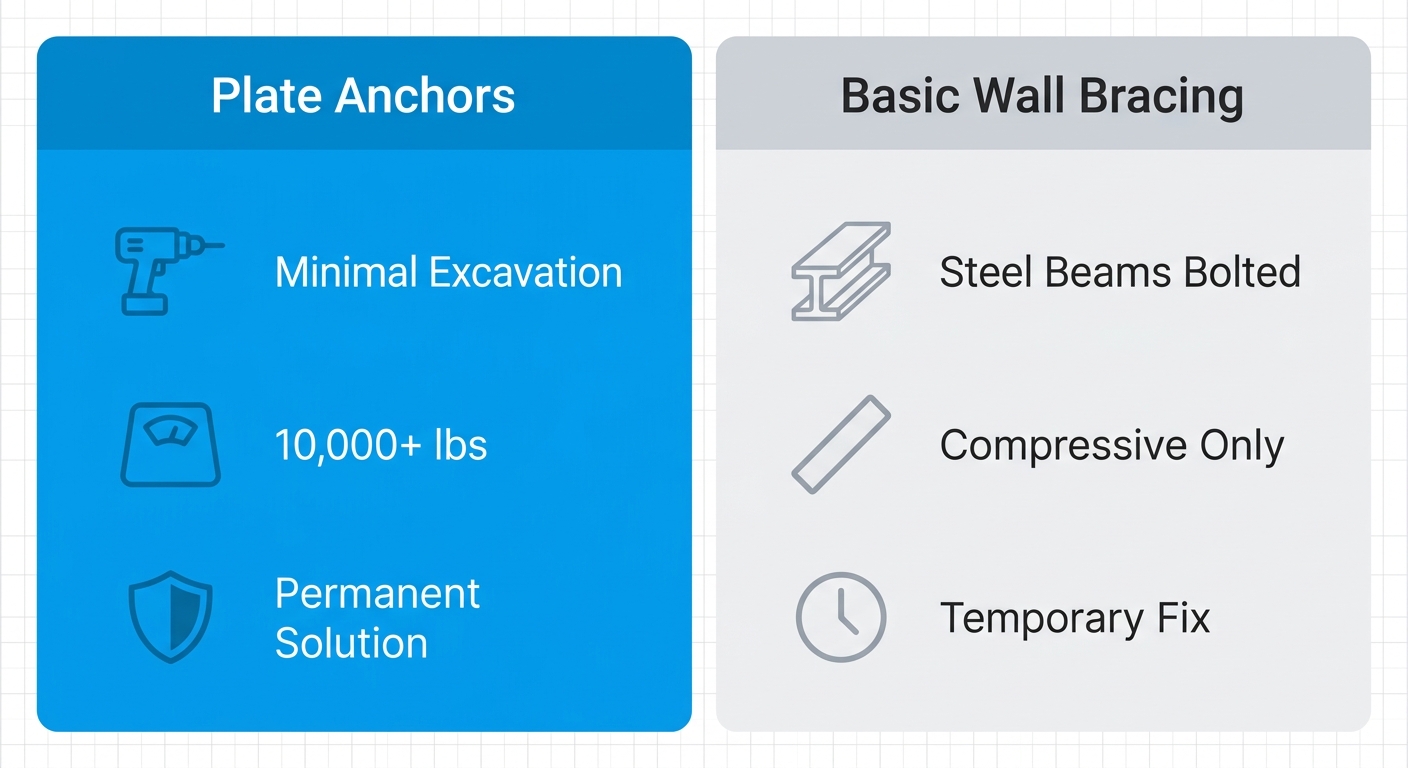
Plate Anchors vs. Basic Wall Bracing comparison for basement walls
As a distributor of ICC-certified products from our Littleton, CO headquarters, we emphasize plate anchors’ role in comprehensive foundation repair solutions. Now that we understand plate anchors, let’s explore their detailed installation process.
Fundamentals of Plate Anchors
Building on identification of bowing walls, plate anchors provide a proven fix for stabilizing foundation walls against hydrostatic pressure. These plate anchor systems consist of exterior plates connected by steel rods to interior wall plates, countering inward movement in residential and commercial structures. At Helical Technology, we distribute ICC-ES certified plate anchors designed to distribute loads evenly across the wall plate surface, preventing further cracking or failure.
The installation process reinforces basement walls effectively. Contractors excavate to expose the wall exterior, attach a galvanized or alloy plate anchor to the footing or wall, drive the steel rod through pre-drilled holes to the interior side, secure it with a wall plate anchor, and tighten nuts to compress the wall back to plumb. Key steps include:
- Site assessment by a structural engineer to confirm load requirements.
- Excavation limited to the anchor location to minimize disruption.
- Rod insertion and plate attachment using torque wrench for precise tension.
- Backfill with compacted soil for corrosion protection.
This method offers non-invasive reinforcement resistant to soil movement, as outlined in practical flood mitigation strategies for wall reinforcement by Reduce Flood Risk.
Plate anchors come in variants suited to different demands, with material choices like galvanized steel for corrosion resistance in moist soils and high-strength alloys for superior tensile strength. Standard options handle typical residential loads, while heavy-duty models support commercial applications. The following table compares common plate anchor variants for foundational understanding, with data from ICC-ES documentation in the Helical Technology catalog:
Types of Plate Anchors by Material and Load TypeMaterialTypical Load CapacityBest Use Case
| Standard | Galvanized steel | 10,000 lbs | Residential bowing walls |
| Heavy-Duty | High-strength alloy | 20,000+ lbs | Commercial retaining walls |
Standard plate anchors suffice for foundation wall anchors in residential foundations experiencing moderate hydrostatic loads from flooding. Heavy-duty versions excel where higher forces demand greater capacity, such as in retaining walls. Explore variants like Wall Plate Anchors for specific applications. These distinctions guide selection based on project scale and soil conditions.
Foundation stabilization anchors reduce flood risk by countering water pressure that causes bowing, ensuring long-term structural integrity. Consult our network of structural engineers for project-specific design, as installations must comply with building codes and ICC-ES criteria. With these fundamentals established, detailed installation follows in our helical pile technology guide.
Deep Dive into Plate Anchor Mechanics
Building on our overview of foundation repair solutions, plate anchors provide reliable wall stabilization through mechanical resistance to hydrostatic and hydrodynamic pressures. At Helical Technology, we distribute ICC-certified plate anchor systems that minimize disruption while ensuring structural integrity in residential settings.
The following table compares plate anchors against helical tiebacks, highlighting key differences in installation, cost, and performance, supported by Helical Technology product specs.
Plate Anchors vs. Helical Tiebacks FeaturePlate AnchorsHelical Tiebacks
| Excavation Needed | Yes, exterior plate | Plate driven remotely |
Plate anchors offer cost advantages and simpler exterior access for many projects, though helical tiebacks excel in confined spaces. These distinctions guide contractors in selecting the optimal system based on site conditions and budget constraints. Understanding these trade-offs enhances decision-making for foundation wall anchors.
Installation Processes for Plate Anchors
First, understanding setup begins with precise preparation. For wall plate anchors, mark locations 4-6 feet apart along the interior basement wall, aligning with bowing or pressure points. Use a core drill or masonry bit to create 1.5-inch diameter holes through the wall, ensuring clean penetration without cracking.
Next, insert a galvanized steel rod attached to an interior bearing plate. From the exterior, drive the plate 4-6 feet into stable soil using hydraulic torque equipment, employing specialized wall plate anchors. Secure the rod with nuts and washers on both sides, torquing to manufacturer specifications.
- Mark anchor locations 4-6 feet apart.
- Drill 1.5-inch holes through the interior wall.
- Insert threaded rod with interior plate.
- Drive exterior plate 4-6 feet into soil.
- Tighten nuts on both plates.
- Backfill minimally, less than 2 square feet per anchor.
- Test for load capacity.
Adaptations include core drilling for concrete walls, masonry bits for brick, and grout removal for concrete block. This process disrupts less than traditional methods, as noted in Reduce Flood Risk authoritative flood mitigation guidelines.
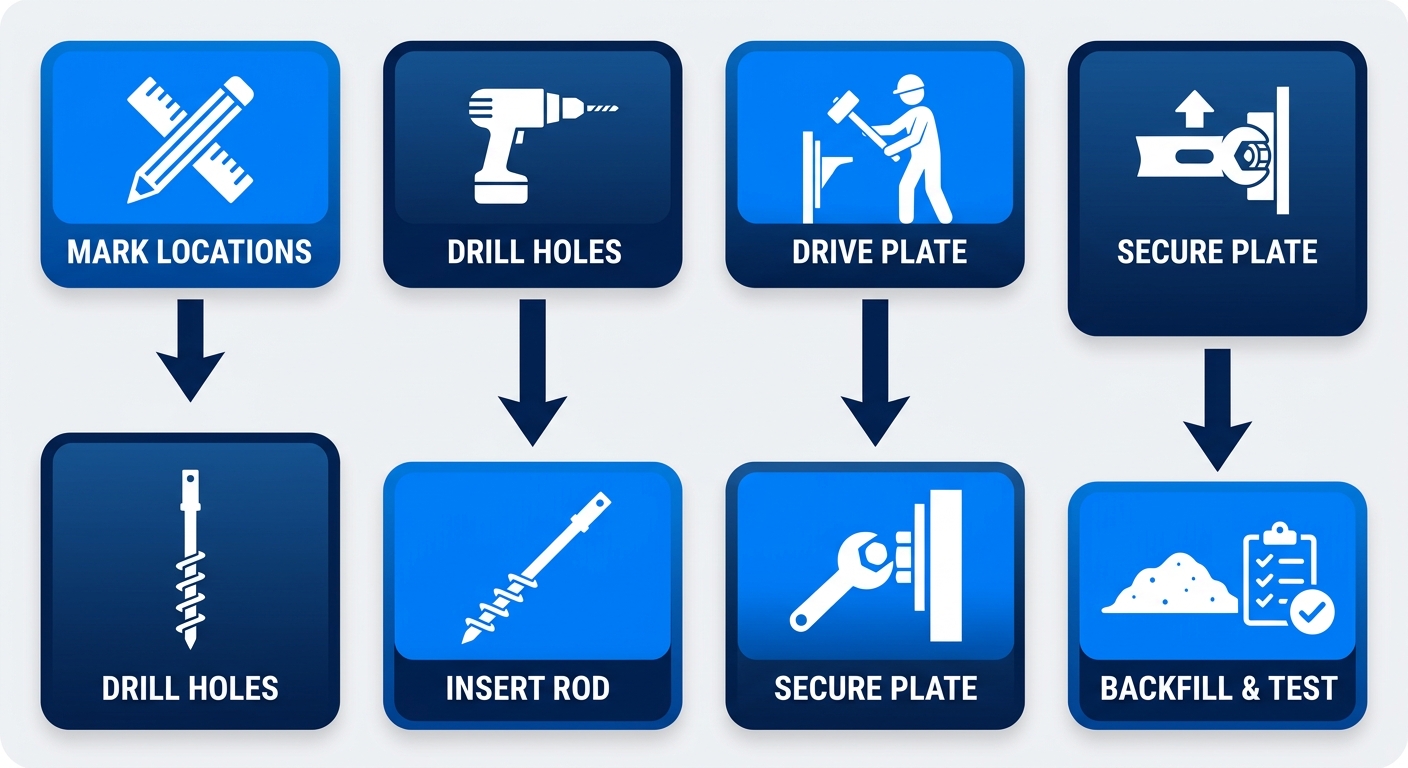
Step-by-step plate anchor installation process for wall reinforcement
These steps ensure secure installation with our advanced earth anchoring systems.
Load Distribution and Soil Interactions
Next, how forces transfer: The interior plate receives thrust from the bowing wall, transferring load axially through the threaded rod to the exterior bearing plate. This plate distributes compressive forces to a stable soil stratum 5-10 feet deep, resisting lateral movement effectively.
Plate anchor systems excel in clay and cohesive soils, where friction provides superior grip. In sandy soils, deeper embedment mitigates shifting risks, while loose fill requires prior compaction to avoid failure. Reduce Flood Risk guidelines emphasize such reinforcements prevent foundation collapse from flood pressures, though pairing with sealants addresses seepage.
We recommend consulting our network of structural engineers for site-specific soil analysis, ensuring optimal performance across conditions. This interaction underscores plate anchors’ versatility in residential foundation repair.
Cost Factors and Residential Pricing
Key variables include:
- Soil access: +20% in urban areas with limited yard space.
- Wall height: + a little extra cost per foot over 8 feet.
- Wall type: Minimal premium for concrete vs. block.
These factors yield savings versus full wall rebuilds, aligning with our ICC and ISO Certified products. Always consult a structural engineer or our engineering team for project-specific design, as installations must comply with building codes and ICC-ES criteria. While cost-effective, professional evaluation ensures long-term reliability in Littleton, CO, and beyond.
Practical Applications of Plate Anchors
Building on plate anchor installation basics, we explore their real-world uses in stabilizing foundations. These systems prove essential for resisting hydrostatic pressure and structural shifts. The following table compares their application across foundation types, highlighting key differences in installation and performance.
Plate Anchors in Different Foundation Types Foundation TypeRecommended AnchorInstall TimeEffectiveness
| Poured Concrete | Heavy-duty plate | 1-2 days | High |
| Cinder Block | Standard with brackets | 2-3 days | Moderate-High |
Data from Helical Technology catalog and ICC reports.
This comparison underscores how plate anchors adapt to various structures, ensuring optimal load distribution and longevity in diverse conditions.
Residential Basement Wall Stabilization
Homeowners frequently turn to wall plate anchors for basement reinforcement against hydrostatic pressure, as outlined in authoritative flood mitigation guidelines from Reduce Flood Risk. In one case, a Midwest family installed plate anchors along bowing concrete walls after seasonal flooding caused cracks; the system halted further movement, preserving the home’s integrity. Another example involves a coastal residence where exterior anchor plates countered hydrodynamic forces from storm surges, preventing collapse during heavy rains.
A third scenario saw a suburban homeowner address hairline fractures from soil expansion by embedding plate anchors into stable strata, restoring plumb walls without excavation. According to Reduce Flood Risk, such reinforcements stabilize foundations but pair best with sealants to block seepage. We recommend annual inspections to check bolt torque and corrosion, tightening as needed and monitoring for new cracks. Routine maintenance like this extends service life, offering peace of mind for decades. Proper upkeep involves clearing debris around plates and verifying alignment, ensuring residential basements remain secure year-round.
Commercial and Retaining Wall Uses
Scaling up from homes, commercial projects leverage foundation wall anchors for robust stability in demanding environments. For instance, a highway retaining wall in Colorado utilized plate anchor systems to resist lateral earth pressures, completing installation over two weeks across 500 linear feet. Similarly, a warehouse foundation repair in an industrial park employed heavy-duty anchors to correct settlement from expansive clays, finishing in four weeks with minimal downtime.
For demanding Retaining Wall Anchors, helical plate systems excel in large-scale stability, supporting loads up to thousands of psf. These applications typically carry warranties of 10-25 years from certified suppliers like ours, backed by ICC documentation. Timelines range from one to four weeks depending on site scale, with crews mobilizing quickly for minimal disruption. Our network of structural engineers provides design support, ensuring compliance with local codes. Scalability makes plate anchors ideal for infrastructure, from bridges to parking garages, delivering proven reliability in high-stakes settings.
Best Practices for Selection
Selecting the right plate anchors demands careful evaluation of site conditions to maximize effectiveness. Start with soil analysis:
- Clay soils: Opt for deeper embeds to counter swelling/shrinking cycles.
- Sandy soils: Focus on frictional resistance with wider plates.
Conduct geotechnical tests like borings to confirm bearing capacity.
Next, perform load assessments using benchmarks of 500-2000 psf for typical walls:
- Calculate lateral forces from soil height and surcharge.
- Factor in seismic or flood risks per local codes.
- Verify with engineering software for precise sizing.
Finally, vet suppliers via these checklists:
- ICC certification and ISO compliance.
- Local experience in your area, such as Littleton, CO projects.
- Proven warranties and technical support.
We at Helical Technology emphasize consulting our structural engineers for project-specific guidance, ensuring installations meet ICC-ES criteria. This methodical approach guarantees durable, code-compliant solutions.
Ready to stabilize your foundation? Contact our team for expert recommendations and certified products.
Advanced Plate Anchor Techniques
While basic plate anchors suffice for standard conditions, advanced techniques are essential for seismic zones and high-load applications. At Helical Technology, we supply plate anchors as part of our foundation repair solutions, including ICC- and ISO-certified products designed for superior pull-out resistance. These advanced earth anchoring systems address challenges in earthquake-prone areas, where standard designs fall short.
Engineers upsize rods by 25% and add cross-bracing to plates for seismic applications, enhancing stability in wall plate anchors. For high-load commercial installations, commercial structural anchors exemplify these adaptations. The advanced process includes: pre-drilling oversized holes, inserting the anchor, torquing to a minimum of 50 ft-lbs, and verifying with pull-testing to twice the design load. Our engineers provide tailored specifications for each unique installation site promptly. Our network of structural engineers supports these precise steps.
In seismic zones, installations require enhanced ICC-ES seismic ratings and upsized rods to meet rigorous standards. The table below compares key differences, drawing from ICC-ES reports.
Plate Anchors in Seismic vs. Standard Zones
Compare approvals and designs for high-risk areas.
Plate Anchors in Seismic vs. Standard Zones Zone TypeICC ApprovalDesign AdjustmentCost Premium
| Standard | Basic ICC-ES | Baseline | None |
| Seismic | Enhanced seismic rating | Upsized rods | 20-30% |
Supporting data: ICC-ES reports
This comparison highlights the 20-30% cost premium for seismic foundation wall anchors due to material upgrades and certifications. Standard options provide baseline performance, while seismic designs ensure compliance in high-risk zones.
Mastering these methods prepares for even more specialized applications like helical extensions. Always consult our structural engineering team or a licensed professional for project-specific guidance, ensuring installations comply with building codes and ICC-ES criteria (AC358). We deliver Engineering Excellence and Design Support from Littleton, CO.
Plate Anchors Frequently Asked Questions
Building on plate anchors’ features as advanced earth anchoring systems, here are answers to the most common questions about plate anchors.
What are plate anchors?
Plate anchors are heavy-duty galvanized steel plates bolted to basement walls and secured with steel rods extending to stable soil below.
How are plate anchors installed?
Installation involves excavating outside the wall, driving steel rods 10-15 feet into the earth, attaching plates inside with expansion anchors, then backfilling the site.
What are the benefits of wall plate anchors over other methods?
Wall plate anchors offer permanence, minimal interior disruption, and immediate load transfer to stable soil. They provide reliable foundation repair solutions with lasting stability.
Can foundation wall anchors be used in all soil types?
Foundation wall anchors suit clay and sand soils effectively. For rock or poor soils, consult a structural engineer or our engineering team for project-specific guidance.
How long do plate anchors last?
Galvanized plate anchors last 50+ years with proper maintenance. Regular inspections ensure optimal performance in demanding conditions.
Contact us for project-specific advice.
Elevating Foundations with Plate Anchors
To counteract settlement, plate anchors provide targeted elevation for sinking foundations. These heavy-duty steel plates bolt securely to foundation walls and link to helical piles underground, offering reliable stabilization.
In the elevation process, we attach wall plate anchors exteriorly, connect them via rods to helical anchors, and use hydraulic jacks to lift incrementally–up to 1-2 inches per session. This method suits poured concrete, block, or brick walls experiencing settlement or lateral movement.
Key benefits include immediate stabilization of bowing walls with foundation wall anchors, prevention of further cracking, minimal excavation, and long-term permanence without interior disruption–ideal foundation repair solutions for residential and commercial structures.
As helical pile specialists at Helical Technology, we deliver this proven, non-invasive approach. Consult our engineering team for project-specific guidance. Next, explore detailed installation steps for optimal results.
This article was researched and written with the assistance of AI tools.