

Table of Contents
Helical Piles: A Reliable Foundation Solution
Overcome foundation challenges with helical piles, our advanced earth anchoring systems at Helical Technology. These steel shafts feature helical bearing plates that rotate into the ground like a screw, delivering immediate load-bearing capacity. Also known as Ground Screw Piles, helical piers provide unmatched stability without excavation.
Key reliability features include:
- Corrosion-resistant galvanized steel construction
- Verifiable installation torque that correlates directly to capacity
- No soil spoils or site disturbance
Their modular configurations and multiple plate diameters let designers tailor capacity to site conditions, reduce design uncertainty, and enable immediate load transfer, shortening project timelines and lowering overall installation costs. This predictability is why engineers prefer helical pile systems for challenging soils.
Unlike traditional concrete foundations, helical piles install faster, disrupt less, and excel in poor soils. We supply them for diverse applications:
- Residential homes
- Commercial buildings
- Boardwalks
- Solar arrays
Screw piles ensure proven performance, backed by load tests and ICC-certified products. Engineers trust helical pile systems for reliability. Consult our network of structural engineers for project-specific guidance. Learn how simple installation ensures reliability in the next section.
Fundamentals of Helical Piles
Components and Design of Helical Piles
Helical piles, also known as helical piers, form the backbone of advanced earth anchoring systems used in foundation repair solutions. These helical pile systems feature key components that work together to provide exceptional load-bearing capacity.
Shafts serve as the primary structural elements, typically constructed from high-strength steel tubes or solid square bars measuring 1.5 to 3 inches square. They transmit torque during installation and handle axial compression or tension loads effectively. Helices consist of 8- to 16-inch diameter circular steel plates welded perpendicular to the shaft at a 45-degree pitch, displacing soil and creating bearing surfaces as they advance.
Extensions, or coupling sections, allow embedment depths exceeding 100 feet, added sequentially as needed. Multiple helices enhance capacity through cylindrical shear along the shaft or individual bearing on each plate, depending on soil conditions. We at Helical Technology supply ICC and ISO certified products engineered for reliability.
Selecting the right shaft type follows from understanding these components, ensuring optimal performance in diverse applications.
Square Shaft vs Round Shaft Helical Piles
Square shaft and round shaft helical piles differ structurally to suit specific load and soil demands. Square shafts, often 1.5 x 1.5 inches, excel in compression and tension within cohesive soils due to high buckling resistance.
Round shafts, using 2.375- to 4.5-inch OD pipe, handle lateral loads better in sandy soils and offer superior corrosion resistance. Applications vary: square helical piles suit lightweight structures like residential decks, while round versions support heavy industrial foundations.
Performance metrics highlight distinctions; square shafts manage 50-100 kips in tension, whereas round shafts reach up to 200 kips. Our network of structural engineers provides design support to match these to project needs.
These trade-offs inform selection, leading to comparisons with similar technologies like screw piles.
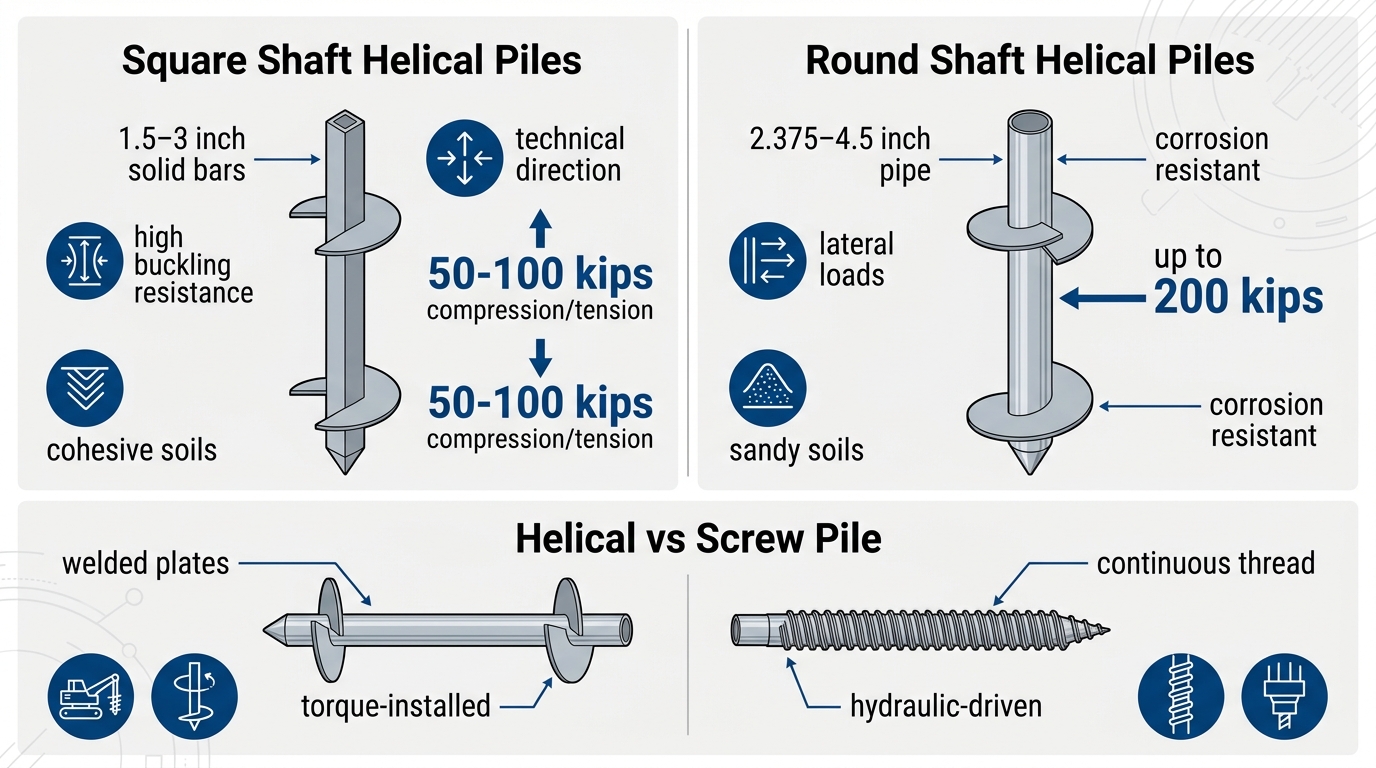
Side-by-side comparison of helical pile types and screw piles
The infographic above illustrates these differences visually, aiding contractors in quick assessments. Building on shaft comparisons, distinguishing helical piles from screw piles clarifies terminology and best uses for foundation projects.
Helical Piles vs Screw Piles
Helical piles feature welded-on uniform pitch helices screwed into the ground via monitored torque of 20,000-100,000 ft-lbs until refusal, enabling precise capacity verification.
Screw piles, by contrast, employ continuous threaded shafts cast during manufacturing and driven hydraulically without torque monitoring. Installation differs markedly: helical piles allow removal and reuse in variable soils, while screw piles suit stable, uniform conditions and large diameters in new construction.
We recommend helical piles for remediation and sensitive sites due to their versatility, reserving screw piles for predictable greenfield projects. Always consult our engineering team or a structural engineer for project-specific guidance, ensuring compliance with ICC-ES AC358 and local codes.
This distinction underscores helical piles’ advantages in engineering excellence and design support.
Key Benefits of Helical Piles
Advantages Over Traditional Concrete Foundations
Helical piles surpass traditional concrete foundations with superior speed, cost efficiency, minimal disruption, and environmental advantages.
Installation completes in 1-2 days, compared to 2-4 weeks for concrete that requires curing. This rapid timeline suits time-sensitive projects. We supply ICC-certified helical piers that twist into the ground without heavy machinery.
Teams achieve 40-60% cost savings through reduced labor and no wait times. These piles eliminate excavation needs, lowering material expenses. Minimal site disruption occurs via vibration-free installation with a small footprint.
Environmentally, helical piles use 50-70% less concrete, cutting emissions from wet trades. They promote sustainable construction practices.
Project managers value predictable scheduling, as crews can plan sequential trades without weather-dependent curing delays, reducing project coordination time and lowering indirect costs. These reliable timelines shorten mobilization windows and reduce on-site traffic, improving safety overall.
In addition to speed and savings, helical piles deliver exceptional load capacity and durability.
Load Capacity and Durability
Helical piles provide robust load capacities and long-term performance across challenging conditions.
Each pile supports 20-100+ tons based on size and design. Immediate load-bearing follows installation, skipping settling periods. Galvanized steel construction resists corrosion effectively.
These systems thrive in expansive clays, seismic zones, and flood-prone areas. A 50-100+ year lifespan ensures reliability. Our advanced earth anchoring systems meet rigorous demands.
Engineers verify torque correlations for precise capacity ratings. This approach guarantees stability without extensive testing.
Engineers confirm torque-to-capacity relationships during installation, enabling precise capacity verification without extensive destructive testing. Galvanized steel alloys and protective coatings limit corrosion, while modular designs allow targeted maintenance and component replacement if required, extending service life.
Beyond strength, helical piles offer versatility for repairs and new builds.
Versatility for Foundation Repair and New Builds
Helical piles adapt seamlessly to foundation repairs and new construction in diverse applications.
Retrofit settling homes using push camera verification for targeted underpinning. Screw piles stabilize residential structures efficiently.
New builds on poor soils support commercial warehouses and solar farms. Install boardwalks, decks, and tower foundations year-round in any weather.
We provide engineering excellence and design support for residential and commercial projects. Our network of structural engineers tailors solutions.
Retrofit projects benefit from non-invasive installation, where push camera verification preserves landscaping. Helical systems support rapid mobilization, enabling year-round work and reduced weather delays, while contractors scale installations across residential, commercial, and utility applications, efficiently.
Consult our team for project-specific guidance to comply with building codes.
These benefits position helical piles as ideal foundation repair solutions.
Installation Mechanics of Helical Piles
Building on design principles, installation mechanics ensure reliable performance of helical piles. At Helical Technology, we equip our network of certified installers with precise procedures to achieve optimal embedment and capacity. These methods prioritize torque monitoring, soil adaptation, and safety protocols.
Step-by-Step Installation Process
The installation begins with a thorough pre-installation site evaluation to identify obstructions and ensure safe access. PPE is required throughout, including helmets, gloves, and eye protection during torquing operations.
Follow these numbered steps for precise execution:
- Achieve precise vertical alignment using laser levels before initial penetration.
- Drive the lead section with a hydraulic drive head applying 500-2000 ft-lbs torque.
- Advance continuously via clockwise rotation at 1-2 ft/min, logging peak torque every 1 ft per helix passage.
- Monitor torque protocol: record peaks, apply site-specific K_t factor (typically 10-20 ft-lbs per kip) to estimate capacity, and stop at target torque or refusal (torque increase >20% per foot).
- Conduct load testing: perform torque correlation on the first pile, followed by static load test to 200% design load using a reaction frame, or dynamic monitoring via PDA.
This structured approach verifies immediate performance before proceeding.
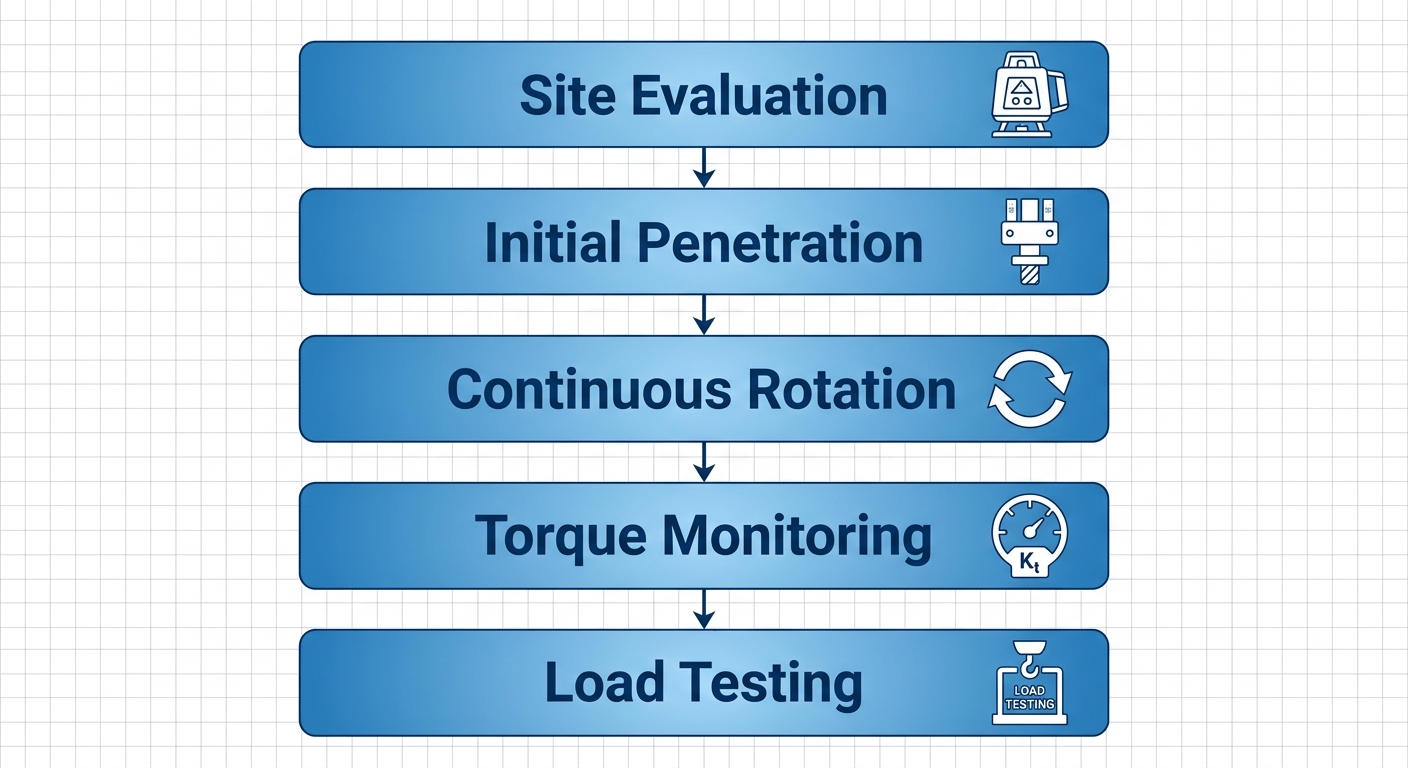
Helical pile installation steps visualization
Visualizing these stages reinforces the importance of methodical advancement, as depicted above, enabling installers to anticipate challenges in real-time operations.
Handling Tight Spaces and Varied Soils
Helical piers excel in confined areas through specialized equipment adaptations. We train contractors on portable 10,000 ft-lb torque motors and sectional extensions (3-7 ft lengths) that hand-couple for access widths under 10 ft, often using excavator-mounted heads.
Adapt to soil conditions as follows:
- Select 8-14 inch lead helix for loose sands or clays.
- Add 3-12 inch follower helices in stiff clays or gravels.
- Pre-auger through cobbles exceeding 3 inches to prevent binding.
These techniques, including controlled crowd force and helix pitch adjustments, maintain advancement rates while minimizing skin friction in screw piles installed in cohesive soils.
Mastering these ensures consistent results across diverse project sites.
Depth and Load Capacity Considerations
Embedment depth and load capacity hinge on torque-rated metrics as the primary indicator. We emphasize T/K_t for capacity estimation, verified with a 2.5x factor of safety.
Key factors include:
- Minimum embedment of 5x helix diameter or 15 ft, whichever governs.
- 20% depth increase in seismic zones per IBC Table 1806.2.
- Soil layering effects on torque transfer, requiring geotechnical input.
Ultimate capacities derive from helix geometry and installation torque, with our ICC and ISO Certified products supporting code-compliant designs. Consult a structural engineer or our engineering team for project-specific guidance, as installations must comply with applicable building codes and ICC-ES AC358 criteria.
These mechanics enable versatile applications explored next.
Best Practices for Helical Pile Deployment
At Helical Technology, headquartered in Littleton, Colorado, we prioritize best practices for helical piles deployment to enhance safety, efficiency, and compliance in foundation projects nationwide. Our ICC- and ISO-certified products, combined with rigorous training, empower contractors to deliver reliable results on challenging soils.
Certification and Training Requirements
Enroll in our comprehensive Helical Technology certification program to master helical piers installation. This ensures adherence to ASTM standards and building codes essential for US projects.
Follow these steps:
- Register for online or in-person training modules covering soil mechanics, torque monitoring, and load testing.
- Complete 40 hours of coursework on precise installation techniques, including shaft alignment and extension splicing.
- Pass a proctored exam with at least an 80% score, demonstrating proficiency in safety protocols and equipment handling.
- Submit a project portfolio showcasing at least three verified installations for final approval by our engineering team.
Upon certification, access our network of structural engineers for ongoing support. Next step: Contact us today to schedule your training and elevate your expertise in helical piers.
Beyond training, securing quality materials demands strategic sourcing to maintain project budgets and timelines.
Sourcing Products and Cost Management
Source helical piles from verified US suppliers like Helical Technology, GoliathTech, and Techno Metal Post, all offering ICC-ES compliant products for foundation repair solutions.
Key strategies include:
- Leverage bulk discounts: Secure 10% off for orders of 50+ units through volume commitments.
- Negotiate effectively: Request quotes with project specs, emphasize long-term partnerships, and bundle with accessories like plate anchors.
- For large projects, consider options to Purchase Bulk Screw Piles directly from manufacturers for optimal pricing and rapid delivery.
These approaches minimize costs while ensuring advanced earth anchoring systems quality. Next step: Reach out to our Littleton team for supplier recommendations tailored to your needs.
With products in hand, consider these key applications to maximize helical pile versatility.
Applications Across Projects
Deploy screw piles across diverse scenarios, integrating with our waterproofing solutions for comprehensive results.
Optimal uses:
- Foundation repair: Underpin sinking slabs with 20-ton capacity per pile, stabilizing structures efficiently.
- New construction: Reach 50-foot depths in poor soils, supporting commercial builds with engineering excellence.
- Residential projects: Install 10-15 piles for decking or additions, ensuring load distribution on expansive clays.
- Waterproofing integration: Encapsulate shafts with vapor barriers and sump pumps, preventing moisture ingress.
Always consult a structural engineer or our team for project-specific design, complying with ICC-ES AC358 criteria. Next step: Pair your certification with these applications–start your next project with Helical Technology support for lasting performance.
Advancing Your Projects with Helical Piles
Helical piles revolutionize construction by providing immediate load-bearing capacity without excavation. These advanced earth anchoring systems advance project timelines up to 50% faster than driven piles. At Helical Technology, we supply ICC and ISO certified products that leverage torque-correlated installation for superior results.
Helical piles offer unmatched advantages over traditional methods. Consider these key benefits:
- Versatility in poor soil conditions: Torque-correlated installation ensures reliable performance where conventional piles fail.
- Minimal site disturbance: No spoils removal cuts environmental impact and cleanup time.
- Long-term durability: Galvanized steel resists corrosion for over 50 years.
Plus, they reduce labor costs by 30-40%. In foundation retrofits, helical piers stabilize structures swiftly. For new builds in expansive soils, screw piles excel, minimizing disruption.
Position your projects for resilience with helical pile systems. See proven successes in case studies below. Contact our team at helicaltechnology.com for engineering support and consultations. Our engineering team can provide on-site evaluations, detailed load calculations, and documented installation specifications to ensure code compliance and optimal performance across residential, commercial, and civil infrastructure projects nationwide when needed. Consult structural engineers for site-specific guidance.
This article was researched and written with the assistance of AI tools.