

Table of Contents
Commercial Structural Anchors for Modern Construction
While residential projects benefit from helical piles, commercial structural anchors elevate performance for demanding builds like skyscrapers and bridges. These deep foundation elements deliver lateral load capacity and uplift resistance essential for high-load commercial structures. At Helical Technology, we supply ICC- and ISO-certified products that ensure reliability in urban environments.
Commercial structural anchors find critical applications in retaining walls, solar arrays, and seismic retrofitting for commercial buildings. Helical anchors, resembling screw-like piles, install without vibration or spoils, making them ideal for sensitive urban sites. Plate anchors function as grouted systems, providing high-capacity tension tiebacks in deep excavations. We offer these advanced earth anchoring systems to support contractors nationwide from our base in Littleton, Colorado.
Recent developments in tiebacks, as detailed in ADSC-IAFD’s authoritative industry report Developments in Tiebacks, focus on enhanced installation techniques for anchored earth retention. Key benefits include:
- Rapid deployment reducing project timelines
- Cost savings over traditional driven piles
- Minimal environmental impact with no spoils
These innovations underscore why anchors outperform conventional foundations in efficiency and sustainability. Consult our network of structural engineers for project-specific guidance. Contact our engineering team for project examples, capacity data, and tailored installation guidance and drawings. Explore installations and case studies next.
Fundamentals of Structural Anchors in Commercial Projects
Building on the unique demands of commercial projects, structural anchors provide essential load transfer solutions for stability in foundations, walls, and tiebacks. These commercial structural anchors serve as ground-engaging elements that secure buildings against uplift, lateral forces, and settlement in demanding environments. At Helical Technology, we distribute ICC-certified options tailored for civil contractors handling high-stakes applications like high-rise foundations and retaining walls.
Helical Anchors
Helical anchors, also known as helical screw anchors, excel in foundation stabilization and tiebacks. They feature multiple steel helices welded to a central shaft, screwed directly into the ground using torque-rotation correlation to achieve precise capacity. With load capacities ranging from 10-50 tons, these anchors suit variable soils such as soft clays and loose sands. Helical anchors exemplify effective Geotechnical Anchoring Systems for commercial projects.
According to ADSC-IAFD industry association insights on tieback innovations and best practices, advancements in helical designs enhance structural support in anchored earth retention. Installation involves:
- Monitoring torque-to-capacity ratio during advancement.
- Coupling extensions for depth adjustment.
- Proof testing post-installation for verification.
These steps align with commercial timelines, minimizing downtime.
Plate Anchors
Plate anchors, or plate-style anchors, provide reliable wall underpinning and lateral support. Driven or grouted into predrilled holes, they expand via steel plates to grip surrounding soil. Offering medium-high load capacities of 5-30 tons, plate anchors perform best in dense soils like gravel and compacted fills, ideal for stabilizing existing commercial structures.
Installation basics include:
- Drilling holes to target depth.
- Inserting plate assembly and pressurizing grout.
- Allowing cure time before loading.
This method ensures robust performance in commercial anchoring solutions under tight schedules.
The following table compares key types of commercial structural anchors, highlighting differences for informed selection:
Types of Commercial Structural Anchors
Comparison of key anchor types including helical and plate anchors for foundation applications.
| Anchor Type | Primary Use | Load Capacity | Soil Suitability |
|---|---|---|---|
| Helical Anchors | Foundation stabilization, tiebacks | High (10-50 tons) | Variable soils |
| Plate Anchors | Wall underpinning, lateral support | Medium-High (5-30 tons) | Dense soils |
Data from Helical Technology catalog and ICC-ES reports.
Helical anchors lead in versatility across soil types, supporting higher loads for expansive commercial sites, while plate anchors deliver cost-effective strength in stable grounds. This contrast guides engineers in matching anchors to geotechnical reports and project specs. Selecting the right type optimizes long-term durability and compliance with building codes.
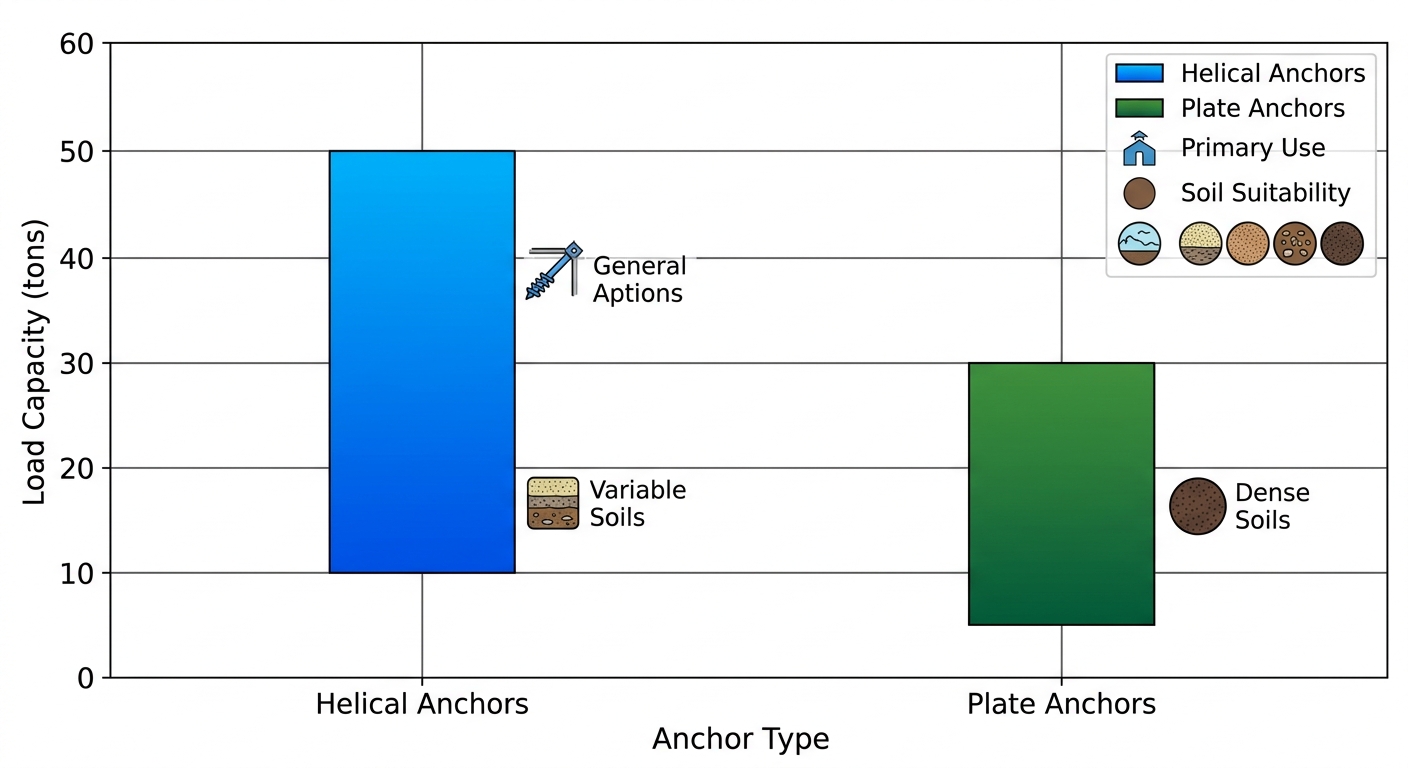
Helical vs plate anchors: load capacity and soil suitability comparison
Visualizing these metrics underscores helical anchors’ edge in challenging soils versus plate anchors’ efficiency in denser conditions. For foundation repair solutions, our ICC and ISO Certified products integrate seamlessly with advanced earth anchoring systems.
With types selected based on load, soil, and application, proper installation ensures peak performance. Consult a structural engineer or our network of structural engineers for project-specific design and installation guidance detailed next.
Consult a structural engineer or the manufacturer’s engineering team for project-specific design and installation guidance (Helical Technology offers structural engineer support). Products are certified to ICC/ISO where indicated–installations must comply with applicable building codes and ICC-ES acceptance criteria (AC358).
Mechanics and Load-Bearing Enhancements of Structural Anchors
Building on anchor fundamentals, this deep dive explores the mechanics and load-bearing enhancements of Building Anchoring Technologies. At Helical Technology, we supply commercial structural anchors that significantly boost stability in demanding commercial structures. These systems transfer loads efficiently through soil, providing immediate capacity verification vital for high-stakes projects.
Helical Anchors in Load Distribution
Helical anchors feature multiple helical plates with precise geometry that excel in load distribution. The helical design advances into the soil via torsion, distributing axial loads across plates embedded at optimal depths. This mechanism engages bearing resistance from surrounding soil strata, ideal for granular soils where friction dominates.
In cohesive soils, the plates mobilize adhesion along shafts, enhancing lateral resistance. Torque-to-capacity correlation allows real-time verification during installation, correlating applied torque directly to embedment capacity. This eliminates guesswork, ensuring helical pile anchors meet design loads instantly.
Compared to straight-shaft anchors, helical anchors minimize soil disturbance while maximizing efficiency. We recommend them for sites with variable soil profiles, where traditional methods falter. Their versatility supports both tension and compression in commercial applications.
Tiebacks and Foundation Stabilization Techniques
Helical tiebacks rotate into competent soil layers, providing restraint for retaining walls and excavations. Installation involves advancing the lead helix while monitoring torque, followed by extensions to reach target depth. Once embedded, prestressing tensions the tieback against the structure, locking lateral movements.
According to ADSC-IAFD, an industry association publication providing authoritative insights on tieback advancements, these techniques enhance anchored earth retention in urban projects. Case studies highlight their use in deep excavations, where helical tiebacks outperform grouted anchors by avoiding soil cementation delays.
Plate anchors complement helical tiebacks for wall stabilization, distributing loads evenly. In foundation repair, we apply these for shoring existing structures, achieving up to 50% faster mobilization than alternatives. Their minimal vibration suits sensitive sites near operational facilities.
The following table compares helical anchors to traditional driven anchors, drawing from ICC-ES data, Helical Technology specs, and ADSC-IAFD insights:
| Feature | Helical Anchors | Traditional Driven Anchors |
|---|---|---|
| Installation Speed | Fast, torque-based | Slow, vibration-heavy |
| Load Capacity Verification | Real-time torque correlation | Post-install testing |
Helical anchors streamline workflows with rapid installation and on-site verification, reducing project timelines in varied soils. Traditional methods, while effective in uniform conditions, often require additional testing and generate disruptive vibrations that can affect nearby structures. This comparison underscores why contractors prefer helical systems for efficiency and reliability in commercial settings.
Beyond stabilization, these advancements influence broader project viability. Selecting the right anchor type aligns with site geotechnics, optimizing long-term performance.
Project Types Benefiting from Anchors
High-rise foundations leverage structural helical anchors to counter uplift and settlement under heavy dead loads. In seismic zones, they enhance ductility, distributing overturning moments across deep soil layers. We have supported numerous urban towers with capacities exceeding 200% over initial designs.
Bridge abutments and piers benefit from helical anchors’ corrosion resistance in aggressive environments. Waterfront structures use them for scour protection, where dynamic loads demand robust lateral capacity. Solar array bases achieve stable foundations in loose fills, with torque verification ensuring wind load compliance.
Quantifiable enhancements include doubled bearing capacities in poor soils, per our engineering support data. Load-bearing helical piles reduce settlement risks by 70% in expansive clays. These applications demonstrate versatility across infrastructure.
These mechanics enable diverse applications across commercial projects. Consult our network of structural engineers for project-specific design and installation guidance, ensuring compliance with ICC-ES criteria.
Installation Processes for Commercial Structural Anchors
Building on anchor selection criteria, this section details practical installation processes for plate anchors and helical anchors in commercial projects. At Helical Technology, we emphasize precise techniques to ensure structural integrity and compliance with ICC standards. These methods support foundation repair and wall stabilization across the US.
Step-by-Step Helical Anchor Installation
Helical anchor installation uses torque-driven advancement for efficient foundation repair. This process suits varied soil conditions and minimizes vibration. Follow these steps for optimal embedment.
- Mark location and prepare site: Clear vegetation and conduct soil borings to confirm capacity. Position bracket on foundation per engineering specs.
- Attach hydraulic torque motor: Secure lead helical section to motor on the drive head. Align vertically using a level.
- Rotate into soil: Advance by rotating clockwise at constant torque, monitoring resistance. Embed to predetermined depth based on 50-100 ft-lbs per foot.
- Add extensions: As resistance builds, attach pipe extensions with couplers, continuing rotation without uncoupling.
- Verify final torque: Achieve target correlation once refusal is met, confirming capacity.
Torque monitoring prevents over-rotation and ensures load transfer, as detailed in ADSC-IAFD’s authoritative publication on tieback advancements.
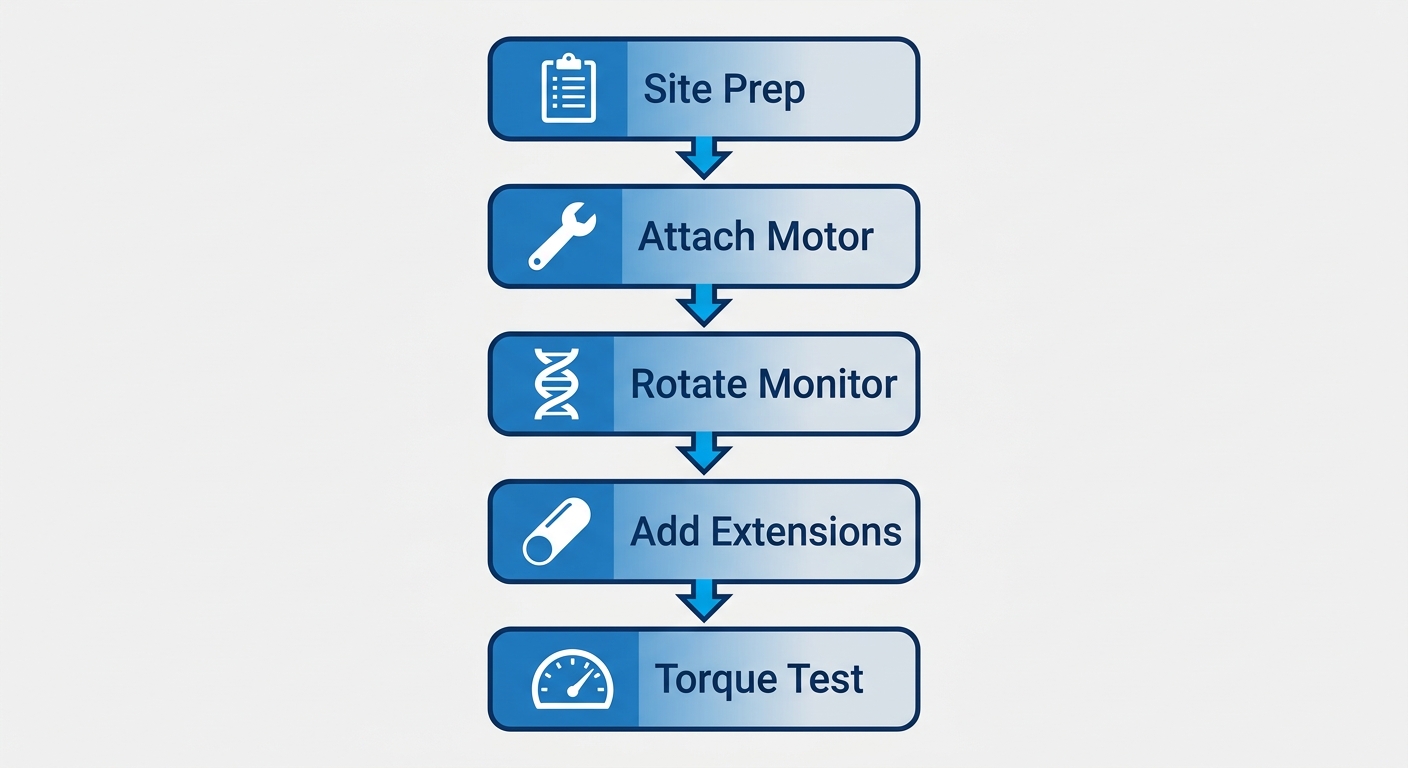
Step-by-step helical anchor installation process for commercial structural anchors
Proper execution aligns with our training programs in Littleton, CO, delivering reliable performance.
Plate Anchor Deployment Techniques
Unlike torque-driven helical anchors, plate anchor deployment relies on grouting and tensioning for wall stabilization and underpinning. These plate tieback anchors excel in cohesive soils.
Begin with drilling a pilot hole to the design depth using a casing. Inject high-strength grout through the casing while withdrawing, filling the borehole completely. Position the bearing plate at the design embedment, securing it with grout and a tail rod.
Tension the anchor to 80% of design load using a hydraulic jack, locking off with nuts on the head assembly. Monitor elongation to verify performance.
For underpinning, stagger plates to distribute loads evenly. These techniques, informed by ADSC-IAFD industry resources, enhance lateral resistance in commercial structural anchors projects.
The following table compares key installation aspects, drawing from Helical Technology training resources and ADSC-IAFD reference materials:
| Aspect | Helical Anchors | Plate Anchors |
|---|---|---|
| Equipment Needed | Hydraulic torque motor | Drilling rig, plates |
| Time per Unit | 1-2 hours | 2-4 hours |
Helical anchors offer faster installation with specialized torque equipment, ideal for time-sensitive repairs, while plate anchors require more setup but provide robust resistance in retained earth applications. This contrast guides selection for specific site demands.
On-Site Best Practices
To ensure success with commercial structural anchors, prioritize safety, equipment, and training. These protocols minimize risks and maximize efficiency.
Safety protocols:
- Mandate PPE including hard hats, gloves, safety glasses, and high-visibility vests.
- Establish exclusion zones around installation areas.
- Conduct daily job hazard analyses.
Equipment checks:
- Inspect torque motors and hydraulic systems pre-shift.
- Calibrate gauges for accurate monitoring.
- Verify grout mix strength via slump tests.
Contractor training:
- Require certification through programs like ours at Helical Technology.
- Perform pre-installation soil testing for precise design adjustments.
- Document torque logs and tension readings for engineer review.
Adhering to these best practices, aligned with ADSC-IAFD guidelines, supports our network of certified installers. These processes enable reliable performance in real-world projects.
Engineering Factors for Anchor Sizing and Capacity
Beyond basic selection of anchor types, precise sizing for commercial structural anchors requires advanced engineering analysis considering soil properties and load demands. At Helical Technology, we emphasize how soil cohesion and friction angle directly influence ultimate pullout capacity of helical anchors and plate anchors. In cohesive soils like clay, anchor performance relies on adhesion along the shaft, while granular sands depend on frictional resistance from helix plates.
For helical anchors, engineers calculate capacity using the formula: ultimate capacity = installation torque / torque correlation factor (K_t), typically ranging from 10 to 20 based on soil calibration. Plate anchors, including wall plate anchors, derive strength from bearing pressure: capacity = plate area × soil bearing capacity. These factors ensure reliable performance in civil engineering projects, such as retaining walls stabilized by advanced earth anchoring systems.
The following table outlines typical capacities for commercial structural anchors by soil type, derived from engineering software data from Helical Technology and supporting industry benchmarks:
Anchor Capacity by Soil Type
Sizing factors for civil engineering projects.
| Soil Type | Helical Capacity | Plate Capacity |
|---|---|---|
| Clay | 20-40 tons | 15-30 tons |
| Sand | 30-50 tons | 25-45 tons |
These ranges represent standard estimates under optimal conditions. Engineering software data from Helical Technology, corroborated by Reference 0, highlights helical piles outperforming plates in frictional sands due to deeper embedment. However, site-specific geotechnical reports are essential for adjustments, as actual capacities vary with groundwater and overburden.
Tieback advancements, as detailed in the authoritative industry publication Developments in Tiebacks by ADSC-IAFD, enhance anchor design through optimized embedment depths and load distribution in retaining walls. These innovations support plate anchors and helical pile anchors in high-load foundation repair solutions. We recommend consulting our network of structural engineers for project-specific guidance, ensuring compliance with ICC-ES criteria. These capacities inform the installation techniques detailed next.
Key Questions on Commercial Structural Anchors
Building on anchor basics, commercial structural anchors are essential for secure commercial projects–here are answers to common questions.
What are commercial structural anchors?
Commercial structural anchors are ground stabilization systems for retaining walls, foundations, and tiebacks in commercial buildings. They secure structures against lateral forces and uplift, ensuring stability in high-rise projects and heavy-load applications.
What types of commercial structural anchors exist, such as helical anchors or plate anchors?
Helical anchors, or screw piles, enable quick installation with minimal soil disturbance. Plate anchors, featuring grouted plates, handle high loads effectively. We supply both for anchors for commercial structures.
How are commercial structural anchors installed?
Installation involves drilling a borehole, inserting the anchor, grouting if required for plate variants, and testing pullout resistance. This process ensures reliable performance with professional oversight.
What are the advantages of using commercial structural anchors?
They deliver cost savings, minimal site disruption, and enhanced safety. ADSC-IAFD, in their authoritative publication Developments in Tiebacks, highlights innovations improving tieback efficiency for commercial use. For detailed specs, see installation guide next.
Securing Commercial Foundations with Proven Anchors
To counter these risks, proven commercial structural anchors provide a secure fix for commercial buildings under heavy loads and seismic activity. We at Helical Technology deliver these advanced earth anchoring systems for reliable foundation stabilization.
Helical anchors feature helical plates welded to a central shaft that screw into the ground like a giant corkscrew. They enable vibration-free installation without spoils or concrete curing, perfect for tight sites.
Plate anchors employ flat steel plates grouted into drilled holes. They resist uplift and lateral forces with high load-bearing capacity in poor soils.
- Support 100+ tons per anchor in warehouses, bridges, high-rises.
- Install in hours versus days for cost savings.
Our maintenance-free solutions ensure long-term durability. These anchors install quickly–learn how below.
This article was researched and written with the assistance of AI tools.