

Table of Contents
Commercial Foundation Stabilization Essentials
Unlike residential projects, commercial foundation stabilization demands engineered solutions for large-scale structures such as warehouses and office buildings. These measures prevent differential settlement and structural failure, ensuring safety and longevity. At Helical Technology, we supply ICC- and ISO-certified products tailored for these demanding applications.
Helical piers, or helical pile systems, consist of screw-in steel shafts that advance into the ground without excavation. They provide immediate load-bearing capacity, making them ideal for commercial sites with limited access or sensitive operations. This advanced earth anchoring system minimizes disruption while achieving precise depth and stability.
Push piers involve steel shafts hydraulically driven to load-bearing soil strata, offering superior control for heavy commercial loads. Within comprehensive Foundation Repair Systems, these proven methods excel. The American Society of Civil Engineers highlights a case study where steel piles replaced concrete foundations for electrical infrastructure, demonstrating faster installation, reduced material use, and enhanced sustainability in commercial-scale projects.
Key selection factors include soil conditions, load requirements, and minimal operational disruption. Benefits encompass long-term durability, cost-effectiveness, and compliance with engineering standards like ICC-ES AC358. Consult our network of structural engineers for project-specific guidance. Once the method is selected, precise implementation follows to safeguard your investment.
Consult a structural engineer or the manufacturer’s engineering team for project-specific design and installation guidance. Products are certified to ICC/ISO where indicated–installations must comply with applicable building codes.
Fundamentals of Commercial Foundation Stabilization
Building on residential basics, commercial foundation stabilization addresses larger-scale challenges in multi-story buildings, warehouses, and infrastructure projects. It involves geotechnical interventions to prevent uneven settlement, where structures sink differentially due to soil instability under heavy loads. Techniques like helical piers and push piers transfer structural weight to deeper, stable strata, ensuring long-term integrity. We at Helical Technology supply ICC-certified products for these applications, helping contractors mitigate risks from soil movement in demanding environments.
The following table outlines Common Causes vs. Signs of Commercial Foundation Issues, drawing from geotechnical engineering basics:
| Cause | Description | Associated Signs |
|---|---|---|
| Soil Shrinkage/Expansion | Clay soils reacting to moisture changes | Uneven settling |
| Poor Drainage | Water accumulation eroding base | Sinking slabs |
| Inadequate Design | Load not matching soil capacity | Structural shifts |
This comparison highlights how underlying soil behaviors manifest as visible distress, guiding early intervention. For instance, clay expansion in wet conditions compresses foundations unevenly, leading to cracks, while poor drainage accelerates erosion beneath slabs.
Post-diagnosis, commercial foundation stabilization relies on proven structural foundation supports like structural foundation supports. Geotechnical engineering– the study of soil-structure interactions–underpins these solutions. Helical piers, or helical screw piles, are twisted into competent layers using torque, resisting uplift and compression without excessive spoil. Push piers, also known as resistance piers, are hydraulically driven through weak soils until they encounter firm bearing strata, then load-tested for capacity. These methods bypass unstable surface soils, distributing commercial loads effectively. Our network of structural engineers provides design support to optimize installations, ensuring compliance with building codes.
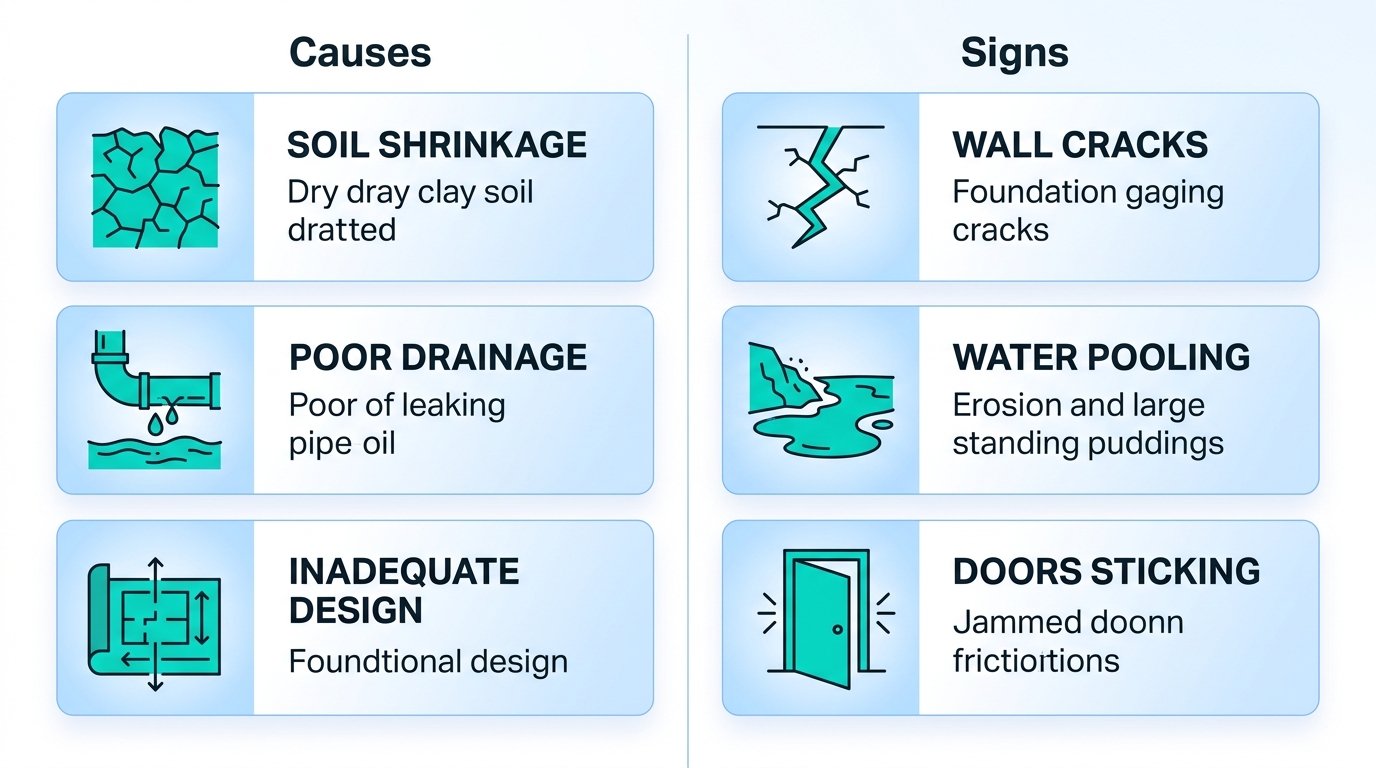
Causes vs. signs of commercial foundation problems comparison
The visual above reinforces the table’s insights, illustrating how proactive monitoring prevents escalation. As a real-world civil engineering example of pile-based stabilization in commercial and infrastructure contexts, the American Society of Civil Engineers (ASCE) documents steel piles replacing concrete foundations for electrical infrastructure on settlement-prone sites. These piles enhance load transfer via soil-pile interactions, offering durability in variable soils–benefits we incorporate in our foundation repair solutions. Such innovations underscore advanced earth anchoring systems for modern projects.
These fundamentals set the stage for helical piers and push piers installations detailed below. Consult our engineering team for project-specific guidance.
Deep Dive into Foundation Stabilization Techniques
Building on identification of settlement signs, here we explore proven techniques for commercial foundation stabilization. At Helical Technology, we provide ICC-certified products that enable contractors to address these challenges effectively in projects across Littleton, CO, and beyond.
Helical Piers for Commercial Applications
Helical piers represent a cornerstone of commercial foundation stabilization, leveraging screw-like helical plates that advance into the soil through rotational torque without removing material. This torque correlation to capacity ensures reliable load-bearing, as the installation torque directly indicates ultimate strength, making them ideal for variable soil conditions common in commercial sites.
Key advantages include:
- Minimal vibration, preserving adjacent structures.
- Suitability for soft or inconsistent soils.
- Immediate load transfer upon installation.
- Long-term durability with galvanized steel components.
Installation basics involve these steps:
- Excavate to expose the footing.
- Position the pier with a hydraulic torque motor.
- Advance until refusal or target torque is achieved.
- Attach a stabilization bracket and floor stabilizer post kit for secure load transfer to the structure.
As demonstrated in infrastructure projects where steel piles replaced concrete foundations, helical pier systems offer superior engineering performance (ASCE, 2025). While effective, helical piers differ from alternatives like push piers in their low-disruption approach.
Push Piers: Mechanics and Use Cases
In contrast, push piers utilize hydraulic rams to drive interlocking steel sections into the ground until they encounter competent stratum resistance. This hydraulic resistance bypass relies on the soil’s structural push-back to determine depth, providing high capacity in firm, cohesive soils like clay.
Compared to helical piers, push piers involve higher driving forces, potentially increasing vibration, but allow faster installation in suitable conditions. Their commercial suitability shines for heavy, uniform loads.
Ideal use cases encompass:
- Slab-on-grade warehouses requiring rapid underpinning.
- Retrofit parking structures with existing heavy loads.
- Sites with predictable, dense soils.
Contractors appreciate their straightforward mechanics for time-sensitive projects. We supply these systems with engineering support to ensure compliance with building codes. Transitioning to comparisons reveals when each excels.
Comparative Analysis of Pier Systems
Helical pier installations and push pier mechanisms each address commercial foundation stabilization, but differ in load capacity, installation disruption, and soil adaptability. Helical piers excel via torque-correlated capacity in variable soils with low vibration, while push piers leverage hydraulic driving for speed in firm strata, though with greater force application.
The following table summarizes key differences:
| Feature | Helical Piers | Push Piers |
|---|---|---|
| Load Capacity | Torque-based, high in variable soils | Hydraulic-driven |
| Vibration | Minimal | Moderate to High |
Helical piers suit diverse sites with minimal disruption, as validated by ASCE case studies on steel pile efficiency (ASCE, 2025). Push piers favor uniform loads where speed matters. Consult our network of structural engineers for project-specific design, ensuring ICC-ES compliance. Selecting the right system depends on site specifics, covered next.
Practical Applications and Installation Methods
At Helical Technology, we transition from theoretical benefits to hands-on guidance on commercial foundation stabilization using our ICC-certified helical piers and push piers. These advanced earth anchoring systems provide reliable solutions for commercial projects facing soil instability.
Step-by-Step Helical Pier Installation
Our certified installers follow a precise process for helical pier deployment in commercial settings. This ensures structural integrity while prioritizing safety per DFI guidelines.
- Conduct pre-construction site survey with geotechnical soil testing to assess bearing capacity and identify issues like poor yard drainage leading to soil erosion, requiring helical piers for stabilization.
- Mobilize equipment, including hydraulic torque drivers and torque gauges, to the site.
- Excavate access points near foundation footings, minimizing disruption.
- Screw helical piers into the ground using torque drivers to target values of 5,000-20,000 ft-lbs, confirming embedment.
- Install hydraulic extensions as needed to reach load-bearing strata.
- Perform load testing per ICC-ES AC358 standards to verify capacity.
- Backfill excavations and cap with concrete brackets for load transfer.
- Final inspection by certified personnel, ensuring all connections are secure.
Safety protocols are critical: require PPE such as hard hats and gloves, monitor torque to prevent over-rotation, and maintain certified oversight. Consult our network of structural engineers for project-specific designs. Products comply with ICC-ES acceptance criteria.
Push Piers in the Field
Push piers, also known as resistance piers, offer efficient commercial foundation stabilization in cohesive soils. We train installers on this hydraulic-driven method for rapid deployment.
- Excavate to footing base, exposing the foundation edge safely.
- Position hydraulic rams and initial pier sections against the footing.
- Incrementally drive piers to refusal on bedrock or load-bearing stratum using hydraulic pressure.
- Lock extensions with hydraulic clamps as depth increases.
- Verify load capacity through uplift tests and monitoring.
- Restore the site by backfilling and grading.
Timelines typically span 3-5 days for small commercial projects, extending to 2-4 weeks for larger ones based on pier count (10-50). Safety first: Bold emphasis on torque monitoring, stable equipment setup, and PPE. Our on-site installation training equips teams for seamless execution.
Cost and Timeline Considerations
Cost and timeline factors for helical piers and push piers vary by site specifics, helping contractors budget effectively for commercial foundation stabilization.
Industry averages guide these estimates, with mobilization fees ranging $5,000-$15,000 and depths of 20-50 feet influenced by soil conditions.
The following table compares key aspects:
| Aspect | Helical Piers | Push Piers |
|---|---|---|
| Per Pier Cost | $300-$800 | $250-$600 |
| Installation Time | 1-2 days per section | Faster in cohesive soils |
Helical piers often incur higher per-pier costs due to torque equipment but excel in variable soils, while push piers prove economical and quicker where resistance is consistent. Soil type significantly impacts expenses: soft clays demand deeper helical pile systems, inflating material needs, whereas dense sands favor push piers for speed. Crew size (4-6 members) and access challenges, like urban constraints, add 10-20% to totals. Large projects (over 50 piers) benefit from economies of scale, reducing timelines by phased mobilization. Always factor engineering support–our team provides real-time design software for optimized planning. Installations must comply with building codes; consult a structural engineer for site-specific guidance.
These variables underscore selecting the method based on geotechnical data, ensuring long-term performance.
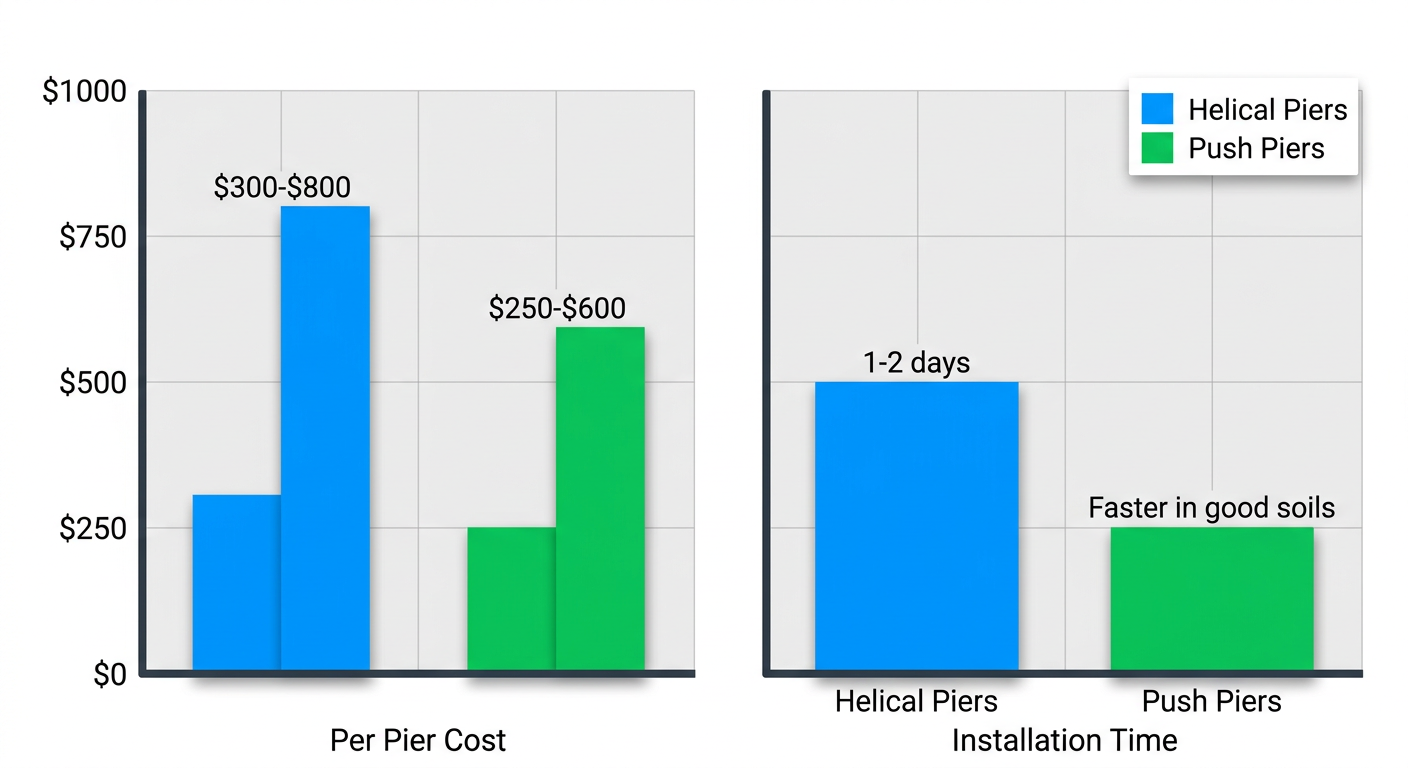
Helical Piers vs Push Piers: cost and installation time comparison charts
Visualizing these metrics aids decision-making, with helical piers suiting complex sites and push piers ideal for straightforward lifts. Our foundation repair solutions deliver value through certified products and expert support.
Advanced Strategies for Complex Commercial Projects
While standard helical piers and push piers handle routine residential foundation repair, complex commercial projects demand advanced commercial foundation stabilization techniques for loads exceeding 50 tons or variable soil conditions. We at Helical Technology supply ICC- and ISO-certified Residential Foundation Repair solutions that scale effectively to high-rises, infrastructure, and mixed-soil sites in Littleton, CO, and beyond. These advanced earth anchoring systems ensure structural integrity where traditional methods fall short.
Extended helical sections represent a high-capacity option, engineered to support 50+ tons, ideal for high-rise and commercial buildings requiring deep penetration and exceptional load-bearing. These configurations leverage extended lengths and robust steel construction to distribute heavy loads across challenging strata. Similarly, hybrid push-helical systems offer variable load capacities, combining the displacement action of push piers with helical rotation for optimal performance in mixed soils. This versatility makes them suitable for urban commercial sites with inconsistent geotechnical profiles, minimizing vibration and installation time.
The following table outlines key advanced pier options for heavy loads:
| Option | Load Capacity | Best For |
|---|---|---|
| Extended Helical Sections | 50+ tons | High-rise/commercial |
| Hybrid Push-Helical | Variable | Mixed soils |
Supported by Helical Technology engineering support resources, these options provide contractors with precise design data for project-specific applications.
A peer-reviewed real-world example from the American Society of Civil Engineers (ASCE) demonstrates steel piles replacing concrete foundations for electrical infrastructure, highlighting load-bearing advantages and faster installation in complex commercial settings. This case underscores how helical piers and push piers outperform conventional methods in efficiency and reliability.
These strategies, validated in infrastructure projects like the ASCE study, pave the way for detailed implementation in upcoming sections. We recommend consulting our network of structural engineers for custom foundation repair solutions and compliance with ICC-ES criteria. Always engage professional engineering support to tailor installations to site conditions and building codes.
Key Questions on Commercial Foundation Stabilization
What is commercial foundation stabilization?
This process halts foundation settlement and restores load-bearing capacity using piers driven to stable soil layers. We offer ICC-certified solutions for reliable results.
- Prevents structural damage
- Ensures safety and longevity
What causes commercial foundations to fail?
Poor soil conditions, excess water, and inadequate construction lead to settlement. As part of foundation repair strategies, helical piers address these issues effectively.
- Soil erosion undermines support
- Water alters soil volume
How do helical piers work for commercial stabilization?
Helical piers screw into stable strata, transferring loads past weak zones. Their helical plates provide immediate resistance for heavy commercial structures.
- Quick installation
- Proven load capacity
What are push piers and when to use them?
Push piers hydraulically drive into competent soil for heavier loads where displacement is feasible. Ideal for uniform soils.
- High capacity for large buildings
- Minimal site disturbance
Contact Helical Technology in Littleton, CO, for a professional assessment.
Achieving Long-Term Commercial Foundation Stability
Building on problem identification, achieving long-term commercial foundation stabilization demands targeted interventions like pier-based foundation repair. We define it as resistance to differential settlement over 20+ years under heavy loads in commercial buildings.
Helical piers installation involves screw-like anchors twisted into stable soil strata for immediate load transfer, without excavation. In contrast, push piers use hydraulic rams to drive steel shafts to refusal, suiting denser soils but sometimes needing pre-drilling. Our ICC-certified helical piers minimize business disruption.
These foundation repair solutions offer engineered capacities up to 500 kips per pier and 100-year warranties. Consult certified installers for site-specific torque correlation testing. These methods ensure decades of reliability–explore real-world applications next.
This article was researched and written with the assistance of AI tools.