

Table of Contents
Helical Foundation Anchors Essentials
Unlike traditional driven piles, helical foundation anchors offer a superior alternative for deep foundation support. These Helical Anchors consist of steel shafts with helical plates that are screwed into the ground, also known as helical piers or screw piles. At Helical Technology, we distribute ICC-approved advanced earth anchoring systems designed for reliable performance in challenging soil conditions.
Installation advances the shafts using a hydraulic torque motor until the required depth or torque is achieved, without soil excavation. According to authoritative building code standards from the International Code Council (ICC), helical pile capacity determination employs the torque correlation method in ICC 1810.3.3.1.9. Ultimate capacity is calculated by dividing installation torque by an empirical torque factor K, ensuring verifiable load-bearing strength.
Key advantages of helical foundation anchors include:
- Vibration-free installation, ideal for limited access sites
- Immediate load-bearing capacity upon completion
- Precise torque readings for installation verification
- Suitability for weak soils, expansive clays, or seismic zones
Common applications encompass stabilizing existing structures, underpinning foundations, and new construction projects. ICC codes also mandate corrosion protection, such as sacrificial anodes or jackets for embedded shafts. We provide foundation repair solutions with ICC and ISO Certified products to meet these requirements.
Consult our network of structural engineers for project-specific guidance, ensuring compliance with applicable codes. Detailed installation techniques follow in the next section.
Fundamentals of Helical Foundation Anchors
Unlike traditional methods that often disrupt sites and require extended timelines, helical foundation anchors provide a reliable, efficient alternative for modern construction projects. These advanced earth anchoring systems consist of steel shafts fitted with one or more helical plates, designed to be rotated into the ground using hydraulic torque. This torque-correlation method determines load capacity, aligning with ICC-ES acceptance criteria established by the International Code Council (ICC). We at Helical Technology supply ICC and ISO Certified products that meet these standards, ensuring contractors achieve immediate load-bearing capacity without waiting for curing or settling.
Installation involves vibration-free, spoil-free processes with hydraulic equipment, making helical piers ideal for tight urban sites or sensitive environments. The Helical Pier System exemplifies this approach, where rotational torque advances the anchor to the required depth, correlating directly to its ultimate capacity per ICC building code provisions in Chapter 18, Section 1810.3.3.1.9. These guidelines specify design parameters like embedment depth, spacing, and corrosion protection in various soils, promoting code-compliant installations.
Key Advantages
Helical foundation anchors deliver several benefits over conventional techniques:
- Rapid installation: Complete in hours rather than days, minimizing labor and downtime.
- Soil adaptability: Excel in variable or cohesive soils where screw piles provide superior grip without excavation.
- Minimal site disturbance: No spoils or vibrations, preserving surrounding landscapes and structures.
- Versatility: Suitable for new construction, repairs, and retrofits, supported by our network of structural engineers for project-specific designs.
These attributes make them a preferred choice for foundation repair solutions in challenging conditions, as endorsed by industry benchmarks.
To illustrate these strengths, the following table compares helical foundation anchors against traditional methods, drawing from data in ICC standards and industry benchmarks, alongside Helical Technology product specs.
| Aspect | Helical Anchors | Concrete Foundations | Driven Piles |
|---|---|---|---|
| Installation Speed | Fast, torque-based | Slow, curing required | Vibration-heavy |
| Soil Adaptability | High in variable soils | Poor in weak soils | Limited |
| Cost per Unit | Moderate | High initial | Variable |
This comparison highlights how helical anchors balance speed, adaptability, and cost-effectiveness. For instance, their torque-based installation avoids the curing delays of concrete, which can span days, while outperforming driven piles in soil versatility and reduced vibration risks. These factors enable faster project timelines and lower overall expenses, particularly in regions with inconsistent ground conditions like those around Littleton, CO.
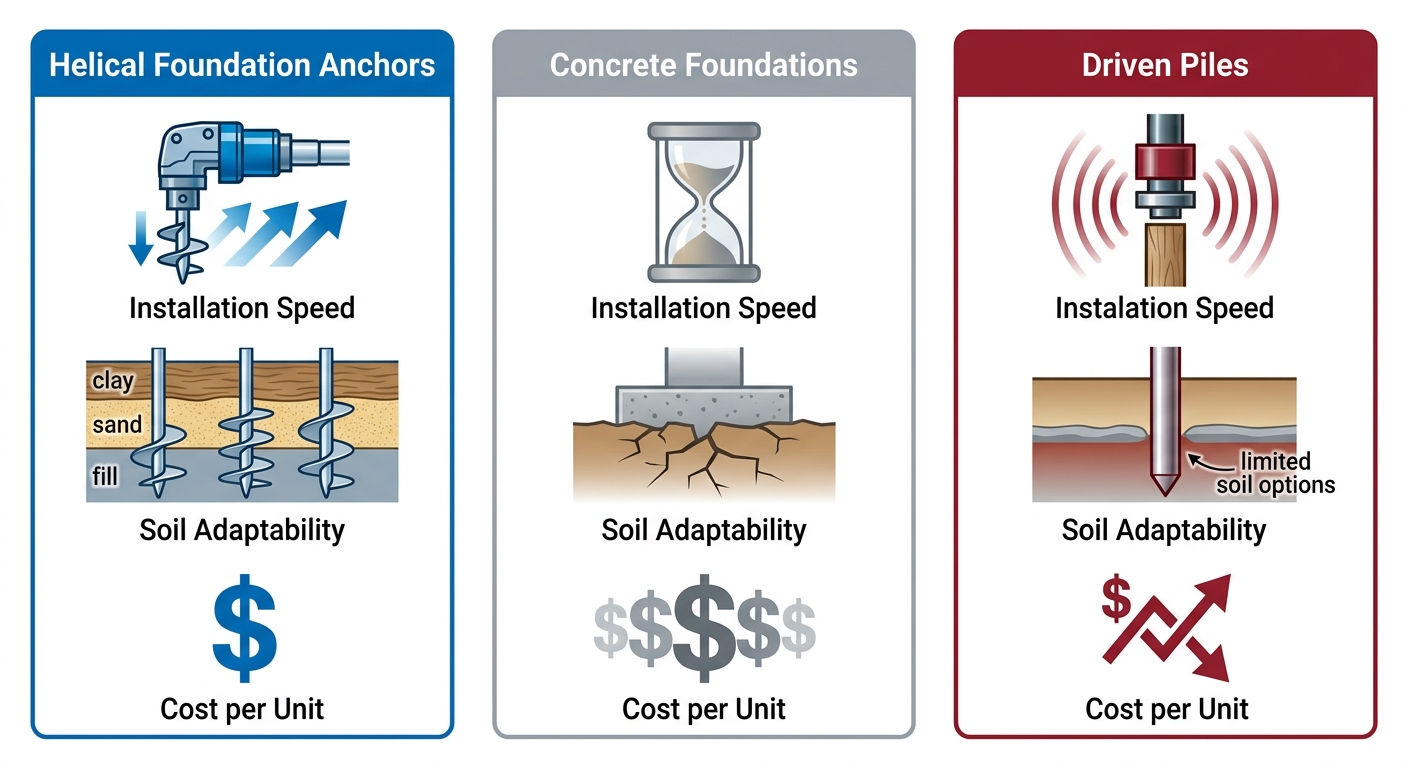
Helical anchors vs concrete vs driven piles comparison infographic
The infographic visually reinforces these distinctions, aiding contractors in selecting optimal foundation repair solutions. Consult a structural engineer or our engineering team for project-specific design and installation guidance, ensuring compliance with applicable building codes and ICC-ES acceptance criteria. With these fundamentals established, explore installation best practices and load testing next.
Deep Dive into Helical Foundation Systems
Building on helical basics, this deep dive examines the installation mechanics, performance in varied soils, and cost structures of helical anchors, piers, and screw piles. At Helical Technology, we provide ICC-approved products and engineering support to ensure these advanced earth anchoring systems deliver reliable foundation repair solutions. Our network of structural engineers aids contractors in precise implementation.
Installation Mechanics and Processes
Helical foundation installation demands precision, starting with thorough site assessment. We recommend pre-construction soil probing using geotechnical borings to determine shaft sizes and embedment depths, followed by layout marking for anchor positions.
The process unfolds in these key steps:
- Assembly: Fabricate lead sections with helical plates and attach extension shafts using hydraulic couplers. Secure a hydraulic torque motor to the lead for controlled advancement.
- Rotational Driving: Advance the helical anchors by rotating clockwise while applying downward thrust, targeting torque or depth correlated to capacity. Real-time monitoring via torque gauges ensures compliance with International Code Council (ICC) standards in Section 1810.3.3.1.9.
- Load Testing: Perform pull-out or compression tests to 200% of design load, verifying installation torque per ICC prescriptive methods.
- Structure Attachment: Bracket the pile cap to the foundation, transferring loads effectively.
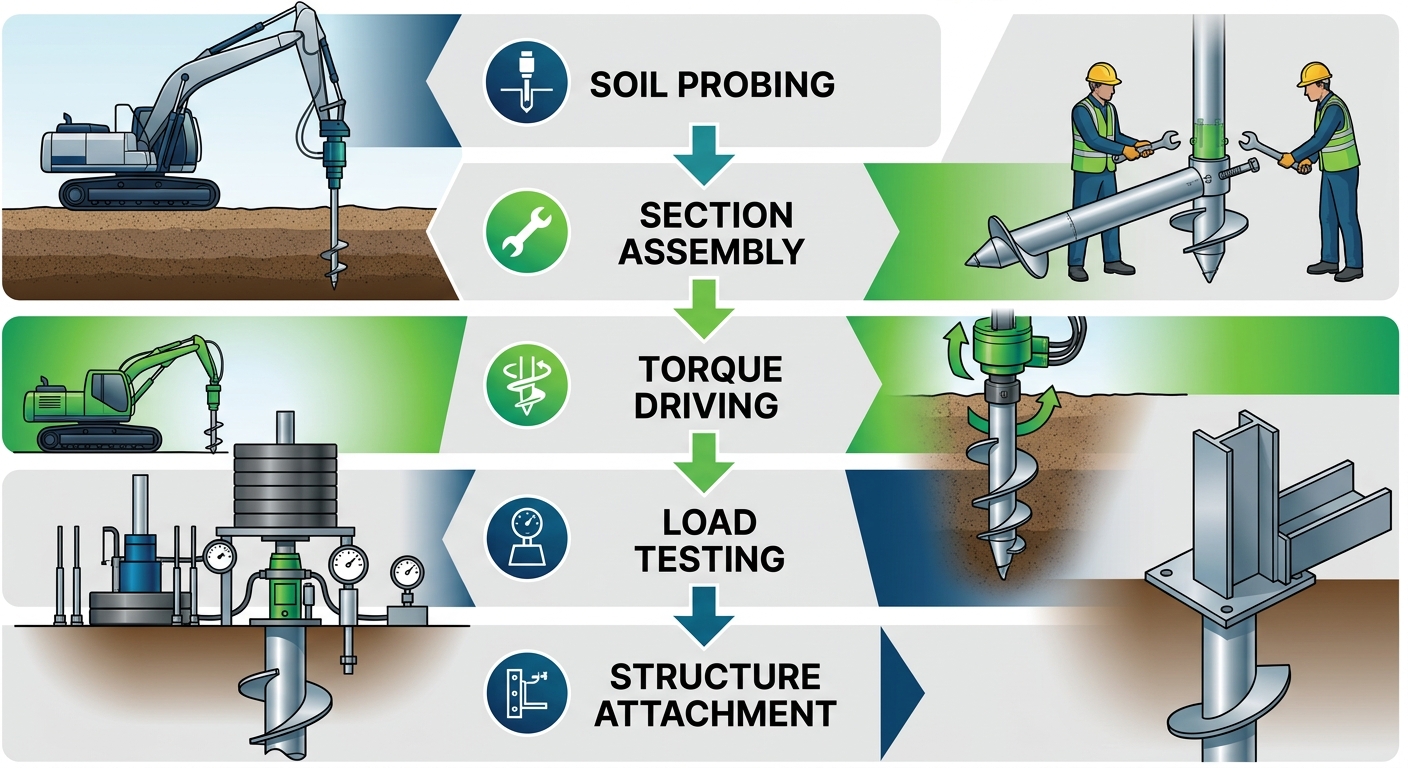
Sequential stages of helical pile installation process
This methodical approach, backed by our ICC and ISO Certified products, minimizes risks and accelerates timelines for contractors.
Performance in Varied Soil Conditions
Helical piers excel in challenging soils, offering adaptable load-bearing via torque-to-capacity correlation. In cohesive clays, they achieve up to 500 kips in compression; granular sands support 300 kips, per authoritative International Code Council (ICC) building code standards for deep foundations.
Cost Analysis Breakdown
Helical installations offer predictable economics, with per-foot material costs for 3-inch shafts at $20-40, and installed rates of $50-80 including mobilization and torque monitoring. Factors influencing costs include shaft diameter, extension lengths, and site access. Consult a structural engineer or our team for project-specific guidance, as installations must comply with ICC-ES AC358.
| Metric | Helical Piers | Screw Piles |
|---|---|---|
| Torque Capacity | High precision | Standard |
| Removal Ease | Retractable | Difficult |
Practical Applications of Helical Anchors
Building on helical anchor fundamentals, we explore the real-world impact of helical foundation anchors. These advanced earth anchoring systems excel in foundation repair solutions, offering quick installation times under one hour per anchor. This versatility makes them ideal for various projects, from residential fixes to commercial stabilizations.
| Project Type | Helical Anchors | Helical Piers | Screw Piles |
|---|---|---|---|
| Residential Repair | Excellent | Good | N/A |
Real-World Use Cases in Repair and Construction
Helical foundation anchors transform challenging repair projects with proven results. In residential foundation uplift repair, we supported a Colorado home settling on expansive clay soils. Installing six 1.5-inch helical anchors stabilized the structure in under four hours total, preventing further cracking and restoring level floors without full excavation.
For bowing walls, integrate wall plate anchors with helical foundation anchors. A Texas case study involved a basement wall bowing inward from hydrostatic pressure. Our ICC and ISO certified products, combined with wall plate anchors, reversed the movement by 2 inches, securing the structure long-term.
Advanced Helical Anchor Engineering
Building on foundational techniques, advanced engineering ensures code-compliant performance for helical foundation anchors in demanding projects. At Helical Technology, our ICC-certified products deliver superior reliability through features like real-time design software and dedicated engineering support.
| Feature | ICC-Certified (Helical Tech) | Standard |
|---|---|---|
| Design Software | Real-time modeling | Basic |
| Engineering Support | Dedicated network | Limited |
Helical Foundation Anchors FAQ
What are helical foundation anchors?
Helical foundation anchors are steel shafts with helical plates that screw into the ground for foundation stabilization. Also called helical piers or screw piles, our ICC-certified products provide advanced earth anchoring systems for durable support.
How are helical foundation anchors installed?
We install helical foundation anchors by torque-driven screwing into the soil until the required load capacity is achieved. This vibration-free process requires no concrete or excavation, enabling fast and precise placement.
Maximizing Foundation Stability with Helical Anchors
Helical foundation anchors from Helical Technology maximize foundation stability with superior load-bearing capacity and reliability across diverse projects.
- Deliver immediate load capacity without concrete curing delays, enabling instant structural support.
- Employ torque-correlated installation for precise depth and verified performance every time.
- Thrive in poor soil conditions where helical piers or screw piles outperform traditional piling.
This article was researched and written with the assistance of AI tools.