

Table of Contents
Essential Guide to Concrete Crack Repair Epoxy
For effective fixes after crack assessment, concrete crack repair epoxy stands out. This high-strength, low-viscosity resin injects into cracks to restore structural integrity in load-bearing elements, per International Code Council (ICC) standards in CBC 2019 P4 Chapter 19A Section 1911A.2.
The epoxy crack injection process starts with surface preparation, port installation, and low-pressure injection using rigid needles, validated by ASTM International’s D8109-17R24 test method. We recommend Structural Injection Epoxy for structural repairs, followed by curing for full bonding.
Concrete crack repair epoxy offers tensile strength matching concrete, durability in harsh environments, and code compliance. Choose it over polyurethane crack injection for dry, non-moving cracks (0.002-0.25 inches). Next, explore step-by-step implementation.
1. Choosing Right Epoxy Products
Selecting the right concrete crack repair epoxy forms the foundation of effective structural repairs. We at Helical Technology emphasize matching products to crack type, load demands, and environmental factors for lasting results. Start with product selection to ensure project success and compliance.
Key factors guide your choice:
- Viscosity: Low for narrow cracks, higher for wider gaps.
- Cure time: Fast for tight timelines, longer for complex applications.
- Tensile strength: High for load-bearing repairs.
- Chemical resistance: Essential for exposure to moisture or chemicals.
Epoxy crack injection suits structural fixes, while polyurethane crack injection handles non-structural water sealing. Always differentiate these for optimal outcomes.
For dynamic loads, high-modulus epoxies excel, as verified by authoritative standards from ASTM International, such as the ASTM D8109-17R24 test method for adhesion and durability. Products like structural repair epoxy meet these demands. Consult data sheets for certifications and concrete compatibility.
Verify manufacturer specs and match epoxy for concrete crack repair to your needs. Once chosen, proceed to proper injection techniques for seamless execution.
2. Surface Preparation Techniques
Once cracks are located, proper surface preparation ensures optimal adhesion for concrete crack repair epoxy and other repair materials. According to the International Code Council, clean, roughened surfaces prevent bond failure in concrete repairs, maximizing long-term durability.
We recommend these code-compliant steps using CBC 2019 P4 Section 1911A.2 standards:
- Remove contaminants mechanically: Eliminate loose concrete, laitance, curing compounds, and debris via abrasive blasting or high-pressure water jetting. Wear PPE including respirators and eye protection during operations.
- Achieve surface roughness: Use sandblasting or scarification to reach CSP 3-5 profile for epoxy crack injection adhesion. Mechanical anchoring with the concrete crack lock kit enhances stability.
- Address residual issues: Apply acid etching only if mechanical methods prove insufficient, followed by neutralization and thorough rinsing.
- Verify moisture and pre-wet: Confirm surface moisture below 4% before epoxy application. Pre-wet dormant cracks 24 hours prior to polyurethane crack injection to control absorption.
Prepared surfaces are now ready for injection techniques in the next section.
3. Injection Process Steps
Building on cleaned and ported crack, the injection process in concrete crack repair epoxy fills voids from bottom to top, ensuring structural integrity.
- Install injection ports along the crack at 6-8 inch intervals using epoxy paste adhesive; space closer for wider cracks (>1/4 inch).
- Seal crack surface between ports with sealing compound, preventing leaks during injection.
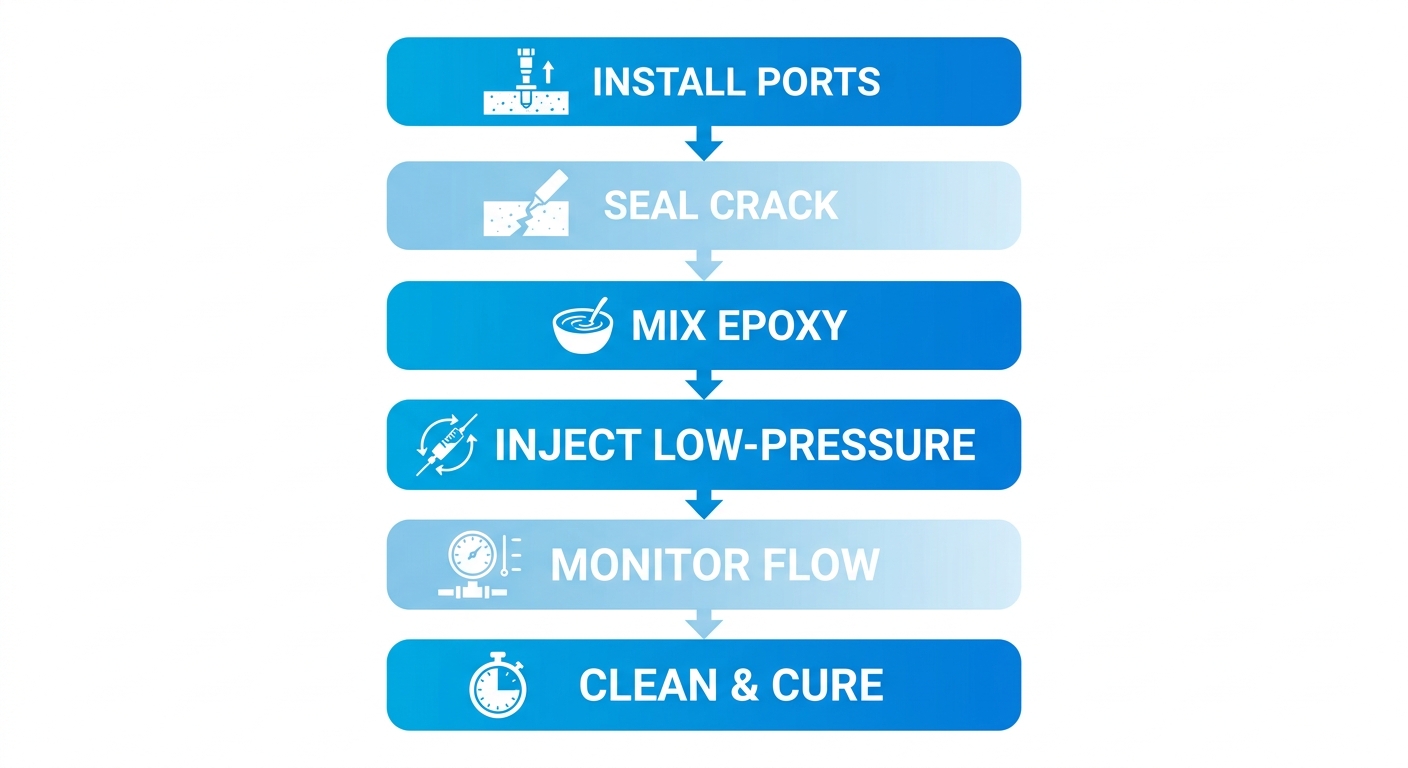
Six sequential steps of epoxy crack injection for concrete foundation repair
This visual outlines the epoxy crack injection sequence we follow at Helical Technology for precise application.
- Mix two-part structural injection epoxy per manufacturer ratios, avoiding air entrapment, as validated by ASTM International standards.
- Inject epoxy starting at lowest port using low-pressure pump (20-40 psi), progressing upward as resin flows out next port in epoxy crack injection.
- Monitor pressure and flow; cap ports after pull-out observed at subsequent port, per ASTM International guidelines.
- Clean excess material and tools with solvent; allow 24-hour cure before loading. For polyurethane crack injection alternatives, adapt mixing accordingly.
Wear PPE, ventilate area, and follow SDS for safety. Post-injection, test integrity per ASTM standards.
4. Cost Considerations Factors
While repair methods vary, costs for concrete crack repair epoxy depend on key factors that influence pricing for options like epoxy and polyurethane injections. These elements ensure accurate budgeting for durable foundation repair solutions.
Here are the primary cost drivers:
- Crack width and depth: Narrow cracks under 1/8 inch require less material, keeping costs lower; wider or deeper ones demand more product and time.
- Repair method: Epoxy crack injection suits structural needs at 20-30% higher cost than polyurethane crack injection for leaks; mechanical options like our crack stitch offer lower material expenses.
- Location and accessibility: Overhead or confined spaces add 50% labor premiums due to specialized equipment.
- Structure type: Residential slabs cost less than bridges or commercial walls.
- Volume of material: Calculated as crack length x depth x width; a 20-ft long, 1/4-inch wide wall crack might total $500-1,200.
- Labor hours: Skilled applicators charge $75-150 per hour.
- Preparatory work: Routing cracks adds $2-5 per linear foot.
Ignoring these leads to underquoting and failures. These elements combine to determine total project bids; we recommend consulting our engineering team for precise estimates and long-term savings.
5. Permanence and Durability
Beyond proper setup, permanence ensures value in basement wall repairs and long-term corrosion protection where applicable in aggressive soil environments. At Helical Technology, we prioritize concrete crack repair epoxy and similar solutions that deliver lasting performance against environmental stresses.
Helical basement wall repair anchors provide permanent lateral stabilization. They transfer loads to stable soils, preventing future bowing or cracking. For cracks, Basement Wall Repair Anchors complement epoxy crack injection, offering rigid strength in dry conditions. In contrast:
- Concrete crack repair epoxy: High strength, low flexibility; ideal for static, dry cracks.
- Polyurethane crack injection: Flexible, water-tolerant; excels in active leaks.
These systems resist freeze-thaw cycles and soil movement for 50+ years. The International Code Council, through authoritative CBC 2019 P4 Chapter 19A Section 1911A.2 specifications, mandates repairs match or exceed original concrete longevity in service environments.
This durability justifies investment in quality systems.
6. Epoxy vs Polyurethane Injection
While both methods seal cracks effectively, epoxy vs polyurethane injection differs significantly in concrete crack repair epoxy applications. Epoxy provides superior structural bonding for dry, non-moving cracks, leveraging high tensile strength and adhesion. Polyurethane offers flexibility and expansion for active leaks in wet conditions, forming foam to stop water.
Key Differences:
- Strength: Epoxy suits load-bearing repairs; polyurethane prioritizes waterproofing.
- Cure Time: Epoxy takes 24-48 hours; polyurethane reacts in minutes.
- Viscosity: Epoxy for narrow cracks; polyurethane penetrates wider gaps.
- Cost: Epoxy has higher material costs but long-term durability; polyurethane is more economical for sealing.
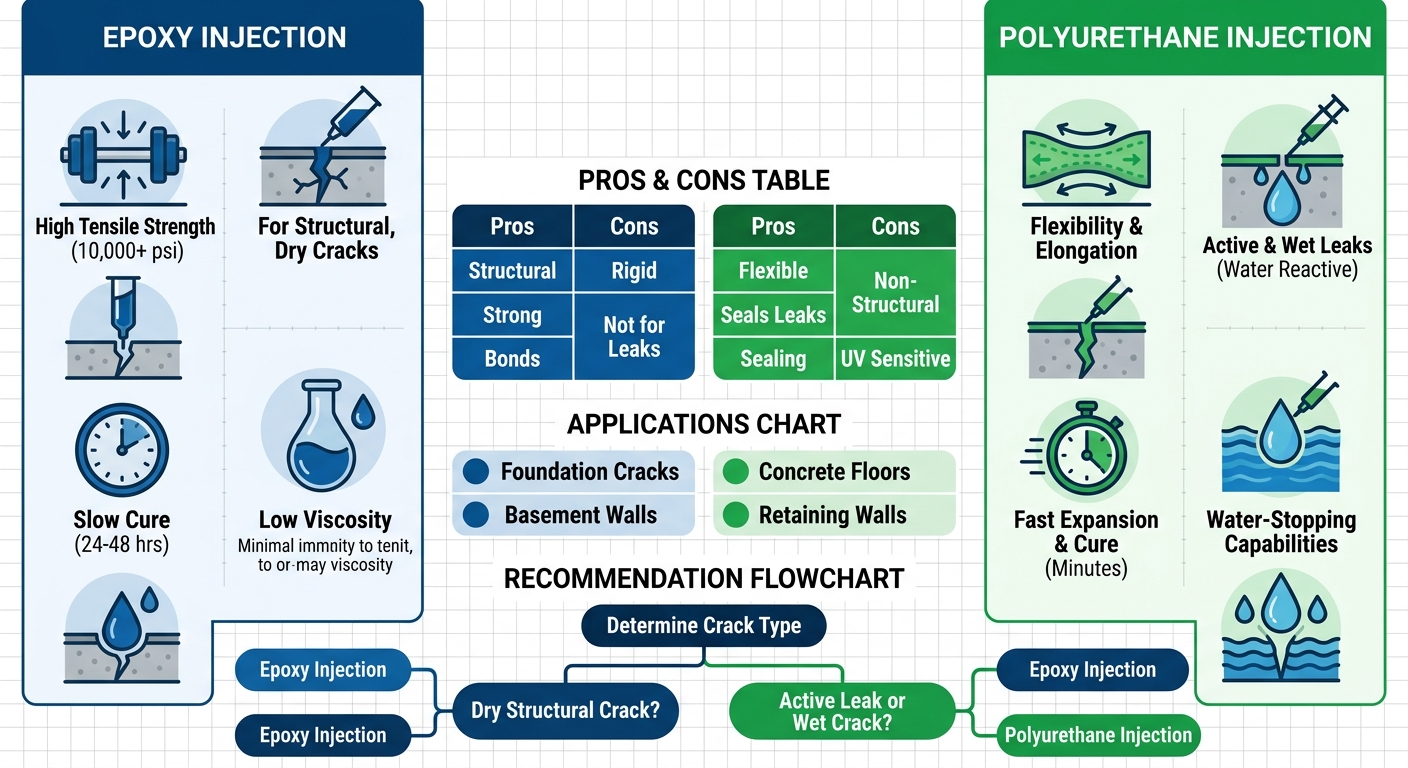
Epoxy vs polyurethane crack injection: strengths, applications, and recommendations
ASTM International’s D8109-17R24 serves as an authoritative industry standard for testing injection efficacy in structural concrete, guiding epoxy crack injection and polyurethane crack injection selections. We at Helical Technology recommend epoxy for restoring structural integrity and polyurethane for waterproofing based on crack type. Understanding these differences guides proper selection, as detailed next.
Achieve Lasting Crack Repairs
Once cracks are assessed, we achieve lasting repairs in concrete structures using concrete crack repair epoxy. This method restores structural integrity through epoxy crack injection, ideal for non-water-bearing cracks wider than 0.004 inches.
Surface preparation is critical: clean cracks thoroughly, install injection ports at 6-8 inch spacing, and seal exteriors with epoxy paste. Low-viscosity epoxy is then injected under pressure of 20-150 psi, per International Code Council standards in CBC 2019 P4 Chapter 19A Section 1911A.2.
For water-bearing cracks, polyurethane crack injection expands to seal leaks flexibly. Both ensure code compliance.
These professional methods prevent water ingress, extend service life by decades, and withstand seismic stresses, leading into maintenance strategies.
This article was researched and written with the assistance of AI tools.