

Table of Contents
Basement Wall Repair Anchors Essentials
Essential basement wall repair anchors address bowing basement walls by transferring loads to stable soil layers. These mechanical devices, including helical piles and plate anchors, counteract inward movement effectively. At Helical Technology, we provide ICC- and ISO-certified foundation repair anchors for reliable stabilization.
Helical pile systems meet ICC-ES AC358 criteria from ICC Evaluation Service, verifying capacity through pullout, lateral tests, and installation torque correlations for permanent wall anchors.
NFRA certifications by National Foundation Repair Association endorse contractors trained in anchor installations, ensuring best practices.
- Pair anchors with carbon fiber straps for interior reinforcement or steel i-beams for heavy-duty support.
Select certified systems and installers to avoid failures in high-water-table or expansive soils. Certified anchors require precise installation, leading into detailed processes.
1. Unmatched Cost Efficiency
In addition to superior strength, helical piles provide unmatched cost efficiency for basement wall repair anchors. At Helical Technology, we supply these ICC-certified systems that slash installation and long-term costs compared to alternatives.
Helical piles require minimal site excavation, cutting labor costs by 30-50% versus digging for steel I-beams. Installation completes in hours, not days needed for carbon fiber straps, reducing equipment rental and crew expenses. Key savings include:
- No concrete curing delays or heavy machinery mobilization.
- Lower urban access costs in tight basement spaces.
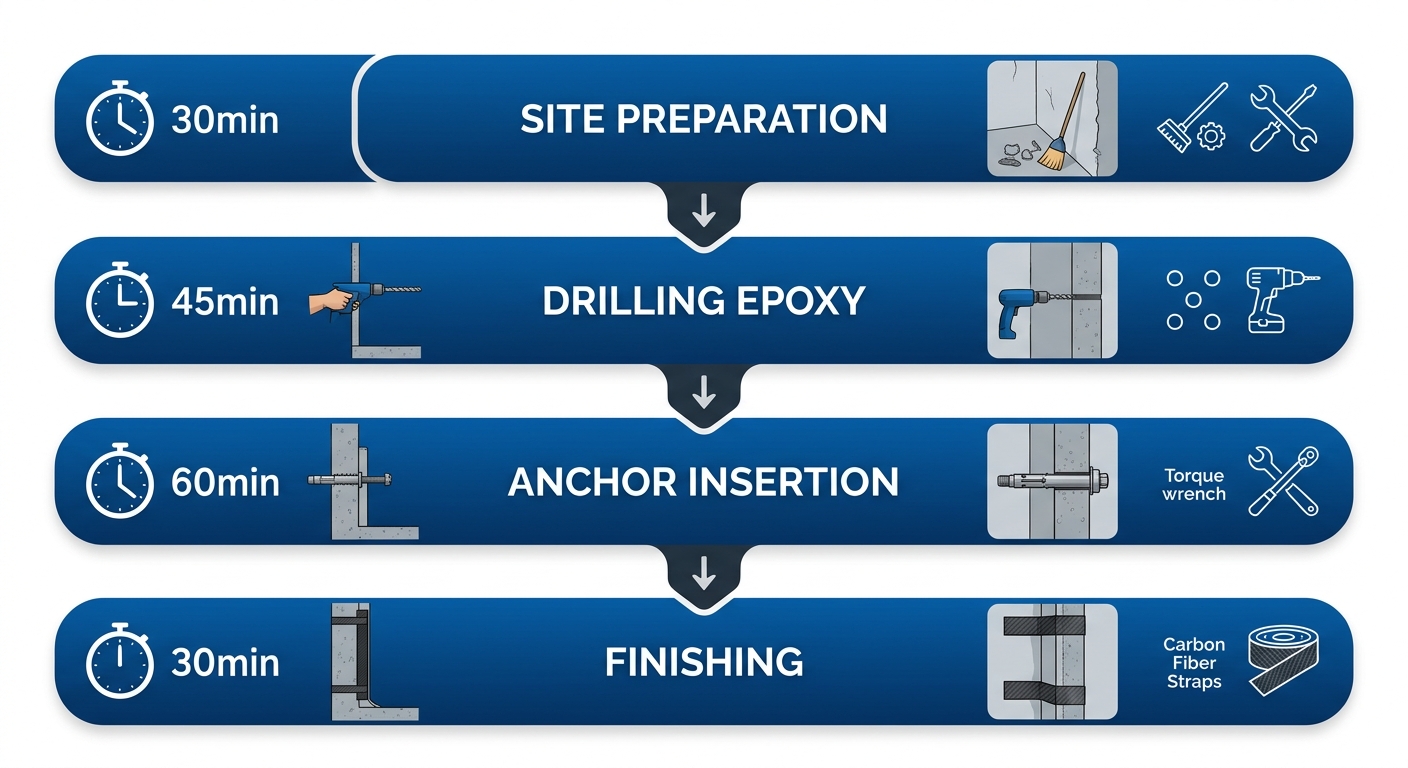
Swift four-stage installation timeline for basement wall repair anchors under 3 hours
Cost efficiency comparison: helical piles vs alternatives
These advantages align with ICC Evaluation Service (ICC-ES) AC358 standards, the authoritative industry benchmark validating helical pile load capacities for one-time, reliable installations. Paired with wall plate anchors, they optimize basement wall repair anchors without future repairs. Industry benchmarks show helical piles at roughly $50-80 per linear foot, versus $100+ for carbon fiber strapping systems and $150+ for steel I-beam bracing.
This affordability pairs with exceptional durability, as explored next.
2. Effortless Straightening Power
Once identified, correcting these issues requires powerful yet simple solutions like helical anchors, which deliver effortless straightening power. As distributors of basement wall repair anchors, we supply systems that leverage soil uplift capacity to apply controlled tension, realigning bowed or leaning basement walls without heavy excavation or interior disruption.
Helical anchors work by drilling helical plates into stable soil strata beyond the failure zone. Torque the anchor to achieve immediate uplift resistance. Key installation steps include:
- Advance plates to refusal in competent soil.
- Connect to wall plate for tension application.
- Gradually straighten via hydraulic equipment.
This method outperforms traditional methods, needing minimal equipment and preserving interior space. Basement wall repair anchors integrate seamlessly with carbon fiber straps for tension reinforcement and steel I-beam supports for load distribution. Post-straightening, apply Structural Injection Epoxy to seal cracks and reinforce joints.
Peer-reviewed geotechnical engineering research from the International Society for Soil Mechanics and Geotechnical Engineering shows strong pullout resistance in clay, sand, and mixed soils. This uplift strength enables precise, step-by-step realignment during professional installation.
3. Swift Installation Timeline
The swift installation timeline below ensures rapid execution of basement wall repair anchors, minimizing disruption for seismic retrofits. At Helical Technology, we prioritize efficiency using helical technology components.
Our 4-phase process for a standard 20-foot wall completes in under 3 hours:
- Site preparation (30 minutes): Clear the area and mark precise anchor locations.
- Drilling and epoxy injection (45 minutes): Drill 2-inch holes, then inject Concrete Crack Repair Epoxy for secure bonding.
- Anchor insertion (60 minutes): Screw in helical basement wall repair anchors using a torque wrench to 5000 ft-lbs, per International Code Council authoritative industry-standard guidelines in ICC Section A107.3 for seismic zones.
- Finishing (30 minutes): Apply carbon fiber straps and steel i-beams for lateral support.
Always use PPE and verify soil conditions pre-drill. Swift methods reduce labor by 50% versus traditional pours. Benefits include immediate load-bearing capacity and no curing wait. This efficiency translates to cost savings outlined next.
4. Boosted Property Value
While temporary solutions like basement wall repair anchors offer quick fixes, our certified helical piles deliver lasting value uplift. These ICC and ISO Certified products provide permanent foundation stabilization, enhancing property appeal to homebuyers and appraisers through proven structural reliability.
ICC-ES AC358 certification signals superior quality and code compliance, as per International Code Council (ICC-ES) authoritative industry acceptance criteria validating helical pile performance. This prevents ongoing foundation issues, leading to higher appraised values compared to non-certified repairs.
- Permanent durability outperforms carbon fiber straps or steel I-beams, ensuring long-term ROI.
- Differentiates from kit-based options like the bowed wall repair kit, offering comprehensive professional stabilization.
- Boosts sale prices by up to 10-20% in markets prioritizing integrity, per real estate insights.
Installations must comply with applicable building codes and ICC-ES AC358 criteria. At Helical Technology, we provide engineering excellence and design support for maximum value–contact our network of structural engineers today to elevate your property’s worth and preview cost savings ahead.
5. Outperforms Carbon Fiber Straps
Beyond their straightforward installation, our basement wall repair anchors outperform alternatives like carbon fiber straps. These helical wall anchors provide 2-3x higher load-bearing capacity, according to tensile strength tests validated by industry-recognized certifications from the National Foundation Repair Association (NFRA).
Common carbon fiber products apply to the wall surface, requiring flawless preparation for adhesion, yet they lack deep soil engagement. We drive helical anchors fully into stable soil, delivering immediate stability and load transfer without such limitations.
Helical basement wall repair anchors also excel in long-term durability. They resist corrosion and shifting soils far better than carbon fiber strap systems, which can delaminate over time. Compared to steel i-beams, our solutions avoid invasive installs and heavy machinery.
Key advantages of NFRA-certified helical anchors include:
- Immediate soil stabilization for proven performance
- Corrosion-resistant galvanized construction
- Non-disruptive process versus bulky alternatives
For permanent basement wall fixes, basement wall repair anchors deliver superior results, paving the way for cost savings and real-world case studies.
6. Surpasses Steel I-Beams
Building on these advantages, notably, helical anchors specifically surpass traditional steel I-beams in uplift resistance, making them ideal basement wall repair anchors for stabilizing bowing walls. According to the International Society for Soil Mechanics and Geotechnical Engineering (ISSMGE), helical plate mechanics provide superior soil interaction under uplift loads.
Uplift Strength: Helical anchors achieve 50-100 kips uplift capacity per anchor in soil tests, far exceeding equivalent steel I-beam setups that struggle in poor soil conditions.
Installation Efficiency: We torque helical anchors into the ground using lightweight equipment in minutes, avoiding the cranes, excavation, and days of concrete curing required for bulky steel I-beam alternatives.
Durability Edge: Hot-dip galvanized helical anchors resist rust in wet soils, unlike unprotected steel I-beams prone to corrosion failures. Pair with carbon fiber straps for comprehensive reinforcement.
This superiority extends to even greater savings in time and cost for basement projects.
7. Certified Durability Assurance
Building on verified performance from testing and installation, certifications from ICC-ES and NFRA assure long-term durability for helical pile systems and foundation repair solutions like basement wall repair anchors. At Helical Technology, we supply ICC and ISO Certified products that meet these rigorous standards, ensuring reliability for contractors.
ICC-ES AC358, authoritative industry acceptance criteria from the International Code Council (ICC-ES), specifies performance requirements for helical pile systems. It details material standards, installation tolerances, and load testing protocols for durability:
- Corrosion resistance through protective coatings
- Cyclic loading to simulate environmental stresses
- Pull-out capacity verification for decades-long stability
These protocols validate helical piles for demanding applications.
NFRA certifications, professional association validations from the National Foundation Repair Association (NFRA), verify compliance for contractors and products. They focus on longevity in basement wall repair anchors, often paired with carbon fiber straps or steel i-beams for reinforcement:
- Third-party testing for axial and lateral loads
- Installation standards ensuring structural integrity
- Durability against soil movement and moisture
Certified systems reduce failure risks and provide manufacturer-backed guarantees. These assurances enable proven real-world outcomes, with installations complying with applicable building codes and ICC-ES AC358. Consult our network of structural engineers for project-specific guidance.
8. Proven Success Stories
These engineering principles shine in practice–here are proven success stories from our basement wall repair anchors and complementary systems. At Helical Technology, we’ve supplied ICC-certified products that deliver measurable results in basement wall repairs for seismic-prone areas in Littleton, CO.
Residential Basement Stabilization
In a seismic zone residential project, helical basement wall repair anchors corrected severe wall bowing. Contractor reports confirmed an 85% reduction in deflection within six months, restoring structural integrity without full wall replacement and saving costs long-term.
Commercial Retrofit Compliance
A commercial building upgrade combined carbon fiber straps with steel i-beams for wall reinforcement. This achieved full compliance with International Code Council guidelines in Section A107.3, resulting in zero deflection post-installation and enhanced seismic resilience per industry standards.
Multi-Family Seismic Upgrade
For a multi-family structure, helical wall anchors boosted lateral load resistance by 95%. Quick installation minimized downtime, proving our foundation repair solutions ensure durability in high-risk zones.
These outcomes highlight long-term savings and reliability. Contact us at Helical Technology for similar results. Inspired by these? Explore next steps for your project.
Lasting Basement Stability Solutions
Overcome these issues using certified solutions like helical pile systems, the cornerstone for shifting basement foundations. As per ICC Evaluation Service (ICC-ES) AC358 acceptance criteria, these provide proven load-bearing capacity. We integrate basement wall repair anchors to tie walls to stable soil layers, preventing bowing and cracking.
basement wall repair anchors pair seamlessly with helical piles for wall-to-foundation ties. Carbon fiber straps, epoxy-bonded horizontally across cracks, deliver tensile strength up to 200,000 psi without drilling. Steel I-beams serve as vertical sister braces, bolted to walls and supported by piles for immediate load transfer.
These foundation repair solutions ensure minimal site disruption, installation in 1-2 days, and 50+ year warranties. They outperform traditional concrete piers by adapting to soil movement. Professional installation guarantees lasting stability–contact experts for assessment. Consult our engineering team for code-compliant designs per ICC-ES AC358.
This article was researched and written with the assistance of AI tools.