

Table of Contents
- Foundation Repair Showdown: Polyurethane Foam vs. Steel Piers
- When Steel Piers Outperform Polyurethane Foam: Expert Perspectives
- Side-by-Side Comparison: Polyurethane Foam and Steel Piering Methods
- Cost Factors in Choosing Between Foam and Pier Foundation Repair
- Making the Right Choice for Your Foundation Repair Project
- Foundation Repair Solutions That Stand the Test of Time
Foundation Repair Showdown: Polyurethane Foam vs. Steel Piers
When evaluating options in polyurethane foam vs steel piers foundation repair, it’s crucial to understand the difference between slab jacking vs foundation underpinning. Polyurethane foam injection provides a fast, non-structural lift for concrete slabs with less than 2 inches of settlement, curing in about 15 minutes. In contrast, steel helical or push piers deliver permanent structural underpinning by transferring building loads to competent soil or bedrock. The load bearing capacity of helical piers exceeds 100 tons per pier, far surpassing polyurethane foam’s under-20-ton limit. According to the National Foundation Repair Association, steel piers are the recommended engineered solution for structural loads exceeding this capacity. Foam is suitable for interior slabs, sidewalks, and driveways; steel piers are required for perimeter foundations, load-bearing walls, and columns in commercial structures. Each method requires a site-specific geotechnical evaluation. For a permanent, engineered solution, our ICC and ISO Certified helical piers provide superior load capacity and longevity. Always consult a structural engineer or our engineering team for project-specific design. Cost varies by project and requires a custom quote from a certified installer.
When Steel Piers Outperform Polyurethane Foam: Expert Perspectives
When evaluating polyurethane foam vs steel piers foundation repair, the critical distinction lies in long-term structural performance under demanding conditions. Polyurethane foam injection serves a specific purpose in void filling and minor slab lifting, but our engineering team at Helical Technology consistently specifies steel pier systems when permanent stabilization is required. This is especially true in geotechnical environments that expose the limitations of foam injection.
Steel piers outperform foam in three primary scenarios. First, soils with high moisture content or expansive clay demand a solution that reaches beyond the active zone of movement. Our internal technical documentation on pile foundation failure confirms that differential settlement and negative skin friction compromise shallow corrections over time. Helical piers installed to bedrock or stable load-bearing strata bypass this instability entirely, a distinction central to the slab jacking vs foundation underpinning comparison.
Second, the load bearing capacity of helical piers routinely exceeds 100 tons depending on soil and pier design, whereas foam is limited to lifting concrete slabs. For historic or heavy masonry buildings requiring deep foundation support, this quantitative advantage is non-negotiable. Finally, structures subject to ongoing lateral movement from slope creep or water infiltration need an engineered solution that foam cannot provide. As noted in our product resources on concrete piers for foundation repair, only driven steel systems offer the 50-year durability rating expected of permanent underpinning.
The expert perspective from our network of structural engineers reinforces this view: foam injection is a suitable tool for minor voids, but steel piers remain the standard for permanent foundation stabilization. For maximum durability, we recommend consulting with our engineering team to ensure project-specific designs meet ICC and ISO Certified products standards. Consult a structural engineer or the manufacturer’s engineering team for project-specific design and installation guidance.
Side-by-Side Comparison: Polyurethane Foam and Steel Piering Methods
To help you understand the practical differences between polyurethane foam vs steel piers foundation repair, the following table breaks down their performance across seven critical factors.
| Feature | Polyurethane Foam Injection | Steel Piers (Helical/Push) |
|---|---|---|
| Permanence | Not permanent for structural loads; may degrade over time | Permanent solution with engineered load ratings |
| Load-Bearing Capacity | Limited to lighter loads (typically < 10 tons) | High capacity (up to 100+ tons per pier) |
| Application for Uneven Slabs | Suitable for minor slab leveling (1–3 inches) | Overkill for slabs unless part of structural restoration |
| Structural Stabilization for Settling Homes | Not recommended for structural foundation settlement | Industry standard for permanent underpinning of settled structures |
| Soil Adaptability | Works best in cohesive soils; less predictable in granular or loose fills | Effective in a wide range of soil types; can reach bearing strata deep underground |
| Installation Time | Often faster (cures in minutes) | Moderate (requires excavation and equipment setup) |
| Typical Cost Range | Lower initial cost ($500–$2,000 per site typical) | Higher initial cost ($1,500–$6,000 per pier) but permanent solution |
Polyurethane foam injection serves a narrow purpose—temporary lift for non-structural slabs—and lacks the engineered capacity needed for structural stabilization. By contrast, steel piers transfer the weight of your home past unstable soils to competent bearing strata, providing a permanent underpinning solution. For projects that demand the superior load bearing capacity of helical piers, we recommend engineered steel pier systems as the definitive approach.
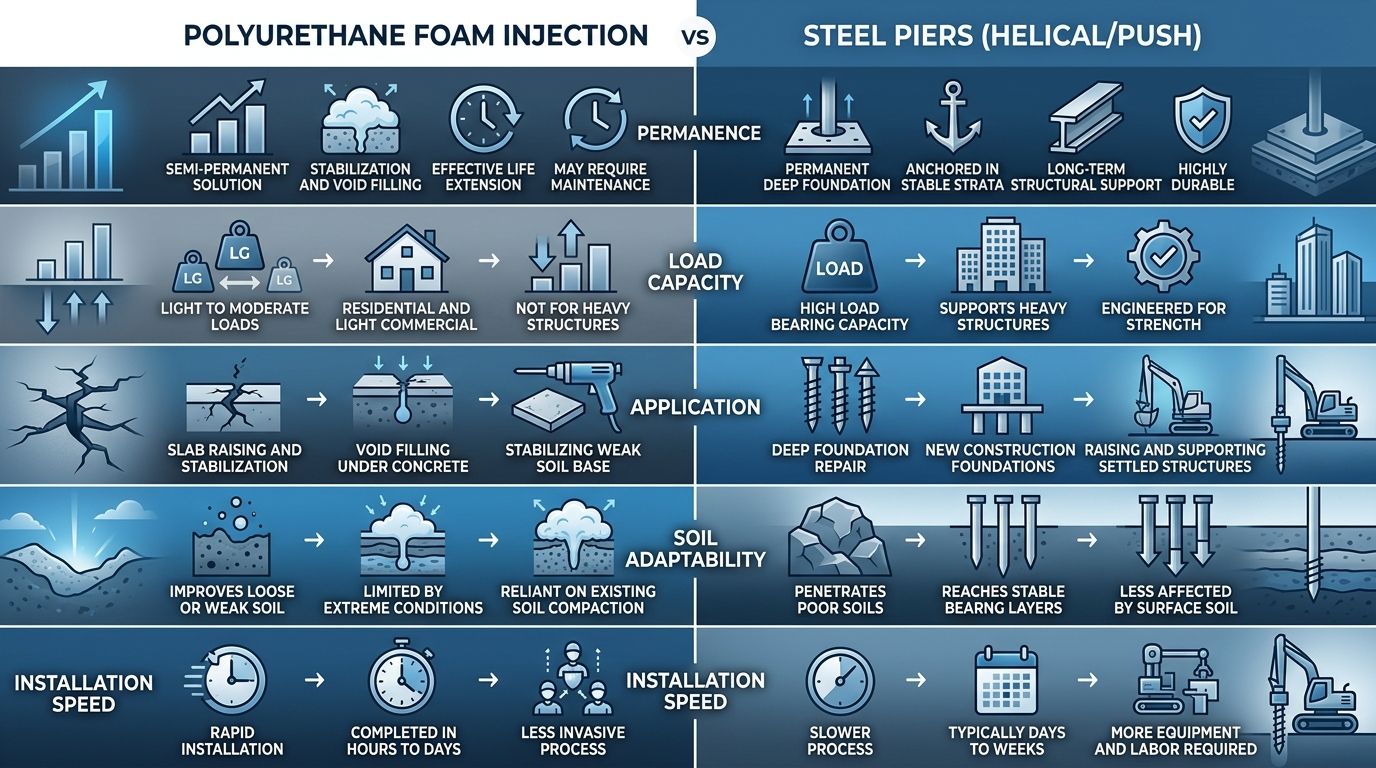
Our foundation repair solutions are rooted in ICC- and ISO-certified products backed by our engineering team. For specifics on helical pier installation, we encourage you to review our step-by-step guide and contact us for a project-specific quote.
Cost Factors in Choosing Between Foam and Pier Foundation Repair
Beyond performance differences, cost is a deciding factor in polyurethane foam vs steel piers foundation repair. While foam injection offers a lower upfront price, it may need re-application within a few years. In contrast, helical piers require a higher initial investment but are designed to last the life of the structure.
Soil conditions heavily influence pricing. In expansive clay soils, common in regions like San Antonio, both methods may demand deeper installations, but pier systems provide more reliable support. Site accessibility also matters. Tight crawlspaces or steep slopes can add surcharges for both methods, yet pier installation equipment often requires larger access. A contractor’s foundation repair contractor marketing approach frequently reflects the strength of their installer network, which can reduce logistics costs and lead to more competitive pricing for homeowners.
Finally, the load bearing capacity of helical piers is precisely engineered, reducing the hidden risk of future repairs that slab jacking vs foundation underpinning solutions like foam injection may not prevent. Because every foundation is unique, we recommend a professional site evaluation for a custom quote. Consult a structural engineer or our engineering team for project-specific design and installation guidance.
Making the Right Choice for Your Foundation Repair Project
Homeowners weighing polyurethane foam vs steel piers foundation repair face a pivotal decision that affects long-term stability. While polyurethane foam injection can stabilize loose soil, it does not transfer structural loads to competent strata. In contrast, steel pier systems—such as helical and push piers—provide deep-foundation support verified by ICC-ES documentation.
When comparing slab jacking and foundation underpinning, consider that slab jacking addresses surface settlement but cannot resolve deep-seated structural issues. For reliable load transfer, our advanced earth anchoring systems and underpinning solutions are engineered to meet the load bearing capacity of helical piers as calculated per ASTM and ICC-ES standards. For foundation crack repair, our structural injection epoxy and crack stitching products offer durable, code-compliant fixes. Also assess site conditions like freeze-thaw cycles, expansive clay soils, and chronic moisture, as these factors influence long-term performance and installation requirements over decades ahead.
We always recommend consulting a structural engineer or our manufacturer’s engineering team for project-specific design. Contact Helical Technology to request a custom quote and leverage our network of structural engineers for a foundation repair solution built to last.
Foundation Repair Solutions That Stand the Test of Time
When evaluating permanent foundation stability, distinguishing between modern solutions like polyurethane foam vs steel piers foundation repair is critical. At Helical Technology, our helical piers and push piers are engineered with ICC-ES documentation and have a proven, long-term track record for permanent stabilization—supported by our extensive network of structural engineers. Unlike temporary slab jacking vs foundation underpinning methods, our advanced earth anchoring systems leverage the exceptional load bearing capacity of helical piers and are custom-engineered for each site’s specific soil conditions. All Helical Technology products are ICC and ISO Certified products, ensuring every project meets the highest industry standards as established by organizations like the Foundation Repair Association. Our certified products and engineering support ensure each solution is built to last—learn more about the process below. Consult a structural engineer or the manufacturer’s engineering team for project-specific design and installation guidance.