

Table of Contents
Helical Pier Installation Training Fundamentals
Effective helical pier installation training begins with a thorough understanding of the helical pier system components. Our program combines classroom soil-mechanics theory, hands-on drive-head and torque-indicator practice, and supervised field installation.
Standard helical pier installation methods include push-to-rotate and synchronized drive techniques:
- Pre-installation: utility locates, tool inspections, hydraulic power pack lock-out/tag-out, and verifying components match engineering plans.
- Monitoring torque to achieve target capacity rather than a set depth, identifying refusal or spin-out conditions.
Torque monitoring is the primary quality-assurance indicator. Our helical pile torque monitoring training teaches installers to correlate torque data with soil capacity and to identify refusal, spin-out, or sudden pressure drops indicative of subsurface obstructions.
Our installer certification program includes modules on reading ICC-ES AC358 reports to confirm code compliance. We stress secure material handling and proper PPE use to prevent injuries. Every engineering decision must be validated by a structural engineer.
Before You Begin Helical Pier Training
Before you begin helical pier installation training, we recommend thorough installer fieldwork preparation that aligns with proven helical pier installation methods and regulatory requirements. Helical Technology provides engineering support through our network of structural engineers, helping you address technical questions ahead of on-site instruction. To get ready for training, follow these four essential prerequisites.
- Download our design software to model real-time load capacities and soil interaction. Familiarity with these foundation anchoring procedures and the torque-to-capacity relationship charts from the Deep Foundations Industry Association’s manual will give you a solid starting point.
- Review ICC-ES AC358 acceptance criteria on the building code compliance platform from the International Code Council (ICC) to understand how code officials evaluate helical pile systems. Pre-installation compliance checks with ICC standards build confidence before training begins.
- Obtain permit checklists from local municipalities that reference ICC/ISO certified products. This ensures your upcoming hands-on practice accurately reflects jurisdictional requirements for deep foundation projects. Reviewing these documents prevents delays during actual installations.
- Verify safety gear and torque indicator calibration meets manufacturer installer certification standards. Calibrating helical pile torque monitoring equipment before training guarantees that you can record accurate installation data during practice. Proper torque monitoring is the cornerstone of helical pier capacity verification.
Once these prerequisites are complete, you will be ready to proceed to the next section covering specific helical pier installation methods. We also recommend reviewing the latest best practices from the Deep Foundations Industry Association to stay current with industry standards.
Choose Your Certification Path
Choosing your certification path is the first actionable step in our helical pier installation training program. We offer distinct tracks based on your experience and project scope, from basic new construction anchoring to deep foundation repair solutions, all leading to mastery of our ICC and ISO certified product lines.
The foundational installer track is designed for newcomers, focusing on standard helical pier installation methods such as properly handling the helical pipe lead section and RCS pipe extensions detailed in our Helical Pier System catalog. This path establishes essential installation skills.
For experienced contractors, the advanced path covers complex underpinning brackets, plate anchors, and compliant helical pile torque monitoring that meets ICC-ES AC358 acceptance criteria.
We offer a downloadable checklist for each path, and our network of structural engineers can help you select the right one. Once you’ve chosen, the next section details the hands-on installation methods and torque monitoring needed to complete certification.
Complete Classroom and Hands-On Training
After completing foundational theory, Step 2 delivers supervised helical pier installation training that bridges knowledge with practical application. We begin in the classroom where our instructors detail product specifications for helical pipes, clarifying the difference between the lead section with its attached helix and the extension without. Our product specifications cover available wall thicknesses—Schedule 40 at 0.216 inches and Schedule 80 at 0.3 inches—and extension lengths from 42 to 124 inches to meet diverse site depth requirements.
Hands-on field exercises reinforce the helical pier installation methods taught in class. Trainees practice coupling a helical pipe diameter extension to a lead section using the exact components shown in our product pages. Under close supervision, trainers demonstrate proper helical pile torque monitoring, logging rotational resistance during installation to confirm compliance with ICC-ES acceptance criteria and our manufacturer guidelines. On‑site training is available through our network, preparing contractors for installer certification and project‑specific challenges. Our engineering team supports complex field scenarios to provide reliable guidance.
After mastering these hands-on techniques, installers are ready to manage real‑world variables on the jobsite.
Pass Written and Practical Exams
Following the coursework in our manufacturer-led training programs, participants progress to an exam phase that validates their helical pier installation training. The written assessment evaluates knowledge of installation methods, torque monitoring, and load-bearing principles, covering helical pier design and load transfer mechanisms. Alignment with the geotechnical engineering society (ISSMGE) professional standards and ICC acceptance criteria like AC358 establishes the technical baseline for certification in the United States. This ensures installers understand both the theoretical and practical aspects of foundation repair.
The practical component requires hands-on demonstration of proper equipment operation, safety protocols, and adherence to installation tolerances set by the International Code Council (ICC). Candidates must demonstrate proficiency in torque monitoring and helical pier installation methods, performing correct equipment setup and interpreting real-time data. Often validated through a competency evaluation or full scale testing, this hands-on assessment ensures every certified contractor meets our rigorous standards. Successful completion of both components leads to installer certification, reinforcing our engineering team’s confidence in each contractor’s skills.
Master Torque Monitoring
Validating theoretical bearing capacity requires precise field execution, making helical pile torque monitoring the definitive link between subsurface analysis and installed performance. For our 2 7/8″ diameter pipe systems, this process relies on a calibrated hydraulic torque head that provides real-time feedback directly correlating to the pile’s axial capacity.
We monitor the lead section advancement closely, as Helical Technology’s engineering specifications dictate that the specific helix configuration, such as an 8″ and 10″ dual-plate lead, is engineered to achieve targeted installation torque data. This resistance must be continuously verified against project-specific soil reports to confirm proper seating into a load-bearing stratum. When evaluating helical pier installation methods during the coupling process, we record the torque as each plain extension is added to ensure resistance does not drop, which would signal soft strata or a refusal not reached on a corner.
A common field misinterpretation is stopping monitoring once refusal torque is hit; however, we record the torque correlation continuously. Documenting the rate of increase, not just the final reading, provides the foundational data that proves engineering compliance and ensures long-term performance.
Apply Installation Methods Across Soil Conditions
With the right components selected, helical pier installation methods must adapt to the specific soil conditions encountered on site. We train contractors through our helical pier installation training to recognize that dense sand or shallow bedrock often allows our 84-inch extensions to reach competent bearing strata, while loose, sandy profiles or soft clay almost always require 124-inch extensions to achieve necessary depth. Throughout every job, helical pile torque monitoring provides real-time verification of soil capacity, confirming the pier has seated firmly in load-bearing ground before termination. We reinforce these practices with our engineering team’s project-specific soil analysis, ensuring every installation complies with ICC-ES AC358 acceptance criteria and matches the ground conditions precisely.
Troubleshooting Common Installation Challenges
Even high‑quality helical pier systems face installation challenges when site conditions vary. Our crews reduce these risks by completing comprehensive helical pier installation training on‑site before the first pile turns. A pre‑installation engineering review through our network remains the single best preventive step.
The following process flow guides our crews through the resolution path when field anomalies appear:
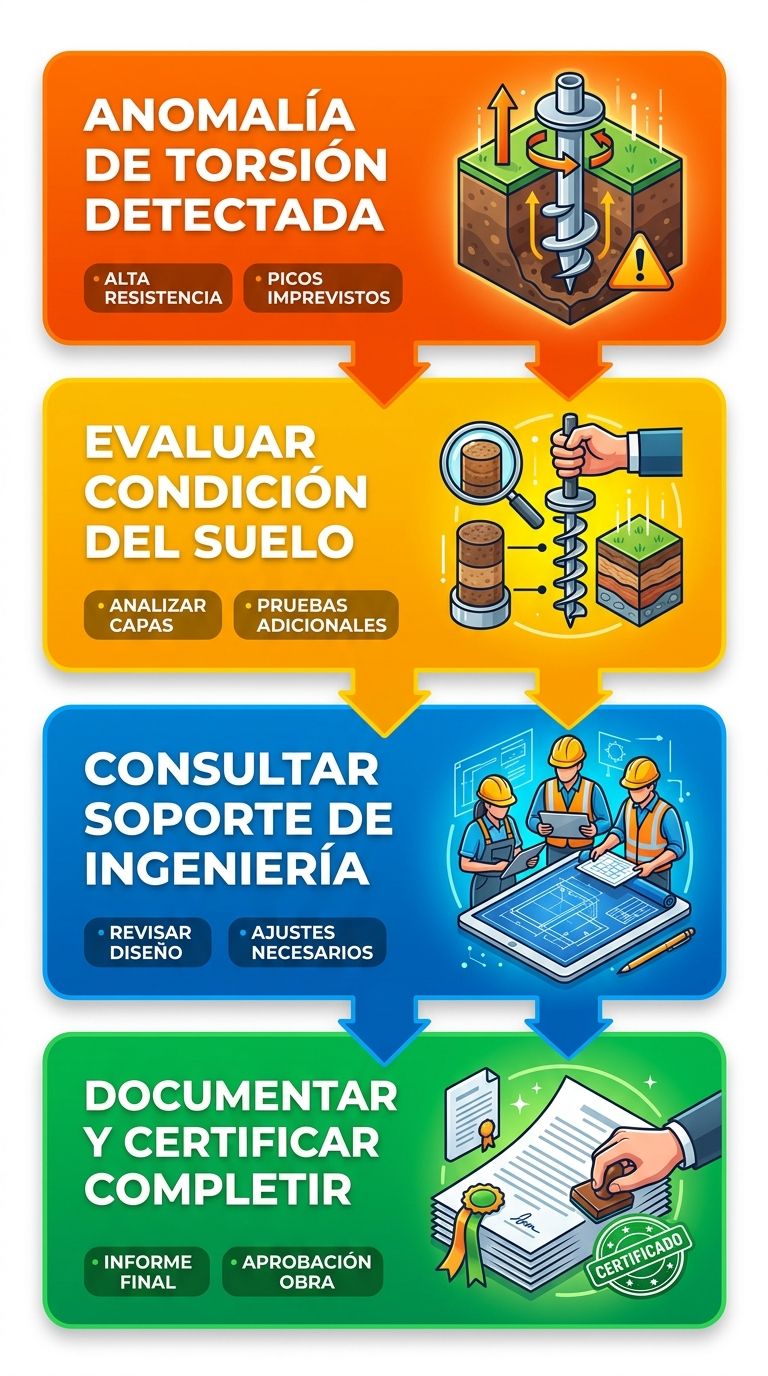
Solución de problemas de instalación de pilotes helicoidales en cuatro etapas
The most frequent field challenge is insufficient torque in layered soils. With real‑time helical pile torque monitoring that correlates hydraulic pressure to drive torque per ICC‑ES AC358 criteria, our teams immediately detect insufficient bearing capacity. When torque falls short, we halt, consult soil logs, and adjust rather than continue blindly. This prevents accepting piers with hidden load‑bearing deficiencies.
When a pier refuses due to buried obstructions, back‑spinning without a plan can compromise capacity. Our helical pier installation methods require documenting refusal depth, then contacting our engineering team for offset pile modeling. In sensitive clays, we avoid augering by switching to a larger lead section or grouted shaft alternative, and never simply powering through.
Field‑splicing in high‑groundwater zones demands precise coupler bolt torque. As Helical Technology’s catalog specifies, each bolt must reach the exact torque value listed for that pier series. Following these values—reinforced in our hands‑on training—prevents water ingress and corrosion that could undermine the foundation. Proper bolt torque is the primary defense against premature splice failure.
For crews, the surest way to avoid these issues is our manufacturer‑led helical pier installation training and certification program. Hands‑on practice and direct engineering design support eliminate guesswork that causes downtime.
Next Steps in Your Certification Journey
Gaining a theoretical understanding of helical pier installation methods is an excellent foundation, but rigorous certification is the key that transforms knowledge into professional credibility and project safety. For professionals ready to advance, we recommend enrolling in formal helical pier installation training at Helical Technology to bridge the gap between classroom concepts and field-ready competence.
To ensure every project is built on a code-compliant and structurally sound design, we direct installers and engineers to the authoritative acceptance criteria found through the International Code Council. The ICC-ES AC358 guidelines establish the benchmark for helical pile systems, and consulting this standard via ICC Digital Codes is a mandatory step before breaking ground.
To complement credentialing, we urge you to leverage our in-house resources. Our real-time design software allows for accurate modeling before installation, while our Engineering Excellence and Design Support network provides project-specific design review, ensuring every engineered solution meets the highest standard. Secure your latest product catalog and ICC/ISO certification documentation for your records, then reach out to our engineering team to specify your next successful project.
This article was researched and written with the assistance of AI tools.
Resources
- Get 3-1/2" Helical Pipe Extension with Helix
- Find 3-1/2 Inch Helical Pipe Lead Section
- Explore ICC-Approved Helical Pier System Products
- Get 2-7/8" Helical Pipe Lead Section with Helix
- Find 2-7/8" Helical Pipe Extension with Helix
- Get 3-1/2" 84-Inch Helical Pipe Extension
- Find 3-1/2" 124-Inch Helical Pipe Extension
- Find Deep Foundation Professionals and Resources
- Access ICC Digital Codes for Building Compliance
- Explore Geotechnical Engineering Resources and Network