

Table of Contents
House Stabilization Equipment Essentials
Essential house stabilization equipment counters foundation settlement issues by providing reliable lifting and load-transfer solutions. These specialized tools secure settling foundations, preventing further structural damage in homes affected by expansive soils or poor drainage. At Helical Technology, we distribute ICC and ISO Certified products designed for durable foundation repair solutions.
Helical piers represent a cornerstone of house stabilization equipment. These galvanized steel shafts are screwed into stable soil layers, transferring structural loads effectively. Ideal for lightweight structures and expansive soils, helical piers minimize disturbance during installation. We offer Building Foundation Reinforcement options that integrate seamlessly with these systems.
- Embedment: Reaches competent strata via torque monitoring.
- Capacity: Up to 100 tons per pier, per soil conditions.
Push piers complement helical piers in heavy-duty applications. Sectional steel columns are hydraulically driven into the ground until hitting bearing strata, enabling precise load transfer for substantial structures. Push piers excel in cohesive soils, driving external to the footing for minimal excavation.
- Installation: Sequential driving with hydraulic pressure.
- Verification: Load-tested incrementally for stability.
The International Code Council provides authoritative building code standards under ICC code Section 1810.3.3.1.9, mandating pier spacing, embedment depth, and capacities. Complete kits include hydraulic jacks, load monitoring systems, and safety gear. These tools enable proven installation techniques detailed next. Consult a structural engineer for project-specific guidance.
Fundamentals of House Stabilization Equipment
Foundation failure poses significant risks to residential and commercial structures, often due to soil settlement or poor load-bearing capacity. At Helical Technology, our house stabilization equipment, including helical piers and push piers, provides reliable foundation repair solutions. These ICC and ISO certified products ensure long-term structural integrity for contractors nationwide.
Types of Equipment for Foundation Stabilization
House stabilization equipment encompasses specialized tools for addressing sinking foundations, with helical piers and push piers as primary options. Helical piers, or screw-shaped steel piles, are rotated into the ground using hydraulic torque motors, offering resistance to uplift and compression.
Push piers consist of sectional steel piers driven hydraulically to bedrock refusal, ideal for dense soils. Key accessories enhance versatility:
- Hydraulic torque motors for precise helical installation
- Load-transfer brackets connecting piers to structures
- Pier extensions for varying depths
Helical piers excel in unstable or variable soils common to sinking houses, while push piers perform best in cohesive soils, per International Code Council (ICC) standards.
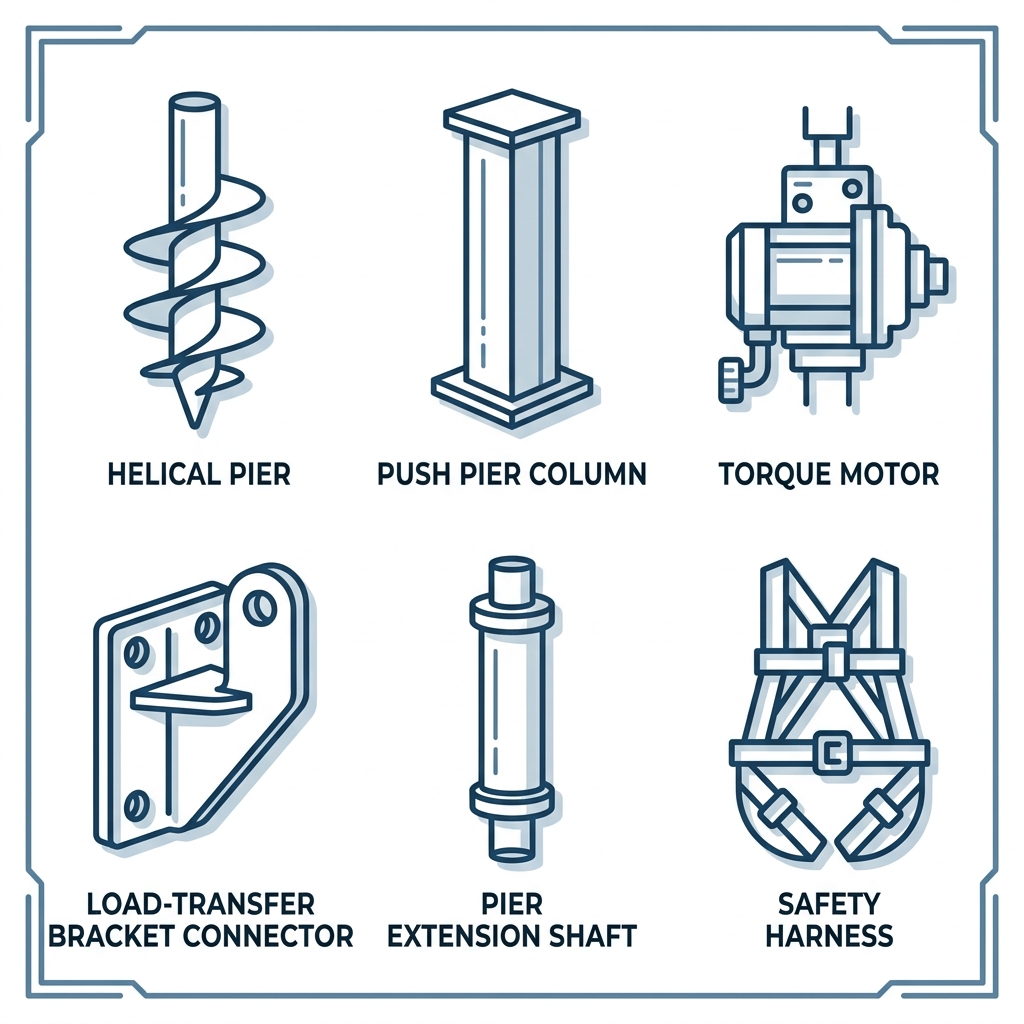
Key icons for house stabilization equipment fundamentals
Key Components and Technical Specifications
Core components of house stabilization equipment drive performance in helical piers and push piers, meeting ICC-ES acceptance criteria such as AC358 for helical piles and AC470 for anchors.
- Helical pier elements include robust galvanized steel: Central shafts (1.5-3.5 inch diameter), Helical plates (8-16 inch diameter), and Couplers.
- Push piers feature: External steel casing (3-4.5 inch diameter), Internal extensions, and Load-transfer brackets.
Example capacities: helical piers 25-100 tons; push piers 50-300 kips per pier, as defined by authoritative ICC building code standards under Chapter 18 Soils and Foundations.
Applications in Residential and Commercial Projects
House stabilization equipment applies to diverse scenarios. In residential projects, helical pile systems level sinking slabs or crawlspaces with minimal vibration. Commercial uses include stabilizing warehouse foundations using push pier systems. ICC guidelines inform pier spacing (4-8 feet) based on soil tests. Consult a structural engineer for site-specific guidance, and contact a trusted Structural Reinforcement Supplier.
Benefits of House Stabilization Equipment
Addressing settlement challenges in residential foundations, house stabilization equipment delivers unmatched benefits for contractors and homeowners. We at Helical Technology supply advanced earth anchoring systems that enhance foundation repair solutions.
Structural Integrity and Long-Term Durability
Helical piers screw into stable soil layers, bypassing weak zones to transfer loads effectively. Hydraulic jacks then lift structures precisely for accurate house leveling. This prevents future settlement and reduces differential settlement across additions and load-bearing walls.
- Enhanced load-bearing capacity through torque-correlated depth.
- Permanent resistance to shifting soils.
- ICC and ISO Certified products ensuring code compliance.
Cost Savings for Contractors and Homeowners
Helical piers pricing ranges from $1,200-$3,000 per pier, while push piers costs fall between $800-$2,500 per pier. Savings stem from reduced site prep, faster timelines cutting overhead by 30-50%, and minimal warranty claims.
Minimal Disruption and Quick Installation
House stabilization equipment installs in 1-2 days per home without heavy machinery. We supply these solutions as a leading US provider. Complementary options like the stabilizer post kit enable quick floor stabilizations with zero excavation.
Versatility Across Soil Conditions
Helical piers achieve torque-based capacities up to 50 kips in soft clays. Push piers excel with driving resistance up to 60 kips in dense gravels. Contact Helical Technology for Engineering Excellence and Design Support.
Mechanics of House Stabilization Equipment
At Helical Technology, we supply essential house stabilization equipment such as helical piers and push piers to counteract foundation settlement. These systems restore structural integrity through precise mechanical operations.
How Helical Piers Stabilize Foundations
- Attach the pier bracket securely to the foundation footing.
- Connect the helical pier extension to a hydraulic torque motor.
- Rotate into the ground until target torque capacity is achieved.
Push Piers Operation and Installation
- Position the steel push pier section via an underpinning bracket.
- Use hydraulic jacks bearing against the structure to drive the pier downward.
- Continue until reaching a stable stratum.
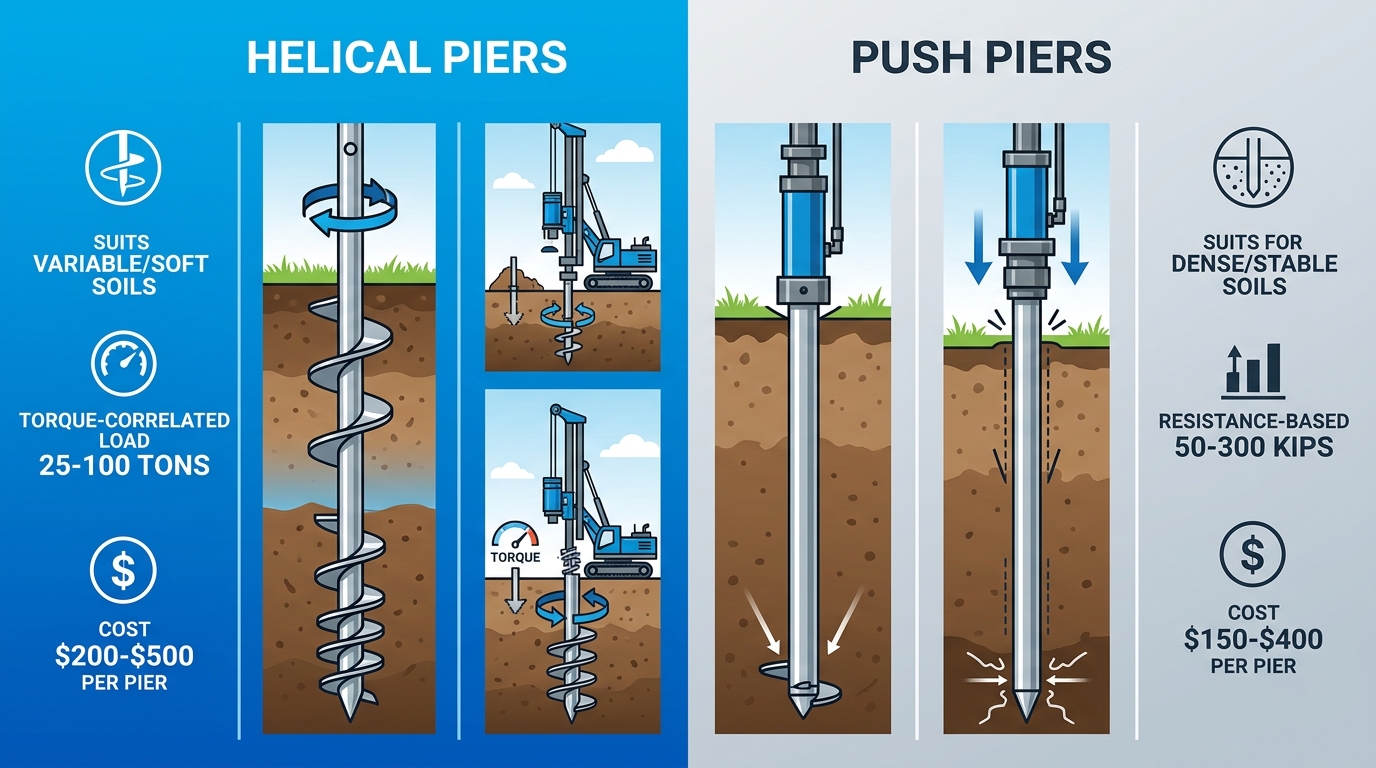
Helical piers vs push piers: key stats comparison
Comparison of Helical Piers vs Push Piers
| Feature | Helical Piers | Push Piers |
|---|---|---|
| Load Capacity | Torque-correlated | Hydraulic resistance-based |
| Installation Method | Rotary torque | Driving with hydraulic jacks |
| Soil Suitability | All types, excels in soft | Dense/stable soils |
| Estimated Material Cost | $200-$500 | $150-$400 |
Supporting Accessories and Tools
Effective systems require hydraulic torque motors, underpinning brackets, and load testing rigs. Our floor stabilization products include specialized brackets. Consult a structural engineer for project-specific guidance.
Best Practices for House Stabilization Equipment
We at Helical Technology emphasize safety and code compliance. Always consult licensed engineers for project-specific guidance.
Site Assessment and Soil Testing
- Conduct soil borings to profile strata.
- Perform standard penetration tests (SPT).
- Analyze load-bearing capacity (targeting 2,000 psf).
ICC-Approved Installation Procedures
Helical Pier Installation: Advance pile with torque motor to 5,000 ft-lbs minimum per ICC Sec. 1810.3.3.1.9.
Push Pier Installation: Push steel sections to refusal and monitor hydraulic pressure throughout.
Sourcing from Reliable Suppliers
Source equipment from trusted US suppliers. We at Helical Technology specialize in ICC-approved helical piers and steel push piers meeting ICC-ES AC358 criteria.
Maintenance and Monitoring Post-Installation
Conduct annual visual inspections. Check for cracks exceeding 1/4 inch; add crawl space stabilizer if needed.
Selecting Optimal House Stabilization Solutions
Key selection factors include soil conditions (helical for variable, push for dense), damage extent (use floor stabilizer post kit for minor settling), and load-bearing needs. Consult our network of structural engineers for a free assessment.
AI Disclosure: This article was researched and written with the assistance of AI tools.