

Table of Contents
Essentials of Structural Foundation Supports
Building on basics, here are IRC essentials for structural foundation supports that ensure load distribution and building stability per IRC R401. The International Code Council sets authoritative residential building code standards requiring foundations to support structures while managing soil loads, drainage, and frost protection. Compliant designs prevent settlement and structural failure.
Footings demand minimum dimensions, reinforcement, and frost protection under IRC R403.1 and Table R403.1(1). For instance, concrete footings require 2,500 psi compressive strength and Grade 40 steel reinforcement at 40,000 psi yield. Foundation walls follow IRC R404 criteria: minimum 7.5-inch thickness in seismic categories D0-D2, with height limits and lateral support. Concrete meets R402.2 specs, while alternatives like permanent wood foundations comply with R403.1.6.
Slab-on-grade provisions in IRC R506 and structural support per R403.1.3 address load-bearing soils up to 3,000 psf for sandy gravel. At Helical Technology in Littleton, CO, we supply ICC-certified options like helical screw piles and hydraulic push piers for advanced structural foundation supports when code minimums need enhancement.
These IRC guidelines prioritize safety; upcoming sections explore our foundation repair solutions, including helical piers, hydraulic push piers, and underpinning systems.
Understanding Structural Foundation Supports
Foundation failures from unstable soil or settling can lead to cracks, uneven floors, and structural risks. Structural foundation supports like piers and brackets provide reliable stabilization. At Helical Technology, our foundation repair solutions ensure long-term safety, complying with International Code Council standards for load-bearing capacities and installation.
Types and Components of Supports
Structural foundation supports include specialized components designed for durability and precise load transfer. These systems address foundation weaknesses effectively in residential and commercial settings.
Key types feature:
- Helical piers: Galvanized steel shafts with helical plates that rotate into the soil like screws, reaching stable strata without excessive excavation.
- Push piers: Interlocking steel sections hydraulically driven into the ground until they encounter firm resistance, providing strong underpinning.
- Brackets: Heavy-duty steel connectors that attach to the foundation footing or wall, transferring loads directly to the piers below.
International Code Council standards specify minimum load-bearing pressures, such as 3,000 psf for sandy gravel, guiding pier design and depth. These components integrate seamlessly for robust performance.
We supply ICC-certified helical piers and push piers to contractors nationwide, ensuring code-compliant installations that withstand soil variations.
Applications in Foundation Repair
Structural foundation supports excel in repairing foundations compromised by soil movement. They restore stability where traditional methods fall short, preventing further damage.
Common applications include:
- Unstable soil causing differential settlement, where piers bypass weak layers to competent bearing strata.
- Bowing basement walls from lateral soil pressure, stabilized using brackets and push piers.
- Long-term structure stabilization to halt cracking and heaving in expansive clays.
Per International Code Council guidelines, soil classifications dictate pier types and depths, with tests required for shifting soils. Push piers suit driven installations in dense conditions, while helical piers handle variable soils.
Our advanced earth anchoring systems enable contractors to address these issues efficiently, promoting safer buildings aligned with building codes.
Helical Piers as Foundation Supports
Helical piers offer superior performance in foundation stabilization. They target unstable soil or settling by advancing directly to load-bearing layers.
Installation involves torquing the helical pier system–galvanized shafts with helical plates–into competent soil, bypassing soft upper zones. This method achieves immediate load capacity upon reaching torque specifications.
Advantages over traditional methods include:
- Vibration-free installation, ideal near existing structures.
- All-weather usability, unlike concrete piers requiring dry conditions.
- Predictable performance verified by torque correlation to capacity, per International Code Council standards.
Consult our network of structural engineers for project-specific designs compliant with ICC-ES criteria. Helical piers in foundation repair provide enduring foundation repair solutions.
These supports transition seamlessly to professional installation techniques explored next.
Benefits of Structural Foundation Supports
Having explored types of structural foundation supports, their real-world value shines through enhanced stability and efficiency. At Helical Technology, our Building Structural Supports deliver unmatched load capacity, long-term cost savings, and project versatility, as endorsed by International Code Council (ICC) standards in IRC Chapter 4.
Load Capacity and Durability
Helical piers, a cornerstone of structural foundation supports, achieve load capacities from 50 to 500 tons, adjustable via helix size configuration. This flexibility aligns with IRC Chapter 4 requirements for permanent foundations, where the International Code Council (ICC) outlines soil-dependent design as authoritative residential building code standards. Unlike fixed concrete loads limited by soil bearing–such as 3,000 psf for sandy gravel per ICC data–helical configurations adapt precisely to site conditions.
Galvanized steel construction ensures 75+ year durability across expansive clays or shifting sands, resisting corrosion far beyond traditional footings. We supply ICC-certified helical piers that meet minimum compressive strengths and reinforcement standards, minimizing settlement risks. These pier-based supports provide reliable performance under heavy structural demands, supporting everything from homes to commercial builds with proven longevity.
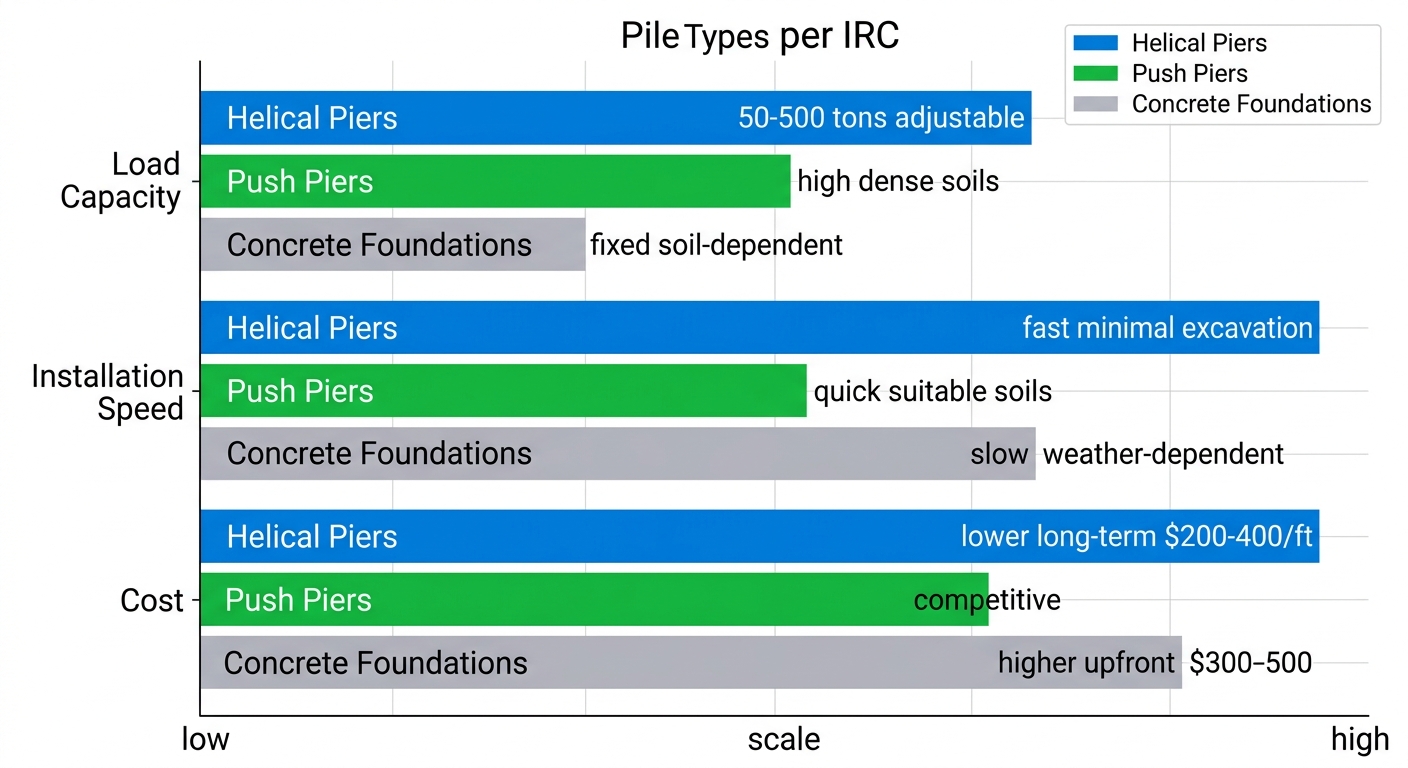
Foundation supports comparison: Helical Piers vs Push Piers vs Concrete
This visualization underscores helical piers’ advantages in capacity and speed, setting the stage for evaluating economic benefits in diverse applications.
Cost-Effectiveness Over Time
Structural foundation supports like helical piers offer initial costs of $200-400 per linear foot, competitive against concrete at $300-500. However, lifecycle savings dominate: minimal excavation avoids $10,000+ in site prep, while push piers provide alternatives in dense soils. Over 20 years, ROI projections favor piers due to reduced maintenance and no weather delays, per ICC installation guidelines.
We at Helical Technology emphasize these efficiencies through our ISO-certified products, cutting disruption and callbacks. Concrete demands extensive curing and backfill, inflating long-term expenses amid soil shifts. In contrast, helical pile foundations install vibration-free, preserving adjacent structures and accelerating project timelines. Clients realize substantial returns via durable, low-upkeep solutions that comply with IRC durability standards.
Versatility Across Projects
Structural foundation supports excel in residential settling repairs, stabilizing homes on poor soils without full replacement. Commercially, helical piers underpin high-rises in expansive clays, while push piers suit dense gravels, per IRC R401.4 soil classifications from the International Code Council (ICC). Our catalog supports clay, sand, or silt adaptations, ensuring code-compliant versatility.
From Littleton, CO projects to nationwide installs, these systems handle light-frame to heavy-load demands. Helical piers thrive in variable conditions, push piers in competent strata, outperforming rigid concrete. This adaptability integrates with underpinning brackets for comprehensive repairs, as we provide engineering support for site-specific designs.
These benefits enable seamless integration–see installation next. The following table illustrates key advantages:
| Feature | Helical Piers | Push Piers | Concrete Foundations |
|---|---|---|---|
| Load Capacity | High, adjustable via helix size | High in dense soils | Fixed, soil-dependent |
| Installation Speed | Fast, minimal excavation | Quick in suitable soils | Slow, weather-dependent |
| Cost | Lower long-term | Competitive | Higher upfront |
Data from Helical Technology catalog and ICC standards highlight helical piers’ edge, with push piers as strong alternatives and concrete lagging in flexibility. Consult our structural engineers for project-specific guidance, ensuring compliance with ICC-ES criteria.
How Structural Foundation Supports Work
Structural foundation supports like helical piers and push piers provide essential stability for buildings facing settlement issues. At Helical Technology, we supply ICC-certified products that ensure reliable performance in demanding conditions. The installation begins with precise processes tailored to each system.
Installation Process Overview
Helical piers and push piers follow distinct yet methodical installation sequences to transfer loads effectively to stable strata. For helical piers, installers start with comprehensive site preparation, clearing vegetation and excavating bracket locations per International Code Council (ICC) standards in IRC 2018 Chapter 4, which mandates minimum foundation depths and inspections.
- Site preparation: Verify soil conditions and mark pier locations.
- Lead section insertion: Advance round shaft helical piers using hydraulic torque motors, monitoring torque to confirm capacity.
- Extension additions: Attach extensions until refusal, correlating torque to load-bearing per engineering data.
- Bracketing to structure: Secure brackets to foundation walls or slabs with approved anchors.
- Load testing: Verify performance through incremental loading.
Push piers use hydraulic equipment for direct advancement. Resistance piers penetrate via skin friction until end-bearing refusal, tested similarly. These steps comply with ICC authoritative international building code standards for materials and inspections, ensuring long-term durability.
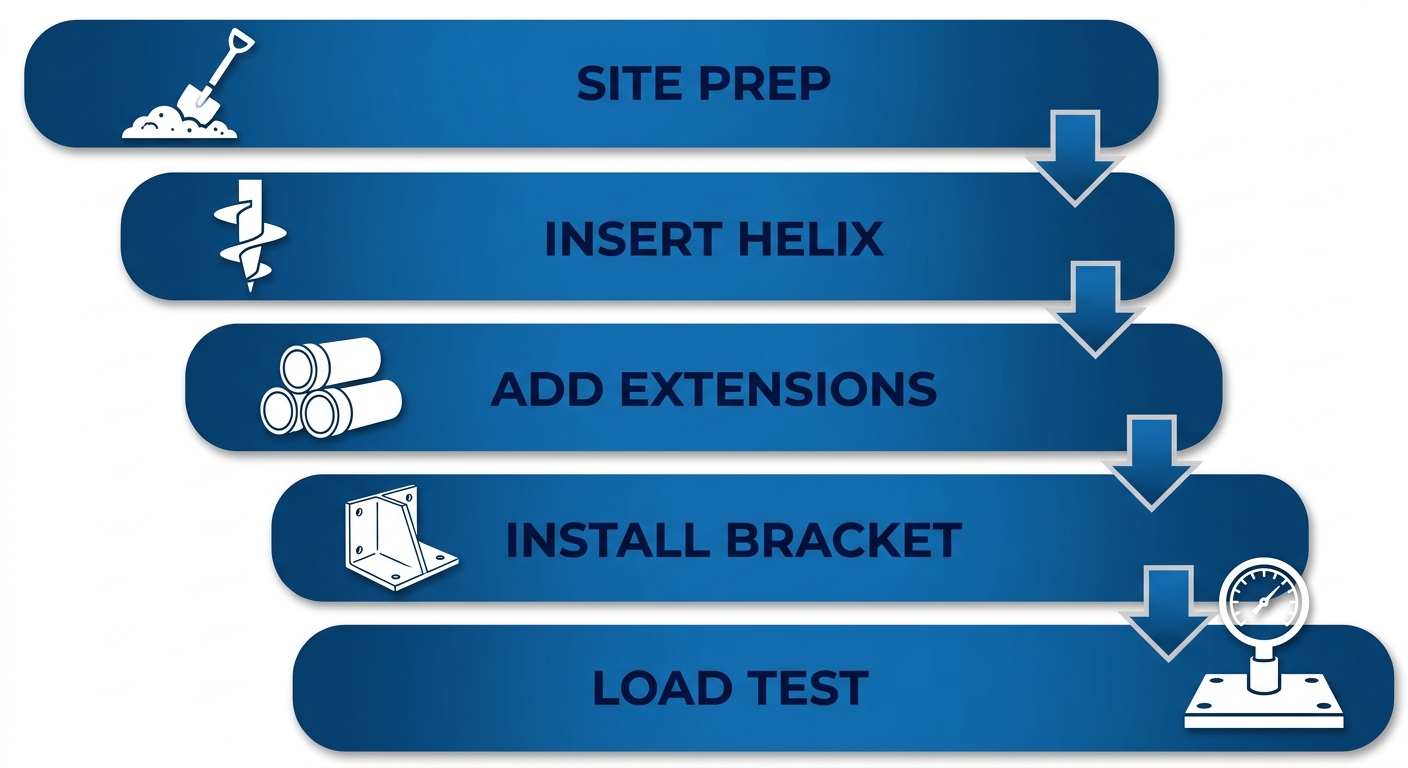
Helical pier installation process flow diagram
This visual illustrates the sequential nature of helical pier deployment, highlighting torque monitoring as a key differentiator from push methods.
Mechanics in Different Soils
Beyond installation, performance of structural foundation supports depends on soil mechanics, where helical piers excel through helix plate interaction. In clay soils, helical piles distribute loads via torque-generated capacity, preventing uplift and settlement as helix plates bear against cohesive soils.
- Clay soils: Helical piers achieve high capacity through plate adhesion and torque correlation, outperforming push piers reliant on skin friction.
- Unstable or collapsible soils: Screw piles provide immediate stability by screwing into competent layers, bypassing weak zones.
- Sandy or silty conditions: Push piers advance incrementally, using end bearing, but helical systems offer superior lateral resistance.
- Variable profiles: Helical piers adjust via extensions for layered soils.
According to ICC guidelines, soil load-bearing like 1,500 psf for clay aligns with pier design criteria. Push piers suit frictional soils but falter in soft clays compared to helical piers’ versatility. We recommend site-specific testing for optimal selection.
Engineering and Design Support
To ensure reliability, engineering design plays a key role in structural foundation supports. Our technical teams leverage proprietary software for precise capacity calculations, inputting torque-soil correlations and project loads to model helical and resistance pier performance.
- Software analysis: Real-time modeling per IRC soil pressures and seismic categories.
- Site-specific designs: Engineers assess geotechnical data for custom layouts.
- Code integration: Verify compliance with IRC 2018 Chapter 4 depths, reinforcements (40,000 psi steel), and inspections.
- Load transfer validation: Simulate bracket connections and foundation anchorage.
- Installer collaboration: Provide certified training and co-branded resources.
ICC authoritative standards guide our network of structural engineers, offering project-specific support. Consult our engineering team for tailored guidance, as installations must comply with building codes and ICC-ES criteria. This expertise previews capacity evaluations in upcoming sections on real-world applications.
Best Practices for Structural Foundation Supports
Once helical piers or push piers are selected, follow these best practices for implementing structural foundation supports that ensure long-term stability. At Helical Technology, we emphasize adherence to authoritative building code standards from the International Code Council (ICC), as outlined in IRC 2018 Chapter 4 Foundations. These guidelines cover foundation design, materials, and installation to handle soil conditions and loads effectively. By prioritizing certified products and skilled professionals, contractors can achieve reliable repairs compliant with ICC requirements across US jurisdictions.
Selecting Suppliers and Contractors
Selecting reliable suppliers and contractors sets the foundation for successful helical piers and push piers installations.
- Verify ICC certification for helical piers and related products.
- Choose US-based manufacturers for helical piers to ensure quality control and compliance.
- Confirm contractor experience with push piers installations, including at least 50 completed projects.
- Check state licensing boards for active contractor credentials and insurance.
- Review references and case studies from similar soil conditions.
- Ensure suppliers offer engineering support and training programs.
- Prioritize vendors with ISO-certified production processes.
We at Helical Technology supply ICC and ISO Certified products like helical piers tailored for US projects. This vetting process minimizes risks associated with substandard materials or inexperienced teams. Contractors benefit from our network of structural engineers for project-specific guidance, aligning with IRC standards for anchorage and reinforcement.
Maintenance and Monitoring
Ongoing maintenance extends the life of structural foundation supports post-installation.
- Conduct annual inspections for corrosion on helical piers.
- Perform torque checks on push piers to verify stability.
- Monitor for settlement signs like cracking walls or uneven floors.
- Clear vegetation within 5 feet of supports to prevent root interference.
- Check drainage systems per IRC guidelines to avoid water accumulation.
- Document changes with photos for trend analysis.
Pair with a Floor Stabilizer Post Kit for enhanced floor stabilization. These steps, informed by ICC foundation requirements, help detect issues early. Our technical support team in Littleton, CO, provides training to certified installers, ensuring foundation repair solutions remain robust against environmental factors.
Beyond monitoring, proactive care aligns with code-mandated durability. Regular upkeep prevents costly failures and maintains load-bearing capacity as per soil classifications in IRC Chapter 4.
Cost Considerations and Planning
Effective budgeting ensures feasible helical piers repair projects without surprises.
- Estimate material costs at $200-500 per pier for structural supports.
- Allocate 20-30% of total for labor by certified teams.
- Include permits and inspections, typically $500-2,000.
- Factor engineering consultations at $1,000-3,000.
- Plan for phased payments to manage cash flow.
At Helical Technology, our Engineering Excellence and Design Support optimizes expenses through precise modeling. These breakdowns comply with IRC provisions for reinforced foundations. Phased approaches suit residential and commercial needs, with disclaimers to consult structural engineers for site-specific designs.
With proper planning, these practices minimize costs and maximize longevity of advanced earth anchoring systems.
Lasting Stability with Structural Foundation Supports
To achieve lasting stability in residential structures, structural foundation supports play a critical role in preventing settlement and ensuring long-term durability. At Helical Technology, we supply ICC-certified products that address foundation vulnerabilities by transferring loads to competent soil layers, safeguarding homes against shifting grounds and structural shifts.
Helical piers provide immediate stability through their screw-in installation method, which advances into stable soil strata without excessive excavation. This torque-correlated process ensures reliable load transfer, minimizing disruption to surrounding landscapes. In contrast, push piers use hydraulic resistance for installation, driving sections incrementally to refusal for robust underpinning.
These methods align with authoritative building code standards from the International Code Council in IRC 2018 Chapter 4, which mandates foundation depths, reinforcement, and anchorage for stability. For instance, concrete must achieve a minimum compressive strength of 2,500 psi. In challenging soils, an advanced earth anchoring system enhances performance by securing structures against lateral forces.
Structural foundation supports deliver enduring reliability and code compliance. Consult our network of structural engineers for project-specific guidance. These supports are installed via proven methods such as helical torque monitoring and hydraulic pushing.
This article was researched and written with the assistance of AI tools.