

Table of Contents
Understanding Advanced Earth Anchoring Systems
Beyond traditional methods, advanced earth anchoring system options offer superior alternatives for infrastructure projects. At Helical Technology, we distribute these torque-induced helical piles or hydraulically driven piers that transfer structural loads to stable soil strata without deep excavation, minimizing disruption and environmental impact.
Helical piers feature galvanized steel shafts equipped with helical plates. Contractors rotate them into the ground using hydraulic torque motors. The helix bearing plates develop load capacity through direct bearing on competent soil layers, ideal for challenging conditions like wet or soft soils.
Push piers comprise interlocking steel sections hydraulically driven into the earth until refusal on bedrock or competent strata. External sleeve extensions provide surface connections for load transfer. Key quantifiable benefits over concrete foundations include:
- 80% faster installation, often completing in days versus months
- Zero spoils generation, eliminating excavation waste
- Verifiable load tests up to 500 kips per pier
An authoritative industry case study by the American Society of Civil Engineers (ASCE) demonstrates steel piles in electrical substation foundations, achieving 30-50% cost reductions with minimal disturbance. Consult our engineering team for project-specific guidance. Next, explore installation techniques for these systems.
Helical Piers
Helical piles form an advanced earth anchoring system. These steel screw piles twist into the ground for stable support without deep excavation. Helical piers deliver reliable foundations superior to concrete.
We screw helical piers into soil using hydraulic torque motors until load-bearing strata. Unlike push piers, they handle variable soils without displacement, providing immediate load capacity and minimal disturbance for urban substations.
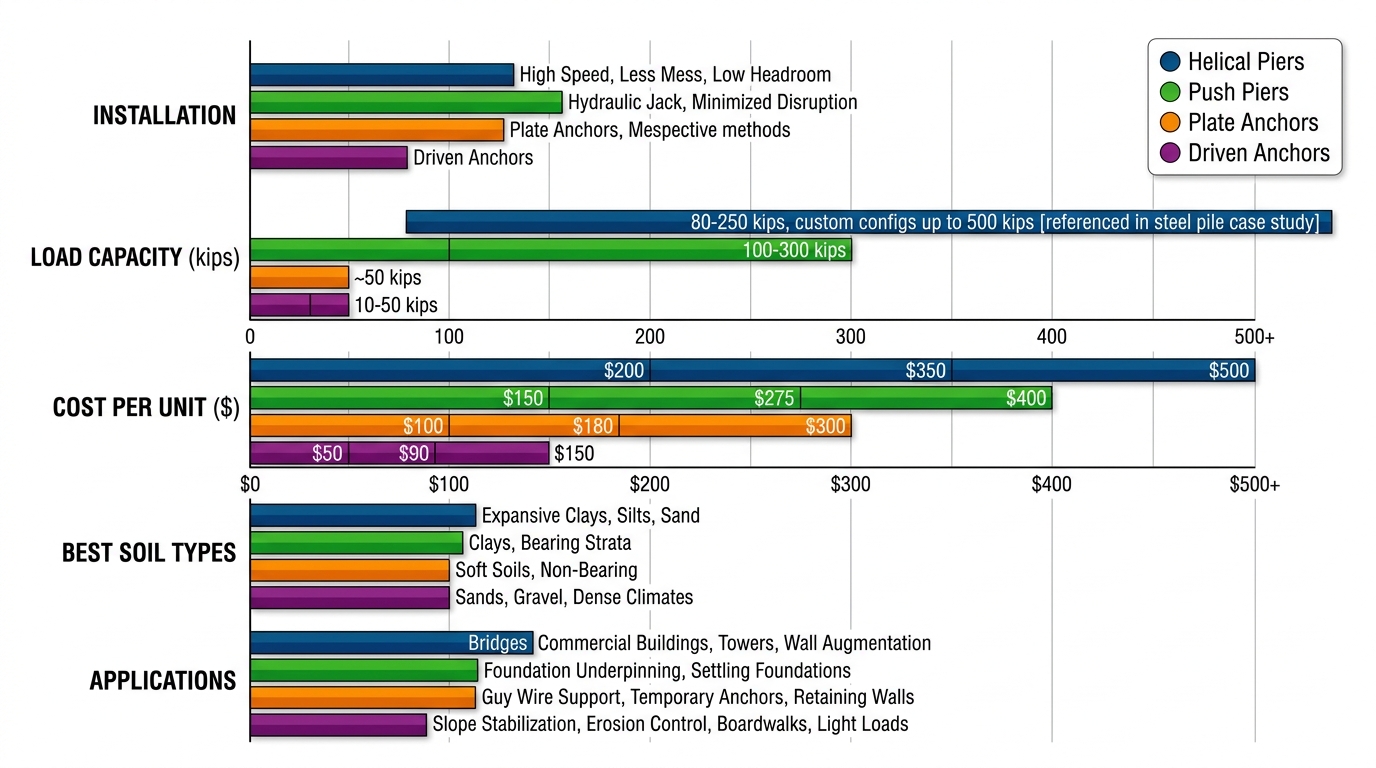
Comparison of advanced earth anchoring tools performance across key criteria
Helical piers installation process visualization in four key steps
An American Society of Civil Engineers case study shows helical piers replacing concrete for electrical infrastructure, cutting installation time and environmental impact.
Push Piers
Unlike torque-installed helical piers, push piers represent an advanced earth anchoring system of steel shafts with helical plates, hydraulically driven into unstable soil until stable strata.
A bracket attaches to the foundation; hydraulic rams advance the pier 3-4 feet per increment, load-tested each step for immediate transfer. Benefits include minimal excavation, no soil removal, and access to tight sites.
ASCE case study shows steel piles replacing concrete for electrical substations, enabling faster installs with less disruption.
Underpinning Brackets
One effective method in our advanced earth anchoring systems involves underpinning brackets, steel brackets attached to the foundation footing and connected to piers for load transfer. These enable precise stabilization in settling residential and commercial structures.
We excavate beside the footing, weld or bolt the bracket, then attach to hydraulically driven push piers or screw-in helical piers. Benefits include minimal disruption and immediate load transfer, unlike direct piers. These brackets excel when combined with helical piers for optimal results.
Plate Anchors
Unlike screw-based helical piers, plate anchors deliver a foundational advanced earth anchoring system through steel shafts with welded circular bearing plates that resist uplift via direct soil bearing pressure.
We drive or auger anchors into the ground until plates fully engage cohesive soil for maximum resistance. Applications include tension ties for retaining walls, guy wires on transmission towers, and uplift restraint for lightweight solar array foundations.
Cost-effective in consistent clays with quick, no-pre-drill installation, they suit pure tension loads versus helical piers for variable soils or push piers for settlement correction. Plate anchors complement push piers in hybrid designs for optimal stability.
Helical Anchors
A primary solution is helical anchors, steel shafts with welded helical plates screwed into the ground to provide tension or compression resistance for foundations. They anchor securely as part of our advanced earth anchoring system portfolio.
We rotate helical anchors into soil using a hydraulic torque motor until target torque correlates to load capacity, enabling immediate loading. Benefits include no excavation, minimal vibration, and verifiable capacity via torque ratio.
Unlike push piers, which displace soil and may need pre-drilling, helical anchors excel in cohesive soils. Our innovative ground anchoring solution ensures reliability.
Helical Tiebacks
Building on helical pier technology, helical tiebacks form a core component of advanced earth anchoring systems. These steel shafts with helical plates rotate into soil to resist lateral forces in retaining walls and foundations.
We install them by torquing into stable strata using hydraulic equipment, achieving immediate load capacity without soil removal. Unlike push piers that hydraulically push and disturb soil, helical tiebacks screw in with minimal disruption; like helical piers but for tension.
Key benefits:
- Vibration-free installation
- Verifiable torque-to-capacity correlation
- Ideal for limited-access sites
Ready to secure your project? Buy Helical Tiebacks today, leading into case studies.
Driven Anchors
In contrast to rotational helical piers, driven anchors represent a vital component of advanced earth anchoring systems. These steel pipe sections are hydraulically driven into the ground without rotation or soil excavation.
Installation starts with a lead push pier section attached to the structure. Hydraulic rams force it through compressible soils to refusal on bedrock or firm strata, then couple extensions as needed.
Advantages feature minimal vibration, no spoils removal, and rapid setup in confined spaces, though ineffective in cobbles and requiring equipment access. Driven anchors suit certain soils, but helical piers excel in others.
Helical Pipes and Extensions
Building on standard helical designs in our advanced earth anchoring system, helical pipes or helical piers use steel shafts with welded helical plates. They screw into soil via torque for load-bearing capacity.
Helical pile extensions, additional segments, couple to piers to reach deeper stable layers when surface soils fail. Installation rotates pipes clockwise using hydraulic equipment to target torque, adding extensions as needed.
Unlike disruptive push piers, helical piers minimize soil disturbance. They provide immediate load capacity, suit limited-access sites, and adapt to varied soils for processes detailed next.
Earth Retention Systems
To address soil instability, Earth Retention Systems are essential. They prevent soil movement during construction by providing lateral support via anchors and walls using our advanced earth anchoring system. Helical piers enable vibration-free installation for temporary or permanent retention, contrasting push piers for deeper, high-load applications in dense soils. Benefits include 30-50% faster times and no spoil versus sheet piling. Discover how our innovative anchoring solutions perform in real projects.
Crack Repair Products
Once cracks are identified, select the right products. Our advanced earth anchoring system features helical piers as screw-like anchors that stabilize foundations by transferring loads to deeper, stable soil layers. These helical piers provide minimal disruption and immediate load transfer for long-term crack prevention.
Push piers, hydraulically driven steel piers, deliver high-capacity support in crack-prone structures within our advanced earth anchoring system. These reliable choices ensure professional crack repair. These products are installed efficiently by certified teams.
Comparison of Advanced Earth Anchoring Tools
Advancing beyond basic anchors, advanced earth anchoring systems provide engineered precision for foundation repair and new construction projects. At Helical Technology, we offer ICC-certified helical piers, push piers, plate anchors, and driven anchors to meet diverse needs. The following table compares key features of these top advanced earth anchoring tools based on project requirements, soil type, and budget.
Side-by-side analysis of key tools to aid selection based on project needs, soil type, and budget.
Feature Comparison of Top Earth Anchoring Tools CriteriaHelical PiersPush PiersPlate AnchorsDriven Anchors
| Installation | Rotary helical screwing | Hydraulic ramming | Plate driving/pulling | Percussion driving |
| Load Capacity | 50-500 kips | 100-300 kips | Wall tension up to 50 kips | 10-50 kips |
| Best Soil Types | Sand, clay, loose | Dense clay, stiff | Stable walls | Firm soils |
| Applications | Settling foundations | Settlement | Wall stabilization | Light tie-downs |
Load capacities vary significantly across these tools, with helical piers offering the highest range of 50-500 kips in compressive and tensile forces, as supported by authoritative civil engineering benchmarks from the American Society of Civil Engineers (ASCE) for steel pile performance. This makes helical piers ideal for demanding loads in variable soils, including soft and wet conditions, while push piers handle 100-300 kips effectively in dense clay. Plate anchors suit wall tension up to 50 kips, and driven anchors manage lighter 10-50 kips.
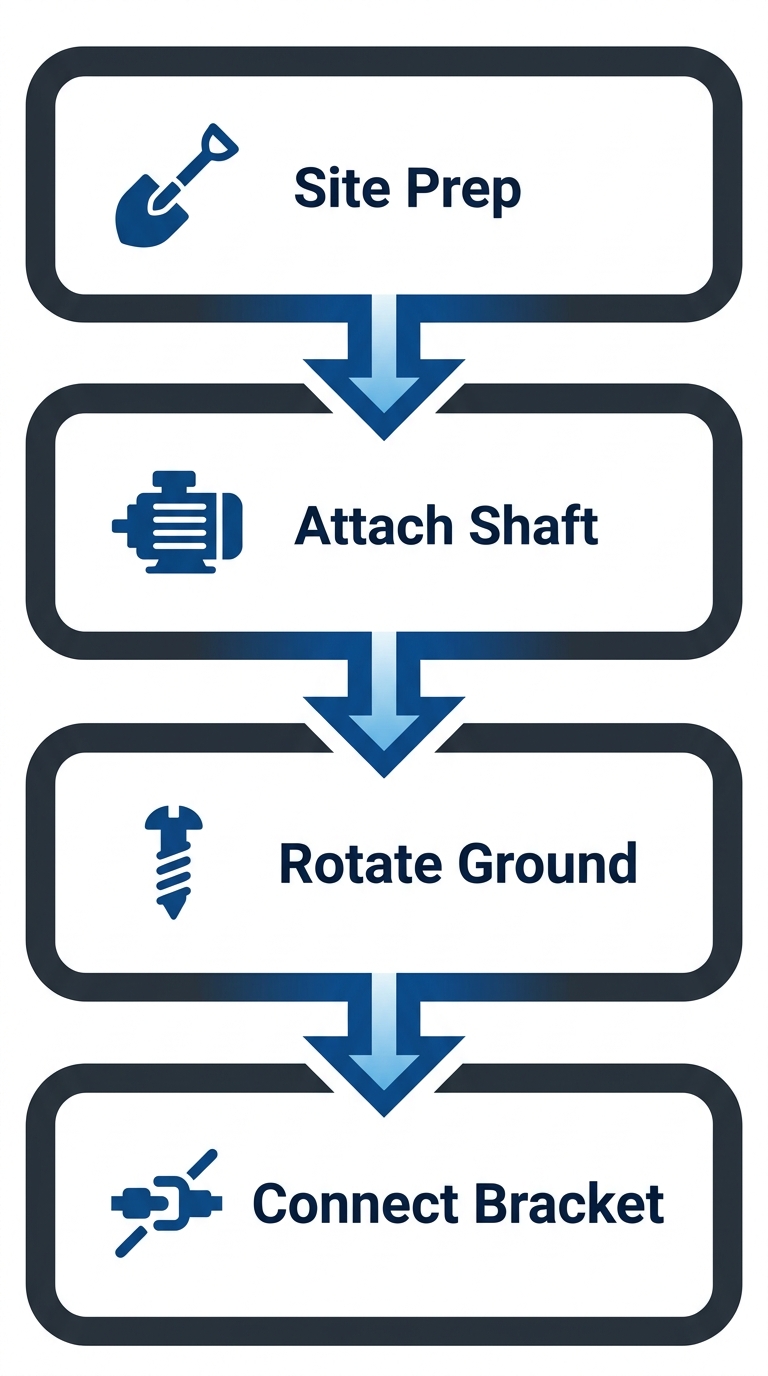
Helical piers installation process visualization in four key steps
Comparison of advanced earth anchoring tools performance across key criteria
Our engineering support helps match these foundation repair solutions to your project. Consult a structural engineer for site-specific design, ensuring compliance with ICC-ES criteria. Select based on soil test results and load requirements for optimal performance. Real-world case studies in the following section demonstrate these tools in action.
Selecting the Right Earth Anchoring Solution
Selecting the optimal advanced earth anchoring system for porches demands matching solutions to site conditions like soil type and loads. Building on identified project needs such as soil stability, we at Helical Technology outline a step-by-step framework to ensure lasting performance.
Follow these key steps:
- Assess soil bearing capacity and type. Sandy soils favor helical piers‘ screw-in action; cohesive clays suit push piers‘ hydraulic drive.
- Calculate total loads. Include dead weight from materials and live loads like occupants or snow, sizing anchors with a 2x safety factor.
- Compare installation traits. Helical piers enable vibration-free work in sensitive areas; push piers deploy rapidly in dense soils.
- Evaluate accessibility. Helical piers use compact equipment for tight spaces; push piers need more headroom.
- Prioritize durability. Choose galvanized steel anchors resisting corrosion for 50-year lifespans in aggressive soils.
Contact local porch builders near me or our network of structural engineers for geotechnical testing and advice. Consult a structural engineer for project-specific designs compliant with ICC-ES criteria.
Prioritize soil testing, load calculations, and site access to select superior modern advanced earth anchoring systems. Proper installation follows next for maximum longevity.
This article was researched and written with the assistance of AI tools.