

Table of Contents
Building Structural Supports Essentials
Beyond basic footings, building structural supports like piers ensure deep, long term stability in challenging soil conditions. These critical foundation elements transfer building loads to stable soil strata, preventing settlement and structural failure. At Helical Technology, we provide ICC and ISO Certified products tailored for reliable performance in new construction and repairs.
Structural Foundation Supports such as helical piers and push piers form the backbone of advanced foundation systems. Helical piers, installed as screw piles by torque correlation, achieve embedment depths per prescriptive International Code Council standards in Section 1810.3.3.1.9. This section mandates verifying deep foundation capacity through load tests or documented correlations, specifying minimum shaft diameters, helix plate sizing, and corrosion protection.
In contrast, push piers use steel shafts hydraulically driven to refusal, offering robust alternatives without pre-drilling.
- Helical pile allowable axial load determined by the least of base capacity, shaft resistance, or torque-based evaluations, per ICC guidelines.
- Site-specific soil investigations are essential before selecting structural piling systems.
These code-compliant essentials guide proper helical pier deployment methods. Consult our network of structural engineers for project-specific design, ensuring compliance with ICC-ES AC358 criteria.
Recognizing Failing Building Structural Supports
Failing building structural supports can lead to catastrophic damage if ignored. At Helical Technology, we see homeowners in Littleton, CO, and beyond overlooking early warning signs of weakening columns, beams, and foundation piers. Early detection prevents costly repairs and ensures safety. This guide outlines visual cues, functional issues, and when to act.
Visual Indicators of Structural Failure
Spotting visible damage in building structural supports starts with routine inspections. Cracks wider than 1/4 inch in foundations or walls signal stress on piers and beams. Differential settling over 1 inch shows uneven support, often from soil shifts. Bulging or bowing exterior walls indicate failing columns under load. Separation gaps around doors and windows exceeding 1/2 inch reveal frame distortion. Spalling concrete on support beams exposes rebar to corrosion. Also inspect support connections and visible corrosion on steel elements, and note any new or progressive movement during seasonal cycles for accurate assessment and documentation.
Functional Symptoms in Buildings
Beyond visuals, functional symptoms emerge from compromised building structural supports. Sticking doors and windows occur as frames warp from shifting foundations. Sloping or uneven floors, testable by rolling a marble, point to settled piers. Wall cracks widening over time track ongoing movement in beams. Water intrusion at baseboards stems from gaps in settling supports, worsening erosion. Squeaking floors signal loose connections in structural elements.
When to Call Foundation Experts
If multiple signs appear, consult foundation experts immediately. We recommend three diagnostic steps at Helical Technology. First, document photos and measurements of cracks, gaps, and settling for precise records. Second, check for utility disruptions like misaligned pipes from shifting supports. Third, perform simple level checks across floors to quantify slopes.
Experts differentiate remediation options. Helical piers excel in variable soils with torque-based capacity, meeting ICC authoritative international building code standards for helical pile design, load capacities, and inspections in Section 1810.3.3.1.9. Push piers suit stable soils but risk refusal. For minor issues, products like the Floor Stabilizer Post Kit provide quick stabilization alongside piers.
Benefits of Helical Piers for Building Structural Supports
Beyond installation, the true value of helical piers lies in their benefits for building structural supports. At Helical Technology, we distribute ICC-certified helical piers that deliver unmatched reliability for foundations in new construction and repairs. These advanced earth anchoring systems ensure long-term stability across diverse projects.
Load Capacity and Durability Advantages
Helical piers excel in load capacity through torque-based load testing, allowing immediate verification of performance during installation. According to authoritative International Code Council (ICC) standards in Section 1810.3.3.1.9, the allowable axial design load considers installation torque correlations, base capacity, shaft resistance, and load tests when required. This enables design capacities up to 500 kips per pier, far surpassing many alternatives. Our helical pier system termination methods comply fully with these code-compliant criteria for safe, verifiable results.
Durability stands out with lifespans exceeding 100 years, even in corrosive soils, due to galvanized steel construction and minimal disturbance. This longevity reduces replacement needs, providing superior strength over traditional driven piles or concrete.
Cost-Effectiveness Over Time
Initial installation costs for helical piers range from $200-500 per pier, lower than concrete piers at $400-800 plus extended curing times. No large-scale excavation saves labor and site preparation expenses, enabling faster project timelines.
Over 50 years, minimal maintenance and no soil resettling keep total ownership costs down. Concrete piers often face cracking and repairs, while helical pile systems avoid these issues, delivering better returns for contractors using our foundation repair solutions.
Versatility in Applications
Helical piers adapt to challenging soil conditions like weak clays, loose sands, rocky terrains, and seismic zones. The ICC emphasizes torque correlations for proper embedment in varied soils, ensuring stable building structural supports without preload requirements.
They suit diverse projects:
- New builds from residential to high-rises
- Retrofitting existing foundations
- Light structures and heavy commercial loads
- Underpinning in urban sites with access limits
| Feature | Helical Piers | Push Piers | Concrete Piers |
|---|---|---|---|
| Installation Speed | Fast, torque-based | Medium | Slow |
| Soil Versatility | High | Medium | Low |
| Cost per Pier | $200-500 | $300-600 | $400-800 |
Data from Helical Technology catalog and ICC reports. Reference section on soils for installation notes.
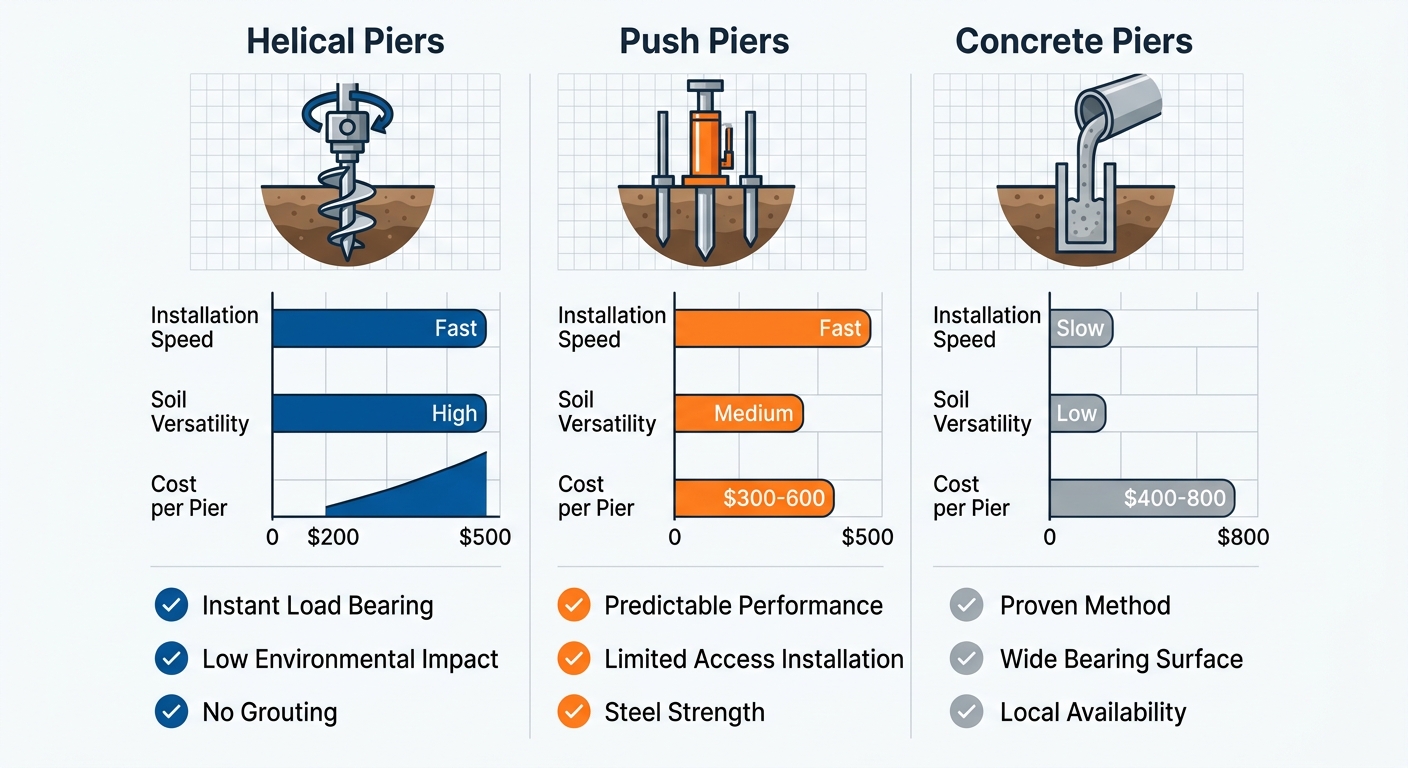
Helical piers vs alternatives: speed, versatility, cost comparison
Mechanics of Helical Piles in Building Structural Supports
Helical piles, also known as helical piers, function as screw-like foundations torque-installed into the ground to transfer building loads to stable soil strata. At Helical Technology, we supply ICC-approved helical piers designed for precise structural foundation supports in diverse conditions.
Installation Process Step-by-Step
- Site preparation: Clear the area and mark pile locations based on engineering plans.
- Attach torque motor: Couple the hydraulic motor to the pile head using adapters.
- Torque advancement: Rotate the helical piers clockwise while applying downward thrust; monitor torque in real-time, correlating it to capacity per International Code Council (ICC) standards.
- Embedment verification: Achieve target depth where torque stabilizes, often using extensions or plate anchors for additional bearing in shallow soils.
- Load testing: Perform pull-out or compression tests to verify at least 200% of the design load, confirming ICC-compliant performance.
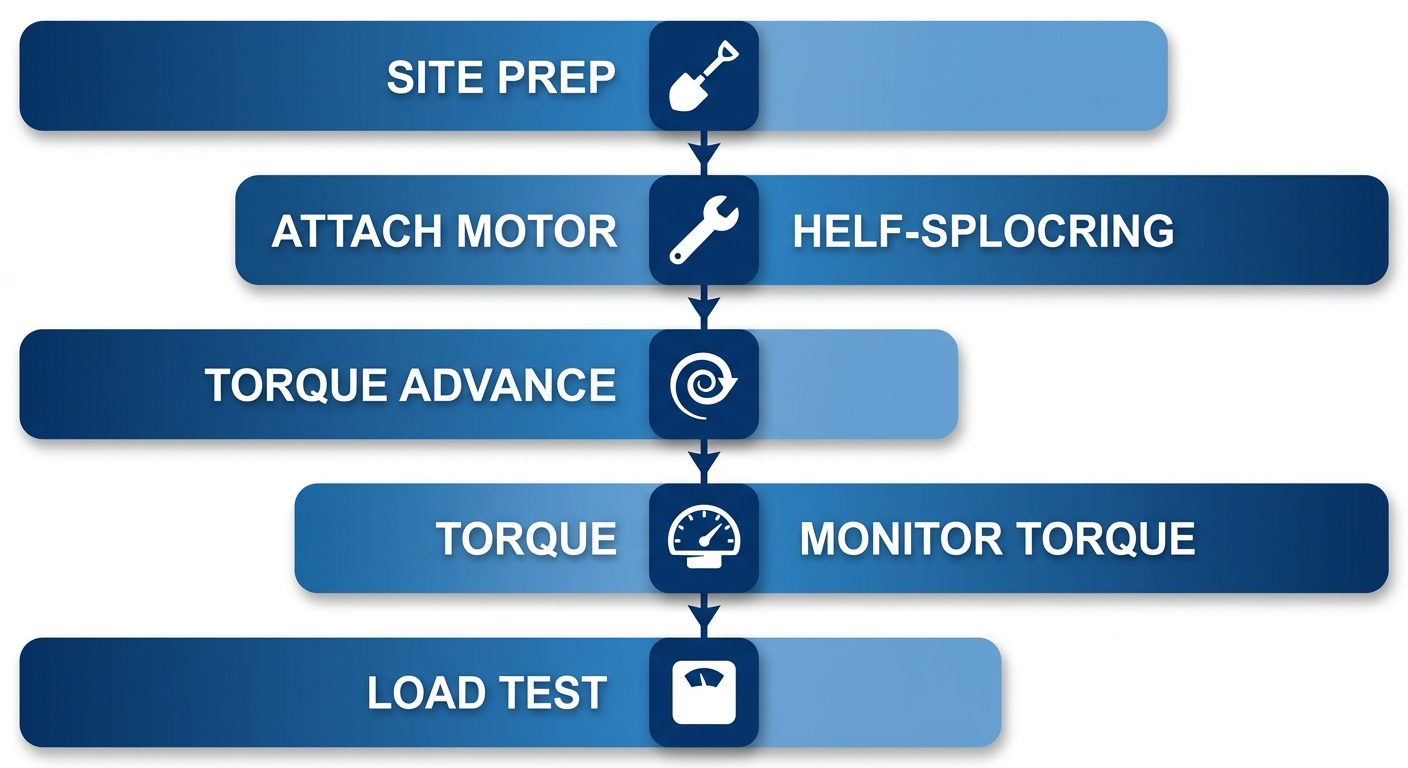
Step-by-step helical pile installation process for building supports
How Helical Piles Transfer Loads
Helical piles primarily transfer loads through helix bearing and shaft friction, optimizing foundation load capacity. The bearing capacity (Qs) sums individual helix capacities via the Terzaghi equation.
Push Piers Complementary Role
Push piers employ hydraulic rams to press steel sections into the ground without rotation, ideal for cohesive soils where helical piers excel in tension. At Helical Technology, we distribute both push piers and helical piers for hybrid building structural supports.
- Helical piers for uplift resistance in expansive clays paired with push piers for downward loads.
- Hybrid systems in mixed soils, using helical screw piers for tension and driven push piers for bearing.
- Comprehensive repairs where push piers underpin slabs alongside helical piers stabilizing walls.
Best Practices for Building Structural Supports
Once failure signs are identified, follow these best practices for building structural supports to ensure long-term stability. At Helical Technology, we emphasize precise site assessment, expert installation, and smart cost strategies using our ICC and ISO Certified products.
Site Assessment and Design
Begin with mandatory soil testing procedures per International Code Council standards for soils and foundations. Conduct bearing capacity analysis through standard penetration tests and evaluate groundwater levels to determine load-bearing potential. Address yard drainage yard drainage to prevent soil saturation.
- Perform borings at 50-foot intervals.
- Analyze soil shear strength.
- Verify expansive soil risks.
Installation Techniques and Tools
For helical piers: 1. Position the lead section vertically using laser levels. 2. Advance with a torque head until 5000 ft-lbs minimum torque is achieved. 3. Install extensions and attach brackets securely to the foundation footing.
Safety Warning: Always use hydraulic torque motors and wear PPE during rotation.
- Hydraulic jacks for push piers.
- Torque heads and drive heads for helical screw piles.
- Laser levels for alignment.
- Load cells for verification.
Cost Management Strategies
Managing costs for constructing structural supports involves understanding breakdowns: helical piers range from $200-400 per pier installed, while push piers cost $150-300 each.
- Prioritize high-load areas first.
- Use manufacturer design software for optimization.
- Schedule during off-peak seasons.
Long-Term Reliability of Building Structural Supports
Helical piers provide exceptional durability through corrosion-resistant galvanized steel shafts and helical bearing plates that distribute loads evenly in unstable soils. As authoritative building code standards from the International Code Council, ICC Section 1810.3.3.1.9 mandates helical pile socket embedment, torque-to-capacity correlation, and proof testing.
- Soil corrosivity mitigation via protective coatings
- Installation verification through torque monitoring and load tests
- ICC-certified materials for 50+ years of performance
At Helical Technology, we recommend the floor stabilizer post kit to enhance interior foundation integrity.
This article was researched and written with the assistance of AI tools.