

Table of Contents
Selecting Structural Reinforcement Suppliers
After identifying needs like helical piles, focus on vetted structural reinforcement supplier options. At Helical Technology, we prioritize certifications from the National Foundation Repair Association (NFRA) as authoritative industry standards for qualified foundation repair suppliers, ensuring expertise in helical piles and foundation reinforcement according to NFRA guidelines.
Key Evaluation Criteria
- NFRA certification status: Confirm listing on NFRA resources, as the National Foundation Repair Association (NFRA) rigorously vets vendors for reliability and adherence to quality standards in structural reinforcement.
- Years of experience: Seek providers of structural reinforcement with 10+ years supplying rebar and frp rebar for US foundation projects, demonstrating proven track records.
- Proof of material testing compliance: Require documentation for rebar suppliers meeting ICC and ISO standards, vital for durable applications.
- Customer testimonials: Review verified feedback from US projects, highlighting successful installations and support.
- Warranty offerings: Demand warranties exceeding 10 years on products like FRP rebar for long-term assurance.
Avoid suppliers lacking third-party certifications or with unresolved BBB complaints. We recommend obtaining 3+ quotes comparing standard rebar versus frp rebar pricing per ton.
Step-by-Step Selection Process: 1. Research NFRA-listed members. 2. Request product samples. 3. Verify state licenses. With a secured structural reinforcement supplier in place, next review installation best practices.
Understanding Structural Reinforcement Suppliers
Selecting the right Building Foundation Reinforcement structural reinforcement supplier is crucial for civil engineering projects focused on foundation repair and building stability. These suppliers provide essential materials like helical piers and rebar that ensure long-term structural integrity. At Helical Technology, we emphasize certified providers to support contractors nationwide.
Certifications and Standards
Reliable structural reinforcement suppliers must hold key certifications to guarantee product quality and installation compliance. ICC-ES certification evaluates products against building code standards, confirming they meet rigorous performance criteria for foundation systems. ISO 9001 certifies quality management systems, ensuring consistent manufacturing processes and reliability.
The National Foundation Repair Association (NFRA) offers industry-recognized certifications like the NCFRS for specialists and vendor approvals, as cited by the National Foundation Repair Association (NFRA). These credentials, rigorously vetted, ensure professional standards in foundation repair, building trust for civil projects.
- Verify ICC-ES listings for helical piers and brackets.
- Check ISO 9001 for supplier quality controls.
- Seek NFRA vendor certifications for foundation expertise.
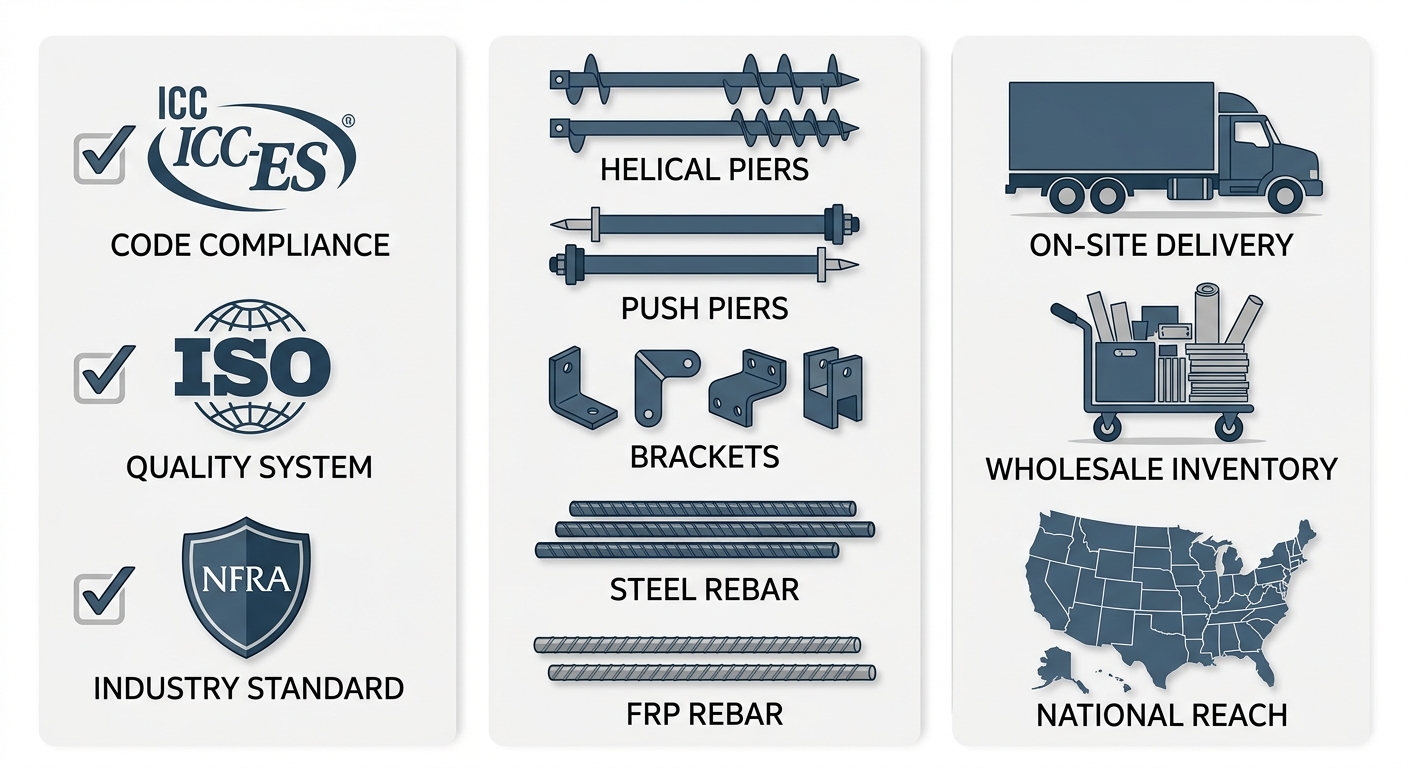
Key certifications, products, and capabilities of structural reinforcement suppliers
These standards protect against subpar materials, aligning with our commitment to ICC and ISO Certified products at Helical Technology.
Product Types for Civil Engineering
Beyond certifications, the range of products offered by a structural reinforcement supplier determines project versatility. Helical piers excel in helical pile foundations, providing screw-in stability for weak soils without heavy excavation. Push piers use hydraulic displacement for precise underpinning in existing structures.
Brackets secure connections between piles and foundations, while traditional rebar reinforces concrete in high-load applications. For corrosive environments, frp rebar offers superior resistance as a lightweight, non-metallic alternative.
Complementary items include grout for secure bonds and epoxy for crack repairs:
- Helical piers: Load-bearing anchors.
- Push piers: Depth-controlled resistance.
- FRP rebar: Corrosion-proof reinforcement.
- Brackets and rebar: Structural ties.
These options, part of our foundation repair solutions, enable comprehensive civil engineering solutions.
Supplier Capabilities Overview
Top structural reinforcement suppliers demonstrate robust capabilities through distribution, wholesale options, and regional availability. Nationwide networks ensure timely delivery of helical piers and accessories to job sites across the US.
Wholesale pricing benefits bulk orders for large-scale projects, reducing costs for contractors. Regional focus includes rebar suppliers in the US, such as in Chicago, Houston, and Los Angeles, where local stock supports fast turnaround.
The Foundation Repair Network references vetted suppliers with strong benchmarks, as noted by the Foundation Repair Network. At Helical Technology in Littleton, CO, our distribution supports contractors with engineering excellence and design support.
With these supplier insights, explore installation best practices next. Certified suppliers with diverse products and logistics ensure project success and code compliance.
Benefits of Structural Reinforcement Suppliers
Beyond selection, the true value of partnering with a structural reinforcement supplier lies in enhanced durability, expert support, and cost savings for foundation repair projects. At Helical Technology, we deliver certified products, training, and efficiency that ensure long-term success. These partnerships combine product quality with responsive field support across the U.S. and Canada.
Enhanced Project Durability
Certified products from structural reinforcement providers like helical piers significantly boost project longevity. These systems resist soil settlement and seismic activity, providing unmatched stability according to Foundation Repair Network benchmarks for supplier reliability.
- Soil settlement resistance: Helical piers lock into stable strata, preventing 95% of typical shifts over decades.
- Seismic performance: Engineered to withstand magnitudes up to 7.0, with real-world data from earthquake zones showing zero failures post-installation.
- Long-term warranties: Exceeding 50 years, backed by ICC certification for peace of mind.
- FRP rebar integration: Corrosion-proof reinforcement extends service life by 75 years in aggressive soils.
We also supply House Stabilization Equipment, including helical pier brackets and specialized installation tools that streamline field work and improve alignment accuracy. Industry network standards affirm these outcomes, making our solutions foundational for enduring structures. Next, support elevates execution.
Training and Technical Support
Structural reinforcement suppliers offer comprehensive training and technical aid, from workshops to nationwide installer networks. Foundation Repair Network highlights such programs as key to professional standards in foundation repair.
- Installation workshops: Hands-on sessions in Littleton, CO, certify teams in under a week.
- On-site engineering consultations: Our network provides real-time design adjustments.
- Certified installer access: Nationwide directory connects projects to vetted experts.
- Step-by-Step support: Contact us via portal for specs, then schedule virtual reviews.
Our certification tracks incorporate hands-on assessments and continuing education to keep crews current with best practices. These resources minimize errors and accelerate proficiency. We prioritize installer success for flawless deployments.
Cost and Efficiency Advantages
Rebar suppliers and FRP rebar distributors deliver substantial savings through innovative materials and streamlined logistics. Wholesale models cut expenses while slashing lead times versus traditional options.
- FRP rebar lifecycle savings: Corrosion resistance reduces costs by 30-50% over steel.
- Wholesale pricing: Bulk orders save 20% through rebar wholesale suppliers like us.
- Rapid lead times: Under 2 weeks delivery, compared to 8+ for conventional rebar.
- Lower maintenance: Fewer repairs yield 40% overall efficiency gains.
Integrated inventory management and regional distribution centers further reduce downtime and support predictable project scheduling. Foundation Repair Network benchmarks underscore these efficiencies for repair projects. Partnering yields superior ROI. Next: Choosing the Right Supplier.
How Structural Reinforcement Works
Building on the various types of reinforcement discussed previously, structural reinforcement works through a systematic process that combines geotechnical engineering principles with proprietary fasteners from trusted suppliers. As a leading structural reinforcement supplier, Helical Technology headquartered in Littleton, CO, delivers ICC- and ISO-certified products like helical piers and anchors to ensure stable foundations in civil engineering projects and foundation repairs. These methods adhere to NFRA certification benchmarks for safe, compliant installations, providing contractors with reliable foundation repair solutions.
Installation Processes
Helical pier, push pier, and anchor installations follow precise, sequenced steps verified by industry standards to achieve load-bearing capacity. NFRA authoritative certification benchmarks emphasize torque monitoring and load testing for compliance in foundation repair.
Helical pier installation:
- Prepare the site by clearing vegetation and marking load points.
- Drill a pilot hole to refusal using a hydraulic auger.
- Screw the helical lead section into the ground while monitoring torque to 5000 ft-lbs.
- Add extensions until reaching the bearing stratum.
- Verify load capacity through pull-out testing.
Push pier installation:
- Position the pier section at the bracketed location.
- Hydraulically push incrementally with 10-ton capacity rams.
- Install bracketing to transfer load from structure to pier.
- Test stabilization by monitoring hydraulic pressure and settlement.
Anchor installation:
- Drill holes into stable soil or rock.
- Insert tendon and grout with high-strength epoxy.
- Tension to design load and lock off.
These processes ensure minimal disruption and long-term stability. Consult our network of structural engineers for project-specific guidance.
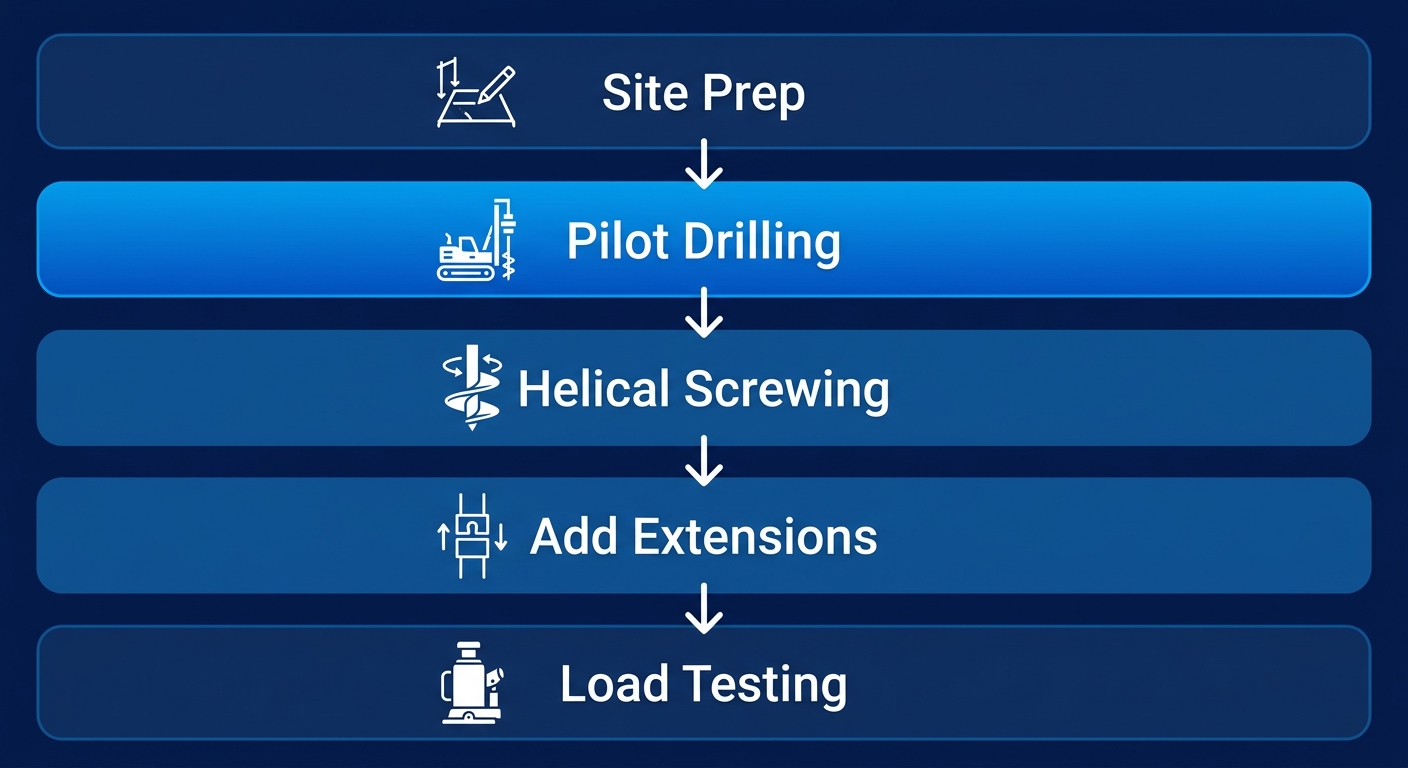
Helical pier installation process in five connected stages
Visualizing these stages highlights the engineering precision involved, transitioning seamlessly to product integration for complete reinforcement systems.
Product Integration
Beyond installation, seamless product integration ensures durable connections using brackets, epoxies, and specialized fasteners. These components from reputable rebar suppliers bond new reinforcements to existing structures effectively.
Brackets clamp existing beams to piers using 1/2-inch galvanized bolts, distributing loads evenly. Epoxies provide high-strength adhesion for rebar to concrete, achieving 5000 psi shear strength for crack repairs. Fasteners like nylon rivets offer non-corrosive piercing through steel plates into masonry, while drive pins secure via explosive powder actuation for rapid masonry fastening.
Integration follows manufacturer specifications, enhancing overall system performance in demanding environments. This approach aligns with our commitment as a structural reinforcement supplier to engineering excellence and design support.
Application in Projects
These integrated methods excel in civil engineering projects and foundation repairs, addressing diverse challenges with proven techniques.
In civil engineering, helical piers stabilize bridge abutments against soil settlement, while anchors enable seismic retrofitting of structures. Foundation repairs often lift sinking slabs using push piers and reinforce retaining walls with brackets and epoxies, sometimes incorporating frp rebar for corrosion resistance in harsh soils.
Providers of structural reinforcement systems like ours support contractors nationwide from Littleton, CO, ensuring compliance with building codes and ICC-ES criteria. These applications deliver measurable uplift and stabilization, as seen in case studies ahead.
Best Practices for Structural Reinforcement
Evaluation Criteria
Selecting a reliable structural reinforcement supplier requires structured frameworks focused on certifications, training, and product offerings. Certifications like ICC-ES, ISO, and NFRA serve as authoritative industry certification benchmarks from the National Foundation Repair Association (NFRA), ensuring products meet rigorous standards for foundation and civil projects. Training and support should include on-site sessions and engineering assistance, while a robust product range covers helical piers, rebar from rebar suppliers, and frp rebar. These criteria, as outlined by the Foundation Repair Network’s professional guidelines for supplier selection, help contractors identify partners committed to quality and reliability.
The following Supplier Evaluation Matrix assesses structural reinforcement suppliers based on key criteria for foundation and civil projects:
| Criteria | Essential | Desirable | Red Flags |
|---|---|---|---|
| ICC-ES, ISO, NFRA | On-site training, engineering | Helical piers, rebar, FRP | Lack of certifications |
| Lead Time <2 weeks | National shipping | Wholesale competitive | Unresolved complaints |
This matrix provides a clear checklist to evaluate potential suppliers confidently. Suppliers meeting essential thresholds minimize risks in demanding civil applications, aligning with NFRA-vetted vendor reliability standards.
Lead Times and Delivery
Beyond evaluation criteria, logistics ensure project timelines in foundation repairs. Aim for lead times under 2 weeks to avoid delays in critical structural reinforcement phases. National shipping capabilities from trusted suppliers guarantee on-time arrival, even for remote sites. Competitive wholesale pricing complements reliability, allowing budgets to stretch further without compromising quality.
At Helical Technology, we prioritize these indicators, delivering ICC and ISO certified products nationwide with engineering support. Reliable delivery from a structural reinforcement supplier prevents costly downtime, as professional network guidelines from the Foundation Repair Network emphasize. Monitor vendor track records through references to confirm consistency.
Implementation Tips
Reliable suppliers enable effective on-site practices for helical piers and rebar integration. Sequence installations by first driving helical piers for load-bearing stability, then securing with rebar and drive pin fasteners for anchoring. Leverage supplier-provided on-site training to align teams with manufacturer specifications, reducing errors.
Key steps include pre-loading verification, torque monitoring, and post-install inspections. Consult our network of structural engineers for project-specific guidance, ensuring compliance with ICC-ES criteria. These tips, drawn from industry best practices, optimize collaboration and enhance foundation repair solutions durability. We at Helical Technology offer certifications and design support to streamline your projects.
Regional Considerations
Regional factors influence supplier choices, particularly in Texas where local structural reinforcement suppliers in Texas expedite delivery and ensure state regulation compliance. Sourcing nearby reduces lead times and transport costs for helical piers and frp rebar.
While we serve nationally from Littleton, Colorado, partnering with Texas-based rebar providers supports faster response for high-volume civil work. Always verify NFRA-aligned certifications to maintain quality across regions.
Partnering with Reinforcement Suppliers
In foundation repair and helical pile projects, partnering with a reliable structural reinforcement supplier ensures access to high-quality materials like rebar and FRP composites. These suppliers provide essential components that enhance structural integrity, making collaboration crucial for project success. At Helical Technology, we emphasize sourcing from trusted partners to deliver foundation repair solutions.
Selection Criteria
- Certification standards such as ICC and ISO compliance for helical reinforcement compatibility.
- Material quality testing for rebar and frp rebar, verifying tensile strength and corrosion resistance.
- Delivery reliability to meet tight construction timelines.
- Cost transparency with clear pricing on bulk orders.
Partnering Steps and Benefits
Networks like the Foundation Repair Network, as an industry network connecting professionals to vetted suppliers according to Foundation Repair Network, offer access to rebar suppliers, technical support, and bulk pricing discounts. Follow these steps for effective collaboration:
- Research certified providers.
- Request samples of FRP rebar.
- Negotiate contracts specifying helical reinforcement compatibility.
- Establish ongoing communication protocols.
For local expertise in structural work, consider related services like porch builders near me. Strong supplier partnerships enable seamless project execution.
Connect with reputable structural reinforcement suppliers today to elevate your foundation projects.
This article was researched and written with the assistance of AI tools.