

Table of Contents
Foundation Settlement vs Heaving: What Contractors Need to Know
Building on our overview of common foundation problems, it is critical to distinguish between two principal forms of movement—settlement and heaving. While foundation settlement vs heaving both compromise structural integrity, settlement is the downward displacement of a footing due to soil compression, moisture loss, or poor compaction. In contrast, heaving forces the foundation upward, typically triggered by frost action, expansive clay swelling, or root pressure.
Visual clues help our team and our contractor partners make the right call on site. Settlement usually produces vertical cracks that are wider at the top, whereas heaving often creates horizontal cracks or visibly lifted slabs. Misdiagnosing whether a foundation is experiencing settlement or heaving can quickly lead to foundation pile failure causes, as Helical Technology’s manufacturer FAQ details. For project-specific assessments, we always recommend you consult a structural engineer or the manufacturer’s engineering team for project-specific design and installation guidance before choosing a repair path.
1. Understanding the Two Movements
When analyzing foundation settlement vs heaving, we look at two distinct soil-structure interactions that produce opposite effects on a building’s footing. Though both compromise structural integrity, their causes, visual clues, and progression patterns differ in important ways.
Settlement is the downward displacement of a foundation. It occurs when the supporting soil compresses under the weight of the structure, erodes away due to poor drainage, or shrinks during prolonged dry periods. On the other hand, heaving describes upward movement, typically triggered when moisture-sensitive clays expand or frost-susceptible soils freeze and lift the foundation from below.
The differences between settlement and heaving show up in the crack patterns you can observe. Diagonal cracking near window and door corners often points to differential settlement, whereas horizontal cracks, bowed walls, or noticeable tilting suggest expansive soil heave is at work.
| Feature | Foundation Settlement | Foundation Heaving |
|---|---|---|
| Primary Direction | Downward | Upward |
| Common Soil Cause | Compression / Moisture Loss | Expansion / Moisture Gain |
| Typical Crack Pattern | Vertical/Stair-step (wider at top) | Horizontal or Diagonal |
It is important to realize that foundation settlement vs heaving can both occur within the same foundation over time as seasonal moisture changes cycle the soil between wet and dry states. This complex movement pattern makes visual diagnosis challenging and underscores why a structural engineer must assess the specific cause before any repair solution is selected.
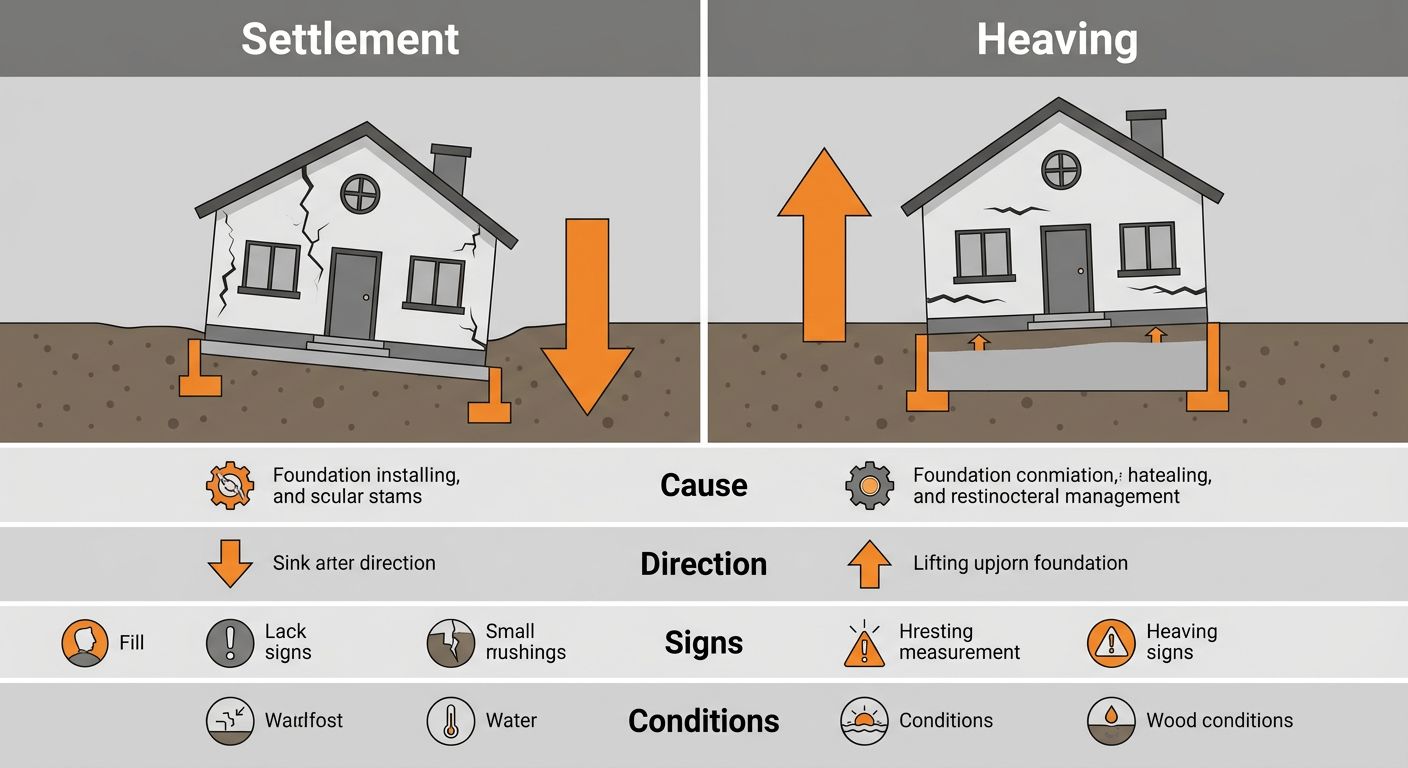
Comparison of foundation settlement vs. heaving with key differences.
Recognizing the difference between these two movements is the first step toward choosing an appropriate repair approach. In the next section, we will examine the diagnostic methods our engineering team uses to differentiate active settlement versus heaving so contractors can specify the correct remedial system.
Consult a structural engineer or the manufacturer’s engineering team for project-specific design and installation guidance.
2. Common Causes of Foundation Settlement
Understanding foundation settlement vs heaving is the first step in diagnosing structural issues. While both are types of foundation movement, settlement specifically refers to the downward motion of a structure as the soil beneath it compresses or shifts. This contrasts with heaving, which is an upward movement caused by soil expansion, often from moisture absorption in clay-rich soils.
Several factors commonly trigger settlement. According to Helical Technology’s technical resources, poor soil compaction during initial construction, shrinkage from prolonged drought, and water saturation from inadequate drainage are leading causes. Tree root systems can also desiccate the soil, while decomposing organic materials underground create voids that undermine foundation support. These conditions typically affect perimeter walls, leading to visible signs like stair-step cracks, uneven floors, and misaligned doors or windows.
Promptly identifying the specific cause is critical, as it dictates whether a repair approach requires the support of our network of structural engineers. Our advanced earth anchoring systems and other foundation repair solutions, including ICC and ISO certified products, are designed to address these challenges with engineering excellence. However, settlement issues often necessitate a professional structural assessment to design an appropriate stabilization plan.
Consult a structural engineer or the manufacturer’s engineering team for project-specific design and installation guidance.
3. What Leads to Foundation Heaving
Unlike foundation settlement, where a structure sinks due to soil compression, foundation heaving describes the upward movement of a foundation caused by soil expansion or other external forces. We see this distinction frequently in our work, and understanding the root causes is essential for accurate diagnosis.
Expansive soils are a leading cause of foundation heaving, particularly in regions with clay-rich ground. These soils swell significantly when they absorb moisture from rain, plumbing leaks, or poor drainage, exerting powerful upward pressure on the foundation above.
Frost heave is another major factor in colder climates. When water in the soil freezes, it expands and forms ice lenses that can lift a foundation from below. This process is cyclical, with repeated freeze-thaw events compounding the damage over time.
Tree root heave also plays a less recognized but important role. As large roots grow horizontally beneath a foundation, their increasing diameter can physically displace the soil and push the structure upward. Additionally, a plumbing leak saturating the subgrade can accelerate soil expansion beneath a slab, creating uneven uplift that leads to cracks and sloping floors.
As industry experts at Helical Technology explain, expansive soils, frost action, and tree root intrusion are the primary drivers of foundation heaving. Recognizing these causes helps property owners move toward the right solution, which we will explore in the following section. For any structural concerns, we always recommend you consult a structural engineer for project-specific design guidance.
4. How to Distinguish Settlement from Heaving
After understanding what settlement and heaving are, you can learn to tell them apart. The key to accurate diagnosis lies in observing crack patterns and structural behavior over time. This is where the critical difference of foundation settlement vs heaving becomes clear.
Settlement is a downward movement, typically caused by soil compression or erosion. Heaving, conversely, is an upward movement driven by soil expansion from moisture or frost. We know from our network of structural engineers that identifying these signs early is essential. Settlement often creates vertical or stair-step cracks in foundation walls. Heaving, in contrast, usually produces horizontal or diagonal cracks along with noticeable upward pressure.
You can identify the issue by checking for these distinguishing signs:
- Sticking doors and windows that bind against their frames
- Sloping or uneven floors across a room
- Gaps appearing around door and window frames
- Chimney separation from the main structure
Heaving frequently worsens during freeze-thaw cycles, while settlement may progress after periods of heavy rain or drought. While these clues are helpful, a professional assessment by a structural engineer is recommended for an accurate diagnosis. Once you have identified whether your foundation is settling or heaving, the next section will cover how our engineered solutions can properly address the issue.
5. The Role of Expansive Clay in the Front Range
In the Front Range, distinguishing foundation settlement vs heaving is a critical step in diagnosing structural movement because the region’s clay-rich soils are highly expansive. According to the Helical Technology foundation repair FAQ, expansive clay undergoes significant volume changes with moisture—it swells when wet and shrinks when dry. This shrink-swell behavior causes heaving (upward foundation movement) during periods of high moisture, such as heavy rains or snowmelt, and settlement (downward movement) as the clay contracts during dry spells.
We encounter this issue frequently: expansive clay is one of the most common causes of foundation problems across Colorado’s Front Range. Without proper foundation design and thorough soil analysis, seasonal cycles of heaving and settlement can lead to severe structural stress. Understanding the difference between heaving and settlement—foundation heaving compared to settlement—guides the selection of effective repair approaches. In the next section, we discuss how helical pier systems address these movements. Consult a structural engineer for project-specific design and installation guidance.
6. Can Both Settlement and Heaving Occur?
When evaluating foundation settlement vs heaving, it’s important to understand that these conditions are not mutually exclusive. In fact, a single structure can experience both settlement and heaving simultaneously in different areas or sequentially over time. We frequently see this in regions with expansive clay soils or significant seasonal moisture variation, where one corner of a foundation sinks while another rises.
Several common site conditions can create this combined foundation movement:
- Soil consolidation beneath one portion of the footing while adjacent expansive clays absorb moisture and swell.
- Frost heave lifting the perimeter of a shallow foundation while interior columns settle due to poor compaction of backfill.
- Leaking plumbing that softens the soil under part of the slab, causing settlement, while trapped moisture migrates to the edges and triggers heaving.
This type of differential foundation movement is particularly damaging because it places the structure in opposing stress fields, often leading to significant diagonal cracking, racked door frames, and uneven floors. When settlement and heaving occur together, the symptoms can be confusing, and the repair strategy must account for both active mechanisms. Our team emphasizes that a thorough evaluation is essential to isolate the root causes and design an effective remediation plan. As Helical Technology notes in its FAQ on combined movement, both conditions can affect the same foundation, and separate repair strategies may be required for each type of movement.
Before any repair method is selected, we always recommend a professional foundation inspection that includes soil analysis and elevation surveys. Our network of structural engineers and real-time design software can model the soil-structure interaction to ensure the proposed solution addresses the full range of movement. If you suspect your project involves overlapping issues, consulting a qualified expert is the most reliable path to a lasting repair.
Consult a structural engineer or the manufacturer’s engineering team for project-specific design and installation guidance.
7. Repair Approaches for Settlement
The expansive clay soils and moisture cycles that drive foundation movement—detailed in the previous section—create a need for robust stabilization methods. When evaluating foundation settlement vs heaving, the appropriate repair technology diverges significantly; for settlement, the two primary structural solutions are helical piers and push piers. As the Foundation Repair Association notes, both systems aim to transfer foundation loads past weak soil to competent bearing strata, but they achieve this through different mechanisms.
Helical pier repair employs steel shafts with helical bearing plates that are screwed into load-bearing soil, mechanically advancing the foundation’s weight to stable ground. Our ICC-ES certified helical piers are engineered for predictable performance, with plate configurations sized to match site-specific soil conditions and structural loads. Push pier installation contrasts by using the building’s own weight to drive pipe segments to refusal, making it effective for heavier structures on dense strata. For any settlement repair, we recommend that a qualified structural engineer design the plan and verify compliance with building codes—our engineering team provides project-specific support. Both systems should be installed by trained contractors familiar with the chosen method. The next section examines repair methods for heaving, which call for entirely different approaches—a distinction that underscores why foundation settlement vs heaving must be assessed separately.
8. Repair Approaches for Heaving
When heaving has already occurred, several engineered foundation repair solutions can stabilize the structure. Effective foundation heaving repair aims to transfer structural loads past the active zone of expansive soil and into stable soil or bedrock. At Helical Technology, we supply three primary systems for heave correction: helical piers, push piers, and plate anchors.
- Helical piers are screw-like piles that resist upward and lateral forces when driven to load-bearing strata. Their helical bearing plates anchor the pier below the zone of moisture fluctuation, providing dependable lift resistance.
- Push piers consist of driven steel sections that bypass heaving soil and lock into competent bearing layers. The pier’s end-bearing capacity counters vertical displacement.
- Plate anchors stabilize walls against lateral earth pressures caused by heaving. Installed in undisturbed soil, they counteract inward wall movement, a common consequence of expansive clay.
All of our advanced earth anchoring systems require proper engineering design. As Helical Technology Inc. notes, wall stabilization techniques using plate anchors and helical piers effectively counteract lateral forces from heaving soil. Our products are ICC and ISO certified, and we maintain a network of structural engineers who provide project-specific support for foundation heaving repair.
Consult a structural engineer or the manufacturer’s engineering team for project-specific design and installation guidance. Products are certified to ICC/ISO where indicated — installations must comply with applicable building codes and ICC-ES acceptance criteria (AC358).
Key Takeaways for Foundation Professionals
Understanding the foundational difference between foundation settlement vs heaving is critical for accurate diagnosis and repair. Foundation settlement — the downward movement of a structure — differs fundamentally from heaving, which is upward displacement caused by expansive soils. Misidentifying the issue can lead to ineffective solutions, so a structural engineer should always determine the specific cause before any repair method is selected.
We provide certified products and engineering support to help you address either condition with confidence. Our real-time design software and network of structural engineers ensure precise project modeling. When promoting your services, leverage these differentiators in foundation repair contractor marketing to build homeowner trust. For complex projects, always partner with a qualified professional, such as porch builders near me who are familiar with regional soil behavior. Consult a structural engineer or the manufacturer’s engineering team for project-specific design and installation guidance.
Resources
- Identify Causes of Pile Foundation Failures
- Get ICC-Approved Foundation Repair Products
- Unlock Contractor Growth with National Network
- Learn Professional Foundation Crack Repair Methods
- Compare Foundation Repair Costs for San Antonio
- Discover Concrete Pier Repair for Texas Foundations
- Explore Crawl Space Encapsulation and Foundation Repair
- Explore NFRA Membership and Certification Benefits