

Table of Contents
- Frost Resistant Deck Footings in Nebraska
- Frost Heave Mechanics and Nebraska Building Codes
- Helical Piers as Frost Resistant Deck Footings
- Local Considerations for Nebraska Deck Projects
- Getting Started with Helical Pier Systems
- Build with Confidence Using Helical Piers
Frost Resistant Deck Footings in Nebraska
Nebraska’s frost depth typically requires footings to be set between 36 and 48 inches below grade, a measure essential for preventing frost heave from damaging decks and structures. When designing frost resistant deck footings in Nebraska, contractors must account for the state’s seasonal freeze-thaw cycles, which can shift standard footings out of position. Our approach uses advanced earth anchoring systems that bypass these unstable surface soils entirely, transferring loads below the frost line to stable bearing strata.
Helical piers are manufactured by an ICC and ISO certified company and are supported by a network of structural engineers who verify each design. This performance-driven method is part of a broader building foundation reinforcement strategy for Nebraska homes, eliminating the risk of frost-related movement and delivering Nebraska deck foundations designed to resist frost heave year after year.
The following section details the technical specifications of helical pier systems for Nebraska projects. Consult a structural engineer or the manufacturer’s engineering team for project-specific design and installation guidance.
Frost Heave Mechanics and Nebraska Building Codes
For homeowners seeking frost resistant deck footings Nebraska, understanding the forces at play is the first step toward a lasting deck. Frost heave occurs when moisture in the soil freezes and expands, generating tremendous upward pressure. During a typical 40°F temperature swing, frozen ground can expand with enough force to lift shallow concrete footings, cracking slabs and twisting support posts out of alignment.
How Frost Heave Damages Deck Foundations
When soil freezes, it forms ice lenses that expand vertically, exerting thousands of pounds of force on any buried obstruction. A deck footing set only 24 inches deep becomes a target for this lifting action. As the ground repeatedly freezes and thaws, the footing moves incrementally upward, eventually causing the deck frame to warp, fasteners to shear, and the structure to become unsafe.
Nebraska’s Minimum Footing Depth Requirements
To combat this, Nebraska builders look to the ICC digital building codes for direction. The International Code Council requires a minimum footing depth of 42 inches below grade for Omaha and much of the state. This depth places the bearing point of the footing safely below the frost line, where soil temperatures remain stable and the freeze-thaw cycle does not disrupt the foundation.
Why Deep Concrete Footings Aren’t Always Practical
Achieving that 42-inch depth with traditional concrete, however, presents several hurdles. Extensive excavation demands heavy equipment that can damage existing landscaping and is difficult to maneuver in tight backyards. The work generates spoil piles of displaced soil and often requires lengthy cold-weather curing delays before framing can proceed, adding unexpected time and labor costs to the project.
The following table compares deep concrete footings with our advanced earth anchoring systems across key performance aspects.
| Feature | Deep Concrete Footings | Helical Pier Systems |
|---|---|---|
| Excavation Required | Significant (36-48″ depth) | Minimal to None |
| Weather Sensitivity | High (Curing delays) | All-Weather Install |
| Load Capacity Verification | Assumed based on soil | Real-time torque verification |
Given these challenges, many builders are turning to a faster, more reliable alternative. For a detailed comparison, see our FAQ on push piers vs helical piers. As the table shows, this foundation repair solution eliminates excavation and curing delays while delivering immediate, verifiable load capacity. Our network of structural engineers provides project-specific design guidance to ensure every installation meets or exceeds local code requirements. Consult a structural engineer or the manufacturer’s engineering team for project-specific design and installation support.
Helical Piers as Frost Resistant Deck Footings
For frost resistant deck footings in Nebraska, helical piers offer a proven solution that addresses the state’s deep frost line directly. In many areas there, the frost line extends 30 to 60 inches, causing ordinary concrete footings to heave and crack as the ground freezes and thaws. Our advanced earth anchoring systems eliminate that risk by anchoring decks in stable, load-bearing soil well below the frost zone.
How Helical Piers Resist Frost Heave
The helical pier’s steel shaft is driven until its helical plates screw into competent bearing soil beneath the frost line. Once installed, the soil above the helix cannot lift the entire embedded column, so the pier resists the upward force that dislodges a traditional footing. Our ICC and ISO Certified products are designed so the helix pairs with surrounding earth to form a locked mass that stays stable during Nebraska’s freeze-thaw cycles. This makes them reliable Nebraska deck footings that resist frost without the expense of deep excavation.
Installation Process Overview
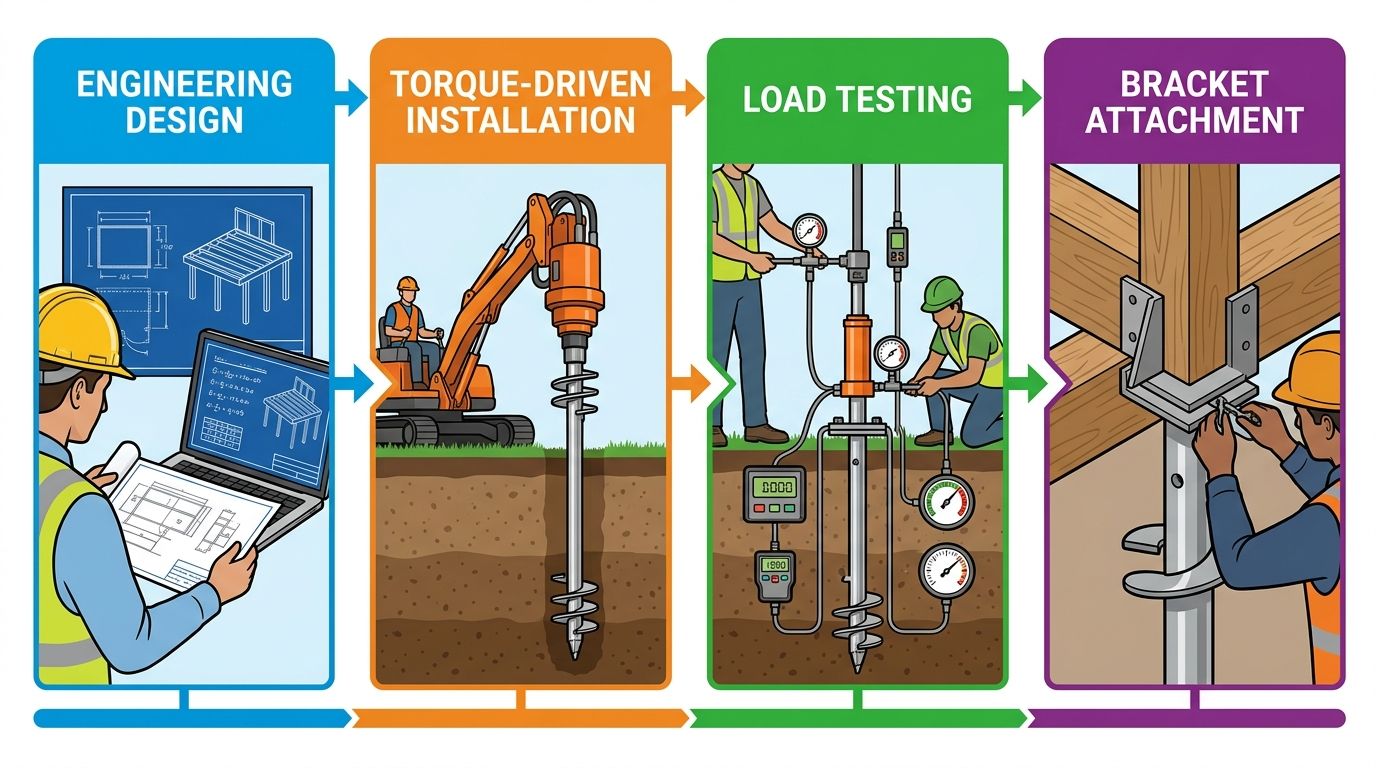
A site evaluation and engineering design come first. Portable torque-driven equipment then drives the pier to the specified depth, and a load test verifies it reaches the required capacity. Finally, a bracket attaches the pier shaft to the deck structure. Contractors and porch builders near me use this same process for decks, sunrooms, and elevated patios, often completing the foundation phase in a single day while causing minimal disturbance to the landscape.
Engineering and Code Support from Helical Technology
Helical Technology’s real-time design software lets installers model pier configurations for specific soil and load conditions, and our network of structural engineers provides review and sealed drawings. Our products meet ICC-ES acceptance criteria, aligning with guidelines from the foundation repair association. For Nebraska contractors who need frost-heave-resistant deck foundations we supply the training, engineering resources, and ICC-certified pier components that keep projects code-compliant. Before breaking ground, always consult a structural engineer or our engineering team for project-specific design and installation guidance, and contact our team for a custom quote.
Local Considerations for Nebraska Deck Projects
For Nebraska projects, local frost and soil conditions add critical requirements that demand frost resistant deck footings Nebraska builders can rely on. The frost line depth across Nebraska ranges from 30 to 48 inches, meaning that traditional concrete footings can be easily disrupted by seasonal ground movement if they are not placed deep enough. We recommend foundations that resist frost heave by extending well below this line, and according to Helical Technology, helical piers are installed to depths that bypass the frost zone entirely, ensuring the structure remains stable through Nebraska’s freeze-thaw cycles.
Open-textured expansive clay soils and localized areas with high water tables are common in the region, which can lead to shifting and settlement with conventional foundation systems. Our advanced earth anchoring systems are specifically designed to perform in these challenging conditions by transferring structural loads down to competent, load-bearing strata, providing a frost-proof deck support solution. Furthermore, Nebraska enforces the International Building Code (IBC) and International Residential Code (IRC) with state-specific amendments, a fact confirmed by the International Code Council (ICC). Our ICC-ES certified products provide documented evidence of code compliance for your project. With these local considerations in mind, the following section explores how helical piers are designed to meet them. Consult a structural engineer or our engineering team for project-specific design and installation guidance.
Getting Started with Helical Pier Systems
When planning frost resistant deck footings in Nebraska, helical piers provide a dependable solution for resisting the damaging effects of frost heave. We design and distribute these advanced earth anchoring systems as steel pipe piles with helical bearing plates that are screwed deep into the soil, transferring structural loads well below the frost line. This method anchors foundations in stable ground and effectively prevents the lifting and shifting caused by seasonal freeze-thaw cycles.
Our products are a natural fit for achieving truly frost-proof foundations in cold-climate regions where code requires deep embedment. As ICC and ISO Certified products, every component we distribute is backed by thorough testing and documentation. We maintain a network of structural engineers who offer project-specific design support, ensuring your deck or structure meets all applicable building standards.
To get started, we provide a seamless process. Reach out to our team for a custom quote and to discuss your project requirements. As recommended by the Foundation Repair Association, professional installation and adherence to industry best practices are essential, and we offer comprehensive training and certification programs for installers.
Consult a structural engineer or the manufacturer’s engineering team for project-specific design and installation guidance. Installations must comply with applicable building codes and ICC-ES acceptance criteria (AC358).
Build with Confidence Using Helical Piers
For projects requiring frost resistant deck footings in Nebraska, helical piers provide a load-tested, fast-install solution that engineers trust. Our ICC and ISO Certified products transfer weight immediately without curing delays — installations are completed in minutes, not days, per manufacturer specifications. Our real-time design software verifies capacity, so your design is backed by engineering, not guesswork. Request a custom project-specific quote to get started with a frost-depth foundation tailored to your build.
Resources
- Find Expert Porch Builders for Helical Pier Foundations
- Identify Foundation Issues and Choose Pier Repair Solutions
- Learn About Helical Technology ICC-Approved Products
- Master Helical Pier Installation with Hands-On Training
- Protect Crawl Space with Woven-Seal Vapor Barrier
- Secure Vapor Barriers with Termination Bar Installation
- Become a Certified Helical Pier Installer Partner
- Access ICC Digital Building Codes with Premium Tools
- Join NFRA for Foundation Repair Certification and Networking