

Table of Contents
- The Role of Structural Engineering in Helical Pile Foundations
- Fundamentals of Helical Pile Design Principles
- Design Methodology and Load Calculations for Helical Piles
- Working with Structural Engineers on Helical Pile Projects
- Advanced Considerations for Helical Pile Engineering
- Frequently Asked Questions About Helical Pile Engineering
- Integrating Engineering Expertise with Helical Pile Solutions
The Role of Structural Engineering in Helical Pile Foundations
While understanding what helical piles are lays the foundation, the true performance of these systems depends on rigorous structural engineering for helical piles in foundation repair and new construction. Professional engineering oversight is critical for ensuring that every installation meets load requirements, complies with building codes and delivers long-term reliability. Our network of structural engineers provides the expertise that transforms site conditions into engineered helical pile solutions.
Structural engineers begin by performing geotechnical analysis to determine soil bearing capacity. This data guides the selection of appropriate helix configurations — including diameter, number of helices and embedment depth — to match the specific soil profile. Engineers then calculate axial and lateral load requirements, verifying that the helical pile design meets those loads with proper safety factors. Standard industry procedures, including those outlined in established resources such as the helical pile foundation design guide from the International Association of Foundation Drilling (ADSC-IAFD), help verify load capacities and installation methods. This engineering expertise for helical pile foundations ensures designs comply with local building codes and ICC-ES AC358 acceptance criteria, a requirement for our ICC and ISO Certified products.
To streamline the structural engineer’s role in helical pier design, Helical Technology provides project-specific support through our engineering team and real-time design software. This software allows engineers to model pile capacities accurately, producing stamped calculations that installers can rely on. When comprehensive foundation repair solutions are needed, engineers may also specify complementary products such as our structural repair epoxy for crack remediation. The engineered designs produced by our network of structural engineers pair seamlessly with Helical Technology’s certified products.
Consult a structural engineer or our engineering team for project-specific design and installation guidance. Products are certified to ICC/ISO where indicated — installations must comply with applicable building codes and ICC-ES acceptance criteria (AC358).
Fundamentals of Helical Pile Design Principles
For structural engineers approaching deep foundation design, understanding the load transfer mechanisms and governing methodologies in structural engineering for helical piles is essential. Helical pile capacity derives from two primary components: end bearing on the helical plates and shaft friction along the pile. The helical plates transfer structural loads into deeper, competent soil strata through bearing, while skin friction along the shaft contributes additional resistance. The International Code Council (ICC) establishes mandatory design standards for these systems, including load combinations per ASCE 7 and the acceptance criteria detailed in ICC-ES AC358.
A key empirical relationship in helical pile design principles for structural engineers is the torque-to-capacity correlation, typically expressed as T = K·Q, where T is installation torque, K is an empirical factor, and Q is the pile capacity. This relationship, documented in the ADSC-IAFD Helical Pile Foundation Design Guide, allows engineers to estimate ultimate capacity during installation by monitoring torque. However, the International Society for Soil Mechanics and Geotechnical Engineering (ISSMGE) emphasizes that site-specific soil investigation remains essential for accurate capacity determination, as soil bearing capacity and stratigraphy directly influence both end bearing and friction contributions.
Two primary design methodologies govern helical pile sizing and rating. Allowable Stress Design (ASD) applies a single safety factor, typically between 2.0 and 3.0, to unfactored loads including dead, live, wind, and seismic forces. This conservative approach remains common in residential and small commercial projects where simplicity and proven performance are priorities. Load and Resistance Factor Design (LRFD), by contrast, uses factored load combinations per ASCE 7 with load factors of 1.2 to 1.6 and resistance factors between 0.5 and 0.8 per ICC-ES AC358. This method is preferred for large commercial, infrastructure, and seismic zone applications where more precise reliability calibration is required.
Design must follow recognized structural engineering standards for helical piles such as those published by the ICC. The ASD methodology offers straightforward application with a single safety factor applied to service-level loads, making it accessible for smaller-scale projects. LRFD provides a more nuanced approach, separating load and resistance uncertainties into distinct factors that allow engineers to optimize designs based on specific project conditions. The ADSC-IAFD design guide serves as the industry best practice reference, providing torque correlation equations, bearing capacity formulas, and installation verification methods. We offer Engineering Excellence and Design Support, with a network of structural engineers available for design assistance on project-specific applications. Our products are ICC and ISO certified, and installations must comply with applicable building codes and ICC-ES acceptance criteria (AC358).
The following table compares the two design approaches:
| Design Approach | Safety Factor / Load Factor | Load Combinations | Typical Use Cases |
|---|---|---|---|
| Allowable Stress Design (ASD) | Typically 2.0–3.0 | Dead, live, wind, seismic (unfactored) | Residential, small commercial where conservative |
| LRFD | Load factors 1.2–1.6; resistance factors 0.5–0.8 | Factored combinations per ASCE 7 | Large commercial, infrastructure, seismic zones |
ASD applies a single global safety factor to unfactored loads, making it appropriate for straightforward projects where conservative assumptions are acceptable. LRFD, by factoring both loads and resistances separately, allows for more efficient designs in complex loading scenarios typical of commercial and seismic applications. The choice between these methodologies ultimately depends on project scope, governing code requirements, and the level of geotechnical investigation available.
Understanding these design principles is critical; the following section will discuss installation methods that ensure these capacities are achieved. Consult a structural engineer or the manufacturer’s engineering team for project-specific design and installation guidance.
Design Methodology and Load Calculations for Helical Piles
Once the type and components are selected, the design methodology ensures the system meets structural requirements. In structural engineering for helical piles, accurate load calculations begin with thorough soil analysis and extend through validated testing protocols, a process we support with ICC-ISO certified products and engineering expertise.
Soil Investigation and Bearing Capacity
A helical pile derives its bearing capacity from the soil layers into which its helix plates are installed. Structural engineers interpret geotechnical data from standard penetration tests, cone penetration tests, and laboratory soil analyses to determine the ultimate bearing capacity of the pile. This process involves evaluating both skin friction along the shaft and end bearing at the helix plates.
The SPT N-value or CPT tip resistance is correlated to soil strength parameters using established empirical relationships. Cohesive soils contribute capacity through adhesion along the pile shaft and bearing on the helix, while granular soils develop frictional resistance and high end-bearing values. Accurate soil layering data is essential for an effective helical pile design methodology, as it dictates the placement of the helix plates within suitable bearing strata and feeds directly into the design software input parameters.
Helical Plate Configuration and Torque Correlation
The configuration of helix plates, including their diameter, number, and spacing along the shaft, is specified by the engineer based on the soil profile and project load requirements. The governing principle in engineering analysis for helical foundations is the direct relationship between installation torque and axial capacity, typically expressed as Q_ult = k_t * T. The torque correlation factor, k_t, is an empirically derived value that depends on soil type, pile shaft size, and helix configuration, with typical values provided in industry acceptance criteria such as ICC-ES AC358.
Manufacturer design specifications provide critical plate geometry and material properties. For example, our 2″ RCS lead sections and 2-7/8″ diameter extensions with helices are engineered to withstand specific torque ratings, ensuring the load path is maintained through every component of the system. A common rule is that helix plates on a single pile should be spaced at least three diameters apart to ensure each plate acts independently in bearing.
Load Testing and Validation
Load testing is the definitive method for validating design assumptions and establishing the true capacity of a helical pile foundation. Three primary types of tests are specified under ASTM standards to cover different loading conditions, and the table below compares their application and data quality.
| Test Type | ASTM Standard | Typical Duration | Application | Data Obtained |
|---|---|---|---|---|
| Static Compression | ASTM D1143 | 1–3 days | Axial capacity verification | Load-settlement curve, ultimate capacity |
| Static Tension | ASTM D3689 | 1–2 days | Uplift capacity | Pullout resistance, displacement |
| Lateral | ASTM D3966 | 1–2 days | Lateral load resistance | Lateral deflection, moment capacity |
Static compression tests apply a downward load in increments to measure settlement behavior, providing the most direct measure of axial capacity. Tension tests similarly apply an uplift force to verify pullout resistance, which is critical for structures subject to wind or seismic overturning. Lateral testing is less common but essential for applications such as sound walls or tower foundations where horizontal forces govern the design. The load-settlement curves and ultimate capacity data obtained from these tests allow the engineer to refine the geotechnical model and optimize the pile layout. Post-installation, structural engineers may specify structural repair epoxy for sealing cracks in the foundation, ensuring long-term integrity of the connected structure. Proof testing, often supervised by the engineer of record, verifies the performance of production piles using the same installation equipment and torque monitoring.
Software-Assisted Design and Real-Time Modeling
We integrate all phases of the structural engineering for helical piles process into a streamlined digital workflow. Our proprietary design software allows the structural engineer to input soil parameters, select pile geometries from our certified product catalog, and apply project-specific load combinations. The software performs iterative calculations to optimize helix plate diameter, number, and spacing, generating a complete design that is ICC-ISO compliant and ready for report submission. This real-time modeling capability reduces design time and increases confidence by instantly correlating torque data with theoretical capacity. Our network of structural engineers also provides project-specific review and design support, reinforcing our commitment to engineering excellence and design support from initial concept through final validation. With a validated design, the installation process begins with the assurance that every pile is backed by rigorous engineering analysis.
Consult a structural engineer or the manufacturer’s engineering team for project-specific design and installation guidance. Products are certified to ICC/ISO where indicated — installations must comply with applicable building codes and ICC-ES acceptance criteria (AC358).
Working with Structural Engineers on Helical Pile Projects
Having established the fundamentals of helical pile foundations, it is equally important to understand how to collaborate with a structural engineer throughout your project. For load-bearing applications, helical pile design is a specialized field that requires professional engineering oversight. Knowing when to involve structural engineering for helical piles ensures your foundation meets all safety and performance standards.
When Is a Structural Engineer Required?
Most U.S. building codes, including the IBC and IRC, mandate that a registered structural engineer seal foundation designs for new construction, additions, and major repairs. This requirement exists because helical pile foundations must resist complex soil-structure interactions that only a qualified engineer can properly analyze. The ICC-ES acceptance criteria (AC358) further specify that engineer-stamped calculations are necessary for code-compliant installations. Whether your project is a residential deck addition or a multi-story commercial building, the structural engineer verifies that the specified helical piles can handle design loads in the actual soil conditions present at your site. Beyond code mandates, involving an engineer protects property owners by ensuring the foundation will perform reliably over decades, and it protects contractors by documenting that a licensed professional designed the system. A structural engineer or the manufacturer’s engineering team must be consulted for project-specific design and installation guidance.
How to Find a Qualified Helical Pile Engineer
Not all structural engineers have deep experience with helical pile systems. When evaluating candidates, look for professionals who regularly use helical pile design software such as HeliCAP and who can demonstrate familiarity with the soil conditions in your region. Membership in organizations like ASCE or DFI indicates a commitment to advanced geotechnical and structural practice. One of the most efficient paths is to leverage our network of structural engineers who specialize in engineered helical foundation design. For a directory of experienced professionals, start with the Foundation Repair Association’s guide on hiring structural engineer for helical pile projects. In our role as a national distributor, we maintain relationships with engineers across the country and can connect contractors and property owners with professionals whose qualifications match their specific project requirements. We also provide our network of installers access to real-time design software, so the technical parameters are already established before the engineer begins detailed modeling of the specialized helical pile structural design.
Cost Factors for Engineering Services
The cost of structural engineering for helical pile projects varies significantly based on several key factors. Project complexity is a primary driver, since a simple residential underpinning job requires far less analysis than a large commercial structure on variable soils. The number of test piles or proof tests specified, the extent of soil investigation needed, and site travel distance all influence the engineering fee. Typical deliverables include staking plans, load test procedures, and sealed construction drawings, each of which requires dedicated professional time. Additional variables such as project scale, load requirements, and whether an existing geotechnical report is available also affect pricing. Because every project is unique, we encourage contractors and owners to request a custom quote from our team or from a qualified engineer early in the planning process. Our engineering support team can review your project scope and provide preliminary guidance on what to expect. Products supplied by Helical Technology are ICC-approved and ISO-certified, and installations must comply with applicable building codes and ICC-ES acceptance criteria (AC358).
Coordination During Installation
A structural engineer’s involvement does not end with issuing sealed drawings. During pile installation, the engineer monitors torque and hydraulic pressure data to confirm that field performance aligns with design assumptions. This real-time helical pile engineering analysis correlates installation torque with the design capacity derived from soil parameters, providing immediate verification of each pile’s load-bearing adequacy. When subsurface conditions differ from those anticipated, the engineer may adjust pile depth or spacing on-site to maintain the required factor of safety. Proof testing oversight is a critical part of this phase. The engineer specifies load test procedures, oversees the testing, and evaluates deflection data to confirm that the as-built system meets or exceeds design requirements. We support this coordination through our engineering team and design tools, which generate installation criteria tied directly to the engineer’s sealed plans. Proper coordination also extends to complementary systems. For example, when a crawl space encapsulation with products like our Term-Bar and Woven-Seal vapor barriers is part of the scope, the engineer specifies how these materials integrate around helical pile penetrations to maintain the integrity of the moisture barrier. As-built documentation, including installation torque logs and proof test reports, must be reviewed and signed off by the engineer to close out the project with a complete record of compliance. Involving structural engineering for helical piles throughout installation safeguards the design intent and delivers a foundation that performs as intended over the long term. Helical Technology’s engineering support team can help review your project requirements and recommend a qualified engineer from our network.
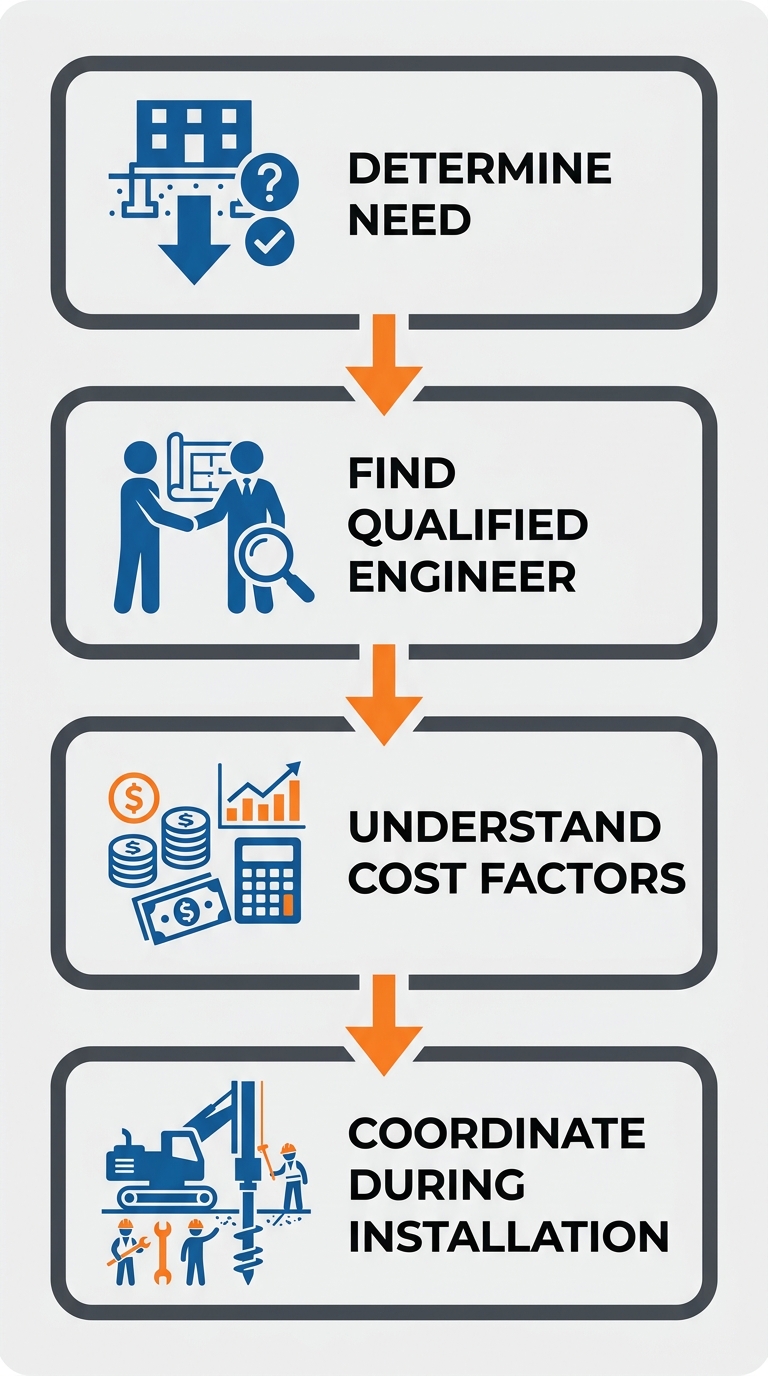
Phases of engineer collaboration for helical pile projects.
Advanced Considerations for Helical Pile Engineering
Building on the fundamental definitions of helical piles, we now explore advanced engineering considerations that govern their successful application. Structural engineering for helical piles requires a thorough understanding of soil behavior, as the interaction between the pile and the surrounding ground dictates load capacity and long-term performance. Unlike simpler foundation types, helical pile design must account for variable subsurface conditions, making soil-specific configurations essential. Our engineering team at Helical Technology emphasizes that proper structural design begins with accurate geotechnical data, aligning with the principles established by the International Society for Soil Mechanics and Geotechnical Engineering (ISSMGE).
As shown in the table below, selecting the appropriate helical pile configuration depends directly on the soil profile at the project site.
| Soil Type | Recommended Configuration | Key Design Factors | Example Application |
|---|---|---|---|
| Cohesionless (Sand, Gravel) | Single-helix with large helix | Tip resistance, friction angle | Solar panel foundations |
| Cohesive (Clay, Silt) | Multi-helix spaced 3× helix diameter | Undrained shear strength, adhesion | Residential underpinning |
| Mixed/Stratified | Tapered lead section with helixes at transition | Layer interface, load transfer | Commercial building foundations |
In cohesionless soils such as sand and gravel, we typically recommend a single-helix pile with a larger helix diameter. Here, the design is governed primarily by tip resistance and the soil’s friction angle, as bearing capacity relies on end-bearing rather than shaft friction. For cohesive soils like clay and silt, a multi-helix configuration with helixes spaced at three times the helix diameter is the standard approach, as outlined in the ADSC Helical Pile Foundation Design Guide. This spacing ensures that each helix acts independently, with the undrained shear strength and soil adhesion controlling the pile’s capacity. When encountering mixed or stratified profiles, the helical pile structural design must adapt by using a tapered lead section with helixes positioned at layer transitions. This strategy optimizes load transfer by engaging bearing strata efficiently, preventing slippage in weaker seams.
All helical pile designs must comply with ICC-ES AC358 acceptance criteria and be verified by a licensed structural engineer. Helical Technology supports this requirement through our network of structural engineers, providing Engineering Excellence and Design Support for every project. Alongside our advanced earth anchoring systems, we supply a complete range of foundation repair solutions, including a termination bar for vapor barrier to complement helical pile installations. Structural engineering for helical piles must be performed or verified by a licensed professional, and all installations must comply with applicable building codes and ICC-ES acceptance criteria (AC358). With a solid understanding of design, let us examine how these piles are installed.
Frequently Asked Questions About Helical Pile Engineering
Now that we’ve covered design specifications, let’s address the engineering questions we hear most often.
How does structural engineering for helical piles work? Our team evaluates soil conditions, foundation loads, and project specifications to develop a load-bearing design that meets ICC-ES AC358 acceptance criteria.
Are Helical Technology products ICC-ES certified? Yes, our products are ICC and ISO certified, meeting rigorous standards set by the International Code Council for foundation systems.
How do I get project-specific structural engineering for helical piles? Share your project details with us, and our network of structural engineers provides tailored design calculations and support.
Who approves the helical pile design? A structural engineer must review and approve the final design to ensure full code compliance for your project.
What is the typical turnaround time for calculations? Most project-specific design calculations are provided promptly. Contact our engineering team for your timeline.
Do you offer other foundation repair solutions, like a woven vapor barrier in crawl space? Yes, we supply encapsulation products and advanced earth anchoring systems for comprehensive foundation repair solutions. For project-specific questions, our engineering team is ready to help.
Integrating Engineering Expertise with Helical Pile Solutions
We integrate structural engineering for helical piles to ensure optimal performance and reliability in every installation. Our in-house engineering team works directly with installers, providing project-specific design support, including load calculations and helical pile selection. We also collaborate with a network of structural engineers for advanced consultation, reinforcing our commitment to Engineering Excellence and Design Support.
We maintain ICC and ISO certifications, adhering to ICC-ES acceptance criteria (AC358) as evidence of our engineering rigor. Our manufacturer-provided design software enables accurate modeling and real-time adjustments tailored to site-specific conditions.
Consult a structural engineer or the manufacturer’s engineering team for project-specific design and installation guidance.
Resources
- Get Fast-Curing Structural Repair Epoxy for Concrete
- Get Semi-Flexible Termination Bar for Vapor Barriers
- Get Puncture-Resistant Woven Vapor Barrier for Crawlspaces
- Get Carbon Fiber Crack Stitch for Structural Repair
- Get ICC-Approved 2-Inch Helical Pile Lead Section
- Get 2-7/8-Inch Helical Pipe Extension with Helix
- Get 3.5-Inch Helical Pipe Extension for Deep Foundations
- Explore Helical Pile Foundation Design Guide for Engineers
- Access ICC Structural Standards for Helical Pile Design
- Hire Experienced Structural Engineer for Helical Pile Projects
- Find Engineering Guide for Helical Pile Foundations
- Get Technical Resources for Helical Pier Structural Support