

Table of Contents
Push Piers vs Helical Piers: Key Differences for Foundation Repair
Two common underpinning solutions are push piers and helical piers, and understanding push piers vs helical piers is essential for selecting the right method for your foundation repair project.
Push piers are hydraulically driven deep into the soil until they reach load-bearing strata, relying on end-bearing and skin friction to stabilize and lift heavy structures. They are a proven choice for permanent underpinning where substantial load transfer is required.
Helical piers are screw-like piles with helical plates that are twisted into the ground to achieve immediate load capacity through plate-bearing. Per the International Association of Foundation Drilling (ADSC), this method is highly versatile for both new construction and repair. Helical piers are a reliable solution for building foundation reinforcement, suited for applications requiring low vibration and fast installation.
We offer both ICC- and ISO-certified push piers and helical piers, providing our network with engineering support for informed decision-making. The best choice depends on project-specific soil conditions, structural loads, and accessibility requirements.
Consult a structural engineer or our engineering team for project-specific design and installation guidance.
1. Load Transfer Mechanism
When comparing push piers vs helical piers, the fundamental differentiator is how each system engages the soil and transfers structural loads to competent bearing strata. Both systems are designed to bypass weak surface soils, but they accomplish this through distinctly different mechanical principles that influence their performance in various ground conditions.
Helical piers transfer load through one or more helical bearing plates that are screwed into the soil using torque-based rotation. As the pier advances, the plates create a combination of end-bearing capacity on each helix and friction along the shaft. This dual-load engagement mechanism allows helical piers to perform effectively in both tension and compression across a wide range of soil densities. The torque required during installation provides a measurable, real-time indicator of the soil’s bearing capacity, giving our installers immediate confirmation that the pier has reached competent load-bearing strata.
Push piers, by contrast, transfer load through a fundamentally different mechanism. During push pier installation, the pier sections are hydraulically driven into the soil using static pushing force until refusal is achieved against a dense soil layer or bedrock. The system relies primarily on end-bearing capacity at the pier tip, concentrating the structural load onto the competent stratum below. This makes push piers an ideal solution when a firm bearing layer is consistently reachable at a predictable depth beneath the structure.
The helical vs push piers discussion ultimately centers on load engagement philosophy: distributed bearing across multiple plates versus concentrated end-bearing on a single tip. Understanding these load transfer differences is critical for proper push and helical pier selection. Consult a structural engineer or our engineering team for project-specific design guidance.
2. Soil Suitability and Performance
When comparing push piers vs helical piers, soil suitability is a critical deciding factor that directly influences long-term foundation stability. The performance of any foundation repair solution depends heavily on the specific geotechnical conditions present at the site, making soil evaluation an essential first step before selecting a pier system.
Our advanced earth anchoring systems are engineered to accommodate diverse soil profiles, but understanding how each pier type interacts with subsurface materials ensures optimal results. Push pier installation relies on driving steel tubes through unstable upper soils until they reach competent, load-bearing strata below. This method works exceptionally well in cohesive clay soils where friction capacity along the pier shaft provides additional support, though expansive clays require careful assessment of seasonal moisture fluctuations.
Helical vs push piers comparison reveals distinct differences in load transfer mechanisms. Helical piers utilize helices that screw into deeper bearing strata, distributing weight through the helix plates rather than relying primarily on end-bearing. According to industry best practices from the Foundation Repair Organization, soil bearing capacity, groundwater conditions, soil consolidation potential, and frost depth requirements all influence pier depth and spacing calculations. The Foundation Repair Organization emphasizes that proper soil assessment remains fundamental to selecting the right foundation repair system.
ICC-ES documentation under AC358 supports helical pier performance across various soil types, validating their effectiveness in sandy substrates, silty conditions, and mixed soil profiles. Helical Technology’s engineering team provides soil-specific design support, leveraging manufacturer product data to match pier geometry and helix configuration to site conditions. We recommend comprehensive soil testing, including boring and plate load testing, before final pier selection.
Consult our engineering team or a structural engineer for project-specific soil analysis and pier design recommendations.
3. Installation Process and Equipment Needs
Now, let’s explore the installation process and equipment needs for each system. When contractors evaluate push piers vs helical piers for foundation repair solutions, understanding the distinct installation procedures and specialized equipment is essential for project planning. Both methods rely on advanced earth anchoring systems, but their processes and tools differ significantly.
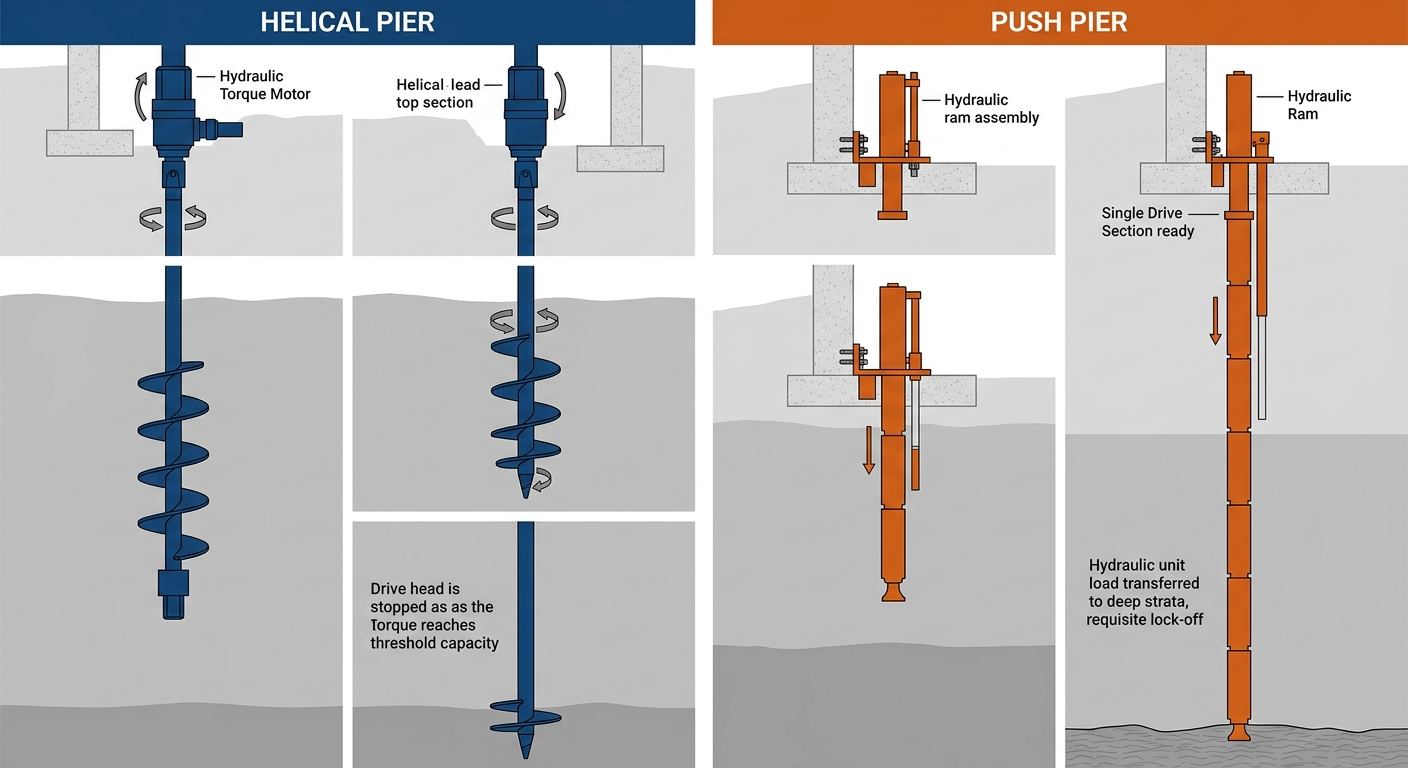
Helical pier installation utilizes a hydraulic torque motor to screw a galvanized steel shaft into the soil until the required torque level indicates it has reached competent load-bearing strata. As the pier advances, our network of structural engineers verifies that extension sections are added to achieve the necessary depth and embedment. A foundation bracket is then attached to transfer the structural load to the pier. This method requires a torque motor, helical lead sections with bearing plates, extensions, and load-transfer brackets.
Push pier installation employs a hydraulic ram to drive sectional steel columns, or push piers, into the ground until the columns meet refusal in a competent bearing layer. During the push pier installation process, pier sections are connected sequentially as the hydraulic cylinder applies downward force, with driving resistance monitored to confirm capacity. A load-transfer bracket secures the pier directly to the foundation footing, effectively stabilizing the structure. This method requires a portable hydraulic ram, pier tube sections, and heavy-duty brackets.
The installation procedure for both helical vs push piers directly affects project timelines and feasibility. Each foundation repair scenario requires a site-specific engineering evaluation to determine proper depth, embedment, and capacity requirements. All installations must be performed by trained professionals using ICC and ISO Certified products, and designs must comply with local building codes and AC358 acceptance criteria.
4. Load Capacity and Depth Requirements
When evaluating foundation options in commercial applications, load capacity and depth requirements often determine the best choice between push piers vs helical piers. Understanding how each system distributes structural weight helps project teams make informed decisions that balance performance with site conditions.
Our 2-7/8″ Schedule 40 and Schedule 80 pipe options provide distinct load capacities. According to Helical Technology product data, the Schedule 80 shaft delivers higher yield strength and allowable working loads compared to Schedule 40, making it suitable for heavier commercial structures. Helical piers develop load-bearing capacity through helix plates that bear on undisturbed soil at depth, while push pier installation relies on end-bearing at the tip driven to competent strata. This fundamental helical vs push piers distinction means helical systems often achieve required capacities at shallower depths, whereas push piers must reach dense soil or bedrock.
Depth requirements depend on soil bearing capacity, the frost line depth which typically ranges from 42 to 60 inches in cold climates, and the magnitude of design loads for commercial structures. The International Code Council establishes minimum load capacities and foundation embedment depths through IBC Chapter 18 and the ICC-ES AC358 acceptance criteria for helical piles, ensuring installations meet rigorous safety standards. Deeper installation may be necessary in poor soil conditions or when higher load capacities are required. For a detailed look at how these factors apply to smaller-scale projects, see our residential foundation pier comparison.
Consult a structural engineer or our engineering team for project-specific load and depth design. These technical factors directly influence project budgets—let’s explore the cost considerations next.
5. Cost Considerations and Project Budget
Beyond installation considerations, cost is a major factor when choosing between push piers and helical piers for foundation repair projects. While we cannot offer a universal price, understanding the key variables helps you plan. We emphasize that each situation requires a custom quote, and our engineering support is designed to help you budget effectively for our foundation repair solutions.
Several site-specific conditions drive the final investment. Soil type, density, and groundwater levels affect penetration depth and labor, directly influencing the cost of push pier installation. Load-bearing requirements dictate the number and size of piers needed, which impacts material volumes. When evaluating helical vs push piers, helical options are typically faster to install for moderate loads, while push piers may be necessary for heavier loads or when reaching deep bearing strata, affecting overall project economics. Site accessibility and obstructions, such as trees or slopes, can also add to the complexity and expense of any deep foundation repair.
Ultimately, the most accurate budget stems from a custom quote. By leveraging our real-time design software and our network of structural engineers, we provide precise project modeling. This tailored approach, grounded in our ICC and ISO Certified products, ensures you receive a reliable plan. Consult a structural engineer or the manufacturer’s engineering team for project-specific design and installation guidance.
6. Durability and Long-Term Performance
Beyond installation, the long-term durability of the foundation system is critical for any successful project. Choosing between push piers vs helical piers requires a close look at how each system performs over decades, especially under variable soil and load conditions.
Our helical piers are manufactured from galvanized steel, providing robust corrosion resistance and reliable structural integrity. This material choice directly supports the longevity of helical piers in aggressive soil environments. For homeowners, the long-term performance of house stabilization equipment ensures lasting foundation protection without the need for costly future interventions.
These durability claims are validated by ICC-ES acceptance criteria (AC358) and standards from the International Society for Soil Mechanics and Geotechnical Engineering, which confirm long-term load-bearing performance. In a helical vs push piers comparison, the screw-like design of a helical pier distributes loads more effectively, significantly reducing settlement risk over time compared to a push pier installation that relies solely on the mass of the structure for driving force.
Products are certified to ICC/ISO where indicated — installations must comply with applicable building codes and ICC-ES acceptance criteria (AC358).
Consult a structural engineer or the manufacturer’s engineering team for project-specific design and installation guidance.
7. Residential vs. Commercial Applicability
The choice between helical and push pier systems often depends on the project scale, with a careful evaluation of load requirements and soil conditions helping determine whether helical or push piers vs helical piers deliver the best outcome. While both systems offer proven foundation repair solutions, their applicability varies significantly between residential and commercial contexts.
For residential projects, helical piers are often preferred due to their versatility in lighter load applications and simpler soil conditions. Our advanced earth anchoring systems install quickly with minimal disturbance, making them ideal for homeowners needing efficient underpinning or new construction support. The installation process is straightforward, and the equipment required is less invasive than that needed for push pier installation in commercial settings.
Commercial projects typically involve heavier structural loads and more complex soil profiles that demand deeper bearing strata. In these cases, push piers frequently demonstrate higher load capacity for heavily loaded commercial foundations. Commercial foundation repairs often rely on proven helical vs push pier effectiveness as outlined in ICC acceptance criteria, and our ICC and ISO Certified products meet these rigorous standards. Our network of structural engineers provides project-specific engineering and design support to ensure code compliance for both residential and commercial applications.
Consult a structural engineer or our engineering team for project-specific design and installation guidance.
8. Pros and Cons at a Glance
Having examined how helical and push piers work, understanding the push piers vs helical piers debate is critical for commercial decision-makers. This at-a-glance summary highlights the key trade-offs between these advanced earth anchoring systems.
Helical piers offer immediate load capacity with minimal site disturbance. Their design adapts to various soil conditions and typically provides faster installation, reducing project timelines. However, they may prove unsuitable for extremely rocky strata or sites with a high water table. Conversely, push pier installation advantages include robust foundation support using the structure’s weight, retrievability if modifications are needed, and strong load transfer with minimal settlement. The key trade-off involves more extensive excavation, requiring skilled labor and often resulting in longer installation times compared to their helical counterparts.
Among foundation repair solutions, the choice in helical vs push piers ultimately depends on site-specific factors. Both systems are ICC- and ISO-certified and are backed by engineering excellence and design support from our network of structural engineers. Cost-efficiency depends on site conditions, and a custom quote from our team provides accurate cost comparisons. Consult a structural engineer or the manufacturer’s engineering team for project-specific design and installation guidance.
Choosing the Right System with Helical Technology
In summary, the choice between push piers vs helical piers hinges on site-specific soil conditions and the load requirements of your project. Both helical piers and push piers are manufactured to meet ICC-ES Acceptance Criteria AC358, ensuring code-compliant reliability whether you’re stabilizing a residential foundation or addressing a complex marine bulkhead. For instance, waterfront projects often demand deep-anchoring solutions that resist lateral forces, which is a frequent consideration in our guide on seawall repair near me and coastal foundation work.
The right decision depends on a thorough geotechnical evaluation, which is where our Engineering Excellence and Design Support comes in. We provide custom quotes through our network of structural engineers, delivering a project-specific strategy for push pier installation or helical anchoring. Contact our team for a personalized evaluation and quote. Consult a structural engineer or the manufacturer’s engineering team for project-specific design and installation guidance.
Resources
- Discover Foundation Reinforcement Using Helical and Push Piers
- Explore House Stabilization Equipment Options and Costs
- Find Certified Foundation Repair and Seawall Solutions
- Get Expert Foundation Repair with ICC-Approved Products
- Discover Helical Pier System with ICC-Approved Quality
- Explore Helical Pipe Extensions Schedule 40 and 80
- Discover 2-7/8 Inch Helical Pipe Options for Piers
- Get Expert Guidance on Pier Selection from ADSC
- Compare Helical and Push Piers for Home Foundation Repair
- Learn Helical and Push Pier Design per ICC Code
- Compare Helical and Push Pier Performance in Soil
- Learn Which Piers Work Best in Clay Soil Conditions