

Table of Contents
- Understanding Foundation Pile Failures in Construction
- How Faulty Soil Investigation Leads to Helical Pier Failure
- Early Signs of Settlement: How Differential Settlement Affects Pile Foundations
- Corrosion as a Cause of Helical Pier Failure Over Time
- Exceeding Design Load and the Impact of Negative Skin Friction
- Installation Best Practices to Prevent Foundation Pile Failure
- Building Long-Term Foundation Stability with Reliable Solutions
Understanding Foundation Pile Failures in Construction
Understanding foundation pile failure causes starts with recognizing how deep foundation systems lose their load-bearing capacity. According to ADSC: The International Association of Foundation Drilling, these problems fall into three categories: structural issues like cracking and buckling, geotechnical concerns including settlement and lateral movement, and construction-related defects such as misalignment or concrete flaws.
Soil conditions frequently drive pile distress. Expansive clays, improperly compacted fill, and water infiltration can all undermine performance, while design errors or unforeseen loads compound the risk. When piles can no longer support design loads, differential settlement occurs—floors slope, walls crack, and foundations shift unevenly. The Foundation Repair Association notes common warning signs in homes, including sticking doors, gaps around windows, and separating trim.
Negative skin friction also reduces capacity as settling soil grips the pile shaft and transfers downward force. Recognizing these causes is the first step toward effective repair. For peer-reviewed studies on pile failure causes, consult the geotechnical engineering online library.
How Faulty Soil Investigation Leads to Helical Pier Failure
One of the most overlooked foundation pile failure causes is a poor soil investigation. While helical piers can fail due to material defects or improper installation, the most frequent root cause is inaccurate geotechnical data. Our experience shows that inadequate subsurface exploration frequently leads to undersized pier plates and incorrect embedment depths, triggering foundation problems that could have been prevented with thorough testing. The International Society for Soil Mechanics and Geotechnical Engineering confirms that reliable soil characterization is fundamental to deep foundation performance in any project.
The Role of Soil Bearing Capacity in Pile Design
Underestimating the actual soil bearing capacity directly contributes to helical pier failure under load. When soil capacity is poorly defined, engineers select pier plates too small for the in-situ conditions, causing excessive differential settlement as the helix displaces weak strata. Research from the International Society for Soil Mechanics and Geotechnical Engineering demonstrates that bearing capacity values derived from inadequate standard penetration tests lead to foundation systems that cannot sustain design loads. In silty clay profiles where capacity underestimation occurs, the pier effectively operates without proper end-bearing support. Our engineering team recommends always cross-referencing geotechnical data with ICC-ES acceptance criteria (AC358) before selecting any foundation repair solution to verify that plate sizes match actual subsurface conditions.
Using Geotechnical Data to Prevent Failure
A thorough geotechnical report provides the critical parameters, including soil type, density, moisture content, and groundwater level, that engineers require for accurate helical pier design. Interpreting this data correctly prevents failures related to negative skin friction, which develops when groundwater drawdown consolidates surrounding soil and creates dragload on the pile shaft. Armed with proper geotechnical data, engineers can design the correct building foundation reinforcement system for the specific soil profile, selecting helix configurations and embedment depths that bypass weak layers. Helical Technology emphasizes that modern geotechnical tools, including advanced earth anchoring systems like plate load tests and cone penetration tests (CPTs), provide the precise soil modulus values and stratigraphy needed to avoid undersized designs. Without this level of investigation, our installers cannot verify that the specified pier will develop sufficient tension and compression capacity for the structure above.
Common Soil Investigation Mistakes
Several recurring errors increase the risk of foundation pile failure and can produce visible helical foundation failure signs over time:
- Ignoring groundwater conditions reduces soil shear strength and introduces buoyancy effects that compromise pile capacity.
- Sampling only at shallow depths misses deeper soft layers, requiring longer embedment lengths that the original design never accounted for.
- Using outdated borehole logs from prior projects neglects site-specific variability in soil composition and density.
- Filing to perform site-specific tests, such as CPT or pressuremeter testing, leaves critical bearing-capacity uncertainty unresolved.
If these mistakes are made, homeowners may notice helical foundation failure signs such as uneven floors, sticking doors, or cracked brickwork, indicating that the foundation system is not performing as intended. Our team recommends that every project begin with a current, site-specific geotechnical report and that all data be reviewed by a qualified structural engineer before any pier selection is finalized. Beyond soil data, improper installation torque can also lead to failure, as we discuss next.
Consult a structural engineer or the manufacturer’s engineering team for project-specific design and installation guidance. Helical Technology provides a network of structural engineers and ICC and ISO Certified products supported by Engineering Excellence and Design Support to help contractors avoid these investigation errors.
Early Signs of Settlement: How Differential Settlement Affects Pile Foundations
Understanding foundation pile failure causes begins with recognizing that uneven soil movement, known as differential settlement, can compromise even the most robust helical pile foundations over time. When one section of a structure settles more than another, the resulting stress can manifest as visible damage that trained observers can identify before structural integrity is threatened. Our experience shows that early detection is the most cost-effective strategy for preventing extensive repairs, though we always recommend that property owners consult a structural engineer for project-specific evaluation.
Recognizing Differential Settlement in the Field
Identifying differential settlement early requires a systematic visual inspection of both interior and exterior elements. The most common field indicators we train our installer network to assess include:
- Cracks in drywall, particularly those exceeding 1/8 inch in width, which often signal movement in the underlying foundation
- Doors and windows that stick or bind unexpectedly, indicating frame distortion from uneven settlement
- Sloping or noticeably uneven floors that suggest differential vertical movement across the structure
- Gaps forming around window frames or exterior trim as portions of the building shift downward
- Tilting chimneys or porches pulling away from the main structure, a serious sign of foundation rotation
- Interior sheetrock cracks wider than 1/8 inch vertically or 1/32 inch horizontally
These symptoms should never be dismissed as normal aging. According to the National Foundation Repair Association (FoundationRepair.org), recognizing these warning signs early allows property owners to pursue targeted solutions before structural distress becomes irreversible.
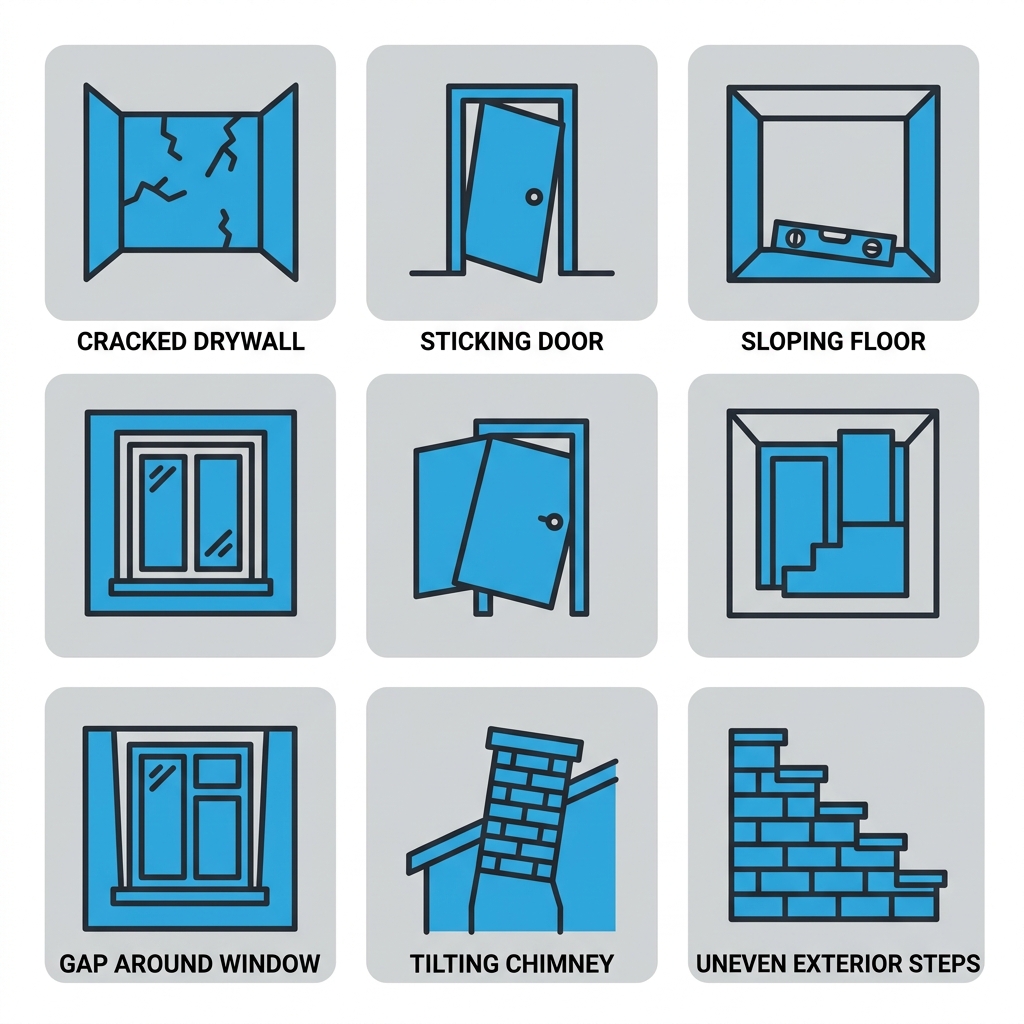
Icon grid illustrating six early warning signs of foundation settlement
How Differential Settlement Develops Over Time
Differential settlement typically develops when soil bearing capacity varies across a structure’s footprint. For instance, clay-rich soil on one side of a building may shrink during dry seasons while fill material on the opposite side compacts at a different rate. This condition is often exacerbated by negative skin friction, where consolidating soil exerts downward drag on piles, amplifying the differential movement. Seasonal moisture fluctuations, poor compaction during original construction, and adjacent excavation work all accelerate this process by altering the load-bearing characteristics of the soil supporting the foundation.
Connection Between Differential Settlement and Pile Failure
When differential settlement remains unaddressed, it imposes significant bending stresses on helical piles that they were never designed to withstand. These lateral and vertical forces can lead to structural distress, including buckling or excessive deflection, ultimately resulting in helical pile failure at critical connection points. For a broader understanding of how these issues escalate, see deep foundation failure insights. This progression highlights why prompt intervention with engineered solutions is essential. Once differential settlement is recognized, helical piers offer a proven intervention that restores stability before permanent damage occurs.
Corrosion as a Cause of Helical Pier Failure Over Time
While improper installation can lead to immediate performance issues, long-term durability is threatened by corrosion—a gradual process that undermines structural integrity over years. One of the key foundation pile failure causes is corrosion, an electrochemical reaction that, if left unaddressed, can compromise even the most precisely installed helical pier systems.
How Corrosion Affects Helical Pier Structural Integrity
Corrosion in steel helical piers is fundamentally an electrochemical process requiring an anode, a cathode, an electrolyte, and a metallic pathway. In the presence of moisture—the electrolyte—iron atoms on the pier’s surface oxidize, releasing electrons and forming iron oxide, or rust. This reaction causes a constant, progressive section loss that directly reduces the load-bearing cross-section of the steel shaft.
As the steel cross-section diminishes, the pier’s capacity to support design loads decreases proportionally. The weakened shaft can no longer transfer structural loads effectively to deeper, competent soil strata. This loss of capacity can lead to differential settlement, where one section of a foundation settles more than adjacent areas, potentially causing cracks and structural distress. In severe cases, corrosion-weakened piers may buckle or fail entirely under loads they were originally designed to support.
Factors That Accelerate Corrosion in Foundation Piles
Three primary environmental factors accelerate corrosion rates in foundation piles beyond what standard atmospheric exposure would suggest. First, soils with low electrical resistivity—typically those with high chloride, sulfate, or acidic content—create an aggressive chemical environment that dramatically speeds up the electrochemical reaction. Second, persistently high soil moisture content sustains the electrolyte function, ensuring the corrosion cell remains active year-round rather than cycling through wet and dry periods. Third, stray DC currents from nearby infrastructure such as utility lines, rail systems, or cathodic protection systems on adjacent structures can introduce external electrical energy that forces accelerated corrosion at current discharge points.
The combined effect of these factors can reduce a helical pier’s effective service life well below its design expectancy. Corrosion can reduce shaft capacity significantly, triggering negative skin friction as surrounding soils shift and grip the weakened pile, further compounding the structural demand.
Corrosion Protection and Mitigation Strategies
Managing corrosion risk begins with proper product specification. AC358, the ICC-ES acceptance criteria for helical pile systems, requires a minimum 0.002-inch hot-dip galvanized coating for standard service life, with thicker coatings mandated for aggressive soil environments. We manufacture our helical pier system products to meet or exceed these ICC-ES requirements, ensuring that the steel shaft maintains its protective zinc barrier throughout the design life.
For extreme environments, additional mitigation measures such as cathodic protection—using sacrificial anodes or impressed current systems—may be specified in accordance with applicable ISO standards for corrosion control. We offer ICC and ISO Certified solutions for projects requiring enhanced corrosion protection. Other causes such as soil erosion or inadequate embedment depth are discussed next.
Consult a structural engineer or our engineering team for project-specific design and installation guidance.
Exceeding Design Load and the Impact of Negative Skin Friction
Among the many factors evaluated in deep foundation design, negative skin friction is one of the most critical yet frequently overlooked. We understand that accurately predicting the total load a pile must carry is essential for long-term structural performance. When a downward drag on the pile shaft is not properly accounted for, the combined forces can easily exceed the design capacity and lead to progressive foundation pile failure causes.
Understanding Negative Skin Friction in Pile Foundations
Negative skin friction is the additional downward load imposed on a pile shaft when the surrounding soil settles more than the pile itself. This creates a dragging effect that transfers the weight of the settling soil column onto the pile. The phenomenon is particularly common in recently placed fill materials, soft compressible clays, and locations where groundwater levels have been lowered, causing the soil to consolidate and sink relative to the deep foundation element.
When this downward drag combines with the intended structural load, the total force acting on the pile often surpasses the original design allowance. According to industry research published by the International Society for Soil Mechanics and Geotechnical Engineering (ISSMGE), this mechanism is a leading contributor to pile overstress in compressible soil profiles. Design codes such as ICC-ES AC358 therefore mandate that negative skin friction be explicitly included in geotechnical calculations to prevent unintentional overload conditions.
How Exceeding Design Load Shortens Pile Longevity
When foundation piles are subjected to loads beyond their design capacity, the consequences manifest as accelerated settlement and compromised bearing capacity. We see that once the total load—structural plus the additional load from soil settlement—exceeds the pile’s geotechnical or structural resistance, the pile begins to plunge or settle more rapidly than anticipated. This differential settlement between adjacent foundation elements can crack floor slabs, distort door frames, and damage load-bearing walls throughout the superstructure.
The ADSC-IAFD, the international association for foundation drilling professionals, confirms that excessive settlement from overloaded deep foundations is a progressive failure mode. As the pile settles further, the relative movement between the pile and soil can increase, intensifying the negative skin friction effect and creating a destructive cycle. Over time, this can lead to a complete loss of load-bearing function, making foundation pile failure causes a direct threat to both life safety and property value when left unaddressed.
Mitigating Negative Skin Friction and Overload Risks
Mitigating the effects of negative skin friction requires careful engineering intervention before and during foundation repair design. We rely on several proven techniques to reduce the downward drag transferred to the pile shaft. Applying a bituminous coating to the upper portion of the pile, installing a PVC or steel sleeve to isolate the pile from the settling soil, or preloading the soil before pile installation are all effective methods recognized in geotechnical practice. Increasing the pile cross-section or length is another option when site-specific soil testing indicates that the drag loads cannot be sufficiently reduced otherwise.
Successful mitigation demands the involvement of a structural engineer and our Engineering Excellence and Design Support resources. Every site presents unique soil conditions, and generic assumptions can lead to unsafe designs. In cases where differential settlement has already occurred, installing basement wall repair anchors can help stabilize affected walls and prevent further movement. We encourage contractors and property owners to engage our network of structural engineers to develop project-specific foundation repair solutions that fully account for negative skin friction. Always consult a structural engineer or the manufacturer’s engineering team for project-specific design and installation guidance.
Installation Best Practices to Prevent Foundation Pile Failure
Recognizing the signs of helical foundation failure signs early is critical to avoiding structural damage, but prevention through proper installation is always the most effective strategy. Common foundation pile failure causes include poor installation workmanship, inadequate soil investigation, and insufficient pile design. To avoid these common failure modes, a disciplined approach centered on certified products, precise installation techniques, and professional engineering support is essential.
ICC and ISO Certified Products as a Foundation of Quality
The foundation of reliability in any project begins with specifying certified products. We recommend only advanced earth anchoring systems that have achieved stringent third-party validation. Using ICC and ISO Certified products from Helical Technology reduces the risk of material defects and design flaws because these systems are manufactured to meet rigorous building code requirements. Products are certified to ICC/ISO where indicated — installations must comply with applicable building codes and ICC-ES acceptance criteria (AC358).
This emphasis on certified foundation repair solutions ensures that every component, from the helical shaft to the termination bracket, has been verified for capacity and performance. By starting with a certified product, contractors establish a critical first line of defense against pile failure triggers before the installation even begins.
The Role of Proper Installation Technique
Even the highest-quality products will underperform if the installation technique is flawed. Proper installation of building foundation reinforcement systems requires careful real-time torque monitoring to confirm that the pier achieves the load-bearing capacity specified in the engineered design. This practice directly mitigates differential settlement by ensuring the pier advances through unsuitable soil until it reaches a load-bearing stratum, rather than stopping in a weak layer that could compress.
Depth verification is equally critical and serves as a primary safeguard against negative skin friction. By penetrating to a depth below active settlement zones, the pier prevents surrounding consolidating soils from dragging the shaft downward and overstressing the structure. Our on-site practices require strict adherence to manufacturer torque and depth specifications. A technically sound installation includes:
- Real-time torque monitoring to correlate installation resistance with capacity
- Logging the final depth and confirming it aligns with the geotechnical design
- Adhering to manufacturer-specified minimum depth requirements for the soil profile
Engineering Support for Accurate Pile Design
At Helical Technology, we believe that Engineering Excellence and Design Support are what transform a standard installation into an optimized, site-specific solution. Our extensive network of structural engineers and manufacturer-provided design software empower contractors to model real-world soil conditions and accurately specify pier configurations. This proactive design approach helps identify and eliminate potential settlement problems and soil friction effects before installation begins.
Consult a structural engineer or the manufacturer’s engineering team for project-specific design and installation guidance. Custom quotes for helical pier systems are available upon inquiry for each unique project scope. For further deep foundation failure insights, industry resources provide additional technical depth.
With these installation best practices in place—certified products, torque-verified installation, and expert engineering support—the risk of foundation pile failure is systematically minimized.
Building Long-Term Foundation Stability with Reliable Solutions
To overcome foundation pile failure causes like differential settlement and negative skin friction, our advanced earth anchoring systems transfer structural loads deep into stable soil layers. This method directly counters uneven foundation settling by bypassing weak surface soils that are prone to movement.
Our helical pier system products are ICC and ISO Certified products, ensuring reliable performance for long-term stability. For lateral support, we offer basement wall repair anchors that stabilize walls against soil pressure. These foundation repair solutions are backed by a network of structural engineers who provide Engineering Excellence and Design Support for every custom-quote project. We coordinate with local contractors and engineers to model soils, specify appropriate anchors, oversee permit documentation, and supervise installation activities closely.
Consult a structural engineer or the manufacturer’s engineering team for project-specific design and installation guidance.
Resources
- Get Expert Helical Pier Foundation Reinforcement
- Get Certified Helical Basement Wall Repair Anchors
- Discover Certified Helical Pier System Products
- Get Expert Helical Pier Installation Training
- Explore Helical Technology’s Foundation Repair Options
- Find Certified Concrete Contractors in Denver
- Find Expert Concrete Repair in Denver
- Explore ISSMGE’s Geotechnical Engineering Online Library
- Discover ADSC-IAFD Deep Foundation Resources
- Explore NFRA Foundation Repair Association
- Explore the ICC Building Codes Library
- Explore BMSA Membership and Education Resources